



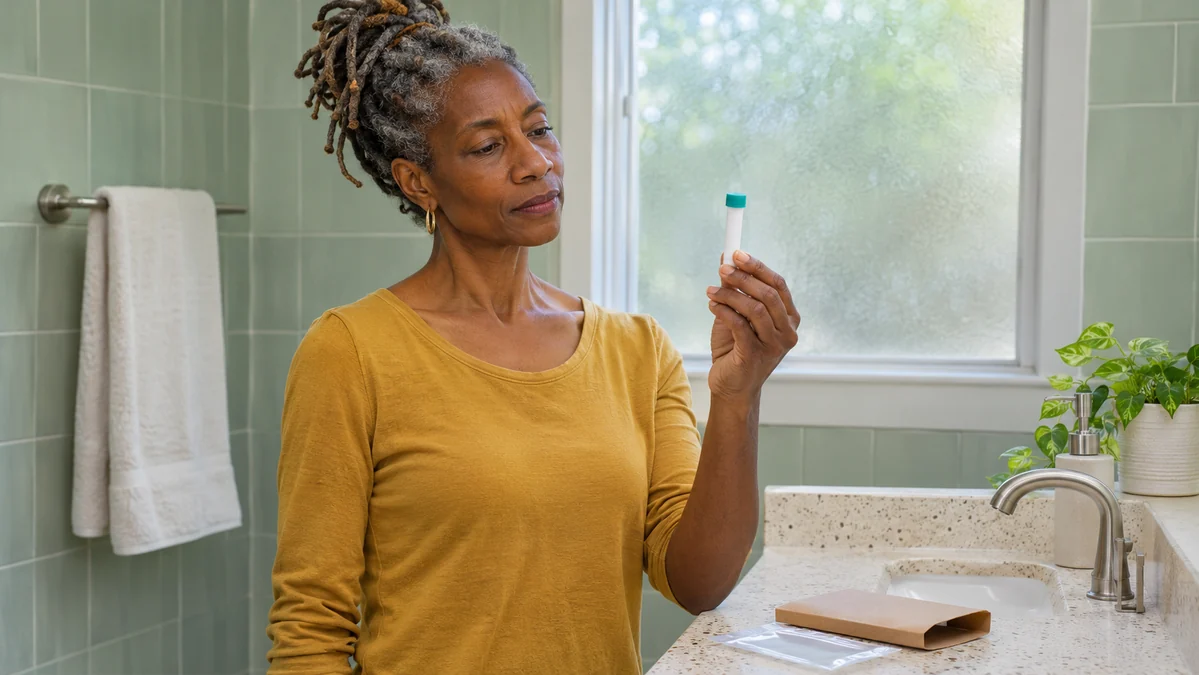
What happens after a positive stool test for colorectal cancer screening?
If your stool test came back positive, contact the screening team or the clinician who ordered it. The result means more checks are needed. By itself, it does not tell you whether you have cancer. Screening looks for signs of colorectal cancer before symptoms appear. Many programs use a home stool collection kit called a fecal immunochemical test, or FIT, to look for tiny traces of blood.
What a positive FIT means
The lab found blood at or above the screening program’s cutoff. Polyps, cancer and other conditions, including hemorrhoids, can cause bleeding. The test cannot tell where the blood came from. Even if you feel well or think you know the cause, contact the screening team for the next step.
Why the next step is usually a colonoscopy
A colonoscopy uses a small camera to examine the lining of your colon and rectum. You take a bowel preparation beforehand to clear the intestine. During the procedure, the clinician can take a tissue sample or remove some polyps. Removing a polyp before it becomes cancer is one potential benefit. There are rare risks, including injury to the bowel wall. The screening team can explain how to prepare, what comfort options are available and what risks apply to you.
What to do with your result
Keep a copy of the result and ask who will arrange follow-up. Repeating a home test on your own does not replace the recommended follow-up after a positive result. If your FIT is negative, follow your program’s screening schedule. If you see blood, have a lasting change in bowel habits or develop other symptoms, talk to a clinician even after a negative test. Screening ages and intervals vary by program.
From scheduling to preparation
If you have not heard from the screening service, have your result handy and call the program. Ask when you can speak to someone about the exam and what help is available if transportation or scheduling is difficult. Tell the team about medical conditions and medications, including blood thinners and diabetes treatment. Follow its instructions before changing any medicine.
The bowel prep clears stool so the clinician can see the lining. Ask for written instructions that spell out what you can eat and drink and when to take the laxative. Plan to stay near a bathroom and call the center if you cannot finish the prep. If you will receive sedation, arrange a ride home and ask when you can drive again.
How you get the results
The clinician may tell you right away what they saw. If they removed a polyp or took a small tissue sample, the lab result comes later. It can help decide whether and when you need another exam. Before you leave, ask who will share the results, what symptoms to expect and whom to call for severe pain, fever or heavy bleeding.
After the exam, get medical help right away if you have severe belly pain, a fever or bleeding that is heavy or does not stop. If you feel dizzy or weak, seek care right away as well.
What research shows about follow-up after FIT
Researchers reviewed records for 111,423 people ages 50 to 69 with a positive FIT in Veneto, Italy. Of those, 88,013 had a colonoscopy through the screening program and 23,410 did not complete one through the program. The estimated number of deaths from colorectal cancer over 10 years was 6.8 per 1,000 people in the first group and 16.0 per 1,000 in the second. The groups may have differed in other ways that affect risk, and some people in the second group had the exam elsewhere. These estimates describe the groups in this study.
Content details
- Study design
- Patient guidance plus a retrospective cohort study in Veneto. The study compared records of 111,423 people ages 50–69 with a positive FIT from 2004–2017. Median follow-up for mortality was 4.9 and 4.2 years. The authors declared no specific grant and no conflicts of interest.
- Population and context
- Adults invited to take part in colorectal cancer screening.
- Evidence limitations
- FIT thresholds, screening ages and intervals vary by program. A FIT result alone cannot establish a diagnosis.
📚 Sources
- National Cancer Institute — Screening Tests to Detect Colorectal Cancer and Polyps
- National Health Service England — Your guide to NHS bowel cancer screening
- National Cancer Institute — Colonoscopy after Positive FIT Test Cuts Risk of Colorectal Cancer Death
- National Institute of Diabetes and Digestive and Kidney Diseases — Colonoscopy
- Gut — Non-compliance with colonoscopy after a positive faecal immunochemical test doubles the risk of dying from colorectal cancer
Sources checked on: 19 November 2026