



Can speech reveal how we age? What a new study found
The rhythm of a conversation may contain clues about aging, but it is not a countdown of the years someone has left. A new speech-based clock found patterns associated with cognitive impairment and dementia. Its promise is a potentially accessible research tool; the study does not establish a home diagnostic test or a way to extend life.
What the researchers studied
The National Institutes of Health reported the findings on October 27, 2026. The original study appeared online in Science Advances on September 30. Researchers analyzed recordings from 2,928 native Spanish speakers in Argentina, Chile, Mexico, Peru and Colombia. The sample included healthy adults and people with mild cognitive impairment, Alzheimer’s disease or frontotemporal dementia, including forms with and without predominant language impairment.
The recordings came from seven guided exercises in Spanish: describing a short animated film, naming words beginning with a given letter, listing animals and vegetables, and retelling a story immediately and again after about 20–30 minutes. This was not a test of an ordinary voice message.
There were 1,504 healthy participants, 1,068 with Alzheimer’s, 255 with frontotemporal conditions without predominant language impairment, 77 with language-dominant forms and only 24 with mild cognitive impairment. This last group had milder memory or thinking difficulties; its small size limits what can be concluded about it.
The models used features of the voice and the words spoken to estimate age in years. Researchers then subtracted actual age from estimated age to calculate a speech age gap. A positive gap meant an older-appearing speech profile. This is a model-derived marker, not a direct measurement of the age of someone’s cells.
What the speech patterns were associated with
Pitch, emotional features, timing and word use contributed in different ways. Patient groups generally had larger age gaps than healthy controls. Gaps were greater in frontotemporal dementia than in Alzheimer’s disease, with the largest pattern in the language-dominant form. These are comparisons between groups, not a rule for recognizing illness in a relative’s voice.
Larger gaps were associated with poorer results on memory and thinking tests. In Alzheimer’s disease they also correlated with p-tau217, an Alzheimer’s-related protein measured in blood. Analyses found links with brain-imaging clocks and some aging clocks based on chemical marks on DNA, with differences between groups and measures. Correlation does not show that a speech change causes disease, or that every person had every biomarker measured.
Social conditions mattered too, including access to food and healthcare, education and childhood experiences. Greater adversity was associated with a higher speech age gap in healthy participants and those with Alzheimer’s. This points to the importance of context. It does not prove that adversity inevitably causes dementia or make individuals responsible for their illness.
How precise is this clock?
The original results figure reports a mean absolute error of 9.04 years when estimating age. That number describes age prediction, not the percentage of dementia cases correctly diagnosed. It is a reason to avoid treating an estimated age as an exact personal result. A useful research association does not automatically become a reliable clinical test.
What the study cannot establish
The analysis was cross-sectional: it compared people at a point in time rather than showing who later developed dementia. It therefore does not establish future risk prediction, a treatment effect, longer survival or rejuvenation. Findings from Spanish-speaking cohorts also do not establish that the same model works equally well in English, Italian or other languages.
The researchers repeated their analyses while accounting for age, sex, education, country, other health conditions and the number of languages spoken. Such checks strengthen interpretation but do not remove every possible bias or replace testing in independent populations. Not everyone had brain scans, blood tests or DNA-based measurements, so those comparisons concern smaller subsets.
Can I use an ordinary phone recording to check myself?
These findings do not validate any arbitrary phone app or voice message for diagnosis. Persistent memory problems that affect daily life deserve professional assessment. The National Health Service notes that stress, anxiety, depression and sleep problems can also contribute to memory difficulties; self-diagnosis from voice changes can therefore mislead.
What would make this useful in practice?
The next steps include following people over time and testing performance across languages, communities and recording conditions. Clinical use would also need careful attention to consent, privacy and fair interpretation. The original authors declared no competing interests; the research reported public, institutional and charitable funding. For now, the result is a promising biomarker candidate, not a prescription or a personal longevity score.
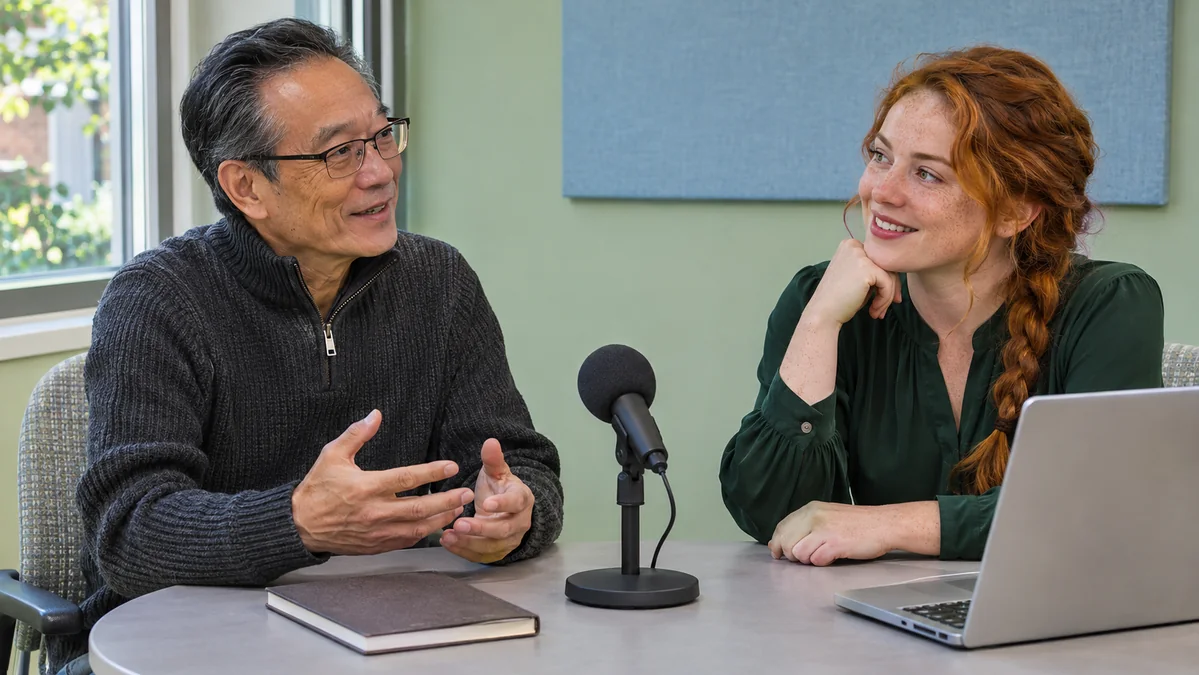
Image: an original AI-generated editorial illustration of a fictional conversation. The people, microphone and laptop do not show the study protocol, real participants or an approved diagnostic test.
Content details
- Study design
- Cross-sectional observational research: 2,928 native Spanish speakers in five Latin American countries. Original paper online September 30, 2026; NIH report October 27. Main paper methods, results, discussion, funding and conflicts consulted; supplements and references not separately reviewed. NHS guidance reviewed October 9, 2023; its scheduled October 2026 review date has passed.
- Population and context
- General readers interested in aging and brain health. Study participants were native Spanish speakers in five Latin American countries; the results cannot automatically be applied to other languages or an individual reader.
- Evidence limitations
- Associations at a point in time do not establish causes, future dementia, faster aging over time or longer life. Guided Spanish tasks; only 24 participants had mild cognitive impairment. Biological comparisons used subsets. Age-estimation error is not diagnostic accuracy. The image is fictional and does not reproduce the study protocol.
📚 Sources
- National Institutes of Health — United States medical research agency — Speech-based clock captures aging
- Hernan Hernandez and colleagues — Science Advances — Speech clocks decode dementia phenotypes, social exposome, and biological aging
- National Health Service — United Kingdom public health service — Memory loss (amnesia)
Sources checked on: 16 November 2026