



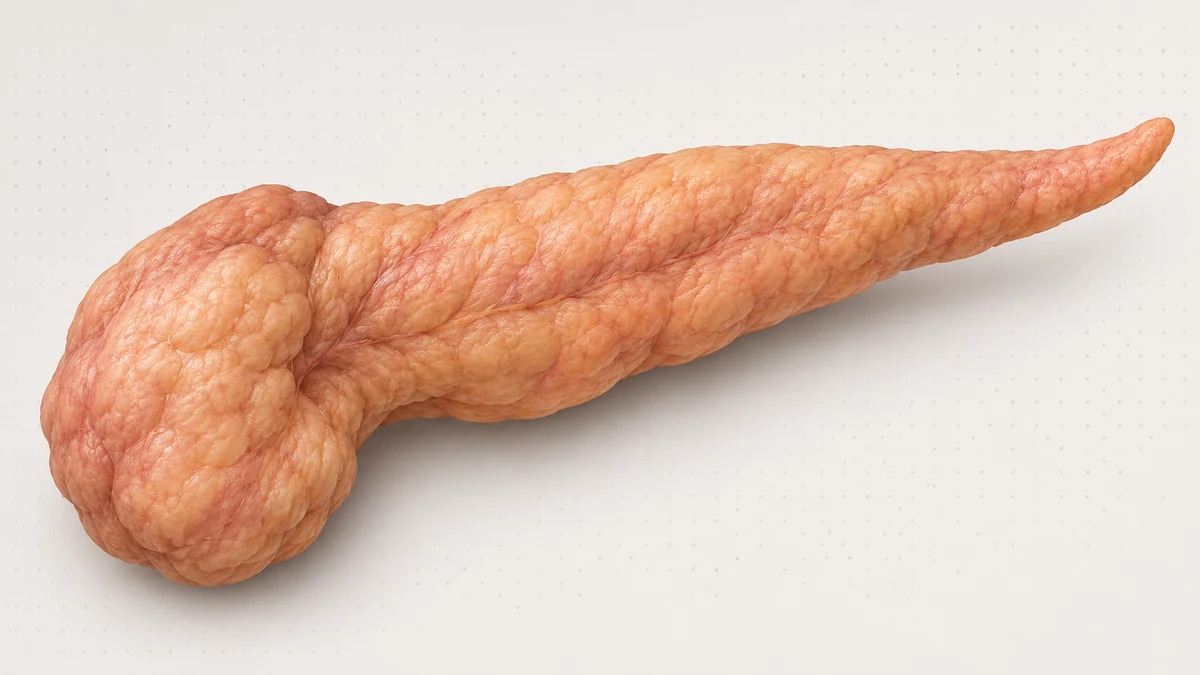
New AI could detect pancreatic cancer up to three years before diagnosis
REDMOD is an artificial intelligence system being studied to look for early signs of pancreatic cancer in existing abdominal CT scans. The important result is that it recognized clues in images taken before a cancer diagnosis, when specialists had found no visible tumor. That makes it a possible aid for further investigation. Whether using those clues helps people live longer still needs to be tested.
How to read the 73% result
In the test, it detected 46 of 63 cancer cases and incorrectly flagged 81 of 430 controls without pancreatic cancer.
The 73% describes how many of the later-confirmed cases were recognized in that test group. A positive alert answers a different question: it signals a finding for assessment, rather than confirming that the person has cancer. The incorrect alerts matter because follow-up examinations can have consequences. An apparently reassuring result also needs to be interpreted in its clinical context.
The time seen in the scans
Some scans were taken up to three years before diagnosis. Across the test cases, the median interval was about 16 months: the middle of the observed intervals, not a guaranteed warning period for a person. The detection rate was nearly twice that of specialists reading the same images without AI. In the smaller subgroup scanned more than two years before diagnosis, the difference was nearly threefold. These comparisons concern recognition of signs in archived images, rather than a proven gain in survival.
Where the result comes from
Gut published the study on April 28, 2026; Mayo Clinic announced it the following day. The work was retrospective. Researchers examined scans that already existed and checked them against diagnoses established later. The project involved about 2,000 abdominal CT scans across its development and validation work, including people later diagnosed with pancreatic cancer and controls without that disease. Keeping those groups distinct is essential: the headline percentage does not describe every scan or every person who received an alert.
CT scans provide detailed images from inside the abdomen. REDMOD measures hundreds of image characteristics, including the appearance and arrangement of pancreatic tissue. It looks for small variations that could be associated with early disease even while the pancreas appears normal to the reader. This supports an assessment of possible risk; identifying a signal is one step in a clinical investigation.
Images from several institutions, scanners and acquisition protocols were used to assess reliability. More diverse patient populations still need testing. The ability to perform across the datasets studied gives a reason for further work, while leaving open how the system will behave in the people and care settings where it may eventually be used.
The step into everyday care
Mayo Clinic’s June 25, 2026 update describes REDMOD as investigational and presents the AI-PACED study to evaluate it. A prospective study follows people forward in time. It can assess detection, incorrect alerts, subsequent investigations and clinical outcomes together. These are the questions needed to understand the overall value of adding the system to care.
The research is aimed at selected higher-risk situations, including some people with recently developed diabetes. A family history of pancreatic cancer can also be relevant when clinicians assess pancreatic cancer risk. Neither of those facts makes this article a reason for everyone with diabetes or a relative with pancreatic cancer to arrange a CT scan. Any monitoring plan needs an individual clinical assessment. The system is intended to help specialists decide what needs investigation.
Why earlier detection could matter
Pancreatic cancer often causes few clear symptoms early on, and many diagnoses occur after it has spread. Recognizing it while treatment with the aim of cure is still possible is a major research goal. Earlier recognition and better outcomes must be demonstrated separately; the current findings alone establish neither a survival benefit nor a screening program for the general population.
The US National Cancer Institute registry reports that about 15% of cases are diagnosed while localized. Its overall five-year relative survival estimate is 13.7% for diagnoses during 2016–2022. Relative survival aims to separate the effects of cancer from other causes of death. These figures describe US patient groups and provide context for the research, rather than a forecast for an individual.
Funding and disclosures
Support came, among others, from the National Institutes of Health, Mayo Clinic and foundations. The publication lists the complete funding details. Authors declared no competing interests.
Content details
- Study design
- Retrospective validation study using existing CT images.
- Population and context
- Nearly 2,000 abdominal CT scans, including prediagnostic cases and controls. The cited survival statistics come from the US SEER registry and cover diagnoses made during 2016–2022.
- Evidence limitations
- The study does not establish a survival benefit or suitability for population screening. Prospective studies are needed, including assessments of false positives and follow-up investigations.
📚 Sources
- Mayo Clinic News Network — US nonprofit medical organization — Mayo Clinic AI helps specialists detect pancreatic cancer up to 3 years before diagnosis in landmark validation study
- Gut — peer-reviewed gastroenterology journal — Next-generation AI for visually occult pancreatic cancer detection in a low-prevalence setting with longitudinal stability and multi-institutional generalisability
- National Cancer Institute — US federal cancer research institute — Surveillance, Epidemiology, and End Results Program — Cancer Stat Facts: Pancreatic Cancer
- Mayo Clinic — US nonprofit medical organization — AI identifies pancreatic cancer years before diagnosis, offering potential for earlier treatment
Sources checked on: 16 November 2026