




How AI reads retinal photos in diabetic eye screening
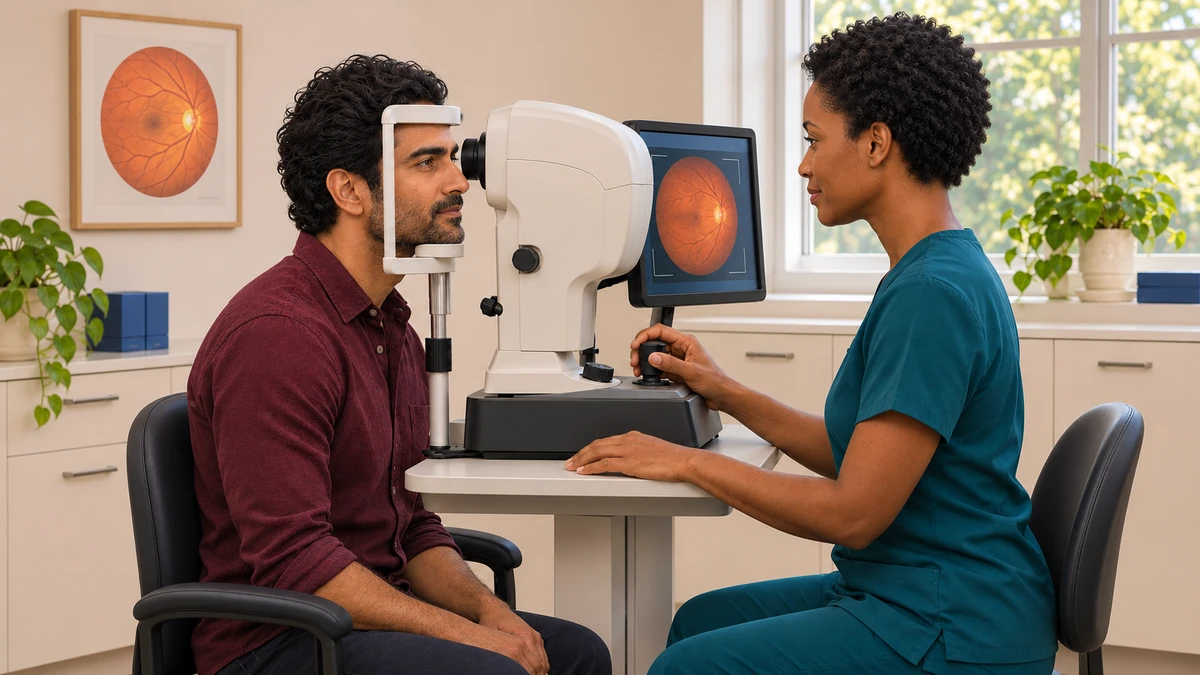
The retina is the light-sensitive layer at the back of the eye. Diabetes can damage small blood vessels in the retina before vision changes become noticeable. In 2018, the U.S. Food and Drug Administration authorized IDx-DR to detect more-than-mild diabetic retinopathy in adults with diabetes who had no previous diagnosis of retinopathy. A trained operator takes pictures of the back of the eye and software analyzes them. The study enrolled people aged 22 or older without visual symptoms.
A flash may be used for the photos. Staff may use eye drops to widen the pupils.
How accuracy was measured
The prospective study enrolled 900 people at 10 U.S. primary care sites. A specialist reading center produced reference results for 852 people and the software gave a result for 819 of them. Estimated sensitivity was 87.2% and specificity was 90.7%. Sensitivity measures how well the test finds cases above the threshold. Specificity measures how well it rules out that threshold when it has not been reached.
What happens after the test
A positive result calls for evaluation by an eye care professional. An unreadable image can lead to repeat testing or a referral. A negative result applies to the threshold the test looks for. Keep up with repeat screening on the schedule advised by your care team. New visual symptoms still need professional assessment, even after a negative test.
What is outside the test’s scope
This test looks for diabetes-related retinal damage; it does not diagnose diabetes. Comprehensive eye exams can also assess other conditions, such as glaucoma. The numbers apply to the device and protocol studied. The manufacturer, IDx, funded the research, and some authors disclosed ties to the company. US authorization does not establish availability in every country.
What the software was compared with
A specialist reading center evaluated detailed retinal photographs and OCT scans, which show the retina in cross section. Against the photography-based reference, the device picked up 173 of 198 people above the threshold and gave a negative result to 556 of 621 people below it. That means 25 cases were missed and 65 people below the threshold received a positive result. The threshold included changes defined in the protocol, including relevant swelling in the macula.
Where the percentages come from
The trial deliberately recruited more people with high HbA1c, a measure of average blood sugar. The published 87.2% and 90.7% estimates came from a statistical model; specificity accounted for that enrollment pattern. The simple observed fractions, 173/198 and 556/621, are about 87.4% and 89.5%. These are different ways of reporting the same trial, not results from two devices. The 95% confidence intervals were 81.8%–91.2% for the sensitivity estimate and 88.3%–92.7% for specificity. They express statistical uncertainty. Whether a positive result indicates disease above the threshold also depends on how common that disease is in the group screened.
An ungradable image leaves the test unresolved
Among 852 people with a complete reference result, 33 did not get a usable result from the software. The FDA instructions call for immediate retesting or referral to an eye care professional when there is no result. A positive result calls for referral. After a negative result, ask when you should return for screening and what to do if you have vision symptoms. These instructions come from the US authorization for this particular device.
Content details
- Study design
- Prospective diagnostic accuracy study at ten sites.
- Population and context
- 900 asymptomatic adults aged 22 or older with diabetes and no previous diabetic retinopathy diagnosis; ten US primary care sites. Enrollment January–July 2017; paper published August 28, 2018.
- Evidence limitations
- Accuracy for one device and protocol. The study did not measure prevention of vision loss.
📚 Sources
- Abràmoff et al., npj Digital Medicine — Pivotal trial of an autonomous AI-based diagnostic system for detection of diabetic retinopathy in primary care offices
- U.S. Food and Drug Administration — De Novo Summary (DEN180001), IDx-DR
- Community Eye Health Journal — Taking good retinal images for DR screening: considerations and practical tips
- National Eye Institute — National Institutes of Health, United States — Diabetic Retinopathy
Sources checked on: 16 November 2026