



Invika immunotherapy: early signs of activity in resistant cancers
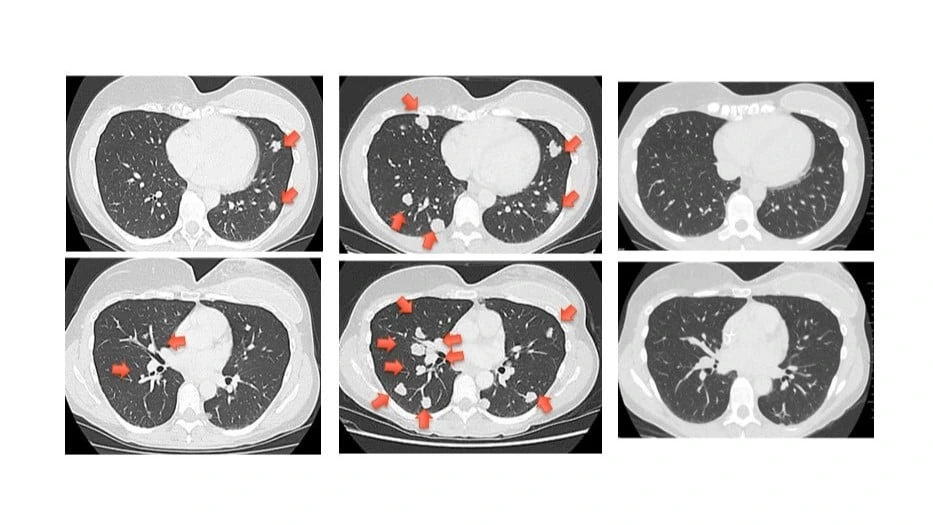
Image: CT scans from one participant with colorectal cancer resistant to immune checkpoint blockade. The columns show six months before invika, the start of treatment and more than nine months after starting. Arrows mark lung metastases. This individual case does not show what every patient can expect. Credit: Sullivan, Tschernia, Friedman and colleagues, via National Institutes of Health.
An experimental immunotherapy has shown early activity in some people whose advanced cancers had resisted previous treatments. On October 23, 2026, the National Institutes of Health reported results of START-001, published that day in Nature Medicine. The drug, invikafusp alfa, known as invika, is still being studied: these findings do not establish a cure or longer survival.
A more selective way to stimulate immune cells
Cancer can evade the immune system, and treatments that release its brakes do not work for everyone. Invika is a bispecific antibody designed to activate two particular T-cell groups, identified as Vβ6 and Vβ10. The aim is to encourage an attack on tumours without broadly stimulating all T cells. This is the treatment’s rationale, not proof that it is free of serious risks.
What the trial actually found
The early multicentre study tested invika alone, mainly in people with solid tumours resistant to immune checkpoint blockade. Phase 1 included 34 participants and the initial phase 2 included 18. The original report analysed data available on March 12, 2025. Phase 1 focused on safety and dose selection; the initial phase 2 explored anti-tumour activity.
Among 27 participants treated at the two optimal biological dose levels, 16 (59.3%) had disease control in the reported analysis. That group included four (14.8%) with confirmed partial responses: targeted tumours shrank by more than 30%. Disease control also includes stable disease; it does not mean that all 16 people had shrinking tumours or were cured.
Responses included some colorectal and lung cancers that had resisted previous immunotherapy. No objective responses were observed below the lower optimal biological dose. The drug expanded the intended T-cell populations, but immune activation did not always produce a clinical response. The researchers selected a dose for further phase 2 testing.
Safety needs continued attention
The most common treatment-related adverse event was cytokine release syndrome, an inflammatory immune reaction, usually grade 1 or 2 in this report. Two participants experienced reversible toxicities that limited dose escalation. No treatment-related deaths or non-laboratory grade 4 adverse events were reported. A small early trial cannot rule out uncommon or delayed harms; treatment requires specialist monitoring.
For anyone receiving immunotherapy, the National Cancer Institute recommends agreeing in advance which symptoms to report and whom to contact. Side effects can appear during treatment or afterwards. Ask your oncology team for clear instructions, including what to do outside clinic hours; a short list of adverse events from this trial is not a personal safety plan.
Why these results are encouraging, but preliminary
This small, early dose-finding study does not establish superiority over standard care or a survival benefit. Different cancers and dose levels were included, and results from the selected 27 participants cannot be applied to everyone with cancer. Larger studies and longer follow-up are needed to clarify who benefits and for how long. Marengo Therapeutics sponsored the trial and was involved in its design, analysis and publication.
The published results and the current trial record
The report describes invika alone using the March 2025 data cutoff. The ClinicalTrials.gov record, last updated on August 11, 2026, also lists chemotherapy combinations in the continuing study. It describes a non-randomized, open-label trial: treatment is known to participants and researchers. Those later study plans are not results and cannot be credited with the responses reported here. Eligibility and places must be confirmed with the study team.
Does Fast Track mean that invika is approved?
No. The National Institutes of Health announcement describes United States Fast Track designations for certain settings. These can facilitate development and regulatory review; they are not marketing approval or proof of efficacy. Invika remains experimental. A person interested in research participation should discuss suitable, currently available trials with their oncology team rather than change treatment independently.
Can this replace the treatment I am receiving?
These findings alone cannot answer that individual question. The relevant issues include the cancer type, previous therapies, trial eligibility and potential harms. Immunotherapy is a broad family of treatments, and the results of one investigational drug do not apply to all of them. Ask your oncology team what the evidence means for your circumstances.
Questions before joining a study
Ask what care is available outside the trial, which visits and tests are required, who covers treatment and travel costs, and how possible harms will be managed. Request the consent information in language you understand and time to discuss it with someone you trust. Taking part is voluntary; you can leave even after signing. Agree with the team how your ongoing cancer care would continue.
Content details
- Study design
- Phase 1 and initial phase 2 of multicentre START-001 (NCT05592626), invika alone; 34 plus 18 participants; data cutoff March 12, 2025; published October 23, 2026. Accessible original abstract, funding and conflict disclosures checked; subscription full text was not reviewed.
- Population and context
- General health news for adults and families interested in oncology research. Study findings concern selected people with advanced solid tumours, mainly resistant to immune checkpoint blockade.
- Evidence limitations
- Early, small dose-finding study; selected-dose subgroup 27; no established comparative efficacy, survival gain or cure. Rare and delayed harms remain uncertain. Sponsor Marengo Therapeutics was involved in design, analysis and publication.
📚 Sources
- National Institutes of Health — United States medical research agency — A precision T-cell therapy stalls treatment-resistant cancers in clinical trial
- Ryan J. Sullivan, Nicholas P. Tschernia, Claire F. Friedman and colleagues — Nature Medicine — Bispecific dual T cell agonist invikafusp alfa in solid tumors: the phase 1/2 START-001 trial
- National Cancer Institute — United States cancer research institute — Immunotherapy to Treat Cancer
- National Cancer Institute — United States cancer research institute — Immunotherapy Side Effects
- ClinicalTrials.gov — National Library of Medicine — A Study of a Selective T Cell Receptor (TCR) Targeting, Bifunctional Antibody-fusion Molecule STAR0602 in Participants With Advanced Solid Tumors (START-001)
- National Cancer Institute — Understanding Informed Consent Forms
- Food and Drug Administration — SOPP 8216: Fast Track Development Programs - Designation and Management
Sources checked on: 21 November 2026