



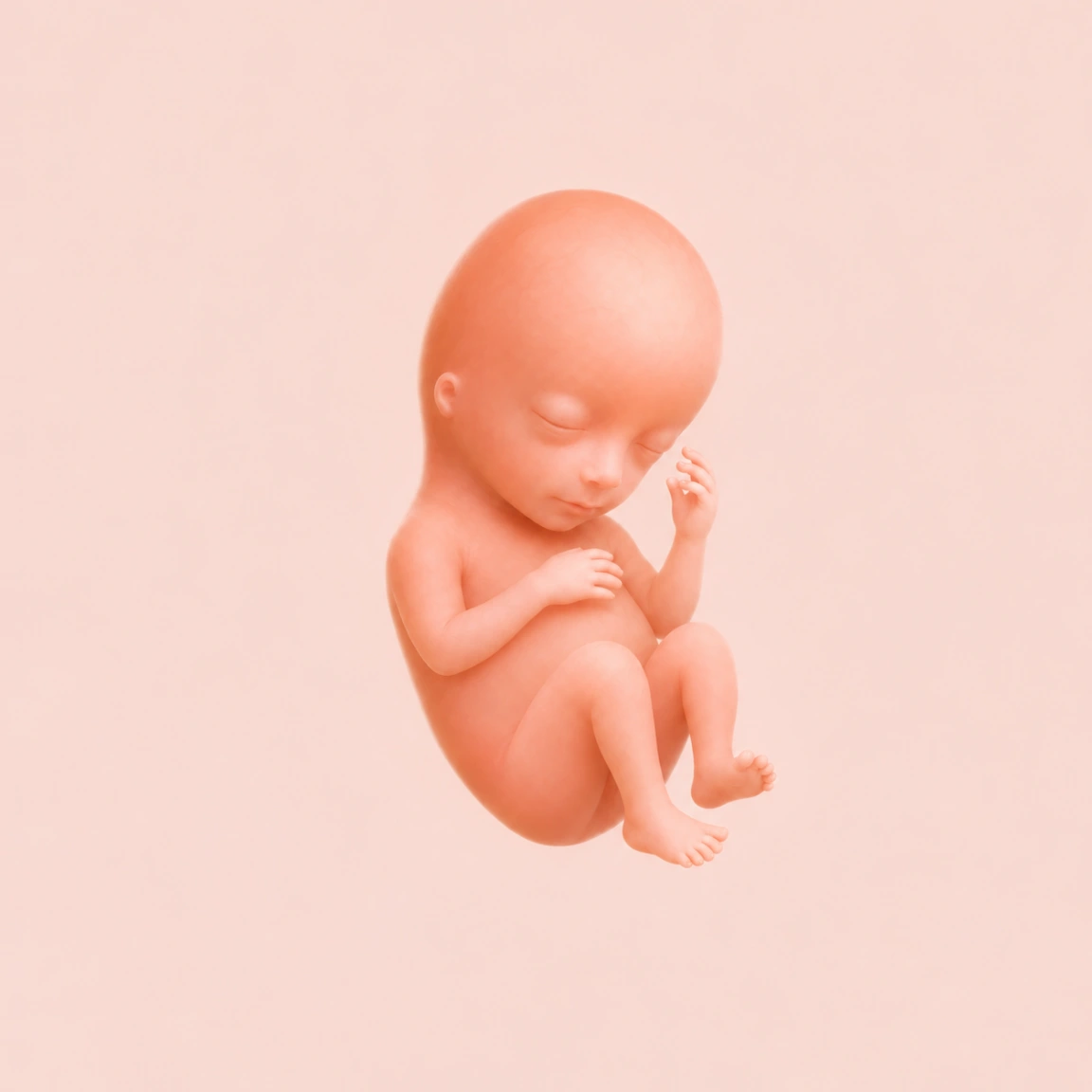
Pregnancy week 11: fingers, toes and a growing body
A large head and a growing body
At 11 weeks by obstetric dating, around nine weeks have usually passed since fertilization. The National Health Service gives about 41 mm from head to bottom as an approximate length. This measurement stops at the bottom; it does not include the legs stretched out. The head is still very large in relation to the body, which is growing quickly. The estimate is a guide, not a target every fetus must meet on one exact day.
Fingers, toes and small movements
The fingers and toes become more distinct. Small ears and tiny nails are developing. The eyelids are closing or closed during this early fetal period and remain closed for a substantial part of pregnancy. Arms and legs can move, even though the movements are still too small to be felt. Not feeling movement now does not mean that the fetus is inactive.
Organs are developing, not finished
The basic structures of many organs are already present, but formation and maturity are different. The brain, lungs and other systems still have a long period of development ahead. Around this early fetal phase the liver makes red blood cells, which carry oxygen. The fetus is not breathing air: the placenta supports oxygen exchange, connected to the fetus through the umbilical cord.
How to read the size comparison
The food gives a rough sense of size. Its length and shape can vary. The photo is for comparison, and the number is an approximate length for this week of pregnancy. Growth and timing vary from one pregnancy to another.
Content details
- Study design
- Developmental guide based on the medical and embryology sources listed below.
- Population and context
- Adults following early fetal development.
- Evidence limitations
- The food gives a rough sense of size. Its length and shape can vary. The photo is for comparison, and the number is an approximate length for this week of pregnancy. Growth and timing vary from one pregnancy to another.
📚 Sources
- National Health Service — United Kingdom public health service — Best Start in Life — Week 11
- National Library of Medicine — United States — MedlinePlus Medical Encyclopedia — Fetal development
- Eunice Kennedy Shriver National Institute of Child Health and Human Development — Human Placenta Project: How Does the Placenta Form?
Sources checked on: 7 November 2026