


Vulvar cancer: diagnosis, treatment and specialist centres
A vulvar lump or persistent sore needs an examination, not a diagnosis from a photograph. This guide explains what the biopsy and lymph nodes change, which treatments may help, and how to prepare for specialist care.
MyMedNest editorial guide · Sources checked:
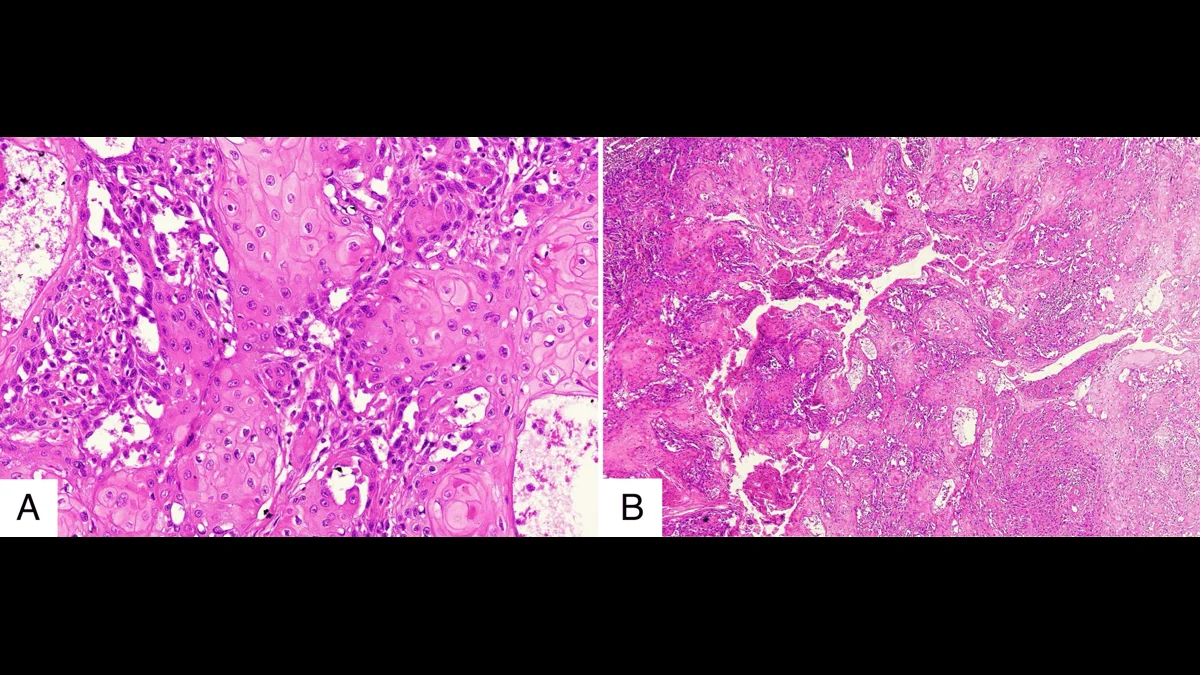
Image source and reuse details
Source: Synchronous Primary Vulvar Squamous Cell Carcinoma and Ciliated Cell Variant of Endometrioid Adenocarcinoma Arising in an Endometrial Polyp: A Rare Dual Malignancy — Figure 3. Full 3000 × 1000 microscopy reduced proportionally to 1200 × 400 and centered in a 1200 × 675 frame with black outer margins. Both panels and labels A/B retained. WebP conversion only; no clinical cropping, recoloring or retouching.
In this guide
First, confirm the organ and the cancer type
The vulva is the external genital area, including the labia and clitoris. It is different from the vagina, the canal inside the body, and from the cervix. Most invasive vulvar cancers are squamous cell carcinomas, which start in the surface lining and grow into deeper tissue.
This guide mainly covers that form in adults. Melanoma, Paget disease and cancers arising in vulvar glands need their own pathology and treatment plans. A photograph cannot identify the type or stage. Some early cancers can be cured; for advanced disease, the team must explain realistically whether treatment aims to cure, control growth or relieve symptoms.
Source: National Cancer Institute — United States — Vulvar Cancer Treatment (PDQ®)–Health Professional Version · National Health Service — United Kingdom — Vulval cancer — Treatment
Changes to have examined
Arrange a medical examination for itching that does not settle, a growing lump, an ulcer that does not heal, unexplained bleeding, persistent pain or a changing patch of skin. Red, white or dark areas and changes in a mole also deserve attention. These symptoms often have a non-cancer cause, but repeated treatment for presumed thrush must not delay reassessment of a persistent lesion.
You can ask for a chaperone, bring someone you trust and ask the examiner to stop. Heavy bleeding, inability to pass urine, sudden severe pain or rapid deterioration need urgent assessment. During cancer treatment, fever of 38 °C or higher needs prompt contact with the treatment team; follow its emergency instructions rather than waiting for the next appointment.
Source: National Health Service — United Kingdom — Vulval cancer — Symptoms · National Cancer Institute — United States — Infection and Neutropenia during Cancer Treatment
HPV is one pathway, not the whole explanation
Persistent infection with a high-risk human papillomavirus, or HPV, can lead to vulvar cancer. Other cancers develop without HPV, sometimes in skin affected by lichen sclerosus, a long-lasting inflammatory condition. Smoking, reduced immune defenses and a history of related genital lesions can increase risk. A risk factor does not prove the cause in one person.
There is no standard population screening test for vulvar cancer. A normal cervical Pap or HPV screening result does not rule out a vulvar lesion. HPV vaccination can prevent new infections with covered types; it does not treat an existing cancer or infection. Ask about the local vaccination programme, smoking support and ongoing care for vulvar skin disease.
Source: American Cancer Society — United States — Risk Factors for Vulvar Cancer · American Cancer Society — United States — Can Vulvar Cancer Be Found Early? · National Cancer Institute — United States — Human Papillomavirus (HPV) Vaccine
A precancerous lesion is not the same as invasive cancer
High-grade squamous intraepithelial lesion, or HSIL, means abnormal cells remain in the surface layer. Differentiated vulvar intraepithelial neoplasia, or dVIN, is a different precursor, usually unrelated to HPV, and needs particular attention. A biopsy distinguishes these lesions from invasion; itching or appearance alone cannot do so.
Selected HSIL lesions may be treated with excision, laser or prescribed imiquimod after invasion has been excluded. dVIN generally needs excision and close follow-up, together with treatment of any underlying skin condition. A cream or laser used for a precancerous lesion is not a substitute for appropriate treatment of an invasive tumor.
Source: British Gynaecological Cancer Society — United Kingdom — Vulval cancer guidelines: An update on recommendations for practice 2023 · National Cancer Institute — United States — Vulvar Cancer Treatment
The biopsy establishes the diagnosis
A clinician examines the vulva and groins and records where each lesion lies. Magnification, called vulvoscopy, may help select the area to sample. A punch or incisional biopsy takes a small tissue sample, usually with local anesthetic. Separate suspicious areas may need separate samples and a clear map.
For suspected invasive cancer, seek specialist advice before an unplanned complete removal that could complicate later treatment or lymphatic mapping. Ask who will review the sample, how you will receive the result and what happens if it does not explain the ongoing symptoms. Blood tests and scans cannot replace tissue examination.
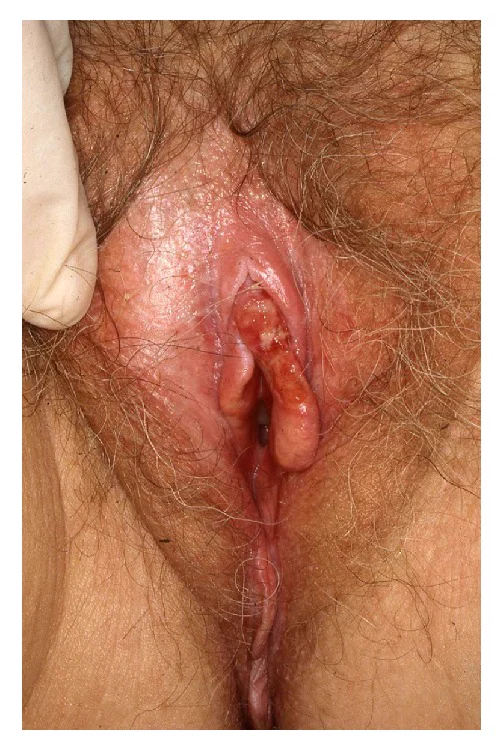
Image source and reuse details
Source: Clinician’s Update on the Benign, Premalignant, and Malignant Skin Tumours of the Vulva: The Dermatologist’s View — Figure 14. Complete 502 × 752 photograph converted to WebP at its original size. No enlargement, cropping, recoloring or diagnostic retouching. Body display is limited to the native width.
Source: National Health Service — United Kingdom — Vulval cancer — Tests and next steps · European Society of Gynaecological Oncology — Pocket Guidelines — Vulvar Cancer, Update 2023 · American Cancer Society — United States — Tests for Vulvar Cancer
What to ask about the pathology report
The report should identify the cancer type, its size and depth of invasion, and whether vessels or nerves are involved. After surgery, it also describes the margins, meaning the edges of the removed tissue, and any sampled lymph nodes. A positive margin means cancer reaches an edge; it may change the next step.
Tests such as p16 staining or HPV testing help classify HPV association. p53 staining is useful in HPV-independent disease and suspected dVIN. These are pathology tools, not personal forecasts or automatic drug prescriptions. For an unusual type or uncertain result, ask whether a specialist gynecologic pathologist should review the slides.
Source: British Gynaecological Cancer Society — United Kingdom — Vulval cancer guidelines: An update on recommendations for practice 2023 · European Society of Gynaecological Oncology — Pocket Guidelines — Vulvar Cancer, Update 2023
Stage describes spread; grade describes cell appearance
Stage considers local growth, nearby structures, groin nodes and distant spread. In broad terms, stage I is confined to the vulva; stage II involves certain nearby structures without involved nodes; stage III includes more extensive local or regional nodal disease; stage IV includes specified advanced local findings or distant spread. Ask which staging system and edition the team used.
Grade describes how abnormal the cells look under the microscope and is not the same as stage. A small skin lesion may still need careful nodal assessment. Prognosis depends on more than a label: nodal findings, margins, cancer type, health and treatment response matter. Population survival figures cannot tell one person exactly what will happen.
Source: National Cancer Institute — United States — Vulvar Cancer Treatment (PDQ®)–Health Professional Version · European Society of Gynaecological Oncology — Pocket Guidelines — Vulvar Cancer, Update 2023
Scans are chosen to answer specific questions
Groin ultrasound can assess nearby lymph nodes. A suspicious node may need needle sampling if the result would alter treatment. Magnetic resonance imaging can clarify local extension, while computed tomography or a PET-CT may help when more extensive disease is suspected. Very small, superficial tumors do not automatically require every scan.
The team may check blood counts, kidney function and other health measures before treatment. If growth into the bladder or rectum is suspected, a targeted examination may be needed. Ask what each test will change, whether contrast is suitable and who will review the results. An abnormal scan alone does not always establish a distant metastasis.
Source: European Society of Gynaecological Oncology — Pocket Guidelines — Vulvar Cancer, Update 2023 · American Cancer Society — United States — Tests for Vulvar Cancer
Choose a team that treats this rare cancer
A gynecologic oncology team should plan treatment with pathology, imaging, radiation and medical oncology specialists. Reconstructive surgery, specialist nursing, skin care, pain treatment and rehabilitation may be needed. Discuss both cancer control and the effects on urination, bowel function, mobility and sexual health.
A second opinion is particularly useful before extensive surgery, for a rare subtype or when surgery and chemoradiation offer different trade-offs. Bring the biopsy report, slides or digital pathology arrangements, scans and a medication list. Ask how the centres will share records so that seeking advice does not create an avoidable delay.
Source: European Society of Gynaecological Oncology — Pocket Guidelines — Vulvar Cancer, Update 2023 · The University of Texas MD Anderson Cancer Center — United States — Vulvar Cancer Treatment
Removing the tumor while preserving function
For many localized cancers, surgery removes the tumor with a border of healthy tissue. The extent depends on its position, depth and size. Partial vulvectomy removes part of the vulva; more extensive removal is needed in some cases. Reconstruction may help close the wound and preserve function. There is no single operation suitable for everyone.
Ask which structures would be removed, whether the clitoris or urethra is involved and what alternatives exist. If invasive cancer reaches a margin, another excision may be possible; radiation is considered when further surgery is unsuitable. Do not assume that removing the whole vulva or nearby organs is always necessary.
Source: American Cancer Society — United States — Surgery for Vulvar Cancer · National Cancer Institute — United States — Vulvar Cancer Treatment · European Society of Gynaecological Oncology — Pocket Guidelines — Vulvar Cancer, Update 2023
When a sentinel lymph node procedure is an option
Sentinel nodes are the first nodes draining the tumor area. In an experienced centre, sampling them can spare some patients a full groin dissection. Typical candidates have a single tumor smaller than 4 cm, invasion deeper than 1 mm and no suspicious groin nodes. Exact eligibility and reliable mapping must be checked by the team.
Tumors close to the midline may drain to both groins, so both sides may need assessment. A radioactive tracer combined with dye or a fluorescent marker helps locate the nodes. If mapping fails, further surgery may be needed on that side. Larger or multifocal invasive tumors generally need a different nodal approach.
Source: British Gynaecological Cancer Society — United Kingdom — Vulval cancer guidelines: An update on recommendations for practice 2023 · European Society of Gynaecological Oncology — Pocket Guidelines — Vulvar Cancer, Update 2023 · University Medical Center Groningen and GROINSS-V investigators — original research — Radiotherapy Versus Inguinofemoral Lymphadenectomy as Treatment for Vulvar Cancer Patients With Micrometastases in the Sentinel Node: Results of GROINSS-V II
A positive node does not have just one treatment
The size of the deposit in a sentinel node matters. For deposits of 2 mm or less, including isolated tumor cells, groin radiation can replace a full dissection in selected protocols. A deposit larger than 2 mm generally calls for inguinofemoral lymph node removal on the affected side. These options are not interchangeable without the pathology and specialist plan.
After a full node dissection, multiple positive nodes or cancer extending beyond a node can lead to radiation, sometimes with sensitizing chemotherapy. Removing or irradiating nodes can cause leg or genital swelling called lymphedema. Ask what the expected benefit is and how the team will prevent, identify and manage complications.
Source: European Society of Gynaecological Oncology — Pocket Guidelines — Vulvar Cancer, Update 2023 · University Medical Center Groningen and GROINSS-V investigators — original research — Radiotherapy Versus Inguinofemoral Lymphadenectomy as Treatment for Vulvar Cancer Patients With Micrometastases in the Sentinel Node: Results of GROINSS-V II
Radiation, with or without sensitizing chemotherapy
Radiation may treat areas at risk after surgery or serve as the main treatment when an operation is unsuitable or would cause major loss of function. Chemotherapy given alongside it can make cancer cells more sensitive to radiation. Modern planning aims to protect nearby organs, but skin soreness, fatigue, bowel symptoms and urinary discomfort can still occur.
Ask for a written skin and pain-care plan and report symptoms early so that avoidable treatment breaks can be reduced. After primary chemoradiation, specialist guidance suggests assessing response around 12 weeks after completion, with biopsy if residual cancer is suspected. A scan or sore area immediately after treatment does not by itself prove treatment failure.
Source: American Cancer Society — United States — Radiation Therapy for Vulvar Cancer · European Society of Gynaecological Oncology — Pocket Guidelines — Vulvar Cancer, Update 2023
Medicines for disease that cannot be treated locally
For metastatic or unresectable recurrent squamous cancer, a platinum medicine such as cisplatin or carboplatin with paclitaxel is a commonly considered combination. Evidence is limited because this cancer is rare. Fitness, kidney function, nerve damage and earlier treatment help decide whether a combination or a less intensive plan is appropriate.
Selected teams consider adding pembrolizumab for PD-L1-positive disease and/or bevacizumab, partly using evidence from cervical cancer. A guideline option or use outside the label is not the same as a vulvar-specific national approval. Ask explicitly about the evidence, authorization, funding and risks, including bleeding, wound problems and bowel perforation with bevacizumab.
Source: American Cancer Society — United States — Chemotherapy for Vulvar Cancer · American Cancer Society — United States — Immunotherapy for Vulvar Cancer · European Society of Gynaecological Oncology — Pocket Guidelines — Vulvar Cancer, Update 2023
What immunotherapy evidence does—and does not—show
In the nonrandomized phase II KEYNOTE-158 study, 101 patients with previously treated advanced vulvar squamous cancer received pembrolizumab. Tumor response occurred in 10.9%; among responders, median response duration was 20.4 months. Grade 3–5 treatment-related adverse events occurred in 11.9%, and 2 treatment-related deaths from hepatitis were reported. Merck sponsored the study. Response is not a cure rate, and there was no control group.
US biomarker-based indications can apply to selected previously treated, unresectable or metastatic solid tumors with no satisfactory alternative: MSI-H/dMMR, meaning a DNA-repair defect, or high tumor mutation burden. On October 16, 2026, the Food and Drug Administration changed the TMB-H threshold to at least 13 mutations/Mb, replacing the former 10 threshold. European pembrolizumab indications are more site-specific. Neither PD-L1 nor an HPV result alone makes these approvals worldwide. Immune inflammation can seriously affect the bowel, lungs, liver and hormone glands.
Source: Shapira-Frommer and investigators — original research — Efficacy and safety of pembrolizumab for patients with previously treated advanced vulvar squamous cell carcinoma: Results from the phase 2 KEYNOTE-158 study · National Library of Medicine — ClinicalTrials.gov — KEYNOTE-158 — NCT02628067 · Food and Drug Administration — United States — Verified Clinical Benefit — Cancer Accelerated Approvals; pembrolizumab MSI-H/dMMR solid tumors · Food and Drug Administration — United States — FDA grants traditional approval for pembrolizumab or pembrolizumab and berahyaluronidase alfa-pmph for unresectable or metastatic TMB-H solid tumors with updated indication · European Medicines Agency — European Union — Keytruda — therapeutic indications
Rare molecular findings may open a different route
For advanced disease, ask whether tumor testing could change treatment. In the United States, trastuzumab deruxtecan has an accelerated indication for previously treated, unresectable or metastatic solid tumors with HER2 IHC 3+ and no satisfactory alternative. This is not a blanket option for any HER2 result. Its benefit must be weighed against risks including serious lung inflammation, low blood counts and heart problems.
A genuine NTRK gene fusion, rather than any NTRK change, can support a tumor-independent route. The European Union conditionally authorizes larotrectinib for qualifying advanced or metastatic fusion-positive tumors, or when surgery would cause severe harm, with no satisfactory options. Such findings are uncommon; testing does not guarantee a match. Ask about local labels, reimbursement, specimen quality and whether the result justifies a trial instead.
Source: American Cancer Society — United States — Targeted Therapy for Vulvar Cancer · Food and Drug Administration — United States — FDA grants accelerated approval to fam-trastuzumab deruxtecan-nxki for unresectable or metastatic HER2-positive solid tumors · National Library of Medicine — DailyMed; Daiichi Sankyo prescribing information — ENHERTU — current prescribing information · European Medicines Agency — European Union — Vitrakvi — therapeutic indication and conditional authorisation
Two research examples, with their current limits
GROINSS-V III / NRG-GY024, NCT05076942, is a single-arm phase II study testing chemoradiation instead of groin dissection for larger sentinel-node deposits. The registry lists 157 planned participants and recruitment, but its last update is August 1, 2023. University Medical Center Groningen is the sponsor. Primary completion is estimated for January 1, 2028. Confirm current places directly; an old recruitment entry is not a booking or a result.
NCT04430699 studies cisplatin, radiation and pembrolizumab. Its 2025 meeting abstract reported a 75% response in 24 participants, without a comparison group, and severe grade 3/4 adverse events in 19 participants. Merck funded the research led by Massachusetts General Hospital. The registry, updated May 5, 2026, says active, not recruiting, with study completion estimated for January 30, 2028. These preliminary findings do not prove superiority or a cure. Dates are estimates, not promises of a new treatment launch.
Source: National Library of Medicine — ClinicalTrials.gov — GROINSS-V III / NRG-GY024 — NCT05076942 · National Library of Medicine — ClinicalTrials.gov — Cisplatin, Pembrolizumab and Radiation for Vulvar Cancer — NCT04430699 · Yeku and investigators — American Society of Clinical Oncology, original meeting abstract — Primary results of a phase 2 study of cisplatin-sensitized radiation therapy and pembrolizumab for unresectable vulvar cancer.
If the cancer comes back
A new lesion after treatment needs assessment and usually a biopsy. It can be a recurrence or a new primary tumor arising in vulnerable skin. The team reviews its location, scans, earlier surgery and radiation before deciding whether another local treatment could control it. Previous radiation does not make all further treatment impossible, but it changes the risks.
Selected patients may be offered surgery, radiation or a combined plan; very extensive pelvic surgery is reserved for carefully considered cases. When cure is unlikely, systemic treatment and early palliative care can work together to relieve pain, bleeding and other problems. Palliative care is support during illness, not a requirement to stop every cancer treatment.
Source: European Society of Gynaecological Oncology — Pocket Guidelines — Vulvar Cancer, Update 2023 · American Cancer Society — United States — Living as a Vulvar Cancer Survivor · National Health Service — United Kingdom — Vulval cancer — Treatment
Wound care, movement and leg swelling
Before leaving hospital, obtain instructions for washing, dressings, drains, pain medicines and whom to call. Report increasing redness, bad-smelling discharge, wound opening or fever. Sudden leg swelling, chest pain or breathlessness needs urgent assessment for causes such as a blood clot; do not assume all swelling is lymphedema.
Lymphedema can develop after groin surgery or radiation and may appear later. Early referral to a trained therapist can help with skin care, suitable exercise and fitted compression when appropriate. Resume walking and other activity gradually according to wound healing and the team’s advice. Do not start forceful massage or tight compression on a new, painful swelling without assessment.
Source: American Cancer Society — United States — Surgery for Vulvar Cancer · National Cancer Institute — United States — Lymphedema and Cancer · National Cancer Institute — United States — Infection and Neutropenia during Cancer Treatment
Sexual health, body image and fertility
Pain, altered sensation, scarring and worry about appearance can affect intimacy. These concerns deserve treatment and private discussion, including when you are older or do not have a partner. Ask about specialist psychosexual counselling, pelvic rehabilitation and, after healing, suitable lubricants or other measures chosen for your situation.
Pelvic radiation and some medicines can affect ovarian function or fertility. If future pregnancy matters to you, discuss preservation before treatment starts whenever possible. Vulvar surgery does not always remove the womb or ovaries, but its effect on comfort and function varies. There is no fixed timetable for resuming sex; healing, symptoms and your own wishes matter.
Source: National Cancer Institute — United States — Sexual Health Issues in Women and Cancer Treatment · European Society of Gynaecological Oncology — Pocket Guidelines — Vulvar Cancer, Update 2023
Food and supplements support care; they do not replace it
No diet or supplement has been shown to cure vulvar cancer. During treatment, maintaining weight, strength, fluid intake and enough protein may be more useful than restrictive diets. Ask for an oncology dietitian if eating is difficult, weight is falling or diarrhea develops. Food choices may need temporary adjustment during pelvic radiation.
Bring a list of vitamins, herbal products and over-the-counter remedies to the team. Products marketed as natural can interfere with medicines or worsen side effects. Treating a proven deficiency is different from taking high-dose supplements to fight cancer. Do not delay effective treatment for fasting, detox programmes or a promised immune boost.
Source: National Cancer Institute — United States — Nutrition During Cancer Treatment · National Cancer Institute — United States — Complementary and Alternative Medicine
Agree a follow-up plan before treatment ends
Follow-up includes symptoms and examination of the vulva and groins, with continued care for lichen or other skin disease. Specialist guidance suggests a first review after 6–8 weeks, then every 3–4 months during the first 2 years, followed by visits every 6–12 months through year 5. This is a suggested framework, adjusted to individual risk and local practice.
Scans and blood tests are chosen for symptoms, findings or risk, not automatically at every visit. Longer monitoring may be appropriate for ongoing skin disease or treatment effects. Report a new lump, ulcer, bleeding or persistent pain between visits. Keep a treatment summary, contact numbers and a plan for sexual health, mobility and emotional support.
Source: European Society of Gynaecological Oncology — Pocket Guidelines — Vulvar Cancer, Update 2023 · Society of Gynecologic Oncology — United States — Vulvar Cancer: What happens after treatment? · American Cancer Society — United States — Living as a Vulvar Cancer Survivor
Finding a specialist at home or abroad
The directory below links documented pathways at centres including MD Anderson in the United States, Princess Margaret in Canada and Gustave Roussy in France. Country and topic filters help narrow the list; the directory is selective, not every hospital worldwide, and does not rank a single best centre. A general international office is different from the treating specialist.
Before travelling, confirm that the centre treats your exact pathology, can review your records and can offer the proposed treatment. Ask about referral rules, interpreters, waiting times, local follow-up and a written estimate. Do not send sensitive medical records to an ordinary email address unless the centre gives a suitable secure route. A trial may not cover travel or all medical costs.
Find documented vulvar cancer pathways →
Source: The University of Texas MD Anderson Cancer Center — United States — Vulvar Cancer Treatment · University Health Network — Princess Margaret Cancer Centre, Canada — Gynecologic Site Group · Gustave Roussy — France — Cancers gynécologiques · National Cancer Institute — United States — Who Pays for Clinical Trials?
What to bring and what to leave knowing
Bring biopsy and pathology reports, available slides or transfer instructions, scan files, earlier operation and radiation summaries, medicines, allergies and your main questions. Include the effect on daily life: pain, urination, walking, sleep and intimacy. You can ask for information in plain language and a written copy of the plan.
Before leaving, know the cancer type and stage, the goal of treatment, alternatives, likely side effects and who to contact urgently. Ask whether any molecular test would change the next step, whether a trial is genuinely open and when the plan will be reviewed. It is reasonable to ask which uncertainties remain and what information could resolve them.
Source: European Society of Gynaecological Oncology — Pocket Guidelines — Vulvar Cancer, Update 2023 · National Health Service — United Kingdom — Vulval cancer — Tests and next steps · National Cancer Institute — United States — Who Pays for Clinical Trials?
Questions to take to your appointment
- Does a normal cervical smear rule out vulvar cancer? No. Cervical screening tests a different site. A persistent vulvar change still needs examination and, when indicated, biopsy.
- Will the whole vulva have to be removed? Not always. The operation depends on the tumor and aims to control cancer while preserving function where possible.
- Can I use a cream instead of surgery? Some confirmed precancerous lesions can be treated with a prescribed cream. That does not make creams a substitute for treating invasive cancer.
- Does a positive sentinel node always mean the same operation? No. The deposit size, location and full pathology help decide between further surgery, radiation and other measures.
- Does immunotherapy work for everyone with HPV or PD-L1? No. Evidence, biomarker criteria, country approvals and personal risks must be assessed separately.
- When can I enter a clinical trial? Only after the research team confirms that recruitment is open and you meet the criteria. A registry date does not guarantee a place or benefit.
Sources and verification
- National Cancer Institute — United States — Vulvar Cancer Treatment (PDQ®)–Health Professional Version
- European Society of Gynaecological Oncology — Pocket Guidelines — Vulvar Cancer, Update 2023
- British Gynaecological Cancer Society — United Kingdom — Vulval cancer guidelines: An update on recommendations for practice 2023
- National Health Service — United Kingdom — Vulval cancer — Symptoms
- National Health Service — United Kingdom — Vulval cancer — Tests and next steps
- National Health Service — United Kingdom — Vulval cancer — Treatment
- American Cancer Society — United States — Surgery for Vulvar Cancer
- American Cancer Society — United States — Radiation Therapy for Vulvar Cancer
- American Cancer Society — United States — Chemotherapy for Vulvar Cancer
- American Cancer Society — United States — Immunotherapy for Vulvar Cancer
- American Cancer Society — United States — Targeted Therapy for Vulvar Cancer
- American Cancer Society — United States — Risk Factors for Vulvar Cancer
- American Cancer Society — United States — Tests for Vulvar Cancer
- American Cancer Society — United States — Can Vulvar Cancer Be Found Early?
- American Cancer Society — United States — Living as a Vulvar Cancer Survivor
- National Cancer Institute — United States — Vulvar Cancer Treatment
- National Cancer Institute — United States — Human Papillomavirus (HPV) Vaccine
- University Medical Center Groningen and GROINSS-V investigators — original research — Radiotherapy Versus Inguinofemoral Lymphadenectomy as Treatment for Vulvar Cancer Patients With Micrometastases in the Sentinel Node: Results of GROINSS-V II
- Shapira-Frommer and investigators — original research — Efficacy and safety of pembrolizumab for patients with previously treated advanced vulvar squamous cell carcinoma: Results from the phase 2 KEYNOTE-158 study
- National Library of Medicine — ClinicalTrials.gov — KEYNOTE-158 — NCT02628067
- Food and Drug Administration — United States — Verified Clinical Benefit — Cancer Accelerated Approvals; pembrolizumab MSI-H/dMMR solid tumors
- Food and Drug Administration — United States — FDA grants traditional approval for pembrolizumab or pembrolizumab and berahyaluronidase alfa-pmph for unresectable or metastatic TMB-H solid tumors with updated indication
- European Medicines Agency — European Union — Keytruda — therapeutic indications
- Food and Drug Administration — United States — FDA grants accelerated approval to fam-trastuzumab deruxtecan-nxki for unresectable or metastatic HER2-positive solid tumors
- National Library of Medicine — DailyMed; Daiichi Sankyo prescribing information — ENHERTU — current prescribing information
- European Medicines Agency — European Union — Vitrakvi — therapeutic indication and conditional authorisation
- National Library of Medicine — ClinicalTrials.gov — GROINSS-V III / NRG-GY024 — NCT05076942
- National Library of Medicine — ClinicalTrials.gov — Cisplatin, Pembrolizumab and Radiation for Vulvar Cancer — NCT04430699
- Yeku and investigators — American Society of Clinical Oncology, original meeting abstract — Primary results of a phase 2 study of cisplatin-sensitized radiation therapy and pembrolizumab for unresectable vulvar cancer.
- National Cancer Institute — United States — Lymphedema and Cancer
- National Cancer Institute — United States — Infection and Neutropenia during Cancer Treatment
- National Cancer Institute — United States — Nutrition During Cancer Treatment
- National Cancer Institute — United States — Complementary and Alternative Medicine
- National Cancer Institute — United States — Sexual Health Issues in Women and Cancer Treatment
- National Cancer Institute — United States — Who Pays for Clinical Trials?
- Society of Gynecologic Oncology — United States — Vulvar Cancer: What happens after treatment?
- The University of Texas MD Anderson Cancer Center — United States — Vulvar Cancer Treatment
- University Health Network — Princess Margaret Cancer Centre, Canada — Gynecologic Site Group
- Gustave Roussy — France — Cancers gynécologiques
Sources checked: 2026-11-17