


Thyroid cancer: types, treatment and specialist centres
The exact type of thyroid cancer matters more than the word “thyroid” alone. Some small cancers can be monitored; other forms need urgent treatment. This adult guide explains the main decisions, tests, treatment evidence and questions to take to your team.
MyMedNest editorial guide · Sources checked:
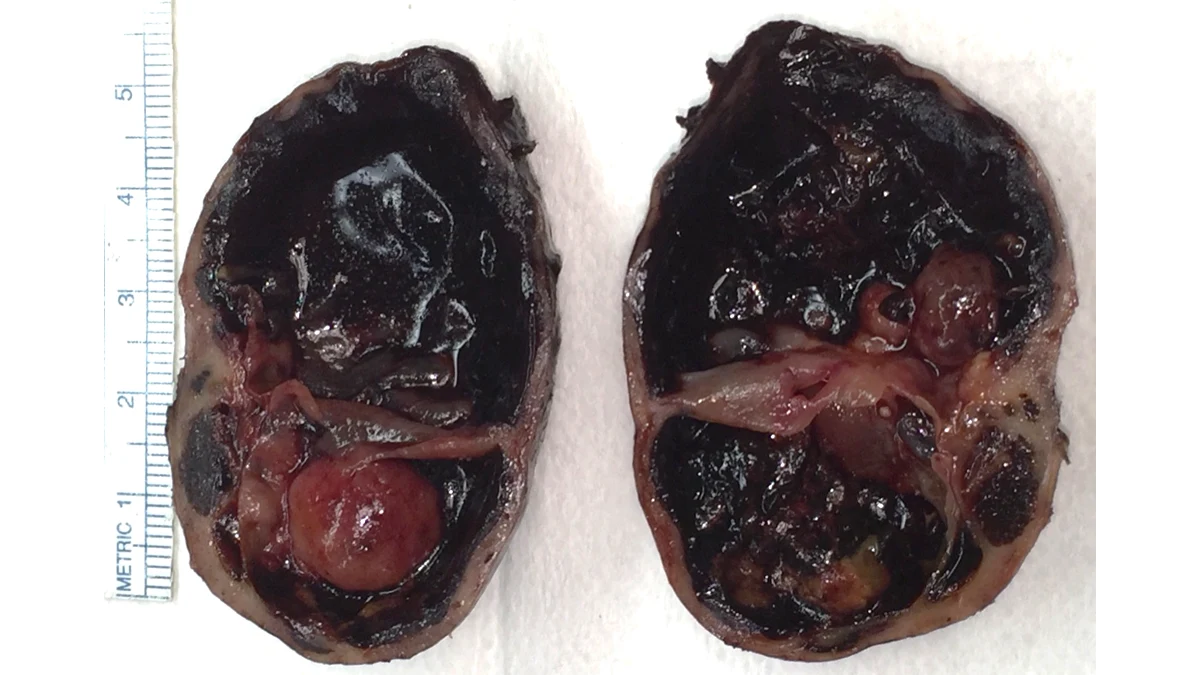
Image source and reuse details
Source: Papillary Carcinoma of the Thyroid Gland, Gross Appearance (22780603300).jpg. Whole photograph fitted proportionally into 1200 × 675 with external white side margins, orientation normalized and converted to WebP. No tissue cropped, recolored or retouched.
In this guide
First establish which cancer it is
The thyroid is a hormone-producing gland in the lower front of the neck. Papillary, follicular and oncocytic cancers, also called Hürthle-cell cancers, arise from its follicular cells. They belong to the differentiated group, although their behaviour and ability to take up iodine can differ. Most thyroid nodules are benign, so a lump is not itself a cancer diagnosis.
Medullary cancer arises from different cells, called C cells, and follows a different pathway. Anaplastic cancer is a rapidly growing, aggressive form. Poorly differentiated cancers, thyroid lymphoma and other rare diagnoses need their own specialist assessment. The pathways below are mainly for adults; children should be assessed by a paediatric thyroid cancer team.
Source: National Cancer Institute — United States — Thyroid Cancer Treatment (PDQ®)–Health Professional Version · American Thyroid Association — 2025 ATA Differentiated Thyroid Cancer Guidelines: Extent of surgery — patient summary of Ringel MD et al. · American Thyroid Association — Medullary Thyroid Cancer · American Thyroid Association — Anaplastic Thyroid Cancer
A neck lump, voice changes or pressure
Arrange a medical assessment for a new neck lump, persistent hoarseness, swallowing problems or pressure in the front of the neck. These symptoms often have other causes. Normal thyroid hormone blood tests do not by themselves exclude a thyroid tumour. A rapidly enlarging neck mass needs prompt assessment rather than waiting for a routine check-up.
New breathing difficulty needs urgent medical help. Severe breathlessness or a rapidly worsening airway problem is an emergency: use your local emergency service. After thyroid surgery, sudden neck swelling, tightness or breathing difficulty also needs emergency assessment. Do not wait for an appointment or a reply from an overseas centre.
Source: National Health Service — United Kingdom — Symptoms of thyroid cancer · The University of Texas MD Anderson Cancer Center — United States — Thyroid Cancer Treatment
Ultrasound and the needle sample
The usual assessment combines a neck examination, thyroid function blood tests and ultrasound of the gland and nearby lymph nodes. Ultrasound helps decide which nodules need sampling; not every nodule needs a biopsy. Fine-needle aspiration takes cells through a thin needle, usually guided by ultrasound. A pathologist examines the sample.
A result may be benign, malignant, suspicious, indeterminate or insufficient. Indeterminate does not mean confirmed cancer. A repeat sample, selected molecular tests, monitoring or diagnostic lobectomy may be discussed. Follicular cancer may require examination of the removed capsule and blood vessels because a cell sample alone cannot show invasion. CT, MRI, other scans or a vocal-cord examination are selected when needed.
Source: National Health Service — United Kingdom — Tests and next steps for thyroid cancer · American Thyroid Association — Fine Needle Aspiration Biopsy of Thyroid Nodules · National Cancer Institute — United States — Thyroid Cancer Treatment (PDQ®)–Health Professional Version
What to ask about the pathology report
Ask for the exact tumour type, size, number of tumour sites, whether it extends beyond the thyroid, whether blood vessels are involved and whether the surgical edges are clear. Lymph-node findings should state how many nodes are involved and relevant features of the deposits. These details help distinguish a small local cancer from a higher-risk disease.
A specialist pathology review can be useful for a rare type, an uncertain result or a second opinion. Molecular testing has different purposes: clarifying an indeterminate nodule, selecting a drug for advanced disease or identifying an inherited syndrome. A gene change in the tumour does not automatically mean that relatives carry it.
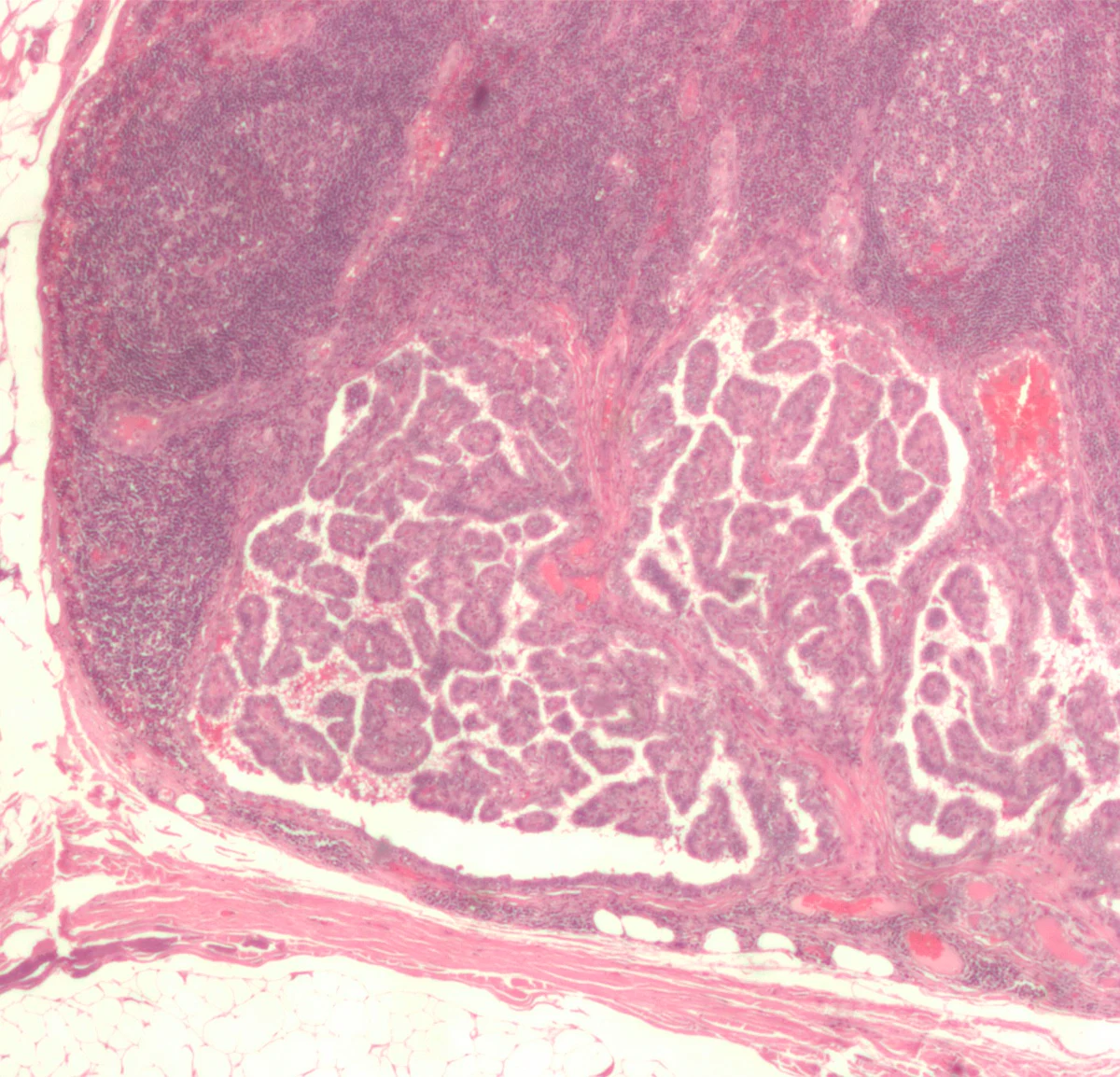
Image source and reuse details
Source: Lymph node with papillary thyroid carcinoma.jpg. Full 1410 × 1356 field proportionally reduced to 1200 × 1154 and converted to WebP. No tissue crop, recoloring or diagnostic alteration.
Source: National Cancer Institute — United States — Thyroid Cancer Treatment (PDQ®)–Health Professional Version · American Thyroid Association — Fine Needle Aspiration Biopsy of Thyroid Nodules
Stage, recurrence risk and outlook are different
Stage describes the extent of disease and helps estimate risk of death from cancer. Differentiated thyroid cancer staging also takes age into account. Recurrence risk estimates the chance that cancer persists or returns. Neither is a personal deadline. Many local differentiated cancers have an excellent outlook; this must not be applied to all medullary or anaplastic cancers.
The plan also depends on symptoms, growth on scans, other illnesses and your priorities. The response to treatment changes the assessment over time. Ask whether the goal is cure, long-term control, relief of symptoms or a combination, and what finding would change the current plan. A single overall thyroid-cancer survival percentage hides important differences.
Source: National Cancer Institute — United States — Thyroid Cancer Treatment (PDQ®)–Health Professional Version · American Thyroid Association — 2025 ATA Differentiated Thyroid Cancer Guidelines: De-escalating therapy and monitoring — patient summary
When careful monitoring is an option
For selected very small, low-risk papillary cancers confined to the thyroid, active surveillance can be an alternative to immediate surgery. It means planned ultrasound follow-up by an experienced team, with clear reasons for changing to treatment. It is not simply ignoring cancer. Location near important structures, lymph-node disease, aggressive features, symptoms and ability to attend follow-up affect suitability.
The American Thyroid Association patient guide describes ultrasound about every 6 months for the first 1–2 years, then annually for many patients; your schedule may differ. Growth or new lymph-node disease can lead to surgery. Ultrasound-guided ablation is another option for carefully selected patients in experienced centres, but confirming complete destruction can be harder than after surgery. It is not a substitute for the treatment of every thyroid cancer.
Source: American Thyroid Association — Thyroid Microcarcinoma: A Guide for Patients · American Thyroid Association — 2025 ATA Differentiated Thyroid Cancer Guidelines: Extent of surgery — patient summary of Ringel MD et al.
Removing one lobe or the whole gland
The 2025 American Thyroid Association guidance favours lobectomy for selected cancers in one lobe, up to 2 cm, without spread outside the thyroid or to lymph nodes. For low-risk cancers larger than 2 cm and up to 4 cm, lobectomy or total thyroidectomy can be considered according to the findings and preferences. Larger or invasive cancers and disease in nodes or distant organs often require a more extensive approach.
Lobectomy removes one half of the gland; total thyroidectomy removes both lobes. Involved lymph nodes may also need removal. These size rules concern differentiated cancer and do not define medullary or anaplastic treatment. Final pathology can sometimes lead to completion surgery. Ask about the surgeon’s experience, the expected benefit of each extent of surgery and the risk of voice changes or low calcium.
Source: American Thyroid Association — 2025 ATA Differentiated Thyroid Cancer Guidelines: Extent of surgery — patient summary of Ringel MD et al. · The University of Texas MD Anderson Cancer Center — United States — Thyroid Cancer Treatment
Recovery, voice and calcium
Thyroid surgery can cause bleeding, voice changes from nerve injury and low calcium if the nearby parathyroid glands are affected. Some effects are temporary, others persist. Ask for written instructions about wound care, calcium symptoms, medicines and who to call. Tingling around the mouth or fingers, cramps or marked weakness should be reported promptly.
Sudden swelling of the neck or breathing difficulty after surgery is an emergency. Persistent voice or swallowing problems may need a specialist assessment and rehabilitation. After total thyroidectomy, thyroid hormone replacement is lifelong; after lobectomy it is needed in some patients. Do not adjust calcium or hormone doses without the team’s plan.
Source: The University of Texas MD Anderson Cancer Center — United States — Thyroid Cancer Treatment · National Health Service — United Kingdom — Treatment for thyroid cancer
Radioactive iodine: useful in the right setting
Radioactive iodine-131 is taken by mouth and can treat remaining or spread differentiated cancer that takes up iodine. It is not routinely needed for every low-risk cancer. Medullary and anaplastic cancers do not respond to this treatment. A food or iodine supplement cannot replace it. The nuclear medicine team weighs expected benefit, uptake and risks.
Preparation may involve a temporary low-iodine diet and either recombinant TSH or supervised interruption of thyroid hormone. Do not stop treatment yourself. Iodine-131 must not be given during pregnancy or breastfeeding; discuss recent breastfeeding, future pregnancy and fertility before treatment. Follow the centre’s written instructions about feeding cessation, conception and temporary contact precautions. Dry mouth, salivary problems, taste changes and longer-term risks must be weighed, especially with repeated treatment.
Source: American Thyroid Association — Radioactive Iodine · American Thyroid Association — Thyroid Cancer (Papillary and Follicular) · National Health Service — United Kingdom — Treatment for thyroid cancer
Hormone replacement is not always TSH suppression
Levothyroxine replaces the hormone the gland can no longer make. In selected differentiated cancers, a dose that lowers thyroid-stimulating hormone, or TSH, may also reduce stimulation of remaining cancer cells. The target depends on current risk and response. Suppressing TSH as much as possible is not a universal rule.
Too much hormone can affect heart rhythm and bone strength. The 2025 approach supports less suppression when risk is low and response is excellent. Medullary and anaplastic cancer do not benefit from cancer-directed TSH suppression; replacement may still be needed after removal of the gland. Ask how and when to take levothyroxine and how to separate it from calcium, iron or other medicines that affect absorption.
Source: American Thyroid Association — 2025 ATA Differentiated Thyroid Cancer Guidelines: De-escalating therapy and monitoring — patient summary · American Thyroid Association — Thyroid Cancer (Papillary and Follicular) · American Thyroid Association — Medullary Thyroid Cancer · The University of Texas MD Anderson Cancer Center — United States — Thyroid Cancer Treatment
Advanced differentiated cancer: when tablets help
A cancer that no longer benefits from radioactive iodine is called radioiodine-refractory. This does not automatically mean starting a systemic drug immediately. The team considers growth, symptoms, tumour sites and local treatment options. Lenvatinib and sorafenib are options in appropriate progressive differentiated disease; cabozantinib has a United States indication after progression on prior VEGFR-targeted treatment when radioactive iodine is unsuitable or no longer works.
In SELECT, 392 patients with progressive radioiodine-refractory disease received lenvatinib or placebo. Median time without progression was 18.3 versus 3.6 months; hazard ratio 0.21. This is a group result for disease control, not proof of cure or a promised lifespan. Overall survival was not significantly improved at the original analysis, and crossover complicates interpretation. Blood pressure, diarrhoea, weight, skin and laboratory monitoring are important during these medicines.
Source: National Cancer Institute — United States — Thyroid Cancer Treatment (PDQ®)–Health Professional Version · United States Food and Drug Administration — Statistical Review and Evaluation — Lenvima, NDA 206947, SELECT study, 2015 · United States Food and Drug Administration — FDA approves cabozantinib for differentiated thyroid cancer
RET and other molecular targets
A RET fusion in differentiated thyroid cancer and a RET mutation in medullary cancer are different findings. Selpercatinib received traditional United States approval on June 12, 2024 for advanced or metastatic RET-fusion thyroid cancer requiring systemic treatment and refractory to radioactive iodine when that treatment is appropriate. It is not a drug for every thyroid nodule or every RET result.
The supporting LIBRETTO-001 study had 65 patients: response rates were 85% among 41 previously treated patients and 96% among 24 without prior systemic treatment. These separate, non-randomized groups do not establish a comparison or cure rate. Other findings, such as NTRK fusions, may open different treatment pathways. The team should check the precise test, current local authorization, prior treatments and safety before choosing a drug.
Source: United States Food and Drug Administration — FDA approves selpercatinib for RET fusion-positive thyroid cancer · National Cancer Institute — United States — Thyroid Cancer Treatment (PDQ®)–Health Professional Version
Medullary cancer has its own treatments
For localized medullary cancer, treatment usually involves total thyroidectomy and appropriate lymph-node surgery. Calcitonin and carcinoembryonic antigen, called CEA, help assess and monitor this disease; thyroglobulin is not its usual tumour marker. Radioactive iodine is ineffective. Advanced disease may be monitored if stable or treated locally or systemically according to its course.
For advanced RET-mutant medullary cancer requiring systemic therapy, selpercatinib received traditional United States approval on September 27, 2024. In randomized LIBRETTO-531 it improved progression-free survival versus physician-selected cabozantinib or vandetanib: hazard ratio 0.280. This is not a cure claim. The United States medullary indication for pralsetinib was withdrawn on July 20, 2023; this must not be confused with its separate RET-fusion thyroid indication. Local access must be verified.
Source: American Thyroid Association — Medullary Thyroid Cancer · United States Food and Drug Administration — FDA approves selpercatinib for medullary thyroid cancer with a RET mutation · United States Food and Drug Administration — Withdrawn — Cancer Accelerated Approvals · United States Food and Drug Administration — Ongoing — Cancer Accelerated Approvals
Inherited RET changes and the family
About 25% of medullary thyroid cancers are hereditary. Genetic counselling and germline RET testing should be offered even without a known family history. A germline change can be present throughout the body and inherited; a tumour-only change is different. Relatives should receive testing and prevention advice through a genetics service, not copy a relative’s treatment.
Multiple endocrine neoplasia type 2, or MEN2, can also involve adrenal pheochromocytomas and parathyroid disease. Before thyroid surgery in MEN2, appropriate biochemical tests should exclude a hormone-secreting pheochromocytoma because it can make surgery dangerous. The specialist team decides the order of treatment. Preventive thyroid surgery in a relative depends on the specific RET variant, age and assessment; it is not a general instruction for every family member.
Source: American Thyroid Association — Medullary Thyroid Cancer · National Cancer Institute — United States — Multiple Endocrine Neoplasia Type 2 (MEN2) (PDQ®) — Screening for pheochromocytoma before thyroidectomy
Anaplastic cancer needs a rapid specialist pathway
Anaplastic thyroid cancer can grow quickly and threaten breathing or swallowing. Diagnosis, airway assessment, staging and molecular testing should be coordinated urgently by a team experienced in this rare disease. Testing for BRAF V600E can change treatment. Surgery is considered when meaningful removal is feasible; radiotherapy, systemic treatment and supportive care may be combined.
Dabrafenib plus trametinib has a United States indication for locally advanced or metastatic BRAF V600E anaplastic cancer with no satisfactory local or regional treatment option. It is not appropriate for every BRAF change. Other molecular findings or clinical trials may matter. Radioactive iodine is not useful. Symptom relief, nutrition and airway planning belong alongside active cancer treatment, with decisions guided by the person’s wishes and realistic expected benefit.
Source: American Thyroid Association — Anaplastic Thyroid Cancer · United States Food and Drug Administration — Tafinlar — Supplement Approval, NDA 202806/S-010, anaplastic thyroid cancer, 2018 · National Cancer Institute — United States — Thyroid Cancer Treatment (PDQ®)–Health Professional Version
Know whom to call during treatment
Targeted medicines may cause high blood pressure, diarrhoea, skin problems, liver changes and other serious effects. Different drugs need different tests and checks for interactions. Ask for an emergency contact and a written plan before starting. Severe breathlessness, chest pain, fainting, major bleeding, a severe rash or inability to drink need urgent assessment.
Report persistent diarrhoea, marked weakness, palpitations or new symptoms promptly. Do not double doses, stop long-term hormone replacement or add herbal products without instructions. External radiotherapy is different from radioactive iodine and may be used for selected local disease or symptoms. Conventional chemotherapy is uncommon in differentiated cancer but can have a role in anaplastic disease.
Source: The University of Texas MD Anderson Cancer Center — United States — Thyroid Cancer Treatment · United States Food and Drug Administration — FDA approves selpercatinib for medullary thyroid cancer with a RET mutation · National Health Service — United Kingdom — Treatment for thyroid cancer
Follow-up should match treatment and response
After differentiated cancer, follow-up may include neck ultrasound, TSH and thyroglobulin with anti-thyroglobulin antibodies. Remaining normal tissue and antibodies affect interpretation. A detectable result after lobectomy is not automatically recurrence; the 2025 guidance does not generally recommend routine serial thyroglobulin after lobectomy. After total removal, trends are interpreted with the treatment history and scans.
For selected low-risk patients with an excellent response, cancer surveillance can be reduced over time rather than keeping intensive scans forever. Hormone replacement after total surgery remains lifelong. Medullary follow-up uses calcitonin and CEA, sometimes their rate of change, plus appropriate imaging. New symptoms or a rising marker should lead to assessment, not an automatic conclusion that a treatment has failed.
Source: American Thyroid Association — 2025 ATA Differentiated Thyroid Cancer Guidelines: De-escalating therapy and monitoring — patient summary · American Thyroid Association — Thyroid Cancer (Papillary and Follicular) · American Thyroid Association — Medullary Thyroid Cancer
Food, movement, fertility and daily life
No food, iodine supplement or “thyroid detox” has been shown to cure thyroid cancer. A low-iodine diet is a temporary preparation when prescribed, not a lifelong anticancer diet. Discuss supplements, especially high-dose iodine or products that interfere with tests or medicines. A dietitian can help with weight loss, poor appetite, swallowing problems or treatment-related diarrhoea.
Adapt activity to recovery, energy, calcium balance and other health problems. Gradual movement, balanced meals and sleep support daily function but do not replace treatment. Discuss pregnancy plans, fertility preservation when relevant, work and emotional support before major treatment decisions. Distress is valid even when a cancer has a favourable outlook. Supportive and palliative care can be provided alongside cancer-directed care.
Source: The University of Texas MD Anderson Cancer Center — United States — Thyroid Cancer Treatment · American Thyroid Association — Radioactive Iodine
What new research can and cannot promise
Studies are testing more selective molecular drugs, ways to restore iodine uptake and approaches that reduce unnecessary surgery or follow-up. A promising laboratory result, tumour shrinkage and longer survival are different outcomes. Redifferentiation, which aims to restore iodine uptake, is not a proven universal cure and should be discussed in an expert or trial setting.
Ask whether a trial is currently recruiting, which tumour type and biomarker it requires, what is standard in the comparison group, what costs and travel are involved and who provides urgent care. There is no reliable date when an experimental medicine will become available to everyone. Approval in the United States does not establish approval, reimbursement or availability in another country.
Source: National Cancer Institute — United States — Thyroid Cancer Treatment (PDQ®)–Health Professional Version · Gustave Roussy — France — Cancer de la thyroïde · The University of Texas MD Anderson Cancer Center — United States — Thyroid Cancer Treatment
Choosing a centre and preparing a second opinion
Look for a team that includes endocrinology, experienced thyroid surgery, pathology, radiology, nuclear medicine and oncology when needed. Ask whether it handles your exact subtype, complex reoperations, inherited disease or anaplastic cancer. The Istituto Europeo di Oncologia thyroid unit, the MD Anderson Endocrine Center and Gustave Roussy publish relevant pathways; these examples are not a world ranking.
Bring the pathology report and, if requested, slides or blocks, ultrasound and other scans with their reports, operation notes, prior iodine treatment details, medicines and molecular results. Use the directory to check documented country-specific contacts, then confirm acceptance, referral requirements, language help, costs and appointment before travel. A selectable country does not mean that every hospital is listed. The directory does not yet calculate the nearest centre from a postcode.
Find documented contacts for thyroid cancer care →
Source: Istituto Europeo di Oncologia — Italy — Unità Neoplasie Tiroidee · The University of Texas MD Anderson Cancer Center — United States — Endocrine Center · Gustave Roussy — France — Cancer de la thyroïde
Questions to take to your appointment
- Does a nodule mean cancer? No. Most thyroid nodules are benign. Ultrasound and, when appropriate, a cell sample help decide the next step.
- Can every small cancer be watched? No. Active surveillance is for selected low-risk papillary cancers with an experienced follow-up team. Other types or aggressive features need a different plan.
- Will I always need radioactive iodine? No. Its benefit depends on the differentiated tumour’s risk and iodine uptake. It does not treat medullary or anaplastic cancer.
- Does a RET result mean my family is at risk? Not necessarily. A tumour-only finding is different from an inherited germline variant. Medullary cancer warrants genetic counselling and germline RET testing.
- Can a normal TSH exclude cancer? No. TSH measures thyroid stimulation, not whether a nodule is cancerous. A normal value does not replace ultrasound or indicated sampling.
- Which centre is best for me? The useful choice is a team experienced in your precise subtype and treatment needs, with a confirmed access route. There is no single verified best centre for every patient.
Sources and verification
- National Cancer Institute — United States — Thyroid Cancer Treatment (PDQ®)–Health Professional Version
- National Health Service — United Kingdom — Symptoms of thyroid cancer
- National Health Service — United Kingdom — Tests and next steps for thyroid cancer
- National Health Service — United Kingdom — Treatment for thyroid cancer
- American Thyroid Association — Thyroid Cancer (Papillary and Follicular)
- American Thyroid Association — Fine Needle Aspiration Biopsy of Thyroid Nodules
- American Thyroid Association — 2025 ATA Differentiated Thyroid Cancer Guidelines: Extent of surgery — patient summary of Ringel MD et al.
- American Thyroid Association — 2025 ATA Differentiated Thyroid Cancer Guidelines: De-escalating therapy and monitoring — patient summary
- American Thyroid Association — Thyroid Microcarcinoma: A Guide for Patients
- American Thyroid Association — Radioactive Iodine
- American Thyroid Association — Medullary Thyroid Cancer
- National Cancer Institute — United States — Multiple Endocrine Neoplasia Type 2 (MEN2) (PDQ®) — Screening for pheochromocytoma before thyroidectomy
- American Thyroid Association — Anaplastic Thyroid Cancer
- United States Food and Drug Administration — Statistical Review and Evaluation — Lenvima, NDA 206947, SELECT study, 2015
- United States Food and Drug Administration — FDA approves cabozantinib for differentiated thyroid cancer
- United States Food and Drug Administration — FDA approves selpercatinib for RET fusion-positive thyroid cancer
- United States Food and Drug Administration — FDA approves selpercatinib for medullary thyroid cancer with a RET mutation
- United States Food and Drug Administration — Withdrawn — Cancer Accelerated Approvals
- United States Food and Drug Administration — Ongoing — Cancer Accelerated Approvals
- United States Food and Drug Administration — Tafinlar — Supplement Approval, NDA 202806/S-010, anaplastic thyroid cancer, 2018
- The University of Texas MD Anderson Cancer Center — United States — Thyroid Cancer Treatment
- Istituto Europeo di Oncologia — Italy — Unità Neoplasie Tiroidee
- The University of Texas MD Anderson Cancer Center — United States — Endocrine Center
- Gustave Roussy — France — Cancer de la thyroïde
Sources checked: 2026-11-16