


Testicular cancer: diagnosis, treatment and life after care
Testicular cancer can often be cured, including in some people whose cancer has spread. The right plan depends on the cells, spread and blood-marker results. Some people need only surgery and careful follow-up; others need chemotherapy or further surgery. Discuss fertility before treatment when possible, and seek a team experienced in your type of cancer.
MyMedNest editorial guide · Sources checked:
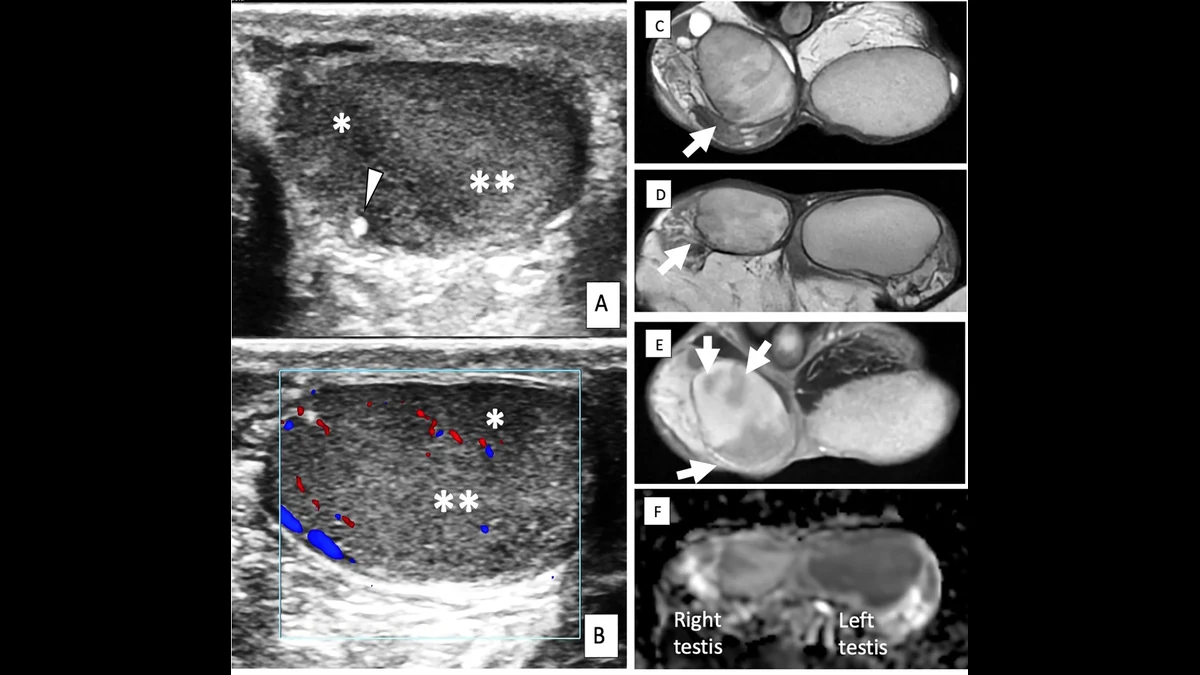
Image source and reuse details
Source: A pure intertubular testicular seminoma mimicking a burned-out tumor: a case report — Figure 3. Complete 1654 × 1514 figure proportionally reduced to 737 × 675 and centered in 1200 × 675 with black margins of 231 pixels left and 232 right. WebP conversion; all panels preserved, no clinical crop, recoloring, retouching or enlargement.
In this guide
Start with the exact type of testicular cancer
Most testicular cancers begin in germ cells, which normally develop into sperm. The two main groups are seminoma and nonseminoma. A tumor containing both is managed as nonseminoma. These differences matter because an operation, radiation treatment or follow-up plan suitable for one group may not suit the other.
This guide mainly covers germ-cell cancer after puberty. Lymphoma, tumors arising from hormone-producing or supporting cells, and childhood tumors need distinct advice. Many germ-cell cancers are curable, but this does not mean every stage or relapse has the same outlook. Ask the team to name the diagnosis and explain the treatment goal.
Source: National Cancer Institute — United States — Testicular Cancer Treatment (PDQ®)–Health Professional Version · National Cancer Institute — United States — Treatment for Testicular Cancer
A new lump needs assessment; sudden severe pain is an emergency
A lump, enlargement, unusual firmness or heaviness in a testicle should be checked promptly, even if it does not hurt. Some people have aching, lower-abdominal or back pain, or breast swelling. Many other conditions cause similar symptoms. Examination and tests are needed rather than guessing the cause.
Sudden severe testicular pain, especially with nausea, vomiting or pain that continues at rest, needs emergency assessment. A twisted testicle can lose its blood supply. Do not wait for a cancer appointment or try to diagnose torsion yourself. New shortness of breath or severe illness also needs timely help.
Source: National Health Service — United Kingdom — Symptoms of testicular cancer · National Health Service — United Kingdom — Testicle pain
Risk factors do not tell you who will develop cancer
An undescended testicle, a previous testicular cancer, or a father or brother with the disease can increase risk. Risk may remain after surgery to bring an undescended testicle down. Many people who develop cancer have no known risk factor. Having one does not mean that a tumor is inevitable.
There is no routine population screening test shown to reduce deaths from testicular cancer. Knowing what is normal for you helps you notice changes; ask about personal advice if you are at higher risk. A new lump needs assessment even after a normal examination. A prostate blood test is not a testicular cancer test.
Source: National Cancer Institute — United States — Testicular Cancer Treatment (PDQ®)–Health Professional Version · European Association of Urology — Testicular Cancer — Diagnostic Evaluation · National Cancer Institute — United States — Testicular Cancer Screening
Ultrasound is usually the first imaging test
A clinician examines both testicles and checks relevant symptoms and lymph nodes. Ultrasound helps show whether a change is inside the testicle, its size and the other testicle. Some small incidental findings are benign. An uncertain result may need expert review or further assessment rather than an automatic assumption of cancer.
Magnetic resonance imaging can help in selected unclear cases, but is not needed for every lump. A positron emission tomography scan is not a routine first test for staging testicular cancer. If another scan has shown a suspicious abdominal mass, the testicles may still need ultrasound even when no lump can be felt.
Source: European Association of Urology — Testicular Cancer — Diagnostic Evaluation · National Cancer Institute — United States — Testicular Cancer Treatment (PDQ®)–Health Professional Version
Blood markers help, but a normal result does not exclude cancer
The usual markers are alpha-fetoprotein, called AFP; human chorionic gonadotropin, often reported as beta-hCG; and lactate dehydrogenase, called LDH. They should be measured before and after removal of the affected testicle. Their levels and changes help assess spread, response and possible recurrence.
Pure seminoma does not produce AFP. A clearly raised AFP may suggest a nonseminoma component, unless there is another explanation such as liver disease. Some mild stable elevations have other causes, and LDH is not specific to cancer. Ask the team to interpret the pattern and expected fall over time, not one number alone.
Source: European Association of Urology — Testicular Cancer — Diagnostic Evaluation · National Cancer Institute — United States — Testicular Cancer Treatment (PDQ®)–Health Professional Version
The tissue report determines the treatment pathway
The report should state whether this is pure seminoma or nonseminoma, including any embryonal carcinoma, yolk-sac tumor, choriocarcinoma or teratoma. It also describes local spread, margins and invasion into small blood or lymph vessels. This vessel invasion can change the risk of recurrence in early nonseminoma.
Ask about expert review if the diagnosis is unusual or the next treatment is major. Germ cell neoplasia in situ is a precursor change, not the same as invasive or metastatic cancer. A biopsy of the opposite testicle is considered for selected risks; it is not automatically needed in everyone.
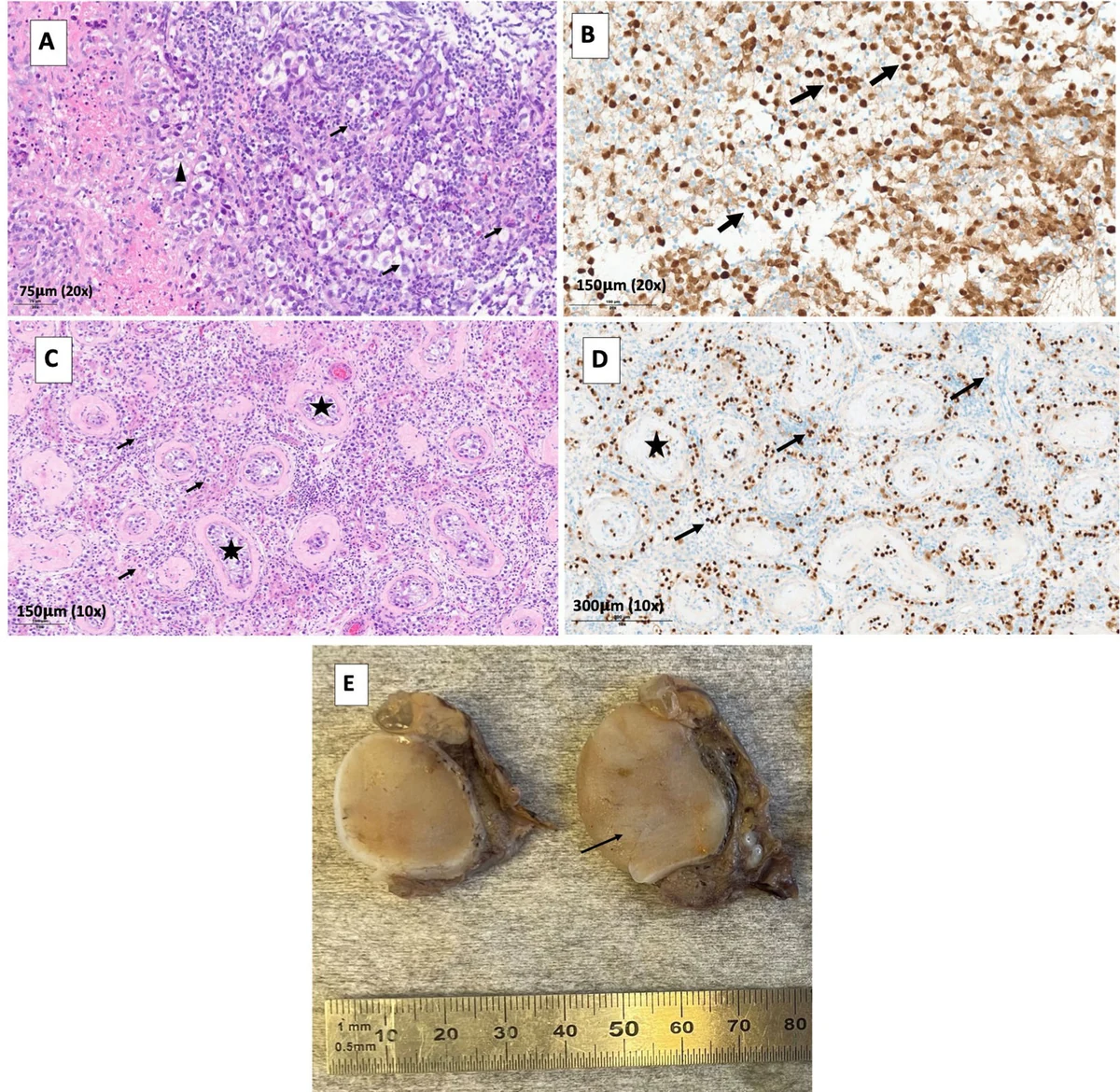
Image source and reuse details
Source: A pure intertubular testicular seminoma mimicking a burned-out tumor: a case report — Figure 2. Whole 1654 × 1613 figure proportionally reduced to 1200 × 1170 and converted to WebP. No crop, recoloring, diagnostic retouching or enlargement; all five panels and scales preserved.
Source: National Cancer Institute — United States — Testicular Cancer Treatment (PDQ®)–Health Professional Version · European Association of Urology — Testicular Cancer — Diagnostic Evaluation
Stage and blood results are read together
The team combines tissue findings, scans and blood markers after surgery. The TNM system describes the primary tumor, lymph nodes and distant spread; a serum-marker category adds information. Abdominal lymph nodes are a common site of spread. Ask for the complete stage and which classification edition was used.
Computed tomography of the chest, abdomen and pelvis helps assess spread when appropriate. Brain imaging is reserved for symptoms or selected high-risk patterns. Confirmed markers that keep rising after surgery can indicate disease even without a visible mass. A stage label alone is not a prediction of how long you will live.
Source: National Cancer Institute — United States — Testicular Cancer Treatment (PDQ®)–Health Professional Version · European Association of Urology — Testicular Cancer — Diagnostic Evaluation · European Association of Urology — Guidelines on Testicular Cancer — Limited Update March 2026
The risk group helps choose treatment, not predict one person’s future
For metastatic germ-cell cancer, the International Germ Cell Cancer Collaborative Group classification adds information beyond stage. Seminoma is grouped as good or intermediate prognosis. Nonseminoma has good, intermediate and poor groups. Cell type, primary site, marker levels and spread to organs other than the lungs can matter.
The terms describe groups used to plan care. They do not mean that every person in a group has the same result, or that metastatic cancer is automatically incurable. Ask whether cure is the aim and which factors apply to you. Cancer that resists previous platinum treatment needs a different discussion from a newly diagnosed early tumor.
Source: National Cancer Institute — United States — Testicular Cancer Treatment (PDQ®)–Health Professional Version · European Association of Urology — Guidelines on Testicular Cancer — Limited Update March 2026
Discuss sperm storage before treatment when possible
Cancer itself can reduce sperm quality before any treatment. Ask about semen assessment and freezing sperm before surgery, chemotherapy or radiation when feasible. Storage gives a possible future fertility option; it does not guarantee a pregnancy. Ask about access, costs and specialist help if producing a sample is difficult.
One healthy remaining testicle often provides enough hormones and sperm, but this is not assured. Discuss future family plans even if you do not want children now. In life-threatening advanced disease, the team may need to start treatment urgently: fertility procedures should not cause an unsafe delay.
Source: European Association of Urology — Testicular Cancer — Diagnostic Evaluation · National Cancer Institute — United States — Male Fertility and Cancer Treatment · National Health Service — United Kingdom — Treatment for testicular cancer
What removal of a testicle involves
The usual initial operation removes the affected testicle through an incision in the groin. This is called radical inguinal orchiectomy and usually provides the definitive tissue diagnosis as well as treatment. A routine biopsy through scrotal skin is generally avoided when a germ-cell cancer is suspected. In selected life-threatening metastatic cases, chemotherapy may come first.
Testis-sparing surgery can be considered in carefully selected situations, such as certain small uncertain lesions, bilateral tumors or a solitary testicle. It requires specialist assessment and careful tissue examination. A testicular implant is optional and can help appearance. It does not make sperm or hormones; discuss benefits, risks and timing without pressure to choose it.
Source: European Association of Urology — Testicular Cancer — Diagnostic Evaluation · National Health Service — United Kingdom — Treatment for testicular cancer
Stage I seminoma may need surveillance rather than more treatment
After removal of a stage I pure seminoma, active surveillance is often preferred when regular follow-up is practical. It means planned visits, blood tests and imaging, with treatment if cancer returns. It is an active care plan, not discharge without checks. Many people avoid unnecessary additional treatment this way.
Selected people may discuss adjuvant carboplatin to lower recurrence risk. Adjuvant means treatment after surgery to reduce the chance of return. Routine radiation after stage I surgery is generally avoided because of possible late harms, including second cancers. Compare your recurrence risk, treatment harms and ability to attend follow-up; chemotherapy is not mandatory for every early seminoma.
Source: European Association of Urology — Testicular Cancer — Disease Management · National Cancer Institute — United States — Testicular Cancer Treatment (PDQ®)–Health Professional Version
Stage I nonseminoma has a different risk discussion
Options after surgery include surveillance or selected adjuvant chemotherapy with bleomycin, etoposide and cisplatin, called BEP. Vessel invasion in the tissue is one important recurrence-risk factor. When adjuvant BEP is chosen, a single course can be appropriate in the guideline setting. The team must confirm your stage and circumstances.
Selected people may consider nerve-sparing surgery to remove abdominal lymph nodes, called retroperitoneal lymph node dissection or RPLND. It should be done by an experienced specialist. Teratoma with a different malignant component needs particular review. The chance of recurrence differs from the chance of dying; no option removes every risk or avoids all side effects.
Source: European Association of Urology — Testicular Cancer — Disease Management · National Cancer Institute — United States — Testicular Cancer Treatment (PDQ®)–Health Professional Version
Abdominal lymph nodes do not all need the same approach
For selected seminoma with limited abdominal nodal spread, chemotherapy or radiation may be discussed. Common chemotherapy plans include 3 courses of BEP, or 4 of etoposide–cisplatin, called EP, if bleomycin is unsuitable. Borderline nodes with normal markers may need repeat assessment before major treatment. Do not apply a waiting plan without specialist review.
Treatment-reduction approaches for seminoma, including primary RPLND, remain under evaluation in the European guideline and belong in experienced centers with prospective monitoring or trials. Marker-negative, limited nonseminoma may instead favor specialist RPLND. Nonseminoma with raised markers generally needs systemic treatment. Histology and blood results prevent using one stage II plan for everyone.
Source: European Association of Urology — Testicular Cancer — Disease Management · The University of Texas MD Anderson Cancer Center — United States — Testicular Cancer — Clinical Practice Algorithm, version 10, approved July 21, 2026
Chemotherapy can still aim to cure cancer that has spread
Cisplatin-based combinations are central to many metastatic germ-cell treatment plans. Good-prognosis disease commonly receives 3 courses of BEP, or 4 of EP when bleomycin cannot be used. Intermediate- or poor-prognosis settings often need 4 courses of BEP, with another combination such as etoposide–ifosfamide–cisplatin, called VIP, when appropriate.
These are examples of specialist regimens, not instructions for choosing drugs yourself. Carboplatin is not an automatic substitute for cisplatin in metastatic disease simply because both contain platinum. Kidney, lung, hearing and other health issues affect planning. Brain or bone metastases require individual discussion of chemotherapy, local treatment and supportive care in an experienced team.
Source: European Association of Urology — Testicular Cancer — Disease Management · National Cancer Institute — United States — Testicular Cancer Treatment (PDQ®)–Health Professional Version
A mass left after chemotherapy is not always active cancer
After seminoma chemotherapy, the team often first monitors a remaining mass with scans and markers. For a selected mass larger than 3 cm, a positron emission tomography scan may help, at least 2 months after chemotherapy. Earlier inflammation can mislead, and a positive scan alone does not automatically justify another cancer treatment.
Nonseminoma is different. A residual mass larger than 1 cm after first-line treatment often needs expert removal, with marker results considered. It may contain teratoma, active cancer or scar tissue. Positron emission tomography cannot reliably rule out teratoma. The thresholds and decisions for seminoma must not be transferred to nonseminoma.
Source: European Association of Urology — Testicular Cancer — Disease Management · Princess Margaret Cancer Centre — University Health Network, Canada — RPLND — Retroperitoneal Lymph Node Dissection, patient information, revised September 2022
Ask for specialist review before salvage treatment
Some relapses can still be cured. Options include conventional-dose combinations such as paclitaxel–ifosfamide–cisplatin, called TIP, or high-dose chemotherapy supported by the person’s own stem cells. The stem cells restore blood production after intensive chemotherapy; this is not a general stem-cell injection cure. Surgery can be important for selected remaining disease.
The choice depends on earlier drugs, response, timing, markers and sites of spread. A late nonseminoma relapse may particularly need complete surgery when feasible. Disease resistant to several treatments has a harder outlook, so ask about realistic benefit and research options. Symptom control, psychological support and palliative care can accompany anticancer care rather than replace it automatically.
Source: European Association of Urology — Testicular Cancer — Disease Management · National Cancer Institute — United States — Testicular Cancer Treatment (PDQ®)–Health Professional Version · United States National Library of Medicine — ClinicalTrials.gov — Standard-Dose Combination Chemotherapy or High-Dose Combination Chemotherapy and Stem Cell Transplant in Treating Patients With Relapsed or Refractory Germ Cell Tumors
Rare testicular tumors need their own advice
Not every tumor in a testicle is a germ-cell cancer. Lymphoma and tumors from supporting or hormone-producing cells require different assessment. Some rare tumors are benign; others need specialized cancer treatment. A germ-cell drug plan should not be applied solely because the tumor is in a testicle.
An expert pathology opinion can prevent the wrong treatment. Ask whether the tumor started in the testicle or spread there, whether more tissue tests are needed and which specialist team should coordinate care. The genuine images in this guide show a rare intertubular seminoma pattern, not every subtype or a way to diagnose your own scan.
Source: European Association of Urology — Guidelines on Testicular Cancer — Limited Update March 2026 · National Cancer Institute — United States — Testicular Cancer Treatment (PDQ®)–Health Professional Version
New blood markers are promising research, not a replacement for all tests
Researchers are studying microRNA molecules, including miR-371a-3p, that can be detected in blood. They may help identify active germ-cell cancer in some settings. Laboratory methods, clinical validation and practical use still need work. Teratoma is a particular limitation because this marker may not identify it.
Ask whether a test is part of a validated clinical pathway or research, what a negative result misses and whether it would change care. Do not cancel scans, established markers or a necessary tissue assessment because of a commercial blood test. A tool for monitoring known disease is not automatically a proven screening test for healthy people.
Source: European Association of Urology — Testicular Cancer — Diagnostic Evaluation · SWOG Cancer Research Network — United States — S1823 — A Prospective Observational Cohort Study to Assess miRNA371 for Outcome Prediction in Patients with Early Stage Germ Cell Tumors · United States National Library of Medicine — ClinicalTrials.gov — A Study of miRNA 371 in Patients With Germ Cell Tumors
What the 2026 miR-371 report can and cannot show
A 2026 conference interim report by Lucia Nappi and colleagues assessed selected samples from a prospective observational study. In 224 people in the planned interim analysis, including 69 relapse cases and 155 controls, sensitivity was 54% (95% confidence interval 42–65%) and specificity 94% (90–97%). The test missed some relapses; these figures do not describe a randomized trial of treatment benefit.
Sensitivity describes how often the test identified the target disease; specificity describes how often it was negative in those without it. Results depend on the tested group and timing. This was a conference abstract, not a final full research paper proving that scans can be replaced or survival improves. The study supports further evaluation, with false-negative results still important.
Source: Lucia Nappi and colleagues — American Society of Clinical Oncology, Journal of Clinical Oncology — First interim analysis of SWOG S1823: Operating characteristics of circulating microRNA 371a-3p (miR371) in predicting active germ cell malignancy in patients with early-stage testicular cancer — Conference abstract LBA5003, 2026 · SWOG Cancer Research Network — United States — S1823 — A Prospective Observational Cohort Study to Assess miRNA371 for Outcome Prediction in Patients with Early Stage Germ Cell Tumors
Research dates are not promises of a new treatment
TIGER, NCT02375204, is a randomized phase 3 study comparing conventional TIP with high-dose chemotherapy and the person’s own stem-cell support at first relapse. It had 420 participants and was not enrolling new people at checking. The estimated primary completion is in 2031. Alliance for Clinical Trials in Oncology sponsors the US study; the European Organisation for Research and Treatment of Cancer sponsors the European part, with UK funding from Cancer Research UK.
BNT211-01, NCT04503278, is early phase research testing modified immune cells targeting CLDN6, a protein on some tumor cells, with or without an RNA-based vaccine that supports the modified cells, in selected advanced solid tumors. Sponsored by BioNTech Cell & Gene Therapies GmbH, it was not enrolling new people, with estimated primary completion in 2028. These are not approval dates or offers of access. The observational miR-371 study has also closed new enrollment. Ask which studies are actually open for your histology, prior treatment and country, and who covers travel and care costs.
Source: United States National Library of Medicine — ClinicalTrials.gov — Standard-Dose Combination Chemotherapy or High-Dose Combination Chemotherapy and Stem Cell Transplant in Treating Patients With Relapsed or Refractory Germ Cell Tumors · The Institute of Cancer Research — United Kingdom — TIGER — Trial details, recruitment closure, sponsors and funding · United States National Library of Medicine — ClinicalTrials.gov — A Clinical Study of the Safety and Effectiveness of an Investigational Cell Therapy Given With and Without an Investigational RNA-based Vaccine in Patients With Organ Tumors
Know which treatment effects need urgent help
Ask about blood counts, kidney function and salts in the blood, hearing, nerve symptoms and lung health before relevant treatment. Bleomycin can cause serious lung injury; cisplatin can affect kidneys, hearing and nerves. Tell future surgical and anesthesia teams about previous bleomycin. Never withhold emergency care or oxygen yourself because you have received it.
Get written instructions for fever, including 38°C or the threshold your team sets, breathlessness, chest pain, severe illness or a painful swollen leg. These may signal infection, lung injury or a blood clot. Clot prevention is individualized: do not start blood thinners yourself. Report hearing changes, tingling or worsening breathlessness early rather than waiting for the next routine visit.
Source: European Association of Urology — Testicular Cancer — Disease Management · National Cancer Institute — United States — Infection and Neutropenia during Cancer Treatment · The University of Texas MD Anderson Cancer Center — United States — Testicular Cancer — Clinical Practice Algorithm, version 10, approved July 21, 2026 · Princess Margaret Cancer Centre — University Health Network, Canada — RPLND — Retroperitoneal Lymph Node Dissection, patient information, revised September 2022
Low testosterone needs assessment, not self-treatment
A remaining healthy testicle often supplies enough testosterone. Persistent fatigue, reduced sexual desire or other symptoms may need hormone assessment, while also checking other causes. If both testicles are removed, discuss a specialist plan for hormone replacement and monitoring. A cosmetic implant cannot replace hormone production.
Tell the team about fertility plans before starting hormone treatment. Testosterone products can interfere with sperm production and should not be used on your own as a way to restore fertility. Ask who will monitor symptoms and blood results over time, and how treatment choices fit your cancer history and other health conditions.
Source: European Association of Urology — Testicular Cancer — Follow-up After Curative Therapy · European Association of Urology — Testicular Cancer — Diagnostic Evaluation · European Association of Urology — Sexual and Reproductive Health — Male Hypogonadism: testosterone treatment and fertility
Erections, ejaculation and fertility are different functions
Cancer and treatment can affect body image, confidence, sexual comfort and relationships. Many people retain sexual function after removal of one testicle, but individual results vary. Abdominal lymph-node surgery can affect ejaculation; nerve-sparing techniques aim to reduce this risk without guaranteeing normal function.
Ask when sexual activity is safe after your treatment and what contraception or timing advice applies before trying for pregnancy. Avoid a fixed waiting period taken from someone else’s treatment plan. Andrology, fertility care, counseling or sex therapy can help. A change in ejaculation does not automatically mean loss of erections or inability to enjoy intimacy.
Source: National Cancer Institute — United States — Sexual Health Issues in Men with Cancer · European Association of Urology — Testicular Cancer — Follow-up After Curative Therapy
Food, activity and supplements during recovery
Enough energy and protein helps maintain strength. Seek a dietitian if appetite, nausea or weight loss becomes a problem. Drink according to your kidney function and treatment plan. After abdominal surgery, eating and activity instructions may differ from those after testicular surgery alone; follow the team’s recovery advice.
Build activity back gradually, stop smoking and discuss alcohol, supplements and bodybuilding products with the team. No diet, herb or supplement has been shown to replace treatment for testicular cancer. Some interact with medicines or affect hormones. Bring a complete list to the pharmacist rather than assuming a product described as natural is safe.
Source: National Cancer Institute — United States — Nutrition During Cancer Treatment · National Cancer Institute — United States — Complementary and Alternative Medicine · European Association of Urology — Testicular Cancer — Follow-up After Curative Therapy
Get a follow-up calendar matched to your treatment
Surveillance uses scheduled visits, blood markers and imaging. The plan differs for seminoma, nonseminoma, initial treatment and response. Ask for a written calendar and a contact for new symptoms or missed appointments. A normal marker result alone does not rule out recurrence, and routine positron emission tomography is not the usual surveillance method.
In experienced centers, magnetic resonance imaging can sometimes replace abdominal computed tomography to limit radiation exposure. The team must choose suitable imaging and readers. Do not apply one calendar to every stage or decide to reduce checks yourself. People without complete remission or with higher-risk disease need an individual specialist plan.
Source: European Association of Urology — Testicular Cancer — Follow-up After Curative Therapy · National Cancer Institute — United States — Testicular Cancer Treatment (PDQ®)–Health Professional Version
Life after treatment includes checking late effects
Long-term care may address blood pressure, cholesterol, hearing, nerve symptoms, kidney or lung problems, testosterone and the risk of second cancers. The risks depend on the treatment received; they are not the same after surgery alone and intensive chemotherapy. Ask for a survivorship summary listing drugs, radiation fields, operations and future checks.
After the most intensive follow-up years, attention often shifts toward late effects and overall health. Rare late relapses still occur, so persistent new symptoms should be assessed. Everyone does not need lifelong routine scans. Discuss work, insurance, distress and practical support too; being cured does not mean every recovery problem should be ignored.
Source: European Association of Urology — Testicular Cancer — Follow-up After Curative Therapy · Princess Margaret Cancer Centre — University Health Network, Canada — RPLND — Retroperitoneal Lymph Node Dissection, patient information, revised September 2022
Choose a documented pathway and prepare for the visit
For complex lymph-node surgery, relapse or high-dose treatment, ask about a team’s experience with that exact problem. The directory lists selected documented clinical pathways, including services in Italy, Switzerland, Germany, France, Canada and the United States. It is not a worldwide ranking, and absence from the list does not mean a center cannot treat you.
Bring tissue reports and requested slides, scans, marker results over time and the full treatment history, including bleomycin. Confirm referral requirements, costs, insurance and a secure way to share records. Ask who coordinates the plan and whether a second opinion would change it. A country filter does not provide a verified distance search from your postal code.
Documented specialist pathways for testicular cancer →
Source: The University of Texas MD Anderson Cancer Center — United States — Testicular Cancer Treatment · Istituto Oncologico Veneto — Italy — GOM Uro-Oncologico — multidisciplinary group and testicular cancer pathway · Universitätsspital Zürich — Switzerland — Hodenkrebs Sprechstunde — patient access and contact details · Nationales Centrum für Tumorerkrankungen Heidelberg — Germany — Blasen-, Prostata-, Nieren-, Hoden- und Penistumoren — appointments and patient center · Gustave Roussy — France — Cancer du testicule — specialist pathway and contact · Princess Margaret Cancer Centre — University Health Network, Canada — RPLND — Retroperitoneal Lymph Node Dissection, patient information, revised September 2022 · National Cancer Institute — United States — Who Pays for Clinical Trials?
Questions to take to your appointment
- Can testicular cancer be cured after it has spread? Yes, some metastatic germ-cell cancers can still be cured. The outlook depends on the type, risk group, previous treatment and response; no personal outcome is guaranteed.
- Does a normal blood marker result exclude cancer? No. Ultrasound, tissue findings and other tests may still be needed. Markers are interpreted together and over time.
- Will one testicle be enough for hormones and fertility? Often, if the remaining testicle is healthy, but not always. Discuss sperm storage and hormone assessment before treatment when possible.
- Does everyone need chemotherapy after surgery? No. Selected early cancers are managed with planned surveillance. Histology and recurrence risk determine the choices.
- Is every mass after chemotherapy active cancer? No. It can contain scar tissue, teratoma or active cancer. Seminoma and nonseminoma require different assessment.
- Are CAR-T cells or a new blood marker standard care for everyone? No. Research has specific eligibility and limits. A trial entry is not an approval or a guarantee of access.
Sources and verification
- National Cancer Institute — United States — Testicular Cancer Treatment (PDQ®)–Health Professional Version
- National Cancer Institute — United States — Treatment for Testicular Cancer
- National Cancer Institute — United States — Testicular Cancer Screening
- European Association of Urology — Testicular Cancer — Diagnostic Evaluation
- European Association of Urology — Testicular Cancer — Disease Management
- European Association of Urology — Testicular Cancer — Follow-up After Curative Therapy
- European Association of Urology — Guidelines on Testicular Cancer — Limited Update March 2026
- National Health Service — United Kingdom — Treatment for testicular cancer
- National Health Service — United Kingdom — Symptoms of testicular cancer
- National Health Service — United Kingdom — Testicle pain
- Vassiliki Pasoglou and colleagues — Frontiers in Oncology — A pure intertubular testicular seminoma mimicking a burned-out tumor: a case report
- United States National Library of Medicine — ClinicalTrials.gov — Standard-Dose Combination Chemotherapy or High-Dose Combination Chemotherapy and Stem Cell Transplant in Treating Patients With Relapsed or Refractory Germ Cell Tumors
- United States National Library of Medicine — ClinicalTrials.gov — A Clinical Study of the Safety and Effectiveness of an Investigational Cell Therapy Given With and Without an Investigational RNA-based Vaccine in Patients With Organ Tumors
- United States National Library of Medicine — ClinicalTrials.gov — A Study of miRNA 371 in Patients With Germ Cell Tumors
- SWOG Cancer Research Network — United States — S1823 — A Prospective Observational Cohort Study to Assess miRNA371 for Outcome Prediction in Patients with Early Stage Germ Cell Tumors
- Lucia Nappi and colleagues — American Society of Clinical Oncology, Journal of Clinical Oncology — First interim analysis of SWOG S1823: Operating characteristics of circulating microRNA 371a-3p (miR371) in predicting active germ cell malignancy in patients with early-stage testicular cancer — Conference abstract LBA5003, 2026
- The Institute of Cancer Research — United Kingdom — TIGER — Trial details, recruitment closure, sponsors and funding
- The University of Texas MD Anderson Cancer Center — United States — Testicular Cancer — Clinical Practice Algorithm, version 10, approved July 21, 2026
- The University of Texas MD Anderson Cancer Center — United States — Testicular Cancer Treatment
- Princess Margaret Cancer Centre — University Health Network, Canada — RPLND — Retroperitoneal Lymph Node Dissection, patient information, revised September 2022
- Istituto Oncologico Veneto — Italy — GOM Uro-Oncologico — multidisciplinary group and testicular cancer pathway
- Universitätsspital Zürich — Switzerland — Hodenkrebs Sprechstunde — patient access and contact details
- Nationales Centrum für Tumorerkrankungen Heidelberg — Germany — Blasen-, Prostata-, Nieren-, Hoden- und Penistumoren — appointments and patient center
- Gustave Roussy — France — Cancer du testicule — specialist pathway and contact
- National Cancer Institute — United States — Palliative Care in Cancer
- National Cancer Institute — United States — Sexual Health Issues in Men with Cancer
- National Cancer Institute — United States — Male Fertility and Cancer Treatment
- National Cancer Institute — United States — Infection and Neutropenia during Cancer Treatment
- National Cancer Institute — United States — Nutrition During Cancer Treatment
- National Cancer Institute — United States — Complementary and Alternative Medicine
- National Cancer Institute — United States — Who Pays for Clinical Trials?
- European Association of Urology — Sexual and Reproductive Health — Male Hypogonadism: testosterone treatment and fertility
Sources checked: 2026-11-19