


Retinoblastoma: signs, tests, treatment and specialist centers
A white reflection in your child’s pupil or an eye that has recently started to turn deserves prompt attention. Call the pediatrician or a children’s eye service. Photos can help the doctor see when the reflection appears. Bring any you already have and ask how to reach a specialist in eye tumors.
MyMedNest editorial guide · Sources checked:
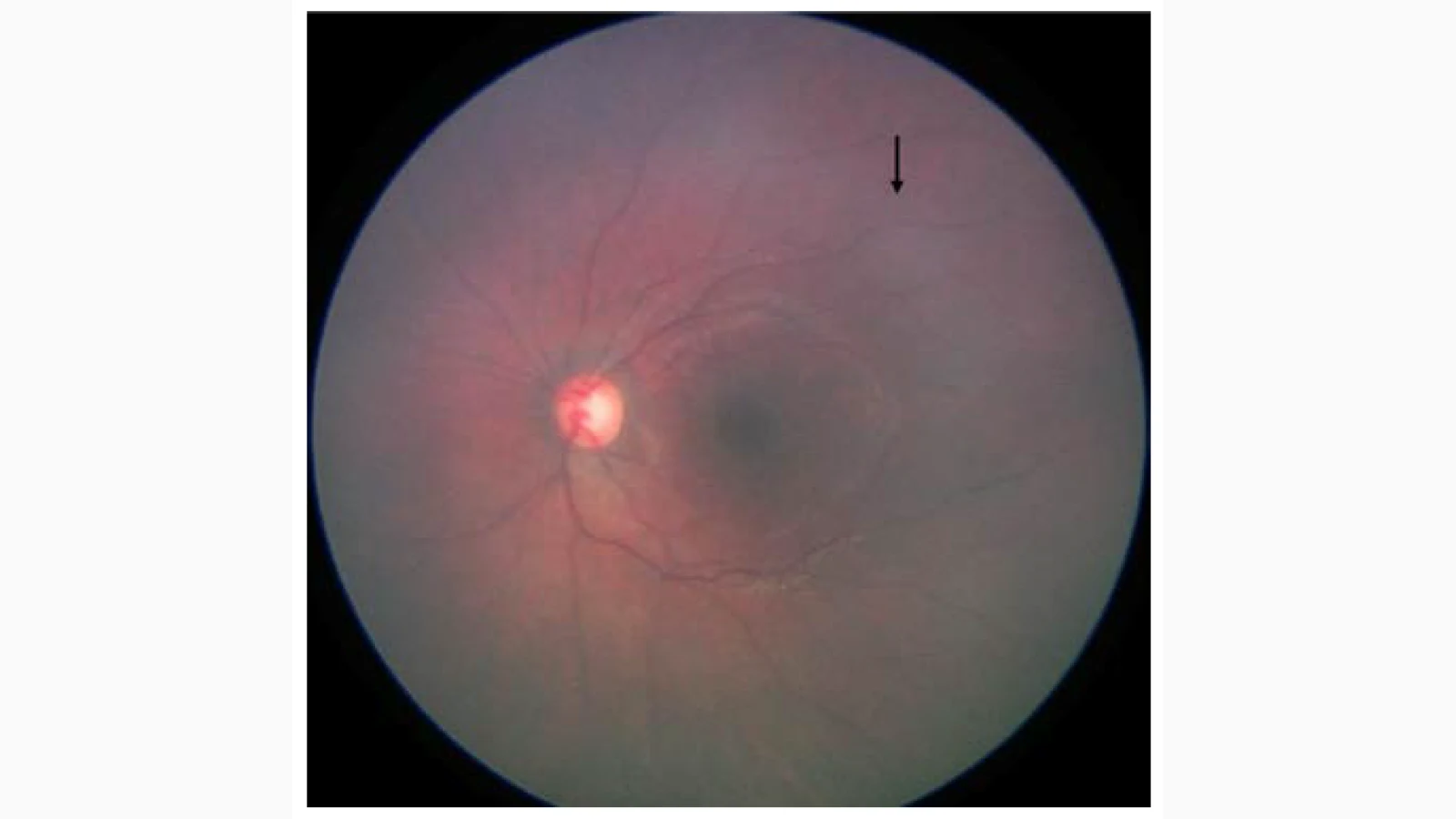
Image source and reuse details
Source: Artificial Intelligence and Machine Learning in Ocular Oncology, Retinoblastoma (ArMOR): Experience with a Multiracial Cohort — Figure 2. Reduced in proportion and framed in WebP. The original arrow is preserved.
In this guide
What retinoblastoma is
Retinoblastoma is a rare cancer that starts in the retina, the tissue at the back of the eye that senses light. It mostly affects young children and can occur in one eye or both. The team also checks the eye that looks healthy.
The RB1 gene carries instructions that help control how cells grow. Some children have a change in this gene from birth. That can happen even with no family history and with cancer in only one eye. The doctor may suggest a blood test and a visit with a genetics specialist.
Source: National Cancer Institute — Retinoblastoma Treatment (PDQ®)–Patient Version · National Eye Institute — Retinoblastoma · National Center for Biotechnology Information — GeneReviews — Retinoblastoma
Signs that need an eye exam
When light enters the eye, the pupil can look white instead of red. Sometimes you can see this in a flash photo. Another sign is an eye that points in a different direction from the other eye, called strabismus. These signs have other possible causes. Get your child checked without waiting for the reflection to show up in another photo.
Tell the doctor when you noticed the change and if it always affects the same eye. A photo with a normal reflection can miss the problem. If retinoblastoma runs in your family, ask the pediatrician when to begin checks even if there are no symptoms.
Source: National Eye Institute — Retinoblastoma · National Cancer Institute — Retinoblastoma Treatment (PDQ®)–Patient Version · Cancers — Artificial Intelligence and Machine Learning in Ocular Oncology, Retinoblastoma (ArMOR): Experience with a Multiracial Cohort
How doctors check for it
The eye doctor uses drops to widen the pupil and look at the back of the eye. Young children may need anesthesia so the doctor can complete the exam. Ultrasound shows structures inside the eye. Magnetic resonance imaging can help check the nerve that carries signals from the eye to the brain and the areas around it.
Doctors can usually diagnose retinoblastoma without taking a piece of the tumor. They check if it is still inside the eye or has spread. The number, position and size of the tumors, the sight that might be saved and how far the cancer has spread help guide treatment.
Source: National Cancer Institute — Retinoblastoma Treatment (PDQ®)–Patient Version · National Cancer Institute — Retinoblastoma Treatment (PDQ®)–Health Professional Version · National Center for Biotechnology Information — GeneReviews — Retinoblastoma
How the team chooses treatment
The first goal is to treat the cancer and protect the child’s life. The team tries to save sight when possible. Some small tumors can be treated with a laser or by freezing them. Depending on the case, specialists can give chemotherapy to the whole body, through the artery that supplies the eye or by injection into the eye.
For some advanced tumors, surgery to remove the eye may be the safest option. If cancer is outside the eye, the plan is different and can involve several teams. The National Cancer Institute lists cyclophosphamide among the drugs approved for retinoblastoma in the United States. Ask what options are suitable for your child and available in your country.
Source: National Cancer Institute — Retinoblastoma Treatment (PDQ®)–Patient Version · National Cancer Institute — Retinoblastoma Treatment (PDQ®)–Health Professional Version · National Cancer Institute — Drugs Approved for Retinoblastoma
What researchers are studying
Some centers are studying whether the clear fluid in the front of the eye can provide more information. This is called a liquid biopsy. It looks for fragments of DNA, the material that carries instructions in cells. It is a specialist test.
A Los Angeles center studied 60 people with lesions inside the eye. Of those, 41 had retinoblastoma. In selected cases, the test can add information to scans and the eye exam. Availability varies by center. Ask what the test could help determine in your child’s case.
Source: npj Precision Oncology — Prospective implementation of an aqueous humor liquid biopsy platform informs clinical diagnosis and management of retinoblastoma and other intraocular lesions · Children’s Hospital Los Angeles — Pediatric Retinoblastoma
Follow-up, sight and daily life
Checkups continue after treatment. The team decides when to check the area that was treated, how to monitor the other eye and what future tests are needed. With a heritable form, a doctor can also explain the chance of other cancers and whether relatives need eye checks.
Ask about support with sight, play and school. If an eye was removed, a specialist can explain when to consider an artificial eye and how to care for it. Tell the team if your child has trouble eating or gaining weight. Check with the team before adding vitamins or supplements.
Source: National Cancer Institute — Retinoblastoma Treatment (PDQ®)–Patient Version · National Cancer Institute — Late Effects of Treatment for Childhood Cancer (PDQ®)–Patient Version · Children’s Hospital Los Angeles — Pediatric Retinoblastoma
How to find a specialist center
Look for a team that brings together children’s eye doctors and cancer specialists. Your pediatrician can help arrange a prompt evaluation. For a second opinion, ask how to send clinical photos, reports, scans and a treatment summary securely.
You can search by country, city or postal code. Each listing says whether the contact is for an appointment, a doctor’s referral or a department office. If your child is already in treatment and has an urgent problem, call the number provided by the care team.
Find a retinoblastoma center →
Source: Ospedale Pediatrico Bambino Gesù — Ambulatorio Oncologia oculare · Barts Health NHS Trust — Referral forms for GPs · L V Prasad Eye Institute — Retinoblastoma
Questions to take to your appointment
- What might explain the white reflection or the eye that turns?
- What tests are needed and will my child need anesthesia?
- Is the tumor in one eye or both?
- What can we expect for my child’s health, eye and sight?
- Could a test show whether other family members need eye checks?
- Who should we call about follow-up, a second opinion or an urgent problem?
Sources and verification
- National Cancer Institute — Retinoblastoma Treatment (PDQ®)–Patient Version
- National Cancer Institute — Retinoblastoma Treatment (PDQ®)–Health Professional Version
- National Eye Institute — Retinoblastoma
- National Center for Biotechnology Information — GeneReviews — Retinoblastoma
- National Cancer Institute — Drugs Approved for Retinoblastoma
- npj Precision Oncology — Prospective implementation of an aqueous humor liquid biopsy platform informs clinical diagnosis and management of retinoblastoma and other intraocular lesions
- National Cancer Institute — Late Effects of Treatment for Childhood Cancer (PDQ®)–Patient Version
- Children’s Hospital Los Angeles — Pediatric Retinoblastoma
- Ospedale Pediatrico Bambino Gesù — Ambulatorio Oncologia oculare
- Barts Health NHS Trust — Referral forms for GPs
- L V Prasad Eye Institute — Retinoblastoma
- Cancers — Artificial Intelligence and Machine Learning in Ocular Oncology, Retinoblastoma (ArMOR): Experience with a Multiracial Cohort
Sources checked: 2026-11-20