


Penile cancer: diagnosis, treatment and life after care
Penile cancer can often be treated with the aim of cure when it is found early. A diagnosis does not automatically mean removing the whole penis. The plan depends on the cells, the depth of the tumor and whether lymph nodes are involved. This guide explains the choices, their effects on daily life and how to seek a specialist opinion.
MyMedNest editorial guide · Sources checked:
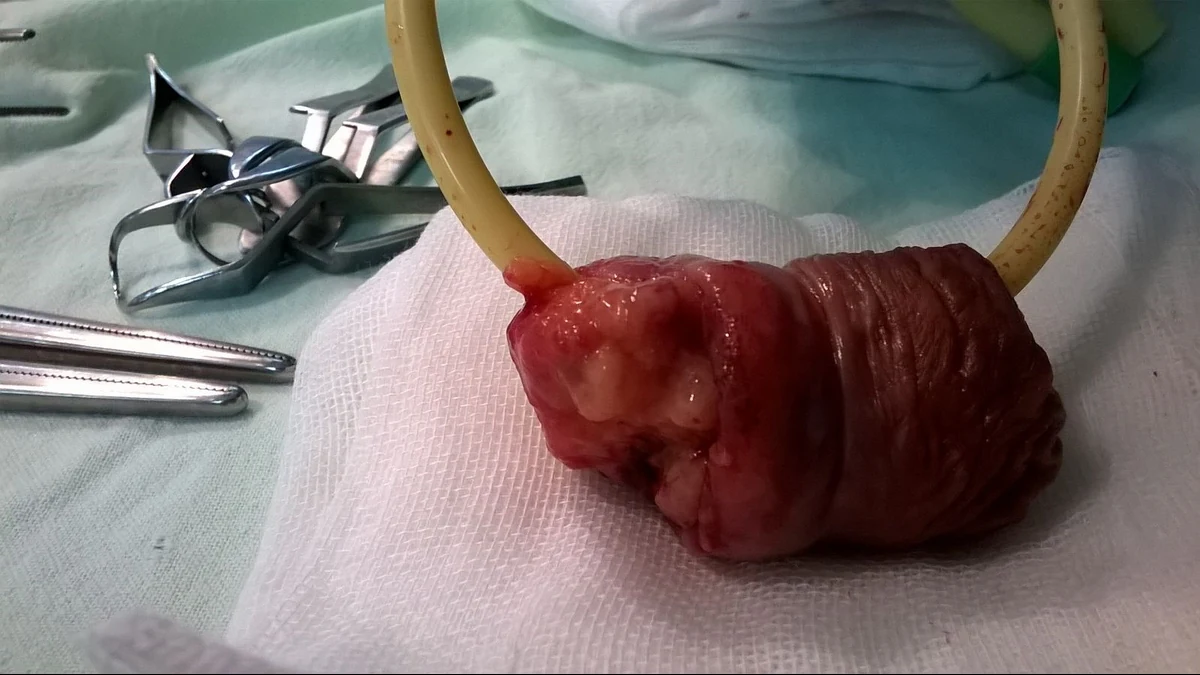
Image source and reuse details
Source: Clinical Presentation and Surgical Management of Penile Carcinoma: A Retrospective Case Series from a Tertiary Referral Center — Figure 1b, Case 1. Complete Figure 1b reconstructed from the two consecutive image strips embedded in the source PDF, without retouching. Proportional reduction from 1600 × 898 to 1200 × 674, with one black bottom row in 1200 × 675. No clinical crop, recoloring or enlargement.
In this guide
What diagnosis does this guide cover?
This guide concerns adults with primary squamous cell carcinoma of the penis. It starts in the surface lining, often on the glans, the head of the penis, or the foreskin. Melanoma, lymphoma, sarcoma and cancer that has spread from another organ need different treatment pathways. Ask which cell type the biopsy found.
Penile intraepithelial neoplasia, called PeIN, means abnormal cells remain in the surface layer. It is different from invasive cancer, which has grown deeper. An intimate location can make it hard to ask for help. Neither embarrassment nor an assumption that a change is only an infection should delay an examination.
Source: European Association of Urology and American Society of Clinical Oncology — Penile Cancer 2026 — Epidemiology, Aetiology and Pathology · National Cancer Institute — United States — Penile Cancer Treatment
Changes to show a doctor and urgent warning signs
Arrange an assessment for a new growth, a persistent red or discolored patch, bleeding, unusual discharge, a sore or difficulty moving the foreskin. A sore that has not healed within 4 weeks is one recognized warning sign; you do not need to wait that long to ask for help. Many such changes have other causes.
Seek urgent care for inability to pass urine, heavy bleeding, rapidly worsening pain or signs of serious infection. During cancer treatment, follow your team's emergency instructions: a fever of 38°C or its specified threshold needs immediate contact. New chest pain or breathlessness also needs urgent assessment, rather than an online search for a cancer appointment.
Source: National Health Service — United Kingdom — Symptoms of penile cancer · National Cancer Institute — United States — Infection and Neutropenia during Cancer Treatment
The first examination, biopsy and scans
A clinician examines the entire penis and both groins, including changes hidden by a tight foreskin. A biopsy removes tissue for laboratory examination. It is important before treatment with creams, laser or radiation, because these do not provide a full surgical specimen. Ask when results are expected and whom to contact if they do not arrive.
Magnetic resonance imaging can help when deeper invasion or the possibility of preserving the penis is uncertain. Ultrasound may be an alternative if that scan is unavailable. Other scans depend on the findings and lymph nodes. Having every available scan is not automatically better, and a scan cannot replace the tissue diagnosis.
Source: National Health Service — United Kingdom — Tests and next steps for penile cancer · European Association of Urology and American Society of Clinical Oncology — Penile Cancer 2026 — Diagnostic Evaluation and Staging
What to look for in the pathology report
Ask about the exact tumor type, grade, depth, surgical margins and invasion of small vessels or nerves. Grade describes how abnormal the cells look. Margins are the edges of tissue removed during surgery. These details help decide whether further treatment or groin assessment is needed. Specialist review of an uncertain report can be useful in this rare cancer.
The report should also include p16 staining, a marker used to help classify tumors associated with human papillomavirus, or HPV. This is not a test that dates an infection or proves infidelity. The clinical photographs shown here come from one published case; they cannot establish whether a change on your own skin is cancer.
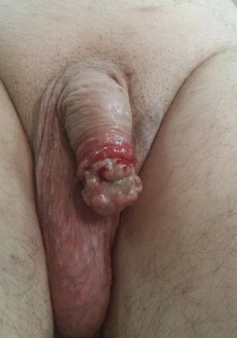
Image source and reuse details
Source: Clinical Presentation and Surgical Management of Penile Carcinoma: A Retrospective Case Series from a Tertiary Referral Center — Figure 1a, Case 1. Original complete Figure 1a image, 237 × 338 pixels, converted to WebP without enlargement, crop, retouching or recoloring.
Source: European Association of Urology and American Society of Clinical Oncology — Penile Cancer 2026 — Epidemiology, Aetiology and Pathology · Arsenie Dan Spînu and colleagues — Diagnostics — Clinical Presentation and Surgical Management of Penile Carcinoma: A Retrospective Case Series from a Tertiary Referral Center — Figure 1, Case 1
Local disease, lymph nodes and distant spread
The TNM system describes the primary tumor, nearby lymph nodes and distant spread. A small surface lesion and a tumor invading the deeper erectile tissues are different situations. Cancer in groin or pelvic nodes also changes the plan. Ask your team to explain the stage in ordinary language and whether it is based on examination or tissue results.
Early disease may be treated with the aim of cure. More extensive disease can sometimes still be treated through several coordinated methods. Once distant organs are involved, treatment often aims to control the cancer and symptoms. Group survival figures are not an individual deadline; extent, general health, treatment response and remaining options all matter.
Source: European Association of Urology and American Society of Clinical Oncology — Penile Cancer 2026 — Diagnostic Evaluation and Staging · National Cancer Institute — United States — Penile Cancer Treatment (PDQ®)–Health Professional Version
Why normal-feeling groins may need further testing
Small deposits of cancer can be present even when no groin lump is felt. Ultrasound, computed tomography and positron emission tomography cannot reliably rule out microscopic spread. The primary tumor's depth, grade and vessel or nerve invasion help determine the risk. Surgical staging is generally offered for T1b or higher disease; selected T1a grade 2 cases need an individual discussion.
In an experienced center, dynamic sentinel node biopsy samples the first draining nodes, reducing unnecessary removal of other nodes. Groin ultrasound and needle sampling of suspicious nodes come first. A positive sentinel node usually leads to further node surgery on that side. A negative result lowers risk but does not remove the need for follow-up.
When groin or pelvic nodes are involved
An enlarged node can result from infection as well as cancer. A suspicious palpable node should usually be confirmed with an image-guided needle biopsy, with scans to assess the pelvis and distant sites. Repeated antibiotics should not be used simply to postpone this assessment. The number, side, size and mobility of involved nodes affect treatment.
Removal of groin nodes is an important treatment for selected patients. Large fixed nodes or pelvic involvement often need cisplatin- and taxane-based chemotherapy first, if health allows it. Surgery is reconsidered after response and assessment of whether complete removal is possible. Node surgery and any additional radiation or chemotherapy should be planned by a specialist team.
PeIN: treating abnormal cells confined to the surface
For biopsy-confirmed PeIN, choices may include circumcision, prescribed fluorouracil or imiquimod cream, laser, or removal and reconstruction of the affected surface. Circumcision removes the foreskin and can form part of treatment. The appropriate option depends on the area involved, prior treatment and the chance of hidden invasion. Cream treatment for PeIN is not a general treatment for invasive cancer.
These treatments can cause soreness, inflammation and skin changes. Ask for written application and review instructions rather than copying an online schedule. A persistent or recurrent lesion needs reassessment, sometimes another biopsy. An unsuccessful course should not simply be repeated without checking why it failed. Follow-up remains necessary even when the skin looks better.
Source: European Association of Urology and American Society of Clinical Oncology — Penile Cancer 2026 — Disease Management · National Cancer Institute — United States — Penile Cancer Treatment
When can the penis be preserved?
Selected localized invasive tumors can be removed while preserving much of the penis. Options include local excision, removal of part or all of the glans, and reconstruction with a skin graft. Clear cancer-free margins remain essential. Ask what each option is likely to change in sensation, appearance and function, and what the surgeon expects to preserve.
Preserving tissue generally brings a greater risk of local recurrence than more extensive removal. It therefore requires reliable, close follow-up and prompt review of a new change. A small recurrence may sometimes allow another preserving procedure, while a larger or deeper one may require more extensive surgery. Available comparisons are limited and do not guarantee equal results for every tumor.
Partial or total penectomy and reconstruction
Partial penectomy removes the affected part of the penis. Total penectomy may be needed when a large or deeply invasive tumor cannot be safely removed otherwise. This does not routinely mean removing the testicles. Ask your surgeon to show which structures are involved and explain the intended cancer control before deciding about any reconstructive procedure.
After total removal, a perineal urethrostomy can create a new urine opening between the scrotum and anus; urination is usually seated. Reconstruction may be possible in selected circumstances but does not promise normal sensation or function. Discuss wound care, support at home, work, recovery and access to psychological and sexual rehabilitation before surgery.
Source: National Health Service — United Kingdom — Treatment for penile cancer · European Association of Urology and American Society of Clinical Oncology — Penile Cancer 2026 — Disease Management
External radiation and brachytherapy
For selected localized T1 or T2 tumors, radiation can offer an organ-preserving option. External radiation comes from a machine; brachytherapy delivers radiation close to the tumor through an implanted source. Suitability depends on tumor size, site and depth, the team's experience and your preferences. Discuss it with a radiation oncologist familiar with penile cancer.
Possible problems include skin reactions, narrowing of the urine opening, tissue damage and later recurrence. Radiation may also be used for involved nodes, combined with chemotherapy in selected settings, or to reduce symptoms. These are different goals and schedules. Ask how treatment will affect the skin, urination, sexual function and the feasibility of surgery if cancer returns.
Source: European Association of Urology and American Society of Clinical Oncology — Penile Cancer 2026 — Disease Management · National Cancer Institute — United States — Penile Cancer Treatment
Locally advanced cancer and care when it has spread
A tumor that cannot initially be removed may shrink enough after systemic treatment to permit surgery. In other situations, radiation with or without chemotherapy is considered. Decisions depend on the site, prior treatment and fitness, rather than a single plan for every advanced cancer. Ask whether the current goal is cure, control, symptom relief or a combination.
For distant spread, medicines may slow growth and relieve symptoms, but cure is often not possible. Supportive and palliative care can begin alongside cancer treatment to address pain, wound symptoms, anxiety and practical needs. It does not require stopping active treatment. A useful plan includes whom to call, how symptoms will be managed and when benefit will be reassessed.
Source: European Association of Urology and American Society of Clinical Oncology — Penile Cancer 2026 — Disease Management · National Cancer Institute — United States — Palliative Care in Cancer
Which chemotherapy medicines may be discussed?
Platinum-based chemotherapy remains a usual systemic option. Regimens may combine cisplatin with fluorouracil, or include a taxane such as paclitaxel or docetaxel. TIP contains paclitaxel, ifosfamide and cisplatin; TPF contains docetaxel, cisplatin and fluorouracil. Their use depends on the treatment setting, kidneys, nerves, hearing, general health and expected toxicity.
Do not transfer a testicular cancer regimen to penile cancer. In particular, the European Association of Urology advises against bleomycin here because of lung toxicity. Less intensive combinations may be appropriate for some people. After progression on platinum, evidence for further standard chemotherapy is limited, making a clinical trial and symptom-focused options important subjects for discussion.
Immunotherapy, molecular tests and approval limits
For advanced disease, tests may identify a rare molecular feature that supports a treatment authorized across several tumor types. Examples include high microsatellite instability or deficient DNA mismatch repair, written MSI-H or dMMR. Eligibility still depends on previous treatment and other conditions. HPV or PD-L1 positivity alone is not an established universal rule for selecting immunotherapy in penile cancer.
In the United States, the Food and Drug Administration changed the tumor mutational burden threshold for the relevant pembrolizumab indication to at least 13 mutations per megabase on October 16, 2026. It concerns eligible unresectable or metastatic tumors after progression, with no satisfactory alternatives and an authorized test. This is not approval for every penile cancer or automatic access in another country.
Source: European Association of Urology and American Society of Clinical Oncology — Penile Cancer 2026 — Disease Management · National Cancer Institute — United States — Agnostic Cancer Therapies (PDQ®)–Health Professional Version — MSI-H/dMMR section; TMB threshold superseded by the linked 2026 regulatory update · Food and Drug Administration — United States — Traditional approval of pembrolizumab or pembrolizumab and berahyaluronidase alfa-pmph for TMB-H solid tumors — updated indication, October 16, 2026
What the HERCULES study found and did not prove
HERCULES was a phase 2 study without a randomized comparison group. It enrolled 37 people in Brazil; 33 were eligible for the efficacy analysis. With pembrolizumab plus platinum-based chemotherapy, 13 responded: 39.4%, with a 95% confidence interval of 22.9–57.9%. Follow-up was a median of 24 months. A response means measurable tumor shrinkage, not necessarily cure.
Median time without progression was 5.4 months and median overall survival 9.6 months; these group figures do not predict one person's life expectancy. Severe treatment-related events occurred in 19 of 37 people, or 51.4%. Merck Sharp & Dohme funded the trial and supplied drugs; the Latin American Cooperative Oncology Group sponsored it, and authors disclosed industry relationships. The study does not prove superiority over chemotherapy alone.
Source: Fernando Cotait Maluf and colleagues — JAMA Oncology — Pembrolizumab Plus Platinum-Based Chemotherapy for Patients With Advanced Penile Cancer: The Nonrandomized HERCULES (LACOG 0218) Clinical Trial · United States National Library of Medicine — ClinicalTrials.gov — NCT04224740 — Pembrolizumab Combined With Cisplatin-based Chemotherapy as First-line Systemic Therapy in Advanced Penile Cancer
Trials in progress and realistic timelines
InPACT, NCT02305654, is a phase 3 randomized trial of treatment around surgery for cancer involving groin nodes. It also examines preventive pelvic node surgery. The registry updated on August 31, 2026 lists it as active but not recruiting. Primary completion is estimated for May 31, 2027. This is a research estimate, not a date when a new treatment will become available.
The Institute of Cancer Research sponsors the trial in the United Kingdom, with international cooperation and Cancer Research UK funding. Ask an experienced team about current local studies and eligibility, especially after progression. Check visits, travel, costs and alternatives. HERCULES, NCT04224740, is completed; absence of posted registry results does not erase its published paper. Registration alone does not establish effectiveness or authorization.
Source: United States National Library of Medicine — ClinicalTrials.gov — NCT02305654 — International Penile Advanced Cancer Trial (International Rare Cancers Initiative Study) · The Institute of Cancer Research — United Kingdom — InPACT — trial design, sponsors and funding; recruitment status checked separately against the dated trial registry · National Cancer Institute — United States — Who Pays for Clinical Trials?
Checks before medicines and symptoms to report
Blood counts, kidney function and other tests help reduce treatment risk. Tell the team about hearing problems, numbness, infections and all medicines or supplements. Before systemic fluorouracil or related drugs, ask about DPD deficiency testing under local guidance. A complete lack of this drug-processing enzyme can make treatment dangerous; topical skin preparations are considered separately.
Ask for a written emergency number and fever instructions before treatment starts. Call promptly for fever, severe diarrhea, inability to drink, new breathing difficulty or chest pain. Immunotherapy can inflame healthy organs, sometimes after it ends; report new symptoms and tell other clinicians that you received it. Do not alter doses or stop prescribed drugs based on this guide.
Source: National Cancer Institute — United States — Infection and Neutropenia during Cancer Treatment · European Medicines Agency — DPD testing before fluorouracil, capecitabine and tegafur — systemic treatment distinguished from skin preparations · European Association of Urology and American Society of Clinical Oncology — Penile Cancer 2026 — Disease Management
Passing urine after treatment
Urine may spray or the stream may change after treatment. Some people need to sit to urinate, and others have a temporary catheter or a new perineal opening. Ask the nurse to demonstrate care and give written instructions. The aim is a practical routine that protects the skin, preserves drainage and suits your day-to-day activities.
A narrowing of the urine opening or urethra can develop after surgery or radiation. Report a weak stream, straining, recurrent infection or difficulty emptying the bladder. Inability to pass urine or a blocked catheter with pain needs urgent advice. Do not try to enlarge an opening yourself; assessment determines whether treatment for a narrowing is needed.
Source: European Association of Urology and American Society of Clinical Oncology — Penile Cancer 2026 — Follow-up and Quality of Life · National Health Service — United Kingdom — Treatment for penile cancer
Sex, body image, hormones and fertility
Erection, sensation, orgasm, ejaculation and fertility are different functions. Their changes depend on what treatment affected, and preserving the organ does not guarantee unchanged sensation. Removal of penile tissue is not automatically removal of testosterone-producing testicles. Discuss what intimacy can mean for you, with a sexual-health professional and your partner if you wish.
If having children matters, ask about sperm freezing before treatment when possible, without delaying urgently needed care. Chemotherapy and radiation exposure can affect fertility, while anatomical changes may affect sexual intercourse or semen delivery. Counseling and rehabilitation can help with fear, body image and relationships. You do not have to wait until distress becomes severe to ask for support.
Source: European Association of Urology and American Society of Clinical Oncology — Penile Cancer 2026 — Follow-up and Quality of Life · National Cancer Institute — United States — Sexual Health Issues in Men with Cancer · National Cancer Institute — United States — Male Fertility and Cancer Treatment
Groin surgery and swelling of legs or genitals
Removing or irradiating lymph nodes can disrupt fluid drainage and cause lymphoedema: persistent swelling of a leg, the genitals or nearby tissue. Node surgery can also cause wound problems, infection or fluid collections. Ask for early follow-up and a referral to a lymphoedema service, rather than waiting for the swelling to become difficult to manage.
Care may include skin protection, individually fitted compression, movement and specialist drainage techniques. It is not simply drinking less water or performing forceful massage. A suddenly painful swollen leg, redness with fever or breathlessness needs urgent assessment because infection or a blood clot may be responsible. Compression and exercise plans should match your wounds and circulation.
A written follow-up plan
Follow-up checks both the treated area and the groins, while also addressing urinary, sexual and emotional recovery. After penile-preserving treatment, a common guideline pattern is review every 3 months in the first 2 years and every 6 months in years 3–5. Node findings, treatment and ability to examine yourself can change this plan.
People treated for involved nodes may need scheduled chest, abdominal and pelvic imaging; those with a low-risk surface lesion do not automatically need the same scans. Ask for an individualized calendar, instructions for self-checks and rapid re-entry to the clinic. Report a new lesion or lump even years later, rather than waiting for the next routine visit.
Food, activity and supplements during recovery
No diet or supplement has been shown to cure penile cancer. Aim for enough food and protein during treatment, with a dietitian if eating is difficult or weight is falling. Fluid advice should reflect kidney and heart function and any treatment instructions. Tell the team about herbal products and high-dose vitamins because they may interact with medicines.
Return to walking and other activity gradually, following wound and lymphoedema advice. Ask when lifting, cycling, swimming and sexual activity are safe for your situation. Help with stopping smoking, pain, fatigue, sleep and financial problems can make treatment easier to complete. Supportive care remains relevant whether treatment aims to cure the disease or control it.
Source: National Cancer Institute — United States — Nutrition During Cancer Treatment · National Cancer Institute — United States — Complementary and Alternative Medicine · National Cancer Institute — United States — Palliative Care in Cancer
HPV, smoking and reducing risk without blame
HPV is one pathway to penile cancer, but not every tumor is HPV-associated. A tight foreskin, chronic inflammation, lichen sclerosus and smoking are also relevant risk factors. A diagnosis is not evidence that someone behaved badly. Ask for assessment of persistent inflammation and gentle skin-care advice; avoid irritating products or forcing back a tight foreskin.
HPV vaccination prevents new infections and is not a treatment for existing cancer or infection. Eligibility and schedules depend on the country and medical situation. Do not assume that a vaccine replaces assessment of a visible lesion. After treatment, keeping follow-up appointments and reporting changes promptly remain important, regardless of HPV status or vaccination history.
Source: Centers for Disease Control and Prevention — United States — Pink Book, Chapter 11: Human Papillomavirus — prophylactic vaccination · European Association of Urology and American Society of Clinical Oncology — Penile Cancer 2026 — Epidemiology, Aetiology and Pathology
Choosing a specialist team and using the directory
For this rare disease, look for a team experienced in penile-preserving surgery, sentinel node assessment, groin surgery, radiation, systemic treatment and rehabilitation. Ask about specialist pathology review and a second opinion before an irreversible procedure when time allows. Experience and a coordinated plan matter more than a claim that one hospital is the best for everyone.
The country filter below links to documented pathways and official contact sources. Examples include Istituto Oncologico Veneto, Universitätsspital Zürich, Nationales Centrum für Tumorerkrankungen Heidelberg, The University of Texas MD Anderson Cancer Center and University College London Hospitals. Contacts may be central offices or clinician referral services: check the stated role, eligibility and costs. The list is selective and is not a postcode-distance search.
Find a documented penile cancer pathway →
Source: University College London Hospitals NHS Foundation Trust — United Kingdom — Penile Cancer Services — specialist pathway, referral office and contacts · Istituto Oncologico Veneto — Italy — UOC Urologia oncologica — penile cancer treatment and secretariat contacts · Universitätsspital Zürich — Switzerland — Peniskrebs — Hoden- und Penistumorzentrum · The University of Texas MD Anderson Cancer Center — United States — Penile Cancer Treatment — Genitourinary Center · Nationales Centrum für Tumorerkrankungen Heidelberg — Germany — Blasen-, Prostata-, Nieren-, Hoden- und Penistumoren — patient appointments · European Association of Urology and American Society of Clinical Oncology — Penile Cancer 2026 — Follow-up and Quality of Life
Questions to take to your appointment
- Does diagnosis mean the whole penis must be removed? No. Some localized tumors allow tissue-preserving surgery or selected radiation. Size, depth, cell type, clear margins and follow-up determine whether that is safe. Discuss the specific choices with an experienced team.
- Can a normal scan exclude cancer in the groin nodes? No. Scans cannot reliably detect tiny deposits. The biopsy and tumor risk determine whether sentinel node biopsy or another surgical assessment is needed.
- Can a cream cure any early penile cancer? No. Prescribed creams are mainly options for selected biopsy-confirmed surface disease. Invasion, persistence or recurrence changes the plan and may require another biopsy or surgery.
- Is immunotherapy approved for everyone with penile cancer? No. Study results, biomarker-specific authorizations and local access are different matters. Your tumor findings, previous treatment, health and country determine the options.
- Can I still have a sexual life or children after treatment? Possibly, but effects vary. Ask separately about erection, sensation, orgasm, semen delivery and fertility, including sperm freezing before treatment and access to rehabilitation.
- Can this website select the closest expert hospital? The directory lets you filter documented services by country and cancer type. It does not yet calculate distance from a postcode, rank every hospital or replace referral and confirmation by the center.
Sources and verification
- European Association of Urology and American Society of Clinical Oncology — Penile Cancer 2026 — Diagnostic Evaluation and Staging
- European Association of Urology and American Society of Clinical Oncology — Penile Cancer 2026 — Disease Management
- European Association of Urology and American Society of Clinical Oncology — Penile Cancer 2026 — Follow-up and Quality of Life
- European Association of Urology and American Society of Clinical Oncology — Penile Cancer 2026 — Epidemiology, Aetiology and Pathology
- European Association of Urology and American Society of Clinical Oncology — Collaborative Guidelines on Penile Cancer — Full guideline, March 2026
- National Cancer Institute — United States — Penile Cancer Treatment (PDQ®)–Health Professional Version
- National Cancer Institute — United States — Penile Cancer Treatment
- National Health Service — United Kingdom — Symptoms of penile cancer
- National Health Service — United Kingdom — Tests and next steps for penile cancer
- National Health Service — United Kingdom — Treatment for penile cancer
- Centers for Disease Control and Prevention — United States — Pink Book, Chapter 11: Human Papillomavirus — prophylactic vaccination
- Food and Drug Administration — United States — Traditional approval of pembrolizumab or pembrolizumab and berahyaluronidase alfa-pmph for TMB-H solid tumors — updated indication, October 16, 2026
- National Cancer Institute — United States — Agnostic Cancer Therapies (PDQ®)–Health Professional Version — MSI-H/dMMR section; TMB threshold superseded by the linked 2026 regulatory update
- Fernando Cotait Maluf and colleagues — JAMA Oncology — Pembrolizumab Plus Platinum-Based Chemotherapy for Patients With Advanced Penile Cancer: The Nonrandomized HERCULES (LACOG 0218) Clinical Trial
- United States National Library of Medicine — ClinicalTrials.gov — NCT04224740 — Pembrolizumab Combined With Cisplatin-based Chemotherapy as First-line Systemic Therapy in Advanced Penile Cancer
- United States National Library of Medicine — ClinicalTrials.gov — NCT02305654 — International Penile Advanced Cancer Trial (International Rare Cancers Initiative Study)
- The Institute of Cancer Research — United Kingdom — InPACT — trial design, sponsors and funding; recruitment status checked separately against the dated trial registry
- Arsenie Dan Spînu and colleagues — Diagnostics — Clinical Presentation and Surgical Management of Penile Carcinoma: A Retrospective Case Series from a Tertiary Referral Center — Figure 1, Case 1
- The University of Texas MD Anderson Cancer Center — United States — Penile Cancer Treatment — Genitourinary Center
- Istituto Oncologico Veneto — Italy — UOC Urologia oncologica — penile cancer treatment and secretariat contacts
- Universitätsspital Zürich — Switzerland — Peniskrebs — Hoden- und Penistumorzentrum
- Nationales Centrum für Tumorerkrankungen Heidelberg — Germany — Blasen-, Prostata-, Nieren-, Hoden- und Penistumoren — patient appointments
- University College London Hospitals NHS Foundation Trust — United Kingdom — Penile Cancer Services — specialist pathway, referral office and contacts
- European Medicines Agency — DPD testing before fluorouracil, capecitabine and tegafur — systemic treatment distinguished from skin preparations
- National Cancer Institute — United States — Palliative Care in Cancer
- National Cancer Institute — United States — Sexual Health Issues in Men with Cancer
- National Cancer Institute — United States — Male Fertility and Cancer Treatment
- National Cancer Institute — United States — Infection and Neutropenia during Cancer Treatment
- National Cancer Institute — United States — Nutrition During Cancer Treatment
- National Cancer Institute — United States — Complementary and Alternative Medicine
- National Cancer Institute — United States — Who Pays for Clinical Trials?
Sources checked: 2026-11-19