


NUT carcinoma: what it is, diagnosis, treatment and centers
NUT carcinoma is a rare cancer that can grow quickly. It can begin in the chest, head or neck. Doctors look for a specific change in the cells. An experienced center can help review the diagnosis and decide how to proceed.
MyMedNest editorial guide · Sources checked:
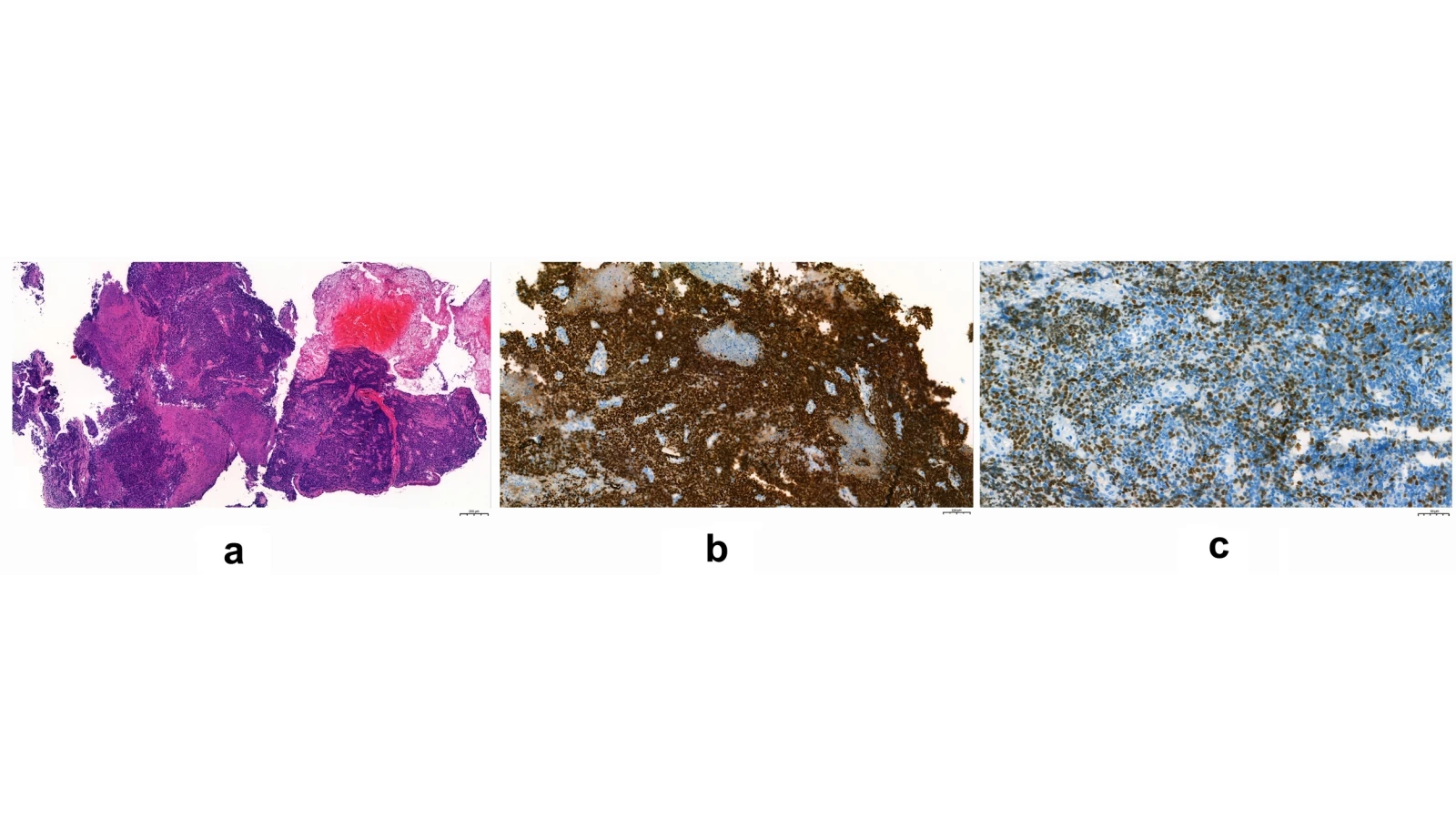
Image source and reuse details
Source: Primary pulmonary NUT carcinoma with NSD3–NUTM1 fusion treated with dose-escalated adaptive radiotherapy and multimodal therapy: case report — Figure 2. Converted to WebP, scaled proportionally and framed. The panels and original scale bars are preserved.
In this guide
Why it has this name
The name comes from a protein called NUT, linked to the NUTM1 gene. A gene is part of the cell’s instructions. In the tumor cells, part of NUTM1 joins another gene, often BRD4. The joining is called a fusion. It can give cells the wrong growth signal.
The fusion forms in the tumor cells and is not usually inherited. The name of the protein does not tell you where the cancer starts. NUT carcinoma can affect children and adults. It is most often found in the chest, head or neck, but can appear in other places.
Source: National Cancer Institute — NUT Carcinoma · National Cancer Institute — Childhood NUT Carcinoma Treatment — Health Professional Version · The Innovation — International NUT Carcinoma Guideline Group — International guidelines on the diagnosis and treatment of NUT carcinoma
Symptoms depend on the location
In the chest the cancer can cause a cough, shortness of breath or chest pain. In the nose or throat it can cause a blocked nose that does not clear, nosebleeds or difficulty swallowing. A lump can be a sign in the neck. Many other conditions can also cause these symptoms.
Ask for a medical check if symptoms last or get worse. If you are struggling to breathe or cannot swallow saliva, call your local emergency service. If you get a fever during chemotherapy, follow your center’s emergency instructions right away.
Source: National Cancer Institute — NUT Carcinoma · Dana-Farber Cancer Institute — NUT Carcinoma · National Cancer Institute — Infection and Neutropenia during Cancer Treatment
Which tests confirm the diagnosis
Doctors can order CT or MRI scans to see where the mass is and how far it has spread. They need a sample, called a biopsy, to identify the cancer. The doctor who examines the sample can stain it to look for NUT protein inside the cells.
If staining is weak, limited or negative despite a strong suspicion, the center can use tests that look directly for a NUTM1 fusion. In the case shown here, the stain did not give a clear answer. A test of the tumor genes confirmed the diagnosis. Ask whether a specialist should review the sample.
Source: The Innovation — International NUT Carcinoma Guideline Group — International guidelines on the diagnosis and treatment of NUT carcinoma · Frontiers in Oncology — Primary pulmonary NUT carcinoma with NSD3–NUTM1 fusion treated with dose-escalated adaptive radiotherapy and multimodal therapy: case report · Dana-Farber Cancer Institute — NUT Carcinoma
How treatment is chosen
Care depends on where the tumor started, how far it has spread and the person’s health. The team can consider surgery if the tumor can be removed, radiation to target a particular area and medicines such as chemotherapy that act throughout the body. Several approaches are often combined.
This cancer can grow aggressively and is best assessed by a team of specialists. There is no single best treatment for everyone. Ask what each treatment aims to do, what needs to happen soon and how the team will assess the result. Your outlook depends on the site, how far the disease has spread and how it responds.
Source: National Cancer Institute — NUT Carcinoma · National Cancer Institute — Childhood NUT Carcinoma Treatment — Health Professional Version · The Innovation — International NUT Carcinoma Guideline Group — International guidelines on the diagnosis and treatment of NUT carcinoma
What is being studied
Study NCT05019716 tests the experimental medicine ZEN003694 with chemotherapy. It includes adults and, in some groups, adolescents ages 12 to 17. It asks how well the combination is tolerated and how it works. A separate study looks at cemiplimab immunotherapy when the tumor cannot be removed or has spread.
In France, Gustave Roussy describes an exceptional access pathway for birabresib after the disease has progressed despite at least one treatment that works throughout the body. The center and the referring doctor assess access. This is a pathway with specific eligibility, rather than routine authorization to market the drug. Ask what is available for your case in your country.
Source: ClinicalTrials.gov — United States National Library of Medicine — Testing the Safety and Efficacy of the Addition of a New Anti-cancer Drug, ZEN003694, to Chemotherapy Treatment — NCT05019716 · National Cancer Institute — Cemiplimab for the Treatment of Incurable Metastatic or Unresectable NUT Carcinoma · Gustave Roussy — Exceptional temporary use protocol for Birabresib for adult and paediatric patients with NUT carcinoma
Eating, breathing and follow-up
Tell the team early if you struggle to swallow, eat less or lose weight. The team can involve a nutrition or swallowing specialist. If your breathing changes because of the cancer or the treatment, ask whom to call and when to get urgent help.
Ask for a plan for visits, scans and symptoms to report. Discuss how to keep moving if you are tired or breathless. Check with your team before taking supplements. You can ask for help with pain, fear and family needs at any stage.
Source: National Cancer Institute — Nutrition During Cancer Treatment · National Cancer Institute — NUT Carcinoma
Finding the right center
Search by country, city or postal code. In Italy, the rare tumor network can help direct adults to the right service. For children, ask for a pediatric cancer service. In Boston, the international registry lists pathology and oncology consultations. Gustave Roussy explains how doctors can make referrals.
Keep your biopsy report, NUTM1 test results, scans and past treatment details handy. Ask how to share them securely. Joining a research registry does not arrange clinical care.
Find a center for NUT carcinoma →
Source: Fondazione IRCCS Istituto Nazionale dei Tumori — Rete Tumori Rari · Portale delle Malattie Rare — Centri di diagnosi e cura — Fondazione IRCCS Istituto Nazionale dei Tumori di Milano · International NUT Carcinoma Registry — Dana-Farber Cancer Institute and Brigham and Women’s Hospital — Consultations · Dana-Farber Cancer Institute — NUT Carcinoma · Gustave Roussy — Exceptional temporary use protocol for Birabresib for adult and paediatric patients with NUT carcinoma · Gustave Roussy — Venir à Gustave Roussy
Questions to take to your appointment
- Where did the cancer start?
- Does the report confirm a change in the NUTM1 gene?
- Should a specialist center review the biopsy?
- Is surgery possible and how could radiation help?
- Which treatments or studies fit my situation?
- Whom should I call if breathing or eating gets harder?
Sources and verification
- National Cancer Institute — NUT Carcinoma
- National Cancer Institute — Childhood NUT Carcinoma Treatment — Health Professional Version
- The Innovation — International NUT Carcinoma Guideline Group — International guidelines on the diagnosis and treatment of NUT carcinoma
- ClinicalTrials.gov — United States National Library of Medicine — Testing the Safety and Efficacy of the Addition of a New Anti-cancer Drug, ZEN003694, to Chemotherapy Treatment — NCT05019716
- National Cancer Institute — Cemiplimab for the Treatment of Incurable Metastatic or Unresectable NUT Carcinoma
- National Cancer Institute — Infection and Neutropenia during Cancer Treatment
- National Cancer Institute — Nutrition During Cancer Treatment
- Fondazione IRCCS Istituto Nazionale dei Tumori — Rete Tumori Rari
- Portale delle Malattie Rare — Centri di diagnosi e cura — Fondazione IRCCS Istituto Nazionale dei Tumori di Milano
- International NUT Carcinoma Registry — Dana-Farber Cancer Institute and Brigham and Women’s Hospital — Consultations
- Dana-Farber Cancer Institute — NUT Carcinoma
- Gustave Roussy — Exceptional temporary use protocol for Birabresib for adult and paediatric patients with NUT carcinoma
- Gustave Roussy — Venir à Gustave Roussy
- Frontiers in Oncology — Primary pulmonary NUT carcinoma with NSD3–NUTM1 fusion treated with dose-escalated adaptive radiotherapy and multimodal therapy: case report
Sources checked: 2026-11-21