


Myelodysplastic syndromes: diagnosis, anemia treatment and transplant choices
An MDS diagnosis does not describe a single course of illness. The next decisions depend on the marrow findings, blood counts, genetic changes and your health. This adult guide explains what to ask, which treatments have defined indications and how to find specialist care.
MyMedNest editorial guide · Sources checked:
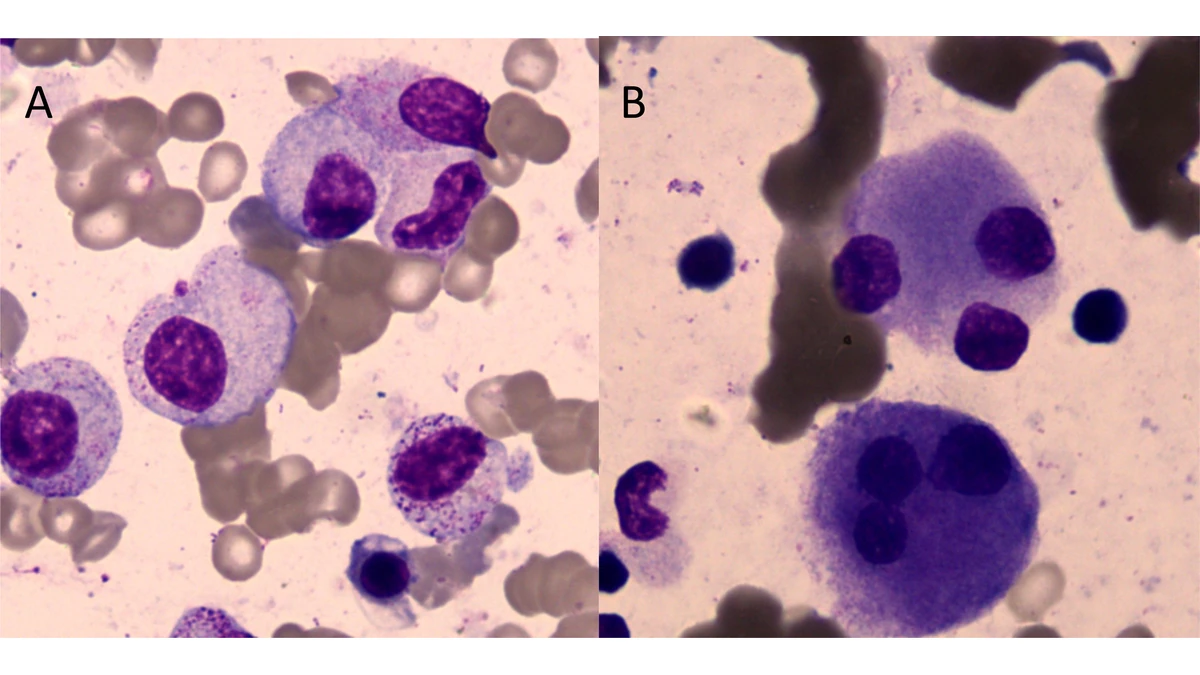
Image source and reuse details
Source: The absolute number of T lymphocyte subsets is beneficial for differential diagnosis of myelodysplastic syndrome with pure red cell aplastic anemia: a case report and review of the literature — Figure 1. Whole original reduced proportionally from 2500 × 1255 to 1200 × 602 and centered inside a white 1200 × 675 frame. Both panels retained; no clinical crop, recoloring, retouching or enlargement.
In this guide
What MDS means
Myelodysplastic syndromes, also called myelodysplastic neoplasms, are cancers of the blood-forming cells in bone marrow. The marrow may contain many cells but produce too few working red cells, infection-fighting cells or platelets. Low blood counts are called cytopenias. They can cause problems even without progression to leukemia.
Some forms change slowly; others have a higher risk of marrow failure or acute myeloid leukemia. MDS is not contagious and does not inevitably become leukemia. This guide concerns adults. Childhood MDS and chronic myelomonocytic leukemia need distinct diagnostic and treatment pathways.
Source: National Cancer Institute — United States — Myelodysplastic Syndromes Treatment (PDQ®)–Patient Version · National Health Service — United Kingdom — Treatment for myelodysplastic syndrome (MDS)
Symptoms and an unexpected blood result
Anemia can cause tiredness, pallor, dizziness or breathlessness. Low neutrophils, a type of white blood cell, can increase infection risk. Low platelets may cause easy bruising, nose or gum bleeding, or tiny red-purple skin spots. Some people have no symptoms and are investigated after a routine blood count.
These signs also occur with many other conditions. A single abnormal count does not prove MDS, and feeling well does not make a persistent abnormality unimportant. Take earlier blood results and a complete medicine list to the appointment so that the hematologist can assess the pattern over time.
Source: National Health Service — United Kingdom — Symptoms of myelodysplastic syndrome (MDS) · National Cancer Institute — United States — Myelodysplastic Syndromes Treatment (PDQ®)–Patient Version
When to contact the team urgently
During treatment or when neutrophils are low, a temperature of 38°C or above needs prompt contact with the treating service. Follow any lower threshold or other instructions they give you. Chills, new confusion or feeling very unwell also require advice even without a high temperature.
Seek emergency care for severe breathlessness, chest pain, fainting, uncontrolled bleeding or a sudden severe headache with neurological changes. Do not wait for the next appointment. Ask for a written plan and an out-of-hours number; do not hide a fever with medication before contacting the team.
Source: National Cancer Institute — United States — Infection and Neutropenia during Cancer Treatment · National Health Service — United Kingdom — Symptoms of myelodysplastic syndrome (MDS)
Why it develops and when genetics matters
MDS becomes more common with age. Previous chemotherapy or radiotherapy and certain chemical exposures can increase risk, but for many people there is no single identifiable cause. The diagnosis is not evidence that the person caused the illness through food, stress or a personal mistake.
Most changes found in marrow cells are acquired, rather than inherited. Young age at diagnosis, a family history of blood cancers or a lifelong pattern of low counts can justify specialist genetic assessment. Tell the transplant team before a relative is considered as a donor, because an inherited predisposition can affect donor selection.
Source: National Cancer Institute — United States — Myelodysplastic Syndromes Treatment (PDQ®)–Patient Version · Daniel A. Arber and international classification working group — Blood — International Consensus Classification of Myeloid Neoplasms and Acute Leukemias: integrating morphologic, clinical, and genomic data
Blood tests and other causes to exclude
The work-up usually includes repeated blood counts with a differential, a blood smear and tests chosen to investigate other causes of anemia or low counts. Vitamin B12 or folate deficiency, other illnesses and medicine effects can resemble parts of MDS. The doctor also reviews previous cancer treatment and relevant exposures.
No consumer blood panel or isolated mutation result can settle the diagnosis. Clonal hematopoiesis, called CHIP, and clonal cytopenia of undetermined significance, called CCUS, can involve altered blood-cell clones without meeting MDS criteria. A hematologist interprets these findings alongside the blood, marrow and clinical history.
Source: National Cancer Institute — United States — Myelodysplastic Syndromes Treatment (PDQ®)–Patient Version · Daniel A. Arber and international classification working group — Blood — International Consensus Classification of Myeloid Neoplasms and Acute Leukemias: integrating morphologic, clinical, and genomic data
What the marrow examination shows
An aspiration collects marrow cells; a biopsy takes a small tissue sample, usually from the hip area with local anesthesia. The laboratory examines how cells develop and counts blasts, which are immature cells. Chromosome testing and molecular testing look for changes that help classify the disease and plan care.
Ask for the written pathology, chromosome and gene reports, including the percentage of blasts. A specialist review can help if the findings are borderline or disagree. A marrow photograph on a website is not enough for diagnosis: the whole specimen, laboratory tests and clinical context matter.
Source: The University of Texas MD Anderson Cancer Center — United States — Myelodysplastic Syndrome Diagnosis · National Cancer Institute — United States — Myelodysplastic Syndromes Treatment (PDQ®)–Patient Version
The subtype is more useful than an old label
Modern classification uses both cell appearance and genetic findings. Examples include MDS associated with del(5q), meaning loss of part of chromosome 5, or with an SF3B1 mutation. The pattern of TP53 changes also matters. These labels have additional criteria; a gene name alone is not a complete diagnosis.
Ask which classification your report uses. The International Consensus Classification includes an adult MDS/AML group with 10–19% blasts, while some defining genetic changes can alter the leukemia boundary. Do not apply a universal 20% rule yourself. Chronic myelomonocytic leukemia and other overlapping disorders are not simply interchangeable MDS subtypes.
Risk scores are not a personal countdown
MDS is not usually described by the stages used for a solid tumor. The Revised International Prognostic Scoring System, IPSS-R, combines marrow blasts, chromosome findings and blood counts. The Molecular International Prognostic Scoring System, IPSS-M, also incorporates gene changes. The team uses the result with symptoms, fitness and other illnesses.
Ask for the actual score, its date and what it changes about treatment. An intermediate category needs individual interpretation. The older IPSS wording used in some medicine approvals must not be silently substituted with IPSS-R or IPSS-M groups. Population estimates do not predict one person's remaining lifespan.
When monitoring is an active choice
Some people with lower-risk disease and few symptoms can have planned observation rather than immediate disease-directed treatment. That means scheduled blood tests and a clear response to new symptoms or falling counts. It is not abandonment, and the plan can change as the illness changes.
For others, the immediate aim is to improve anemia, reduce transfusions or prevent infections and bleeding. In higher-risk disease, controlling the abnormal marrow cells and assessing transplant options become more urgent. Ask which problem the proposed treatment is meant to solve and how success will be measured.
Source: National Health Service — United Kingdom — Treatment for myelodysplastic syndrome (MDS) · The University of Texas MD Anderson Cancer Center — United States — Myelodysplastic Syndrome (MDS) – Adult — clinical algorithm V9, 16 December 2025
Transfusions and iron overload
Red-cell transfusions can relieve symptomatic anemia; platelet transfusions may be needed for severe low counts, bleeding or procedures. The decision depends on symptoms and clinical circumstances, not a single universal number. Supportive transfusions can be used alongside medicines and are not proof that care has failed.
Repeated red-cell transfusions can lead to iron accumulation. The team may monitor iron measures and organ health and consider iron-removing treatment for selected people. This needs its own benefit–risk assessment. Do not start iron supplements just because you are anemic: MDS anemia does not automatically mean iron deficiency.
Source: National Cancer Institute — United States — Myelodysplastic Syndromes Treatment (PDQ®)–Patient Version · National Cancer Institute — United States — Myelodysplastic Syndromes Treatment (PDQ®)–Health Professional Version
Erythropoietin-type medicines and luspatercept
Erythropoiesis-stimulating agents, or ESAs, encourage red-cell production and can help selected people with lower-risk MDS. The choice depends on factors including the body's erythropoietin level and transfusion needs. Luspatercept acts on red-cell maturation. Neither approach substitutes for a transfusion when anemia needs immediate correction.
The US luspatercept label covers adults with very-low- to intermediate-risk MDS who have not previously used an ESA and may need regular red-cell transfusions. A separate indication after ESA failure requires ring sideroblasts or the specified overlap disorder and at least 2 units over 8 weeks. Blood pressure and other adverse effects need monitoring; local indications may differ.
Source: National Cancer Institute — United States — Myelodysplastic Syndromes Treatment (PDQ®)–Patient Version · Food and Drug Administration — United States — REBLOZYL (luspatercept-aamt) — Prescribing Information, revised October 2026
del(5q) and selected immune treatments
Lenalidomide may reduce red-cell transfusion needs in selected MDS with del(5q). Its suitability depends on the full marrow and genetic picture, not merely the presence of anemia. Counts can fall during treatment, so scheduled monitoring and dose decisions by the team are essential.
A small selected group may benefit from immunosuppression, such as antithymocyte globulin-based treatment, particularly when the marrow pattern and clinical assessment support this approach. It is not a general immune booster. Do not assume that a treatment suitable for aplastic anemia, another marrow disorder, is automatically right for MDS.
Source: National Cancer Institute — United States — Myelodysplastic Syndromes Treatment (PDQ®)–Patient Version · The University of Texas MD Anderson Cancer Center — United States — Myelodysplastic Syndrome (MDS) – Adult — clinical algorithm V9, 16 December 2025
Imetelstat has a precise indication
The Food and Drug Administration approved imetelstat in 2024 for adults with low- or intermediate-1-risk MDS under the older IPSS system, with transfusion-dependent anemia requiring at least 4 red-cell units over 8 weeks, after ESA failure, loss of response or ineligibility. This is not an indication for every person with MDS.
The approval trial, IMerge, randomized 178 patients and was double-blind and placebo-controlled. It assessed periods without red-cell transfusions, not proof of cure. Platelet and neutrophil reductions, infections, fatigue and liver-test abnormalities require monitoring. Discuss whether the possible reduction in transfusions is worth these risks in your situation.
Azacitidine, decitabine and oral formulations
Azacitidine and decitabine are hypomethylating medicines: they affect how cells use genetic instructions and can control MDS, especially higher-risk disease. Blood counts may initially worsen and several cycles may be needed before a benefit can be judged. The team decides when response, toxicity or progression warrants a change.
Oral decitabine with cedazuridine has a US MDS indication for specified subtypes in the older intermediate-1, intermediate-2 and high IPSS groups. Its separate 2026 indication with venetoclax is for defined adults with acute myeloid leukemia, not an automatic MDS combination approval. Oral azacitidine and injectable azacitidine are not interchangeable products. Oral azacitidine is not an approved MDS treatment; its label warns of increased early deaths in an MDS trial and advises against use outside controlled trials.
Source: National Cancer Institute — United States — Myelodysplastic Syndromes Treatment (PDQ®)–Health Professional Version · Food and Drug Administration — United States — INQOVI (decitabine and cedazuridine) — Prescribing Information, revised May 2026 · Food and Drug Administration — United States — ONUREG (azacitidine) tablets — Prescribing Information, revised April 2026
Donor transplantation: potential cure and real risks
An allogeneic stem-cell transplant replaces blood formation using cells from a donor after preparatory treatment. It can potentially cure MDS, but it can also cause severe complications or death. Assessment includes disease risk, organ function, other illnesses, donor options and the person's wishes; age alone does not answer the question.
Discuss infection, graft-versus-host disease, relapse, fertility effects, time away from home and the need for a caregiver. Reduced-intensity preparation may be an option for some people, but it does not remove risk. An early transplant consultation can clarify timing without committing you to the procedure.
Source: National Cancer Institute — United States — Stem Cell Transplants in Cancer Treatment · National Health Service — United Kingdom — Treatment for myelodysplastic syndrome (MDS)
If the first treatment stops working
A falling blood count can reflect treatment effects, infection or disease progression. The team may repeat marrow and molecular tests before changing the plan. Ask whether the problem is loss of response, intolerance, evolution to leukemia or a complication that can be treated without abandoning a useful medicine.
Options may include a different supportive approach, transplantation when suitable, a treatment matched to a specific mutation or a clinical trial. Intensive leukemia-type chemotherapy is reserved for selected circumstances. There is no single rescue treatment that is best for everyone after a hypomethylating medicine fails.
Source: The University of Texas MD Anderson Cancer Center — United States — Myelodysplastic Syndrome (MDS) – Adult — clinical algorithm V9, 16 December 2025 · National Cancer Institute — United States — Myelodysplastic Syndromes Treatment (PDQ®)–Health Professional Version
Ivosidenib for a defined IDH1-mutated group
The Food and Drug Administration approved ivosidenib in 2023 for adults with relapsed or refractory MDS and a susceptible IDH1 mutation detected by an approved test. Relapsed means the disease returned; refractory means it did not respond. This does not cover all mutations or all newly diagnosed MDS.
The supporting trial included 18 adults and had no comparison group, so it cannot establish a randomized survival advantage. Differentiation syndrome can be life-threatening, and abnormal heart-rhythm timing, called QT prolongation, is another important risk. Ask about warning symptoms, electrocardiograms and interactions with other medicines.
Source: Food and Drug Administration — United States — FDA approves ivosidenib for myelodysplastic syndromes
Research: what the VERONA result actually showed
VERONA, NCT04401748, compared venetoclax plus azacitidine with placebo plus azacitidine in previously untreated higher-risk MDS. It was a phase 3 randomized, masked trial. The sponsor and investigators reported that it did not meet its main aim of improving overall survival. Response signals in exploratory subgroups do not prove that those groups live longer.
The registry records 531 enrolled participants, AbbVie sponsorship and Genentech collaboration. In its 6 May 2026 update, the study was active but not recruiting, with no results posted in the registry. Reports outside the registry and the registry record are different sources; the negative survival result should not be hidden behind a promising headline.
Source: United States National Library of Medicine — ClinicalTrials.gov — NCT04401748 — VERONA: registry record updated 6 May 2026 · AbbVie — study sponsor, United States — AbbVie Provides Update on VERONA Trial for Newly Diagnosed Higher-Risk Myelodysplastic Syndromes — 16 June 2025 · Dana-Farber Cancer Institute — United States — Phase III VERONA trial results show potential benefit for some groups with myelodysplastic syndrome (MDS) — 6 December 2025
How to discuss a trial without a false timetable
Ask a specialist which studies are actually recruiting for your subtype, previous treatment, mutation profile, health and country. A phase number or a registry entry is not proof that a treatment works or that a place is available. Ask about standard-care alternatives, extra visits, expected risks and who pays routine and research costs.
VERONA's registry lists July 2027 as an estimated completion period; this is not an approval or availability date. Other studies can change status or finish late. There is no reliable date by which an experimental MDS therapy must become routine care. Recheck the individual site and registry before making travel or treatment decisions.
Source: United States National Library of Medicine — ClinicalTrials.gov — NCT04401748 — VERONA: registry record updated 6 May 2026 · National Cancer Institute — United States — Who Pays for Clinical Trials?
Prevent infections and bleeding with the team
Ask whether you need infection-preventing medicines, vaccines or other measures based on your treatment and blood counts. Wash hands, take food-safety precautions and report symptoms early. Vaccination timing and live vaccines require advice, especially around transplantation or immunosuppressive treatment.
With low platelets, ask about dental care, exercise and medicines that can increase bleeding. Do not start aspirin, anti-inflammatory painkillers or supplements without checking. Do not stop prescribed blood thinners on your own either. Have the team reconcile every prescription, nonprescription medicine and herbal product.
Source: National Cancer Institute — United States — Infection and Neutropenia during Cancer Treatment · National Cancer Institute — United States — Myelodysplastic Syndromes Treatment (PDQ®)–Patient Version
Food, activity and supplements
No food or supplement has been shown to cure MDS or replace treatment. Aim for enough energy, protein and fluids, adjusted for your other health conditions. Weight loss, mouth pain, nausea or trouble eating deserve dietitian support. Use careful food handling when infection risk is high.
Gentle activity can help daily functioning, but anemia, dizziness, fever and low platelets can require changes or rest. Ask what is safe for your counts and symptoms. Avoid smoking and discuss alcohol. Iron, high-dose vitamins, herbs and products sold as immune boosters need review; a proven deficiency is different from an advertised cancer cure.
Source: National Cancer Institute — United States — Nutrition During Cancer Treatment · National Cancer Institute — United States — Complementary and Alternative Medicine
Fertility, distress and symptom relief
If future parenthood matters, discuss fertility preservation before chemotherapy or transplant whenever possible. Some treatments can damage fertility or a developing pregnancy. Ask about contraception and breastfeeding for the actual medicine; do not infer safety from another drug or from having an oral treatment.
Fatigue, repeated transfusions and uncertainty can affect work, sleep, money and family life. Psychological help and social support belong in the care plan. Palliative care treats symptoms and distress at any stage and can accompany disease-directed treatment or transplant assessment; it is not limited to the last days of life.
Source: National Cancer Institute — United States — Female Fertility and Cancer Treatment · National Cancer Institute — United States — Male Fertility and Cancer Treatment · National Cancer Institute — United States — Palliative Care in Cancer
Follow-up and what to expect
Follow-up tracks symptoms, counts, transfusion frequency, treatment adverse effects and, when needed, marrow findings. Ask which changes should trigger a call and whether repeat chromosome or gene tests would change decisions. A response that reduces transfusions can matter even when it does not mean the disease has disappeared.
Outlook varies widely with the subtype, genetic findings, risk score, other illnesses and response. Ask the hematologist for a realistic range of possible courses and the next decision point. A published patient's blood-count chart, including the example below, does not predict your own course or prove a treatment's effect.
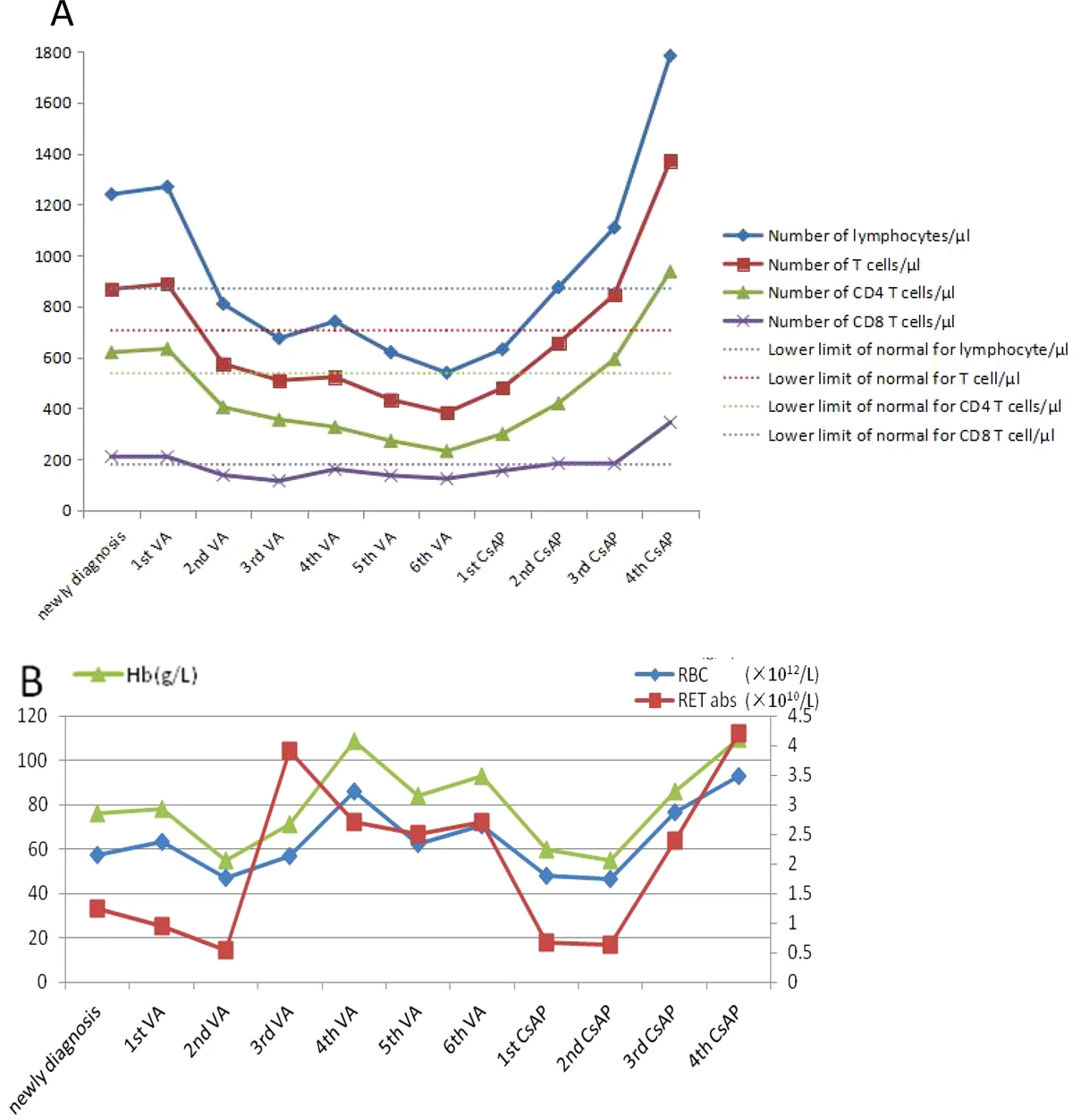
Image source and reuse details
Source: The absolute number of T lymphocyte subsets is beneficial for differential diagnosis of myelodysplastic syndrome with pure red cell aplastic anemia: a case report and review of the literature — Figure 2. Whole original proportionally reduced from 2395 × 2500 to 1200 × 1253 and saved as WebP. Both graphs, axes, curves, units and labels preserved; no data alteration, crop or enlargement.
Source: National Cancer Institute — United States — Myelodysplastic Syndromes Treatment (PDQ®)–Patient Version · The University of Texas MD Anderson Cancer Center — United States — Myelodysplastic Syndrome (MDS) – Adult — clinical algorithm V9, 16 December 2025 · Liangjun Zhang and Huixiu Zhong — Frontiers in Immunology — The absolute number of T lymphocyte subsets is beneficial for differential diagnosis of myelodysplastic syndrome with pure red cell aplastic anemia: a case report and review of the literature — Figures 1 and 2
Choosing a service and preparing the consultation
Look for an adult hematology service experienced in MDS, with specialist marrow review and access to transplantation or clinical trials when appropriate. Bring blood-count trends, marrow slides or their transfer details, pathology and gene reports, previous treatment, transfusion history and a medication list. A second opinion can clarify a difficult classification or a major treatment decision.
The directory below links documented pathways in selected countries; it is not a ranking or a complete list. Confirm referral rules, language help, appointment route, cost and whether your subtype is treated. Some services accept physician referrals only. Use the center's secure method for medical records rather than sending sensitive documents to an unverified address.
Find documented MDS care pathways →
Source: The University of Texas MD Anderson Cancer Center — United States — Myelodysplastic Syndrome · The University of Texas MD Anderson Cancer Center — United States — Myelodysplastic Syndrome Treatment · Fondazione IRCCS Istituto Nazionale dei Tumori — Italy — Ematologia — patologie trattate e prime visite · Universitätsspital Zürich — Switzerland — Myelodysplastic syndrome treatment · Nationales Centrum für Tumorerkrankungen Heidelberg — Germany — Myelodysplastisches Syndrom (MDS) — Terminvereinbarung · Universitätsklinikum Heidelberg — Germany — Sprechstunden — Innere Medizin V: Akute Leukämien und Myelodysplastisches Syndrom; Routinesprechstunde · The University of Texas MD Anderson Cancer Center — United States — International Referrals — international appointment contact
Questions to take to your appointment
- What is my exact MDS subtype, and which classification was used?
- What do my IPSS-R or IPSS-M result and gene findings change about treatment?
- Is the aim fewer transfusions, disease control or a possible cure through donor transplantation?
- Which symptoms or temperature require an urgent call, and what number should I use?
- Does this medicine's actual indication match my risk group, prior treatment and country?
- Should I have a transplant opinion, specialist marrow review or trial assessment now?
Sources and verification
- National Cancer Institute — United States — Myelodysplastic Syndromes Treatment (PDQ®)–Patient Version
- National Cancer Institute — United States — Myelodysplastic Syndromes Treatment (PDQ®)–Health Professional Version
- National Health Service — United Kingdom — Symptoms of myelodysplastic syndrome (MDS)
- National Health Service — United Kingdom — Treatment for myelodysplastic syndrome (MDS)
- Food and Drug Administration — United States — FDA approves imetelstat for low- to intermediate-1 risk myelodysplastic syndromes with transfusion-dependent anemia
- Food and Drug Administration — United States — FDA approves ivosidenib for myelodysplastic syndromes
- Food and Drug Administration — United States — REBLOZYL (luspatercept-aamt) — Prescribing Information, revised October 2026
- Food and Drug Administration — United States — INQOVI (decitabine and cedazuridine) — Prescribing Information, revised May 2026
- The University of Texas MD Anderson Cancer Center — United States — Myelodysplastic Syndrome (MDS) – Adult — clinical algorithm V9, 16 December 2025
- The University of Texas MD Anderson Cancer Center — United States — Myelodysplastic Syndrome
- The University of Texas MD Anderson Cancer Center — United States — Myelodysplastic Syndrome Treatment
- Fondazione IRCCS Istituto Nazionale dei Tumori — Italy — Ematologia — patologie trattate e prime visite
- Universitätsspital Zürich — Switzerland — Myelodysplastic syndrome treatment
- Nationales Centrum für Tumorerkrankungen Heidelberg — Germany — Myelodysplastisches Syndrom (MDS) — Terminvereinbarung
- AbbVie — study sponsor, United States — AbbVie Provides Update on VERONA Trial for Newly Diagnosed Higher-Risk Myelodysplastic Syndromes — 16 June 2025
- Dana-Farber Cancer Institute — United States — Phase III VERONA trial results show potential benefit for some groups with myelodysplastic syndrome (MDS) — 6 December 2025
- United States National Library of Medicine — ClinicalTrials.gov — NCT04401748 — VERONA: registry record updated 6 May 2026
- Liangjun Zhang and Huixiu Zhong — Frontiers in Immunology — The absolute number of T lymphocyte subsets is beneficial for differential diagnosis of myelodysplastic syndrome with pure red cell aplastic anemia: a case report and review of the literature — Figures 1 and 2
- Daniel A. Arber and international classification working group — Blood — International Consensus Classification of Myeloid Neoplasms and Acute Leukemias: integrating morphologic, clinical, and genomic data
- Universitätsklinikum Heidelberg — Germany — Sprechstunden — Innere Medizin V: Akute Leukämien und Myelodysplastisches Syndrom; Routinesprechstunde
- Food and Drug Administration — United States — ONUREG (azacitidine) tablets — Prescribing Information, revised April 2026
- The University of Texas MD Anderson Cancer Center — United States — Myelodysplastic Syndrome Diagnosis
- The University of Texas MD Anderson Cancer Center — United States — International Referrals — international appointment contact
- National Cancer Institute — United States — Female Fertility and Cancer Treatment
- National Cancer Institute — United States — Stem Cell Transplants in Cancer Treatment
- National Cancer Institute — United States — Palliative Care in Cancer
- National Cancer Institute — United States — Male Fertility and Cancer Treatment
- National Cancer Institute — United States — Infection and Neutropenia during Cancer Treatment
- National Cancer Institute — United States — Nutrition During Cancer Treatment
- National Cancer Institute — United States — Complementary and Alternative Medicine
- National Cancer Institute — United States — Who Pays for Clinical Trials?
Sources checked: 2026-11-19