


Male breast cancer: symptoms, diagnosis, treatment and centers
Men also have breast tissue. Get a new lump near the nipple, skin pulling inward or an unexpected nipple discharge checked. If it is cancer, tests help show the type and which treatments might help.
MyMedNest editorial guide · Sources checked:
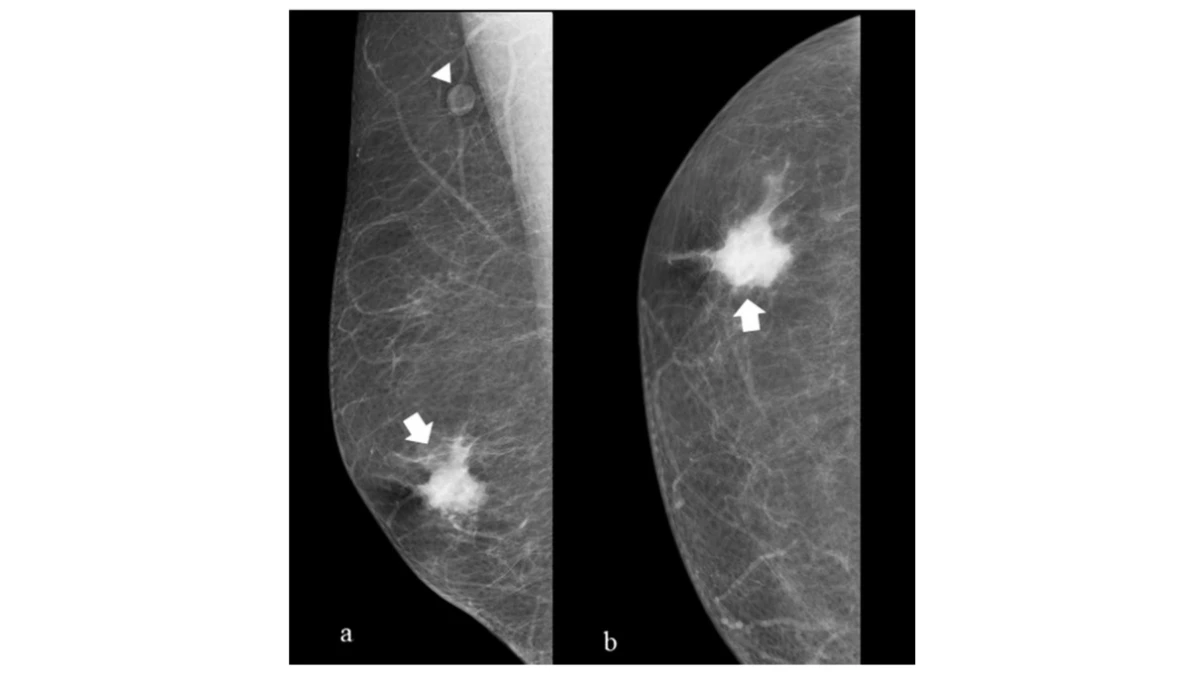
Image source and reuse details
Source: Radiological Features of Male Breast Neoplasms: How to Improve the Management of a Rare Disease — Figure 3. Framed and converted to WebP. Both views and the original arrows are preserved.
In this guide
Where the cancer starts
The male breast has small tubes called ducts. Many breast cancers start in the cells that line them. A cancer is called invasive if it grows into nearby tissue. When abnormal cells stay inside the ducts, it is called ductal carcinoma in situ.
Risk can rise with age, certain family histories and inherited changes in genes such as BRCA2. Family history can be a clue. The disease can also occur in people without known cases in their family.
Source: National Cancer Institute — Male Breast Cancer · National Cancer Institute — Male Breast Cancer Treatment (PDQ®) — Health Professional Version · National Cancer Institute — BRCA1 and BRCA2 (PDQ®) — Health Professional Version
Changes to get checked
Ask for a visit for a new lump in or near the breast or under the arm, even if it does not hurt. Get a nipple that turns inward, an unexpected nipple discharge or skin that changes or does not heal checked too.
Some causes of swelling or pain are benign. One is gynecomastia, which means the breast tissue has grown. A medical exam can help tell what is happening. If a change lasts or gets worse, ask to have it reassessed.
Source: National Cancer Institute — Male Breast Cancer · National Cancer Institute — Male Breast Cancer Treatment (PDQ®) — Health Professional Version
How doctors confirm the diagnosis
The team examines the breast and the area under the arm. It may request a mammogram, an ultrasound or both. A small piece of tissue is taken to confirm a cancer. This is called a biopsy. The photo in this guide shows the same breast area from two directions.
The report checks for receptors for estrogen and progesterone. These are proteins that can respond to hormones. It also checks HER2, a protein that varies between tumors. The stage tells how far the cancer has spread. Ask about genetic counseling too. Guidelines recommend offering testing for inherited changes to men with this diagnosis.
Source: National Cancer Institute — Male Breast Cancer Treatment (PDQ®) — Health Professional Version · Diagnostics — Radiological Features of Male Breast Neoplasms: How to Improve the Management of a Rare Disease · American Society of Clinical Oncology — Management of Male Breast Cancer: ASCO Guideline · National Cancer Institute — BRCA1 and BRCA2 (PDQ®) — Health Professional Version
How treatment is chosen
If the cancer is local, the team may suggest removing the whole breast or, in suitable cases, just the affected area. It may also assess lymph nodes under the arm and consider radiation. Depending on the stage and type, chemotherapy, targeted medicines against HER2 or other treatments may be helpful.
For many hormone-sensitive cancers, tamoxifen after surgery can lower the chance of the cancer coming back. A specialist may suggest an initial five years and then reassess. If you cannot take it or have hard-to-manage side effects, talk with your doctor before changing treatment. The individual outlook also depends on how far the cancer has spread and its type.
Source: National Cancer Institute — Male Breast Cancer Treatment (PDQ®) — Health Professional Version · American Society of Clinical Oncology — Management of Male Breast Cancer: ASCO Guideline
What researchers found
The phase 2 MALE study, published in 2021, compared three hormone treatments. Results from 52 participants could be evaluated. After three months, two combinations that reduced hormonal signals from the testicles lowered a hormone called estradiol more than tamoxifen alone.
The study measured hormones and quality of life. It was not designed to show which treatment helped people live longer. Problems with sexual function and quality of life were reported in the combination groups. Ask if there are relevant studies for your type and what questions they can answer.
Source: JAMA Oncology — American Medical Association — Efficacy of Endocrine Therapy for the Treatment of Breast Cancer in Men: Results from the MALE Phase 2 Randomized Clinical Trial · European Medicines Agency — European Union Clinical Trials Register — Male-GBG54 — EudraCT 2009-015122-11, trial results
Follow-up and everyday life
Ask for a plan for visits and breast imaging. Whether you need a mammogram depends on the operation and inherited risk. Tell the team if hot flashes, tiredness or sexual problems affect daily life. Your team can help you manage them.
Ask how to return to activity after surgery, especially if your arm swells or is hard to move. Speak with the team before taking supplements. If you are losing weight or having trouble eating, ask for nutrition support.
Source: American Society of Clinical Oncology — Management of Male Breast Cancer: ASCO Guideline · Memorial Sloan Kettering Cancer Center — About Your Mastectomy: Information for Men · National Cancer Institute — Nutrition During Cancer Treatment · National Cancer Institute — Popular Diets, Supplements, and Cancer
Finding a breast cancer service
Use the country, city or postal code filters. Look for a breast team with experience diagnosing breast cancer in men. The European Institute of Oncology in Milan and Memorial Sloan Kettering Cancer Center in New York publish care information you can use to make contact.
Keep the biopsy report, receptor results and scans ready for your first appointment or a second opinion. Ask how to send them securely. If you are offered an inherited gene test, ask what it might change for you and your family.
Find a center for male breast cancer →
Source: Istituto Europeo di Oncologia — Informativa generale sullo studio e modulo di consenso alla partecipazione — UID 4714 · Memorial Sloan Kettering Cancer Center — Male Breast Cancer Experts · LMU Klinikum — Ludwig-Maximilians-Universität München — Mammakarzinom beim Mann · LMU Klinikum — Ludwig-Maximilians-Universität München — Brustzentrum — Kontakt zum Brustzentrum
Questions to take to your appointment
- Do I need a mammogram, ultrasound or biopsy?
- What do the tumor receptors and stage mean for me?
- Can I speak with a genetics specialist and have inherited changes checked?
- Which operation does the team suggest and why?
- Which tamoxifen side effects should I report?
- How do I plan follow-up or get a second opinion?
Sources and verification
- National Cancer Institute — Male Breast Cancer
- National Cancer Institute — Male Breast Cancer Treatment (PDQ®) — Health Professional Version
- American Society of Clinical Oncology — Management of Male Breast Cancer: ASCO Guideline
- National Cancer Institute — BRCA1 and BRCA2 (PDQ®) — Health Professional Version
- JAMA Oncology — American Medical Association — Efficacy of Endocrine Therapy for the Treatment of Breast Cancer in Men: Results from the MALE Phase 2 Randomized Clinical Trial
- European Medicines Agency — European Union Clinical Trials Register — Male-GBG54 — EudraCT 2009-015122-11, trial results
- Memorial Sloan Kettering Cancer Center — About Your Mastectomy: Information for Men
- National Cancer Institute — Nutrition During Cancer Treatment
- National Cancer Institute — Popular Diets, Supplements, and Cancer
- Istituto Europeo di Oncologia — Informativa generale sullo studio e modulo di consenso alla partecipazione — UID 4714
- Memorial Sloan Kettering Cancer Center — Male Breast Cancer Experts
- LMU Klinikum — Ludwig-Maximilians-Universität München — Mammakarzinom beim Mann
- LMU Klinikum — Ludwig-Maximilians-Universität München — Brustzentrum — Kontakt zum Brustzentrum
- Diagnostics — Radiological Features of Male Breast Neoplasms: How to Improve the Management of a Rare Disease
Sources checked: 2026-11-21