


Lung cancer: tests, treatment choices and specialist care
A scan alone does not tell you which lung cancer treatment is right. The next decisions depend on the type of cells, where the cancer has spread, molecular test results and your health. Here is a practical way to understand the reports and prepare for specialist care.
MyMedNest editorial guide · Sources checked:
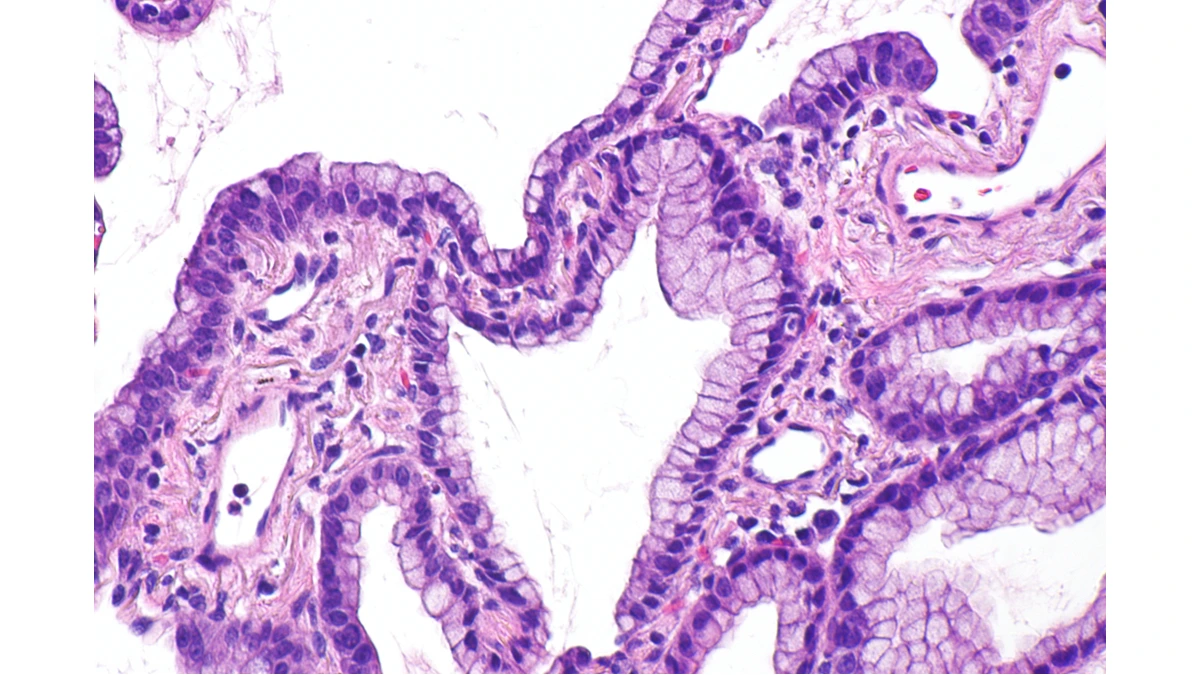
Image source and reuse details
Source: Mucinous lung adenocarcinoma — high mag.jpg. Proportional reduction, external white side margins and WebP conversion. The entire microscopic field is preserved, with no clinical cropping, recolouring or added annotation. The image remains under CC BY-SA 4.0.
In this guide
Get the diagnosis in writing before comparing treatments
Bring the pathology report, scan reports and images, medicine list and previous treatments to the appointment. Ask who coordinates the case and when outstanding results will be ready. A lung cancer team can bring together respiratory medicine, thoracic surgery, oncology, radiotherapy, radiology, pathology and specialist nursing. A second opinion is useful when choices are unclear; agree how much time is safe to take.
This guide concerns adults with primary lung cancer. Non-small cell cancer includes adenocarcinoma and squamous carcinoma; small cell cancer follows a different treatment pathway. A cancer that started elsewhere and spread to the lung keeps its original diagnosis. Mesothelioma, carcinoid tumours and childhood tumours need their own specialist assessment.
Source: National Health Service — United Kingdom — Tests and next steps for lung cancer · National Cancer Institute — United States — Non-Small Cell Lung Cancer Treatment (PDQ®)–Patient Version · National Cancer Institute — United States — Small Cell Lung Cancer Treatment (PDQ®)–Patient Version · National Cancer Institute — United States — Finding Cancer Care
A persistent change needs assessment, even if you never smoked
Arrange a medical assessment for a cough that persists or changes, repeated chest infections, unexplained weight loss, a hoarse voice or increasing breathlessness. Coughing up blood needs urgent assessment. Severe breathing difficulty, sudden major chest pain or heavy bleeding requires emergency help through the local emergency service. These signs can have other causes; they cannot establish cancer on their own.
Screening is different: it looks for disease before symptoms. Low-dose CT can reduce lung cancer deaths in selected people at high risk, but it can also cause false alarms, unnecessary procedures and overdiagnosis. Eligibility and access depend on the national programme. Chest X-rays are not an equivalent screening substitute. Do not wait for a screening invitation if you already have symptoms.
Source: National Health Service — United Kingdom — Symptoms of lung cancer · National Cancer Institute — United States — Lung Cancer Screening (PDQ®)–Patient Version
Understand why a CT, biopsy and further scans answer different questions
CT shows abnormalities and helps plan the next step; it does not always distinguish cancer from infection or another benign condition. A biopsy provides cells or tissue for a pathologist. Depending on the location, the sample may be taken through a bronchoscope, through the chest wall with a guided needle, from a lymph node or during surgery. Ask about the aim, risks and alternatives of the proposed procedure.
Further tests may include PET, brain MRI and lymph-node sampling to check spread. Blood tests assess general health, and breathing tests help judge treatment safety. Not everyone needs every examination. Ask what each result would change and whether sufficient material will remain for molecular testing. If the sample is inconclusive, the team should explain the next diagnostic step.
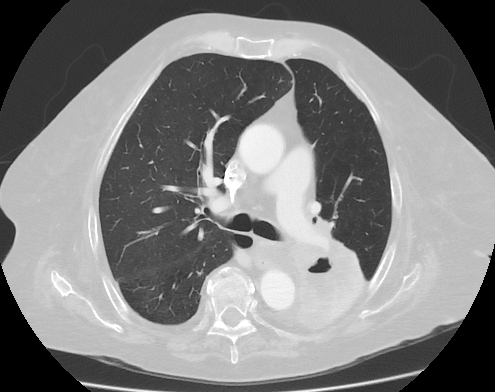
Image source and reuse details
Source: CT scan of lung cancer with cavitation.png. Lossless WebP conversion only; native 495 × 392 pixels, no enlargement, cropping, recolouring or diagnostic alteration.
Source: National Health Service — United Kingdom — Tests and next steps for lung cancer · National Cancer Institute — United States — Non-Small Cell Lung Cancer Treatment (PDQ®)–Patient Version
Stage describes spread; operability also depends on your health
For non-small cell cancer, the TNM system records the main tumour, lymph nodes and distant spread. These findings are combined into a stage. The same stage can still contain different clinical situations. Being technically removable does not automatically mean an operation is safe: lung and heart function, other illnesses and your priorities also matter.
Small cell cancer is often discussed as limited-stage or extensive-stage disease. Limited-stage disease can be covered within a suitable chest radiation field; extensive-stage disease goes beyond that setting. Ask which system your report uses. A survival estimate from a study is not a deadline for one person: cancer biology, response and available care can change the outlook.
Source: National Cancer Institute — United States — Non-Small Cell Lung Cancer Treatment (PDQ®)–Patient Version · National Cancer Institute — United States — Small Cell Lung Cancer Treatment (PDQ®)–Patient Version
Ask which biomarkers must be known before treatment is chosen
Biomarkers are features of the tumour that can help select a treatment. In non-small cell cancer, testing may look for changes in EGFR, ALK, ROS1, BRAF, MET, RET, NTRK, KRAS or HER2, depending on the case and the available panel. PD-L1 is a separate protein test used in some immunotherapy decisions. A positive result is not a guarantee of response, and the exact alteration matters.
Testing may use tissue or, in some circumstances, tumour material circulating in blood: a liquid biopsy. Ask what an uninformative result means and whether another sample is needed. Tumour testing is different from testing inherited family risk. A result may identify a licensed medicine, a trial, an uncertain change or no matching option. Costs and access should be discussed before ordering additional tests.
Source: National Cancer Institute — United States — Biomarker Testing for Cancer Treatment · National Cancer Institute — United States — Advances in Lung Cancer Research · United States Food and Drug Administration — FDA grants accelerated approval to sevabertinib for locally advanced or metastatic non-squamous non-small cell lung cancer
Early non-small cell cancer: compare surgery and focused radiotherapy
For suitable early cancers, treatment may aim to cure. Surgery can remove part of a lung or a lobe, with assessment of lymph nodes. The appropriate extent depends on the tumour and breathing reserve; a smaller operation is not suitable for every case. Focused stereotactic radiotherapy can be an option when surgery is unsuitable or is declined after discussion.
Some patients also receive medicines before surgery, after surgery, or both. These are called neoadjuvant and adjuvant treatments. Chemotherapy, immunotherapy or a targeted drug is selected according to stage, biomarkers and the evidence for that exact situation. Ask about the expected reduction in recurrence and the extra risks, rather than assuming everyone needs the same sequence.
Source: National Cancer Institute — United States — Non-Small Cell Lung Cancer Treatment (PDQ®)–Patient Version · National Health Service — United Kingdom — Treatment for lung cancer · National Cancer Institute — United States — Advances in Lung Cancer Research
Locally advanced disease needs a coordinated treatment sequence
Stage III non-small cell cancer is not a single treatment category. Some cases can be considered for surgery as part of combined treatment. Others are treated with chemotherapy and chest radiotherapy, given together when appropriate or in a planned sequence. The team should explain whether treatment aims at long-term disease control and why an operation is or is not proposed.
Treatment after chemoradiotherapy can depend on biomarkers and the response. Immunotherapy and targeted approaches are not interchangeable. A patient with a particular EGFR alteration may have a different pathway from someone without it. Ask for the exact indication and national access conditions; do not add a drug on the basis of an online stage label alone.
Source: National Cancer Institute — United States — Non-Small Cell Lung Cancer Treatment (PDQ®)–Patient Version · National Cancer Institute — United States — Advances in Lung Cancer Research
Advanced disease: match the first treatment and plan what comes next
When non-small cell cancer has spread, treatment commonly uses medicines that reach the whole body. A matching targeted treatment may be appropriate for a specific alteration. Otherwise, immunotherapy alone or combined with chemotherapy may be considered, according to the tumour and the person's health. Radiotherapy and procedures can also treat painful or threatening sites, including selected brain lesions.
Write down when response will be checked and what would lead to a change of treatment. At progression, another biopsy or molecular test may sometimes clarify resistance and the next option. A drug that helped another person may not fit your cancer. Ask about likely benefit, daily burden, hospital visits, side effects and what support would remain available if you choose not to have another anticancer treatment.
Source: National Cancer Institute — United States — Non-Small Cell Lung Cancer Treatment (PDQ®)–Patient Version · National Health Service — United Kingdom — Treatment for lung cancer · National Cancer Institute — United States — Biomarker Testing for Cancer Treatment
Small cell cancer has its own initial and later treatment options
Limited-stage small cell cancer commonly uses platinum-based chemotherapy with chest radiotherapy. In the United States, durvalumab was approved on 4 December 2024 for adults whose disease has not progressed after concurrent platinum-based chemoradiotherapy. Lung inflammation and fatigue are important concerns. Surgery is reserved for selected cases, rather than being the usual starting treatment.
Extensive-stage disease often starts with chemotherapy and immunotherapy when suitable. Brain radiotherapy, brain surveillance and symptom-directed radiation require an individual discussion. For progression after platinum treatment, the United States granted traditional approval to tarlatamab on 19 November 2025. It can cause dangerous cytokine-release reactions and neurological problems, so specialist monitoring is essential. These United States decisions do not establish access in every country.
Source: National Cancer Institute — United States — Small Cell Lung Cancer Treatment (PDQ®)–Patient Version · United States Food and Drug Administration — FDA approves durvalumab for limited-stage small cell lung cancer · United States Food and Drug Administration — FDA grants traditional approval to tarlatamab-dlle for extensive stage small cell lung cancer
Read new drug results with the eligible population and limits
On 9 September 2026, the United States Food and Drug Administration expanded accelerated approval of sevabertinib to adults with locally advanced or metastatic non-squamous non-small cell cancer carrying activating HER2 tyrosine-kinase-domain mutations, detected by an authorised test. In the single-arm SOHO-01 study, 75% of 69 previously untreated patients had a confirmed tumour response. This is not a 75% cure rate or proof of longer survival against another treatment. Important risks include diarrhoea, liver injury and lung inflammation.
The evidence for later small cell treatment answers a different question. In DeLLphi-304, 509 patients progressing after platinum-based chemotherapy were randomised to tarlatamab or standard chemotherapy. Median overall survival was 13.6 versus 8.3 months. These group results do not predict one person's lifespan or justify comparing the two trials directly. Accelerated approval, traditional approval, reimbursement and a recruiting study are separate statuses; this section gives selected updates, not a complete drug formulary.
Source: United States Food and Drug Administration — FDA grants accelerated approval to sevabertinib for locally advanced or metastatic non-squamous non-small cell lung cancer · United States Food and Drug Administration — FDA grants traditional approval to tarlatamab-dlle for extensive stage small cell lung cancer
Trials can offer an option, but cannot promise a cure or a launch date
Ask about trials before starting a new line of treatment: previous treatment, the exact mutation, other illnesses and the study location can determine eligibility. Research includes new targeted drugs, immunotherapy combinations, resistance mechanisms and ways to improve detection. A laboratory result or early response is not the same as a proven survival benefit in patients.
Check the trial identifier, recruiting site and current status with the study team. Ask about the comparison group, unknown risks, extra tests, travel and who pays for routine and research care. A listing does not guarantee an available place. No responsible source can give a certain approval date for an unproven treatment. Standard care should not be delayed while waiting for a speculative future drug.
Source: National Cancer Institute — United States — What Are Clinical Trials? · National Cancer Institute — United States — Advances in Lung Cancer Research
Protect strength without replacing treatment with diets or supplements
Tell the team early about weight loss, poor appetite, nausea or swallowing difficulty. A dietitian can adapt food and, when needed, nutritional support to help maintain energy and protein intake. A restrictive anticancer diet can make malnutrition worse. There is no special food or supplement proven to replace cancer treatment, and some products can interfere with medicines.
Stopping smoking remains useful after a diagnosis; ask for practical cessation support without blame. Discuss activity that fits your breathing, fatigue and treatment, rather than forcing exercise through pain or severe breathlessness. Take a complete list of vitamins, herbal products and non-prescription medicines to the pharmacist or oncology team. Ask before starting supplements, including high-dose beta-carotene, which is a lung cancer risk concern in heavy smokers.
Source: National Cancer Institute — United States — Nutrition During Cancer Treatment · National Cancer Institute — United States — Complementary and Alternative Medicine · National Cancer Institute — United States — Tobacco · National Cancer Institute — United States — Non-Small Cell Lung Cancer Treatment (PDQ®)–Patient Version
Breathing, pain and emotional support belong in the care plan now
Do not assume worsening breathlessness is just something to endure. It can have several causes that need assessment, including infection, fluid around the lung, airway blockage or a treatment effect. Treatment can include medicines, radiotherapy or procedures chosen for the cause. Oxygen is not automatically suitable for every breathless person; its need should be assessed by the team.
Palliative care can be offered alongside anticancer treatment, not only in the last days of life. It helps with symptoms, anxiety, sleep, family needs and practical difficulties. Ask for a written contact plan and help for the person supporting you. If new confusion, severe chest pain or serious breathing difficulty develops, use urgent medical services rather than a website or routine appointment.
Source: National Cancer Institute — United States — Cardiopulmonary Syndromes (PDQ®)–Patient Version · National Cancer Institute — United States — Palliative Care in Cancer · National Health Service — United Kingdom — Symptoms of lung cancer
Leave with a follow-up schedule and clear emergency instructions
The plan should identify who reviews scans, when the next appointment is due, which effects may persist and whom to contact for new symptoms. Follow-up during active treatment checks response and safety; follow-up after treatment also looks for recurrence and recovery needs. There is no single scan schedule suitable for every type, stage and treatment.
During cancer treatment, fever of 38 °C or higher, chills or other signs of infection require prompt contact with the care team; follow any stricter instructions they gave you. New or worsening cough and breathlessness on immunotherapy or some targeted drugs may indicate lung inflammation and need urgent advice. Ask before taking fever-reducing medicine, because it can hide a serious infection.
Source: National Cancer Institute — United States — Small Cell Lung Cancer Treatment (PDQ®)–Patient Version · National Cancer Institute — United States — Infection and Neutropenia during Cancer Treatment · National Cancer Institute — United States — Cardiopulmonary Syndromes (PDQ®)–Patient Version · United States Food and Drug Administration — FDA grants accelerated approval to sevabertinib for locally advanced or metastatic non-squamous non-small cell lung cancer
Choose a relevant lung team, not a supposed universal best hospital
A useful centre can confirm pathology, provide appropriate molecular tests and discuss surgery, radiotherapy, systemic treatment and trials in a coordinated team. Ask whether the team regularly treats your exact cell type and whether a remote second opinion is possible. The right referral can be in your own country; travel abroad is not automatically better care.
The directory links selected documented pathways and official contacts. Confirm the relevant department, referral requirements, language support, waiting time and costs before sending records or travelling. Availability can change, and a centre listing is not a promise of acceptance, a treatment recommendation or an outcome ranking. If there is no verified match for your country and diagnosis, ask your national cancer service for a referral rather than assuming care is unavailable.
Find documented lung cancer care pathways →
Source: National Cancer Institute — United States — Finding Cancer Care · National Health Service — United Kingdom — Tests and next steps for lung cancer
Questions to take to your appointment
- What is my exact cell type and stage, and which results are still pending?
- Is the sample sufficient for the molecular tests that could change my treatment?
- Can the cancer be removed, and is my lung function adequate for the proposed treatment?
- Is the aim cure, reducing recurrence, controlling the disease or relieving symptoms?
- Which benefit and serious risks should I expect, and what alternatives are reasonable?
- Would a second opinion or a recruiting trial change the plan before treatment starts?
- Who can help with breathing, nutrition, smoking cessation and emotional support?
- What is my follow-up plan, and whom should I call urgently outside office hours?
Sources and verification
- National Cancer Institute — United States — Non-Small Cell Lung Cancer Treatment (PDQ®)–Patient Version
- National Cancer Institute — United States — Small Cell Lung Cancer Treatment (PDQ®)–Patient Version
- National Health Service — United Kingdom — Tests and next steps for lung cancer
- National Health Service — United Kingdom — Symptoms of lung cancer
- National Health Service — United Kingdom — Treatment for lung cancer
- National Cancer Institute — United States — Lung Cancer Screening (PDQ®)–Patient Version
- National Cancer Institute — United States — Biomarker Testing for Cancer Treatment
- National Cancer Institute — United States — Advances in Lung Cancer Research
- United States Food and Drug Administration — FDA grants accelerated approval to sevabertinib for locally advanced or metastatic non-squamous non-small cell lung cancer
- United States Food and Drug Administration — FDA approves durvalumab for limited-stage small cell lung cancer
- United States Food and Drug Administration — FDA grants traditional approval to tarlatamab-dlle for extensive stage small cell lung cancer
- National Cancer Institute — United States — What Are Clinical Trials?
- National Cancer Institute — United States — Tobacco
- National Cancer Institute — United States — Nutrition During Cancer Treatment
- National Cancer Institute — United States — Complementary and Alternative Medicine
- National Cancer Institute — United States — Cardiopulmonary Syndromes (PDQ®)–Patient Version
- National Cancer Institute — United States — Palliative Care in Cancer
- National Cancer Institute — United States — Infection and Neutropenia during Cancer Treatment
- National Cancer Institute — United States — Finding Cancer Care
Sources checked: 2026-11-15