


Kidney cancer: diagnosis, treatment and specialist care
A kidney mass is not always cancer. If renal cell cancer is confirmed, the next decisions depend on its type, spread and your remaining kidney function. This guide explains the choices and their limits, with sources checked on November 16, 2026.
MyMedNest editorial guide · Sources checked:
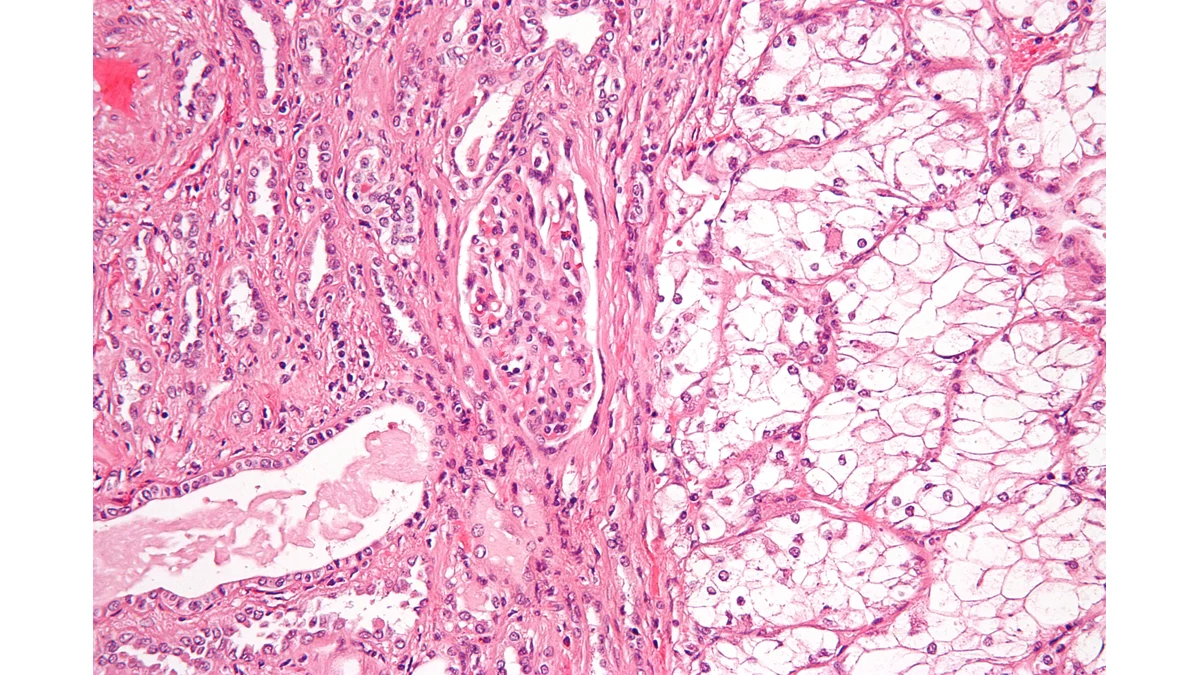
Image source and reuse details
Source: Clear cell renal cell carcinoma high mag.jpg. Full microscopic field reduced proportionally from 4272 × 2848 to fit 1200 × 675 pixels with external white side margins, then converted to WebP. No clinical cropping, recoloring or new annotation.
In this guide
Which kidney cancer does this guide cover?
Renal cell carcinoma starts in the kidney tissue that helps make urine. Clear cell cancer is its most common form. Papillary, chromophobe and other rarer types can behave differently. The tissue report matters: a scan showing a mass does not by itself identify the exact type.
This guide concerns adults. Cancer of the renal pelvis or ureter usually belongs to the urothelial cancer pathway, while Wilms tumor mainly affects children. Treatments for these diseases are not interchangeable. Ask for the full diagnosis before comparing medicines or seeking a second opinion.
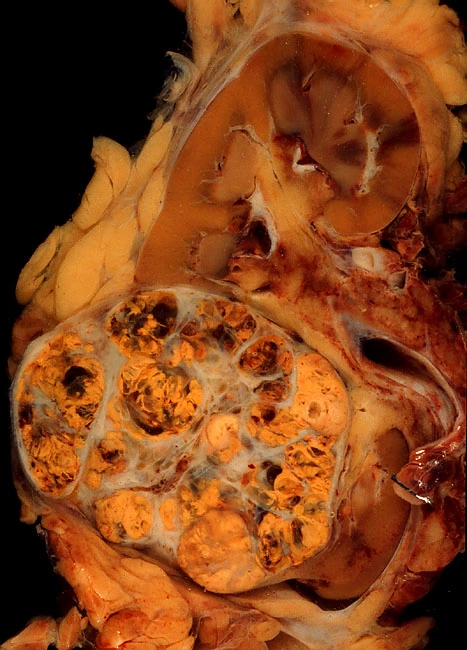
Image source and reuse details
Source: Renal cell carcinoma.jpg. Whole 467 × 650 photograph converted to WebP without enlargement, cropping, recoloring or added clinical detail.
Source: National Cancer Institute — United States — Renal Cell Cancer Treatment (PDQ®)–Patient Version · National Cancer Institute — United States — Renal Cell Cancer Treatment (PDQ®)–Health Professional Version
Blood in the urine needs assessment
Kidney cancer may cause no early symptoms and be found on a scan for another reason. Possible signs include blood in the urine, lasting pain in the side, a lump, unexplained weight loss and marked tiredness. Infections and other conditions can cause similar problems.
Arrange prompt medical assessment for visible blood in the urine or persistent flank pain; do not wait for several symptoms to appear together. Tell the clinician about fever, painful urination and all medicines you take. A referral for tests means the cause needs checking, not that cancer is already certain.
Source: National Health Service — United Kingdom — Symptoms of kidney cancer
Scans, urine tests and kidney function
The work-up commonly includes blood and urine tests and imaging of the kidneys. Creatinine and estimated filtration rate help measure how well the kidneys work. A contrast CT scan can show the mass, nearby veins and other organs. MRI can answer selected questions or provide an alternative when appropriate.
The team decides whether chest imaging or other scans are needed to look for spread. Report previous contrast reactions and kidney disease before a scan. A cystoscopy may help investigate urinary bleeding or a suspected bladder source; it is not automatically required for every incidental kidney mass.
Source: National Health Service — United Kingdom — Tests and next steps for kidney cancer · European Association of Urology — Guidelines on Renal Cell Carcinoma 2026 — Diagnostic Evaluation
Is a biopsy always necessary?
A needle biopsy removes tissue for a pathologist to examine. It can help when imaging is uncertain, before drug treatment, before ablation or when considering surveillance. Sometimes surgery can proceed without a prior biopsy because the result would not change the plan; the removed tissue is then examined.
A sample may be too small or inconclusive, and a repeat biopsy may be discussed. Before ablation, European guidance recommends obtaining the biopsy beforehand. Ask what the result could change, how bleeding risk is managed and whether expert pathology review is needed for an unusual tumor.
Source: European Association of Urology — Guidelines on Renal Cell Carcinoma 2026 — Diagnostic Evaluation · National Cancer Institute — United States — Renal Cell Cancer Treatment (PDQ®)–Patient Version
Stage, grade and the outlook
Stage describes where the cancer is: within the kidney, in nearby tissues or veins, in lymph nodes, or in distant organs. Grade describes features of the cancer cells under the microscope. These are different pieces of information. A kidney cancer deposit in the lung remains kidney cancer, not a new primary lung cancer.
Localized disease can often be treated with curative intent. Advanced disease has more treatment options than in the past, but control is not the same as cure. Ask about your own stage, subtype and treatment goal. Trial averages and survival percentages cannot predict how long one person will live.
Source: National Cancer Institute — United States — Renal Cell Cancer Treatment (PDQ®)–Patient Version · National Cancer Institute — United States — Renal Cell Cancer Treatment (PDQ®)–Health Professional Version
When to ask about inherited risk
Genetic assessment deserves particular attention when kidney cancer develops at age 46 or younger, affects both kidneys, appears in several tumors, or occurs alongside a relevant family history or unusual tissue features. These clues do not prove an inherited syndrome, but they can justify referral to a cancer genetics team.
A gene change found only in a tumor is not automatically inherited. A germline test looks for changes that may also affect relatives. Counseling explains the test, possible results and what screening could be useful. Some inherited conditions need specialist plans that differ from those for a single sporadic mass.
Source: European Association of Urology — Guidelines on Renal Cell Carcinoma 2026 — Diagnostic Evaluation
Can part of the kidney be preserved?
Partial nephrectomy removes the tumor while leaving working kidney tissue. It is generally preferred for suitable localized T1 tumors (confined to the kidney and no larger than 7 centimeters) when technically feasible. Radical nephrectomy removes the whole kidney when a safe partial operation is not suitable. The position of the mass and the other kidney’s health matter as well as size.
Removing the adrenal gland or nearby lymph nodes is not routine in every localized case. Ask why each planned part of the operation is needed, the expected effect on kidney function and the team’s experience. Open, laparoscopic and robotic techniques are tools; a robot alone does not guarantee a better outcome.
Source: European Association of Urology — Guidelines on Renal Cell Carcinoma 2026 — Disease Management · Istituto Europeo di Oncologia — Italy — Tumori urologici (altri)
Active surveillance is a monitored choice
Some small kidney masses can be monitored with planned scans instead of treated immediately. This may suit selected people when slow growth, other illnesses or treatment risks make immediate intervention less helpful. The plan must specify the scan schedule and the findings that would trigger treatment.
Active surveillance keeps the option of later treatment. Watchful waiting has a different purpose, usually symptom relief when future curative treatment is not appropriate. Neither approach means ignoring new symptoms. Discuss uncertainty, biopsy results and the small but real possibility of progression before choosing surveillance.
Source: European Association of Urology — Guidelines on Renal Cell Carcinoma 2026 — Disease Management
Ablation, focused radiation and symptom relief
Ablation destroys a tumor with cold or heat. Focused stereotactic radiation can be considered for selected localized tumors when surgery is unsuitable. These approaches require a specialist assessment of size, position, kidney function and the evidence for lasting control. They are not equivalent choices for every patient.
Ask about obtaining tissue before ablation, the risk of incomplete treatment and the follow-up needed. In other situations, radiation to a painful metastasis or blocking the tumor’s blood supply can relieve symptoms. A treatment offered for relief should not be mistaken for an operation intended to cure the whole disease.
Source: National Health Service — United Kingdom — Treatment and support for kidney cancer · European Association of Urology — Guidelines on Renal Cell Carcinoma 2026 — Disease Management
Pembrolizumab after surgery: who may benefit?
Adjuvant treatment aims to reduce recurrence after surgery. Pembrolizumab is an immune treatment used for selected clear cell cancers with increased recurrence risk. It is not automatically needed after every small kidney tumor. The decision balances the expected benefit against immune side effects, including problems that may last.
In KEYNOTE-564, 994 participants were studied. Estimated survival at 48 months was 91.2% with pembrolizumab and 86.0% with placebo, after median follow-up of 57.2 months. Severe treatment-related adverse events (grade 3–4) occurred in 18.6% versus 1.2%. These results apply to the selected trial population, not all kidney cancers.
Source: Toni K. Choueiri and colleagues — New England Journal of Medicine — Overall Survival with Adjuvant Pembrolizumab in Renal-Cell Carcinoma · European Association of Urology — Guidelines on Renal Cell Carcinoma 2026 — Disease Management
2026 update: belzutifan with pembrolizumab
On June 12, 2026, the United States Food and Drug Administration approved belzutifan with pembrolizumab for adults with a clear cell component and intermediate-high or high recurrence risk after nephrectomy, including specified patients who also had metastases removed. Belzutifan blocks a protein involved in the response to low oxygen.
LITESPARK-022 included 1,841 participants and compared this combination with pembrolizumab plus placebo. Recurrence or death events numbered 186 versus 246; the hazard ratio, a comparison of risk over time rather than a cure percentage, was 0.72. Median disease-free survival had not been reached in either group, and overall survival was immature. This is not proof of more cures or longer life. Local authorization and access need separate confirmation.
Treatment when cancer has spread
Common initial options for advanced clear cell cancer include pembrolizumab with axitinib or lenvatinib, and nivolumab with cabozantinib. Nivolumab with ipilimumab is another option, particularly for intermediate- or poor-risk disease. These combine immune treatment with another immune drug or a targeted medicine that affects tumor growth and blood vessels.
Choice depends on symptoms, risk group, other illnesses, previous treatment and local approval. Removing the kidney first is not automatic in metastatic disease. The team may start medicines and reassess surgery later. Symptom care, pain treatment and psychological support can begin alongside anticancer therapy, not only when treatment ends.
Source: National Cancer Institute — United States — Renal Cell Cancer Treatment (PDQ®)–Patient Version · European Association of Urology — Guidelines on Renal Cell Carcinoma 2026 — Disease Management
Papillary and other rare types need their own plan
Non-clear cell kidney cancers are not one single disease. For papillary cancer, cabozantinib has supporting randomized evidence; some immune combinations also have evidence in selected non-clear cell groups. Much of that research involves smaller studies than those for clear cell cancer, so uncertainty is greater.
Chromophobe, collecting duct, renal medullary and other rare cancers should be discussed with a team experienced in that subtype. A treatment result in clear cell cancer cannot simply be transferred to them. Expert pathology review and an appropriate clinical trial may be especially useful; this guide is not a complete formulary for rare kidney cancers.
Source: European Association of Urology — Guidelines on Renal Cell Carcinoma 2026 — Disease Management
After earlier treatment: another 2026 update
On September 24, 2026, the United States Food and Drug Administration approved belzutifan with lenvatinib for advanced cancer with a clear cell component after a PD-1 or PD-L1 inhibitor. In the 747-person LITESPARK-011 trial, median time without progression was 14.6 months versus 10.6 with cabozantinib. Final overall survival was not significantly improved.
On November 12, 2026, the European Medicines Agency’s medicines committee gave a positive opinion on this combination. That is a recommendation, not itself the European Commission’s authorization or national reimbursement. Other later options depend on prior drugs and tolerance. Do not change treatment because a new approval exists in another country.
Source: United States Food and Drug Administration — FDA approves belzutifan in combination with lenvatinib for advanced renal cell carcinoma with a clear cell component · European Medicines Agency — Welireg — opinion on variation to marketing authorisation, adopted 12 November 2026 · European Commission — Union Register of medicinal products — Welireg, EU/1/24/1893
Side effects: agree on an urgent contact plan
Immune medicines can inflame organs, including the lungs, bowel, liver, hormone glands and kidneys. Targeted medicines may cause high blood pressure, diarrhea, skin problems or protein in the urine. Belzutifan can cause anemia and low oxygen. Monitoring is part of treatment, even when you feel well.
Ask the team which symptoms require an immediate call and which number works outside office hours. New breathlessness, severe diarrhea or a marked change in how you feel must not wait for the next routine visit. These drugs can harm a pregnancy; discuss contraception and fertility. Do not stop, restart or adjust doses without clinical instructions.
Source: United States Food and Drug Administration — FDA approves belzutifan with pembrolizumab for adjuvant treatment of renal cell carcinoma · United States Food and Drug Administration — FDA approves belzutifan in combination with lenvatinib for advanced renal cell carcinoma with a clear cell component · National Health Service — United Kingdom — Treatment and support for kidney cancer
Food, supplements and protecting the remaining kidney
One healthy functioning kidney does not automatically require a special diet. Kidney function, weight loss and treatment effects determine the plan. An oncology dietitian and, when needed, a kidney specialist can balance enough energy and protein with any necessary restrictions. Do not start a restrictive diet or force large amounts of water on your own.
Avoid excess salt and discuss all pain medicines, herbs and supplements with the team. No food or supplement has been shown to replace kidney cancer treatment or prevent its return. Activity should match recovery and symptoms; ask before contact sports or strenuous exercise after surgery. Support for sleep, anxiety and smoking cessation is part of care.
Source: National Institute of Diabetes and Digestive and Kidney Diseases — United States — Solitary or Single-functioning Kidney · National Cancer Institute — United States — Nutrition During Cancer Treatment · National Cancer Institute — United States — Complementary and Alternative Medicine · National Health Service — United Kingdom — Treatment and support for kidney cancer
Follow-up must also protect kidney function
After treatment, the follow-up plan should reflect recurrence risk, the procedure and kidney health. It can include scans, blood pressure checks, blood tests and urine tests. More scans are not always better. PET scans and bone scans are not routine for everyone; new symptoms may require a targeted investigation.
Ask for a written schedule and who to contact between visits. Late recurrence is possible, so there is no single scan interval or universal stopping date that suits everyone. Report new blood in the urine, lasting pain, breathing changes or unexplained weight loss rather than waiting for the next appointment.
Trials, new therapies and realistic timelines
Trials test new combinations, treatment sequences and approaches for rare subtypes. Ask whether a suitable study is recruiting now, its registration number, phase, comparison group, eligibility rules and location. The fact that a study exists does not mean it has a place available or that its treatment is better.
There is no reliable date when every promising treatment will become available. A positive result must be weighed against side effects, follow-up, regulatory decisions and reimbursement. An approved medicine used for a different subtype or stage may still be outside its licensed use. Discuss evidence and costs with the treating team before travelling or paying.
Source: National Cancer Institute — United States — What Are Clinical Trials? · European Association of Urology — Guidelines on Renal Cell Carcinoma 2026 — Disease Management
Choosing a specialist center and preparing your records
Look for a kidney cancer team that can discuss urology, oncology, radiology, pathology and kidney health together. Ask about experience with your exact subtype, kidney-sparing procedures, rare disease review and trials. No single hospital is the best choice for every person; a well-coordinated local service may be the right first step.
For a second opinion, collect the tissue report, scan images and reports, operation notes, current medicines and kidney function results. The directory below filters verified contact routes by cancer type and country. It is selective and does not calculate distance from a postcode. Confirm the correct office, referral, acceptance, costs and appointment before travelling; these are not emergency numbers.
Find verified kidney cancer contact routes →
Source: National Cancer Institute — United States — Finding Cancer Care · Istituto Europeo di Oncologia — Italy — Tumori urologici (altri) · The University of Texas MD Anderson Cancer Center — United States — Kidney Cancer · Gustave Roussy — France — Cancer du rein
Questions to take to your appointment
- Does a kidney mass always mean cancer? No. Imaging and sometimes tissue examination distinguish cancer from other masses. A mass is a reason for assessment, not a diagnosis by itself.
- Can I keep part of my kidney? Often this can be considered for suitable localized tumors. Position, size, kidney function and surgical safety determine whether partial nephrectomy is feasible.
- Why has my doctor suggested surveillance? Some selected small masses can be monitored safely with a defined scan and treatment plan. Ask what would trigger intervention and how new symptoms should be reported.
- Is immunotherapy needed after every operation? No. Adjuvant treatment is for selected recurrence-risk groups. Its likely benefit must be balanced against side effects and your circumstances.
- Do the 2026 belzutifan combinations prove a cure? No. The adjuvant trial improved disease-free survival while overall survival was immature. The advanced-disease trial improved progression-free survival without a significant final overall survival benefit.
- Does a US approval mean I can obtain it in my country? No. Local authorization, the exact indication, reimbursement and availability must be checked separately. A positive European committee opinion is not itself a final authorization.
- Do I need a special diet with one kidney? Not automatically if the remaining kidney works well. Reduced function, weight loss and treatment effects may require an individual dietitian-led plan.
- How do I ask a specialist center for help? Use the verified country and cancer filters, then follow the hospital’s official route. Prepare reports and scans and confirm referral requirements, costs and acceptance before travelling.
Sources and verification
- National Cancer Institute — United States — Renal Cell Cancer Treatment (PDQ®)–Patient Version
- National Cancer Institute — United States — Renal Cell Cancer Treatment (PDQ®)–Health Professional Version
- National Health Service — United Kingdom — Symptoms of kidney cancer
- National Health Service — United Kingdom — Tests and next steps for kidney cancer
- National Health Service — United Kingdom — Treatment and support for kidney cancer
- European Association of Urology — Guidelines on Renal Cell Carcinoma 2026 — Diagnostic Evaluation
- European Association of Urology — Guidelines on Renal Cell Carcinoma 2026 — Disease Management
- European Association of Urology — Guidelines on Renal Cell Carcinoma 2026 — Follow Up in Renal Cell Carcinoma
- Toni K. Choueiri and colleagues — New England Journal of Medicine — Overall Survival with Adjuvant Pembrolizumab in Renal-Cell Carcinoma
- United States Food and Drug Administration — FDA approves belzutifan with pembrolizumab for adjuvant treatment of renal cell carcinoma
- United States Food and Drug Administration — FDA approves belzutifan in combination with lenvatinib for advanced renal cell carcinoma with a clear cell component
- European Medicines Agency — Welireg — opinion on variation to marketing authorisation, adopted 12 November 2026
- European Commission — Union Register of medicinal products — Welireg, EU/1/24/1893
- National Institute of Diabetes and Digestive and Kidney Diseases — United States — Solitary or Single-functioning Kidney
- National Cancer Institute — United States — Nutrition During Cancer Treatment
- National Cancer Institute — United States — Complementary and Alternative Medicine
- National Cancer Institute — United States — What Are Clinical Trials?
- National Cancer Institute — United States — Finding Cancer Care
- Istituto Europeo di Oncologia — Italy — Tumori urologici (altri)
- The University of Texas MD Anderson Cancer Center — United States — Kidney Cancer
- Gustave Roussy — France — Cancer du rein
Sources checked: 2026-11-16