


Germ cell tumors in children: tests, treatment and specialist centers
If a report says germ cell tumor, ask for its exact name and where it began. Many choices depend on the type of cells and your child’s age. Bring the images and blood test results you already have to the specialist center.
MyMedNest editorial guide · Sources checked:
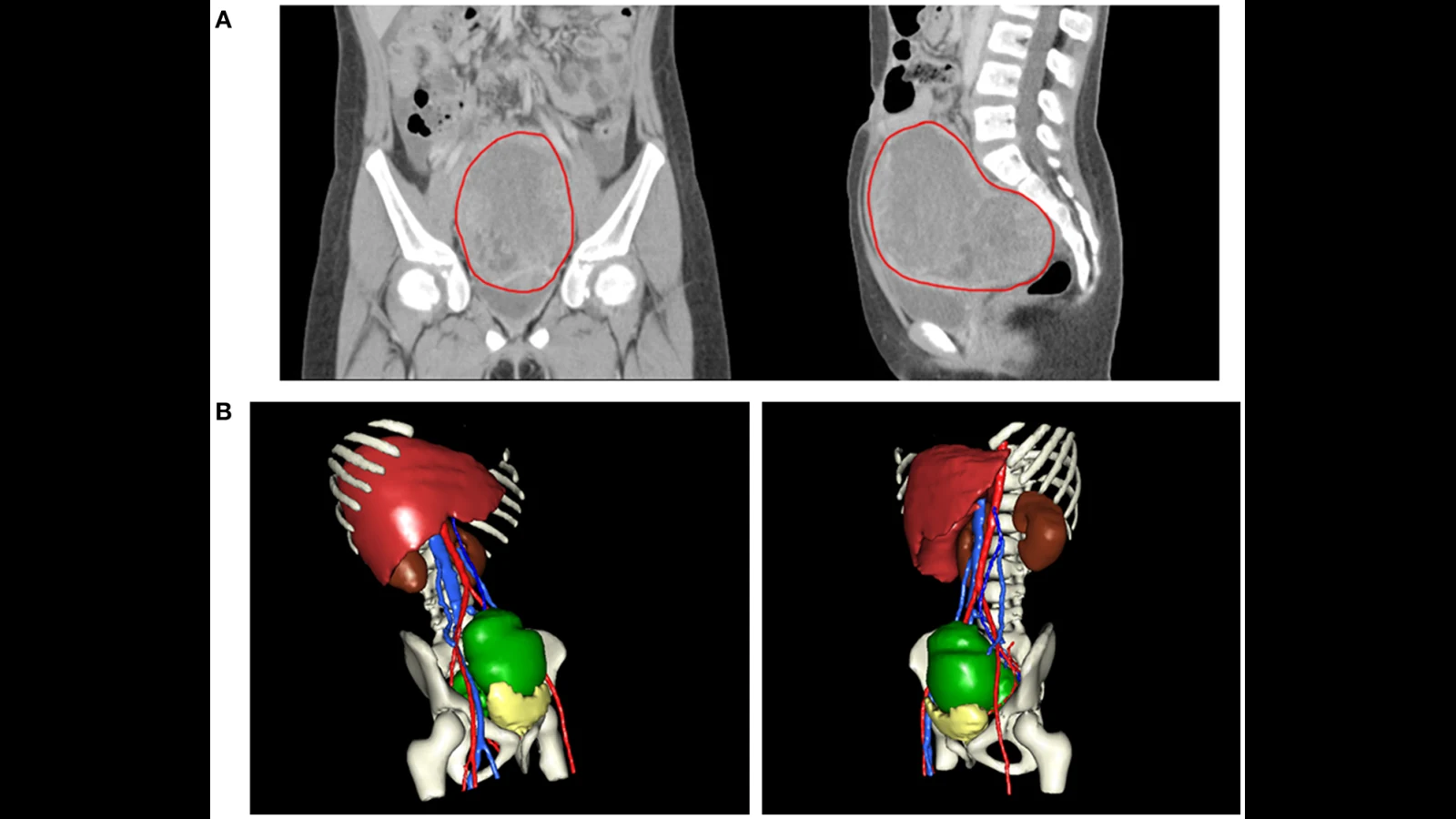
Image source and reuse details
Source: Yolk Sac Tumor in an Eight-Year-Old Girl: A Case Report and Literature Review — Figure 1. Proportionally reduced and framed in WebP. Every view, label and original mark is preserved.
In this guide
What germ cell tumors are
Germ cells are the cells that develop into eggs or sperm. Tumors that start in these cells can appear in an ovary, a testicle or other parts of the body, such as the chest or the area at the base of the spine. This guide covers tumors that start outside the brain. Tumors in the brain need a different care pathway.
Some are benign, including many mature teratomas. Others are cancer, such as a yolk sac tumor. The name describes how the cells look. A tumor can contain more than one cell type and need different care from another tumor in the same place.
Source: National Cancer Institute — Childhood Extracranial Germ Cell Tumors Treatment (PDQ®) — Patient Version · National Cancer Institute — Childhood Extracranial Germ Cell Tumors Treatment (PDQ®) — Health Professional Version · Ospedale Pediatrico Bambino Gesù — Tumori a cellule germinali del sistema nervoso centrale · Ospedale Pediatrico Bambino Gesù — Tumori a cellule germinali in età pediatrica
What signs you might notice
A lump in a testicle, belly swelling or pain, trouble urinating or a cough that does not go away can have many causes. The signs depend on where the tumor is. Ask for a medical visit if a lump grows or if symptoms continue or get worse.
Call your local emergency service if your child is struggling to breathe. Sudden, severe pain in a testicle also needs urgent assessment. The testicle can sometimes twist and cut off its blood supply.
Source: National Cancer Institute — Childhood Extracranial Germ Cell Tumors Treatment (PDQ®) — Patient Version · Ospedale Pediatrico Bambino Gesù — Tumori a cellule germinali in età pediatrica · National Health Service — Testicle pain
Blood tests, scans and a tissue sample
An ultrasound or magnetic resonance imaging scan can help find the mass. The doctor decides whether other tests are needed to see how far it has spread. Tissue taken during a biopsy or the operation chosen by the team helps identify the types of cells.
Blood tests may measure alpha-fetoprotein (AFP) and beta human chorionic gonadotropin (beta-hCG). Some tumors release these substances. Healthy newborns can also have high alpha-fetoprotein. The team considers age, the kind of tumor and changes in the results over time.
Source: National Cancer Institute — Childhood Extracranial Germ Cell Tumors Treatment (PDQ®) — Patient Version · National Cancer Institute — Childhood Extracranial Germ Cell Tumors Treatment (PDQ®) — Health Professional Version · Frontiers in Pediatrics — Yolk Sac Tumor in an Eight-Year-Old Girl: A Case Report and Literature Review
How treatment is chosen
Surgery is the main treatment for many mature teratomas. After complete removal, some low-risk cancers can be followed with scheduled visits, scans and blood tests. The team decides based on type, location, age and how far the tumor has spread.
In other cases the child needs chemotherapy with platinum-based drugs. Cisplatin can be used with etoposide and bleomycin in some treatment plans. The team may consider surgery before or after the drugs and how to protect future fertility. Ask what outcomes are realistic for the specific diagnosis.
Source: National Cancer Institute — Childhood Extracranial Germ Cell Tumors Treatment (PDQ®) — Patient Version · National Cancer Institute — Childhood Extracranial Germ Cell Tumors Treatment (PDQ®) — Health Professional Version
What researchers are studying
The phase 3 AGCT1531 trial (NCT03067181) studies close monitoring after surgery in people at low risk. Another part compares carboplatin and cisplatin for some standard-risk tumors to see if a choice can keep treatment effective while causing fewer side effects.
The public registry lists participating centers and the requirements. Age, tumor location and test findings affect who can take part. The comparison is ongoing. Your care team can help you decide whether to ask about the study and which options are already available.
Follow-up, food and daily life
After treatment, ask for a written plan with visits and tests. Follow-up can include blood tests and scans. Ask which hearing and kidney checks are needed after the drugs. Before treatment, ask about its possible effect on future fertility and options that fit your child’s age.
Ask a pediatric dietitian for help if eating is hard. Check with your team before giving vitamins or supplements. Ask about school and returning to play. During chemotherapy, follow the team’s fever plan and use the contact number they gave you promptly if your child develops a fever.
Source: National Cancer Institute — Childhood Extracranial Germ Cell Tumors Treatment (PDQ®) — Health Professional Version · National Cancer Institute — Late Effects of Treatment for Childhood Cancer (PDQ®) — Patient Version · National Cancer Institute — Infection and Neutropenia during Cancer Treatment · National Cancer Institute — Nutrition During Cancer Treatment · National Cancer Institute — Popular Diets, Supplements, and Cancer
Where to ask for another opinion
Look for a pediatric cancer center that treats germ cell tumors and has surgeons experienced with the area involved. Use the filter for country, city or postal code. Ask the doctor how to send the report, scans, blood test results and any specimens securely.
A second opinion can help when the type is rare or surgery may remove an organ. Ask if the first team can contact the specialist center directly. If there is an urgent decision, ask how long it is safe to wait.
Find a pediatric germ cell tumor center →
Source: Ospedale Pediatrico Bambino Gesù — Chirurgia Oncologica · St. Jude Children’s Research Hospital — Germ Cell Tumors (Solid Tumor) Treatment · Gustave Roussy — Comité de cancérologie de l’enfant et de l’adolescent
Questions to take to your appointment
- In which organ or area of the body did it start?
- Which tests confirm the type and how far it has spread?
- How should we read the blood results for our child’s age?
- After surgery, are scheduled checks enough or is more treatment needed?
- How will the team check hearing, kidneys and future fertility?
- Who should we call if our child has a fever during treatment?
Sources and verification
- National Cancer Institute — Childhood Extracranial Germ Cell Tumors Treatment (PDQ®) — Patient Version
- National Cancer Institute — Childhood Extracranial Germ Cell Tumors Treatment (PDQ®) — Health Professional Version
- Ospedale Pediatrico Bambino Gesù — Tumori a cellule germinali del sistema nervoso centrale
- Ospedale Pediatrico Bambino Gesù — Tumori a cellule germinali in età pediatrica
- National Health Service — Testicle pain
- National Cancer Institute — Active Surveillance, Bleomycin, Etoposide, Carboplatin or Cisplatin in Treating Pediatric and Adult Patients with Germ Cell Tumors
- National Cancer Institute — Late Effects of Treatment for Childhood Cancer (PDQ®) — Patient Version
- National Cancer Institute — Infection and Neutropenia during Cancer Treatment
- National Cancer Institute — Nutrition During Cancer Treatment
- National Cancer Institute — Popular Diets, Supplements, and Cancer
- Ospedale Pediatrico Bambino Gesù — Chirurgia Oncologica
- St. Jude Children’s Research Hospital — Germ Cell Tumors (Solid Tumor) Treatment
- Gustave Roussy — Comité de cancérologie de l’enfant et de l’adolescent
- Frontiers in Pediatrics — Yolk Sac Tumor in an Eight-Year-Old Girl: A Case Report and Literature Review
Sources checked: 2026-11-21