


Gastrointestinal neuroendocrine tumors: tests, treatment and specialist care
If your report says neuroendocrine tumor, look for three details: where it started, how the cells look and how far it has spread. These details help your team choose tests and treatment. This guide covers tumors of the stomach and intestines in adults.
MyMedNest editorial guide · Sources checked:
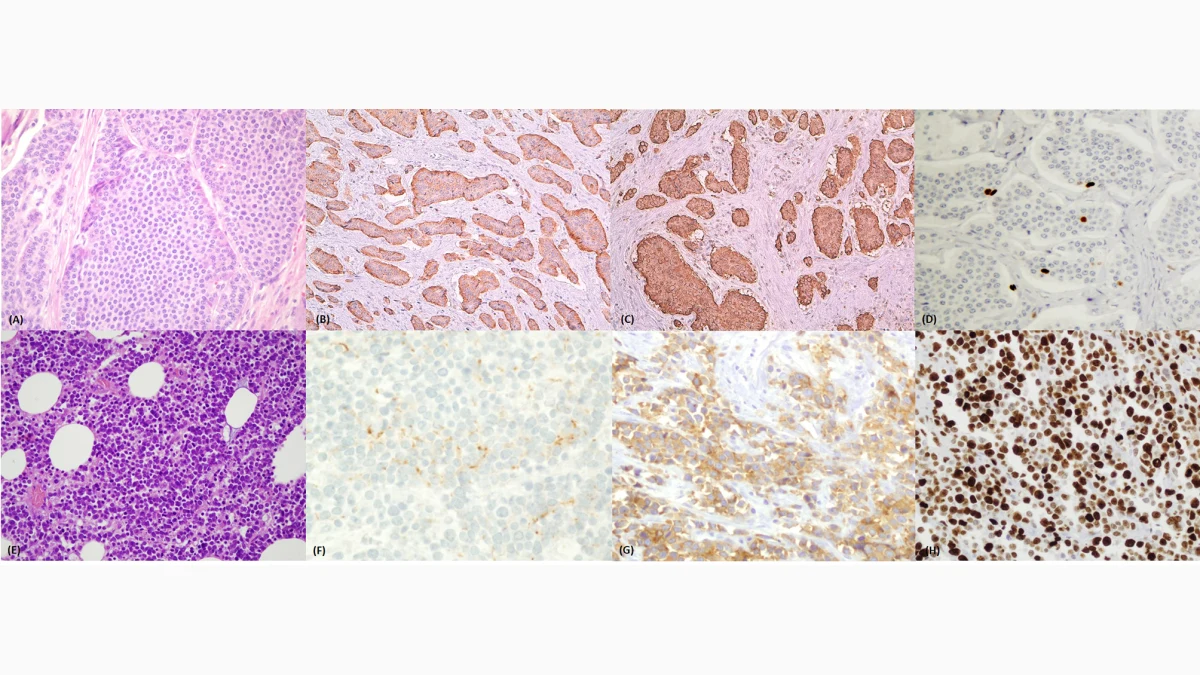
Image source and reuse details
Source: Pathology Reporting in Neuroendocrine Neoplasms of the Digestive System: Everything You Always Wanted to Know but Were Too Afraid to Ask — Figure 1 (A–H). Reduced in proportion. All eight original views and letters are preserved.
In this guide
Where they start and how they differ
Neuroendocrine cells help the digestive system work. Some release substances that act like hormones. Tumors can start in the stomach, duodenum, the rest of the small intestine, appendix, colon or rectum. A neuroendocrine tumor of the pancreas has its own care pathway.
Well-differentiated tumors, often called NETs, still look somewhat like normal cells. Poorly differentiated neuroendocrine carcinomas, called NECs, are a distinct group. Mixed tumors also contain another type of tumor cell. The grade tells you how fast the cells tend to multiply. The stage tells you how far the cancer has spread. A well-differentiated tumor can still be grade 3.
Source: National Cancer Institute — Gastrointestinal Neuroendocrine Tumors Treatment (PDQ®)–Patient Version · Frontiers in Endocrinology — Pathology Reporting in Neuroendocrine Neoplasms of the Digestive System: Everything You Always Wanted to Know but Were Too Afraid to Ask
Symptoms and carcinoid syndrome
Some tumors are found during a test done for another reason. Others can cause belly pain, bleeding or changes in your bowel habits. When a tumor releases certain substances into the blood, some people get diarrhea and waves of flushing, especially in the face. This group of symptoms is called carcinoid syndrome.
Tell your team if symptoms get worse or you have swollen legs and shortness of breath. In some people the substances released by a tumor can damage the heart valves. Get urgent care for sudden severe pain, repeated vomiting, trouble breathing or fainting. Tell your team about carcinoid syndrome before a procedure.
Source: National Cancer Institute — Gastrointestinal Neuroendocrine Tumors Treatment (PDQ®)–Patient Version · European Neuroendocrine Tumor Society — European Neuroendocrine Tumor Society (ENETS) 2022 Guidance Paper for Carcinoid Syndrome and Carcinoid Heart Disease
Tests and what the report means
A tissue sample helps identify the type of tumor. The report may give a Ki-67 value, a measure of how many tumor cells are multiplying. A CT or MRI scan shows the tumor and whether it has reached other sites. In some cases, a PET scan can show whether its cells have somatostatin receptors. These receptors can make a targeted treatment possible.
If the team suspects carcinoid syndrome, it may order a 5-HIAA test. It measures a substance your body makes when it breaks down serotonin. Ask how to prepare for the test. Chromogranin A can also rise for other reasons, so a high value alone cannot establish a diagnosis. Some people also need a heart ultrasound.
Source: European Neuroendocrine Tumor Society — European Neuroendocrine Tumor Society (ENETS) 2024 guidance paper for the management of well-differentiated small intestine neuroendocrine tumours · European Neuroendocrine Tumor Society — European Neuroendocrine Tumor Society (ENETS) 2022 Guidance Paper for Carcinoid Syndrome and Carcinoid Heart Disease · Frontiers in Endocrinology — Pathology Reporting in Neuroendocrine Neoplasms of the Digestive System: Everything You Always Wanted to Know but Were Too Afraid to Ask
When the tumor can be removed
The plan depends on where the tumor is, its size and grade, and what the scans show. A doctor can remove some small stomach or rectal tumors with an endoscope, a thin instrument passed inside the body. Other tumors require surgery, sometimes including nearby lymph nodes.
Ask what was removed, whether tumor cells reach the edge of the removed tissue and when to return for checks. If a tumor is found after appendix surgery, the team reviews the full tissue report. A second operation is not automatic.
Source: National Cancer Institute — Gastrointestinal Neuroendocrine Tumors Treatment (PDQ®)–Health Professional Version · European Neuroendocrine Tumor Society — European Neuroendocrine Tumor Society (ENETS) 2023 guidance paper for gastroduodenal neuroendocrine tumours (NETs) G1–G3
Treatment for advanced tumors
Medicines that act like somatostatin, such as octreotide or lanreotide, can ease hormone-related symptoms and slow some tumors. Lutetium-177 therapy may be an option when the cells have the right receptors. The medicine delivers radiation close to cells that bind it. The team assesses risks and monitors the kidneys and blood cells, among other checks.
In the United States, cabozantinib is authorized from age 12 for certain previously treated, advanced, well-differentiated tumors that cannot be removed. In the European Union its indication includes adults whose disease got worse after at least one treatment that works throughout the body other than a somatostatin analogue. Some people may have options such as liver-directed treatments or other medicines. Poorly differentiated carcinomas have a different care pathway, often involving chemotherapy.
Source: European Neuroendocrine Tumor Society — European Neuroendocrine Tumor Society (ENETS) 2024 guidance paper for the management of well-differentiated small intestine neuroendocrine tumours · United States Food and Drug Administration — LUTATHERA — Prescribing information · European Medicines Agency — Lutathera — withdrawal of application for variation to marketing authorisation · United States Food and Drug Administration — FDA approves cabozantinib for adults and pediatric patients 12 years of age and older with pNET and epNET · European Medicines Agency — Cabometyx — European public assessment report: product information · European Neuroendocrine Tumor Society — European Neuroendocrine Tumor Society (ENETS) 2023 guidance paper for digestive neuroendocrine carcinoma
What recent trials can tell us
NETTER-2 compared two treatments in 226 people with advanced, well-differentiated gastroenteropancreatic tumors of higher grade 2 or grade 3. The median time until the cancer got worse or a person died was 22.8 months with lutetium-177 and octreotide, compared with 8.5 months with high-dose octreotide. The initial results did not establish that people lived longer. In 2025 the EU request to extend use to first-line treatment was withdrawn. The existing authorization for selected progressing tumors remains.
In CABINET, among 203 people with previously treated tumors from outside the pancreas, the same measure was 8.4 months with cabozantinib and 3.9 months with placebo. These results describe groups. The phase 1/2 trial NCT04086485 is studying lutetium with olaparib. Ask your team what is still unknown and whether the trial could apply to you.
Source: The Lancet — [177Lu]Lu-DOTA-TATE plus long-acting octreotide versus high-dose long-acting octreotide for the treatment of newly diagnosed, advanced grade 2–3, well-differentiated, gastroenteropancreatic neuroendocrine tumours (NETTER-2): an open-label, randomised, phase 3 study · The New England Journal of Medicine — Phase 3 Trial of Cabozantinib to Treat Advanced Neuroendocrine Tumors · European Medicines Agency — Lutathera — withdrawal of application for variation to marketing authorisation · United States National Library of Medicine — ClinicalTrials.gov — Lu-177-DOTATATE (Lutathera) in Combination With Olaparib in Inoperable Gastroenteropancreatico Neuroendocrine Tumors (GEP-NET)
Managing symptoms day to day
Tell your team about diarrhea, weight loss or trouble eating. Symptoms can come from the tumor, surgery or medicines. A dietitian can help you work out what to drink and eat for your needs. Bring a list of your medicines, vitamins and supplements before adding any more.
Ask for a written plan for checkups, medicine side effects and symptoms to report. If you feel tired, ask how to get moving again in a way that fits your condition. Note how often symptoms happen and how long they last.
Source: European Neuroendocrine Tumor Society — European Neuroendocrine Tumor Society (ENETS) 2022 Guidance Paper for Carcinoid Syndrome and Carcinoid Heart Disease · National Cancer Institute — Popular Diets, Supplements, and Cancer
Where to go and what to bring
Look for a center that brings together specialists in digestive neuroendocrine tumors. It may be helpful to have the tissue, scans and earlier treatment reviewed. Bring your records, scans, medicines list and notes on possible hormone-related symptoms.
Use the directory to search by country, city or ZIP code. Check who handles requests and how to arrange an appointment or second opinion. The European Neuroendocrine Tumor Society publishes a list of centers it has accredited.
Find specialist care for gastrointestinal neuroendocrine tumors →
Source: European Neuroendocrine Tumor Society — European Neuroendocrine Tumor Society (ENETS) 2024 guidance paper for the management of well-differentiated small intestine neuroendocrine tumours · European Neuroendocrine Tumor Society — Find an ENETS Centre of Excellence
Questions to take to your appointment
- Where in the digestive tract did the tumor start?
- Is it well differentiated, poorly differentiated or mixed?
- What do the grade, Ki-67 and stage tell us?
- Do I need a receptor scan or a heart test?
- What might treatment help with, and what are the risks?
- Where can I get a second opinion and learn about trials?
Sources and verification
- National Cancer Institute — Gastrointestinal Neuroendocrine Tumors Treatment (PDQ®)–Patient Version
- National Cancer Institute — Gastrointestinal Neuroendocrine Tumors Treatment (PDQ®)–Health Professional Version
- European Neuroendocrine Tumor Society — European Neuroendocrine Tumor Society (ENETS) 2024 guidance paper for the management of well-differentiated small intestine neuroendocrine tumours
- European Neuroendocrine Tumor Society — European Neuroendocrine Tumor Society (ENETS) 2022 Guidance Paper for Carcinoid Syndrome and Carcinoid Heart Disease
- European Neuroendocrine Tumor Society — European Neuroendocrine Tumor Society (ENETS) 2023 guidance paper for gastroduodenal neuroendocrine tumours (NETs) G1–G3
- European Neuroendocrine Tumor Society — European Neuroendocrine Tumor Society (ENETS) 2023 guidance paper for digestive neuroendocrine carcinoma
- Frontiers in Endocrinology — Pathology Reporting in Neuroendocrine Neoplasms of the Digestive System: Everything You Always Wanted to Know but Were Too Afraid to Ask
- United States Food and Drug Administration — LUTATHERA — Prescribing information
- European Medicines Agency — Lutathera — withdrawal of application for variation to marketing authorisation
- United States Food and Drug Administration — FDA approves cabozantinib for adults and pediatric patients 12 years of age and older with pNET and epNET
- European Medicines Agency — Cabometyx — European public assessment report: product information
- The Lancet — [177Lu]Lu-DOTA-TATE plus long-acting octreotide versus high-dose long-acting octreotide for the treatment of newly diagnosed, advanced grade 2–3, well-differentiated, gastroenteropancreatic neuroendocrine tumours (NETTER-2): an open-label, randomised, phase 3 study
- The New England Journal of Medicine — Phase 3 Trial of Cabozantinib to Treat Advanced Neuroendocrine Tumors
- United States National Library of Medicine — ClinicalTrials.gov — Lu-177-DOTATATE (Lutathera) in Combination With Olaparib in Inoperable Gastroenteropancreatico Neuroendocrine Tumors (GEP-NET)
- National Cancer Institute — Popular Diets, Supplements, and Cancer
- European Neuroendocrine Tumor Society — Find an ENETS Centre of Excellence
Sources checked: 2026-11-20