


Extragonadal germ cell tumors in adults: diagnosis, treatment and centers
Extragonadal means the tumor started outside the testicles or ovaries. One possible site is the middle of the chest. Ask if the team has found where it began, which cells are involved and what tests are needed to plan your care.
MyMedNest editorial guide · Sources checked:
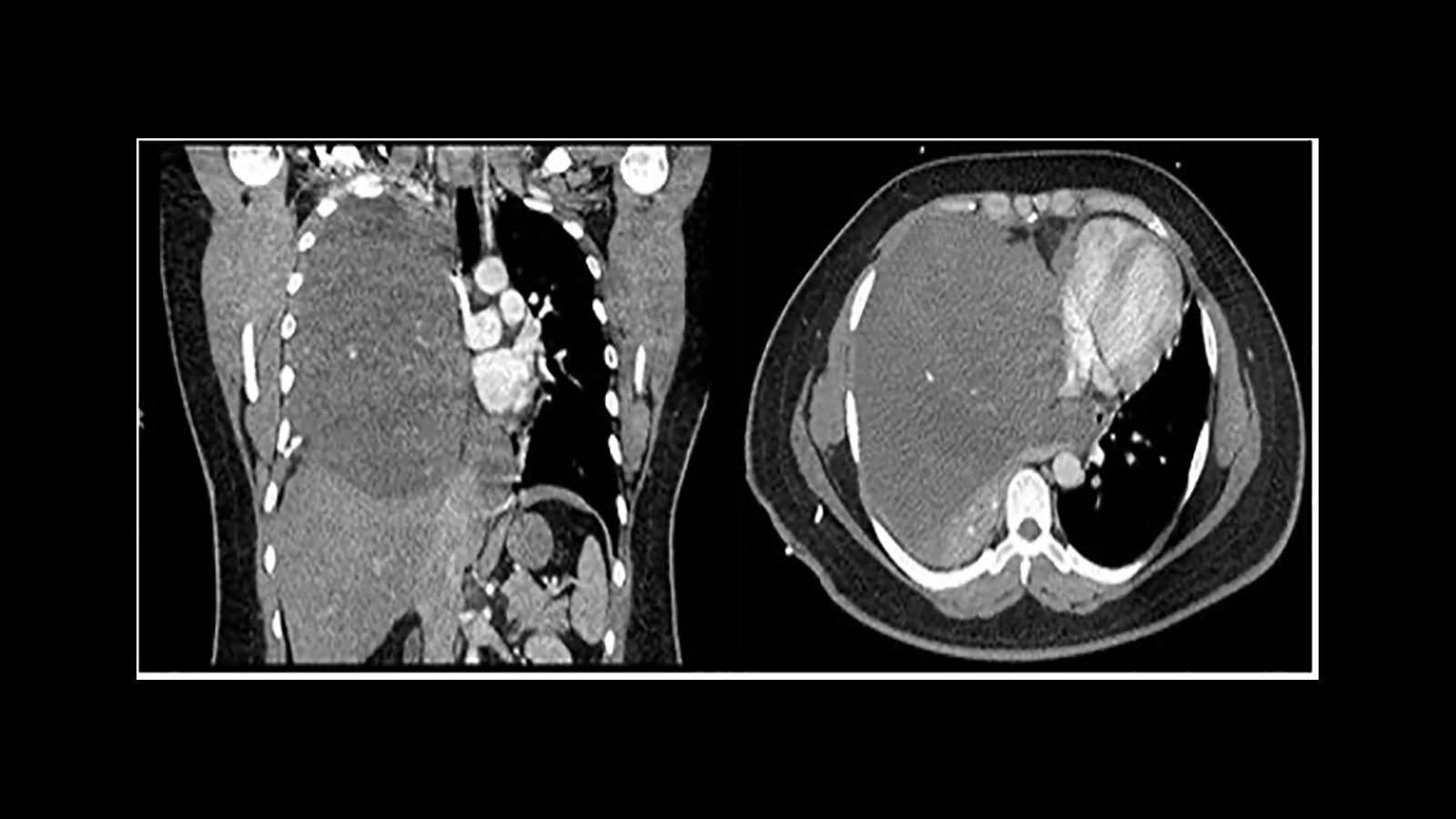
Image source and reuse details
Source: Aggressive somatic-type malignant transformation in primary mediastinal immature teratoma despite multimodal therapy: a case report — Figure 1. Framed in WebP at the original image size. Both views are preserved in full.
In this guide
What extragonadal means
Germ cells are the cells that develop into eggs or sperm. A tumor from these cells can also start away from the ovaries and testicles. In adults, two sites are the mediastinum, the space in the middle of the chest, and the retroperitoneum, an area behind the organs in the belly. A mass near a lung may be a germ cell tumor that started in the chest.
Malignant tumors are grouped into seminomas and nonseminomas. Nonseminomas include several types, such as yolk sac tumors. Some growths, such as mature teratomas, can be benign. Germ cell tumors of the brain and childhood cases have separate care pathways.
Source: National Cancer Institute — Extragonadal Germ Cell Tumors Treatment (PDQ®) — Patient Version · National Cancer Institute — Extragonadal Germ Cell Tumors Treatment (PDQ®) — Health Professional Version
Signs that may prompt testing
A chest mass may cause a cough, chest pain or shortness of breath. A mass behind the organs in the belly can cause back pain or pressure. Many other conditions cause similar symptoms. Ask for a medical visit if symptoms continue or get worse.
If you have severe trouble breathing, call emergency services right away. New swelling of the face or neck with shortness of breath needs urgent assessment. A chest mass can make it harder for blood to return to the heart.
Source: National Cancer Institute — Extragonadal Germ Cell Tumors Treatment (PDQ®) — Patient Version · National Cancer Institute — Cardiopulmonary Syndromes (PDQ®) — Patient Version
How doctors find where it began
A computed tomography scan of the chest, belly and pelvis helps locate the mass and look for other sites. Men may need an ultrasound of the testicles even when no lump can be felt. A change in a testicle can be the original site of a mass elsewhere.
Your doctor may check alpha-fetoprotein (AFP), beta human chorionic gonadotropin (beta-hCG), and lactate dehydrogenase (LDH). These markers help classify some tumors and track the response. The team uses them with scans and, when needed, a tissue sample. A normal blood result alone cannot rule out a tumor.
Source: National Cancer Institute — Extragonadal Germ Cell Tumors Treatment (PDQ®) — Health Professional Version · European Association of Urology — Testicular Cancer Guidelines — Diagnostic Evaluation · Frontiers in Oncology — Aggressive somatic-type malignant transformation in primary mediastinal immature teratoma despite multimodal therapy: a case report
How treatment is chosen
Cell type, location, spread and marker levels guide the choice. Many malignant germ cell tumors are treated with a combination containing cisplatin. The team may consider bleomycin or a different combination based on lung health, other risks and whether surgery is planned.
Sometimes a mass remains after chemotherapy. The team reviews scans, blood tests and the tumor type before deciding if surgery is useful. A nonseminoma that started in the chest can be harder to treat. If the tumor comes back, ask promptly for specialist advice about further treatment and trials.
Source: National Cancer Institute — Extragonadal Germ Cell Tumors Treatment (PDQ®) — Health Professional Version · European Association of Urology — Testicular Cancer Guidelines — Disease Management · Memorial Sloan Kettering Cancer Center — Outcomes After Multidisciplinary Management of Primary Mediastinal Germ Cell Tumors
What researchers are studying
Gustave Roussy’s phase 2 VAPOR research program (2023-505040-19-00) studies care for people with high-risk nonseminomatous germ cell tumors. One part concerns tumors that started in the mediastinum. It looks at how to use changes in blood markers during early treatment and when to operate on eligible patients.
Eligibility and availability vary by center. Research findings do not predict one person’s outcome. Ask what decision taking part would change and which options are already available.
Source: European Medicines Agency — Clinical Trials Information System — A prospective program aiming at improving outcome for young adults with poor-prognosis non seminomatous germ-cell tumors (VAPOR (GETUG T06)) · Gustave Roussy — Tumeur germinale non-séminomateuse avec un mauvais pronostic — IGR 3282
Follow-up and daily life
If you want children in the future, ask about options before treatment. Which drugs you receive can affect the need for kidney, hearing or lung checks during and after treatment. Get a written plan, including any blood markers and scans.
Ask your team for help if you are losing weight or having trouble eating. Agree on how to return to activities gradually. Ask before using supplements. If you get a fever during chemotherapy, follow your care team’s instructions and use the contact number they gave you right away.
Source: National Cancer Institute — Extragonadal Germ Cell Tumors Treatment (PDQ®) — Health Professional Version · National Cancer Institute — Fertility Issues in Boys and Men with Cancer · National Cancer Institute — Infection and Neutropenia during Cancer Treatment · National Cancer Institute — Nutrition During Cancer Treatment · National Cancer Institute — Popular Diets, Supplements, and Cancer
How to find a specialist
Look for a center with germ cell tumor specialists, radiologists, pathologists and surgeons familiar with the area involved. Filter by country, city or postal code. Ask how to send reports, images and blood marker results securely.
A second opinion can help if the starting site is unclear, if a mass remains after treatment or if the tumor has come back. Ask your doctor how long you can safely wait. For an emergency, use local services and contact your usual care team.
Find a center for extragonadal germ cell tumors →
Source: Fondazione IRCCS Istituto Nazionale dei Tumori — Oncologia Medica Genitourinaria · Gustave Roussy — Tumeur germinale non-séminomateuse avec un mauvais pronostic — IGR 3282 · Memorial Sloan Kettering Cancer Center — Outcomes After Multidisciplinary Management of Primary Mediastinal Germ Cell Tumors
Questions to take to your appointment
- Where did the tumor start and which tests confirm that?
- Does the report show seminoma, nonseminoma or another type?
- Which blood markers will the team check during care?
- Which drug combination fits my case and why?
- Should a surgeon assess a mass that remains after treatment?
- How can we protect fertility and check for effects after treatment?
Sources and verification
- National Cancer Institute — Extragonadal Germ Cell Tumors Treatment (PDQ®) — Patient Version
- National Cancer Institute — Extragonadal Germ Cell Tumors Treatment (PDQ®) — Health Professional Version
- European Association of Urology — Testicular Cancer Guidelines — Diagnostic Evaluation
- European Association of Urology — Testicular Cancer Guidelines — Disease Management
- National Cancer Institute — Cardiopulmonary Syndromes (PDQ®) — Patient Version
- European Medicines Agency — Clinical Trials Information System — A prospective program aiming at improving outcome for young adults with poor-prognosis non seminomatous germ-cell tumors (VAPOR (GETUG T06))
- Gustave Roussy — Tumeur germinale non-séminomateuse avec un mauvais pronostic — IGR 3282
- National Cancer Institute — Fertility Issues in Boys and Men with Cancer
- National Cancer Institute — Infection and Neutropenia during Cancer Treatment
- National Cancer Institute — Nutrition During Cancer Treatment
- National Cancer Institute — Popular Diets, Supplements, and Cancer
- Fondazione IRCCS Istituto Nazionale dei Tumori — Oncologia Medica Genitourinaria
- Memorial Sloan Kettering Cancer Center — Outcomes After Multidisciplinary Management of Primary Mediastinal Germ Cell Tumors
- Frontiers in Oncology — Aggressive somatic-type malignant transformation in primary mediastinal immature teratoma despite multimodal therapy: a case report
Sources checked: 2026-11-21