


Esophageal cancer: tests, treatments and eating support
Esophageal cancer is not one disease with one treatment. The cell type, location, spread and ability to eat all matter. This adult guide explains the main decisions, what newer results mean and how to prepare for specialist care.
MyMedNest editorial guide · Sources checked:
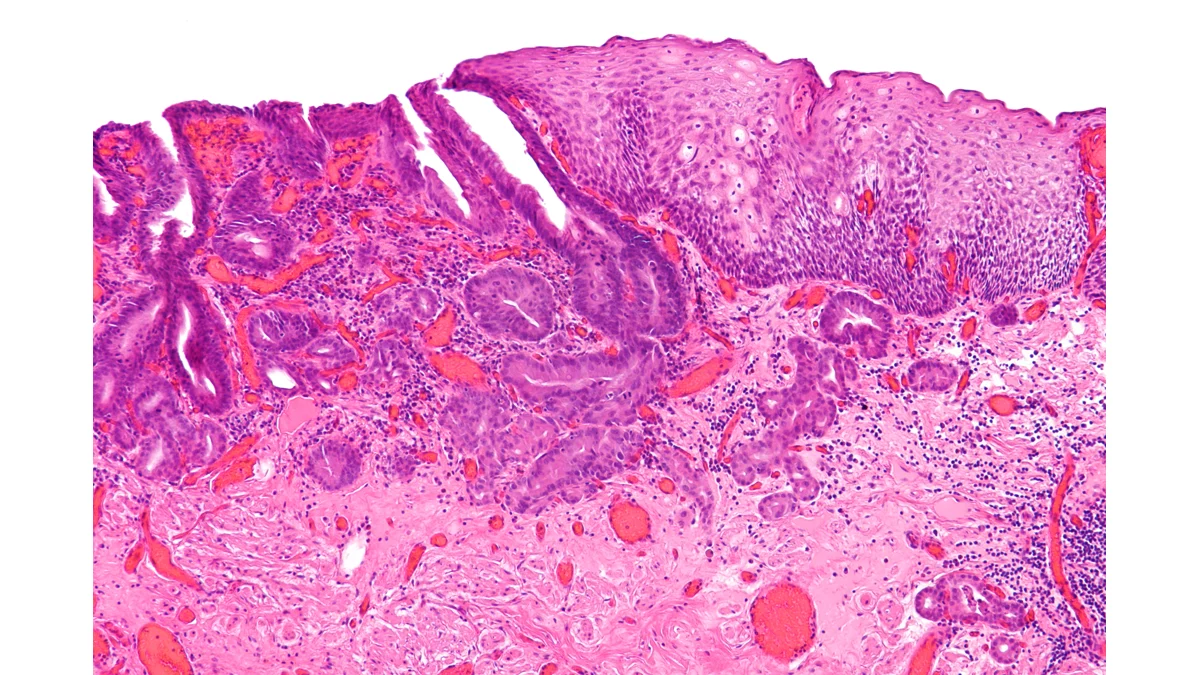
Image source and reuse details
Source: Esophageal adenocarcinoma – intermed mag.jpg. Whole microscopic field proportionally reduced from 4272 × 2848 to fit 1200 × 675 pixels with external white side margins; WebP conversion. No clinical crop, recolouring or new annotation.
In this guide
First establish the exact type and location
The esophagus carries food from the throat to the stomach. Squamous-cell carcinoma starts in its lining cells. Adenocarcinoma starts in gland-forming cells and often affects the lower part. A tumour at the gastroesophageal junction, where the esophagus meets the stomach, needs precise classification. These names influence treatment; they are not interchangeable labels.
Ask for the pathology report and the tumour's location. A cancer that has spread into the esophagus from another organ is different from a cancer starting there. This guide concerns adults and the two main types. Rare tumours and childhood disease need their own specialist assessment.
Source: National Cancer Institute — United States — Esophageal Cancer Treatment (PDQ®)–Health Professional Version · National Cancer Institute — United States — Esophageal Cancer Treatment
Difficulty swallowing should not wait
Food sticking, pain on swallowing, unexplained weight loss or worsening reflux need medical assessment. Hoarseness, a persistent cough or vomiting can also occur. These symptoms have non-cancerous causes too. A symptom list cannot diagnose cancer, but progressively struggling to swallow is a reason to seek help promptly rather than simply change your diet.
Get urgent medical help for swallowing difficulty, choking or breathlessness after drinking or eating. If you cannot manage fluids, seek urgent assessment rather than force food down. Vomiting blood, black stools with weakness, or severe breathing difficulty may be emergencies. During treatment, use the emergency instructions and contact number supplied by your team.
Source: National Health Service — United Kingdom — Symptoms of oesophageal cancer · National Health Service — United Kingdom — Dysphagia (swallowing problems) · National Health Service — United Kingdom — Vomiting blood
Gastroscopy, biopsy and scans answer different questions
Gastroscopy uses a thin camera passed through the mouth to examine the esophagus. Small tissue samples, called biopsies, allow a pathologist to identify the cells. A scan alone does not usually establish the full tumour type. Bring any previous endoscopy and biopsy reports so the team can assess whether further sampling is needed.
CT helps assess spread. Depending on the case, PET-CT, endoscopic ultrasound or a laparoscopy may add information. Endoscopic ultrasound looks through the wall and nearby tissues; laparoscopy examines the abdomen through small incisions. Not everyone needs every test. Ask which unanswered question each examination is intended to resolve.
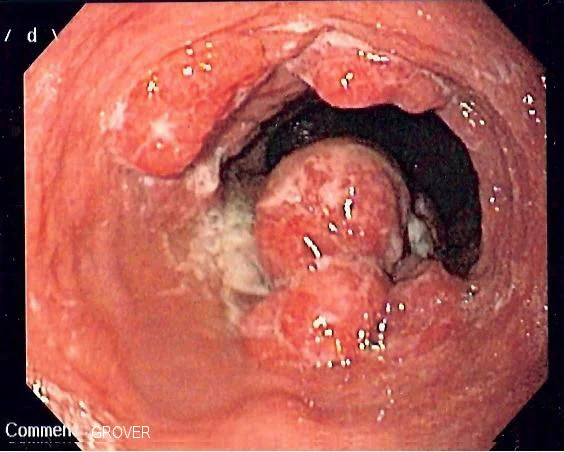
Image source and reuse details
Source: Esophageal adenoca.jpg — historical full 564 × 452 image. Historical full 564 × 452 image converted to WebP without enlargement, cropping, recolouring or removal of source annotations.
Source: National Health Service — United Kingdom — Tests and next steps for oesophageal cancer · National Cancer Institute — United States — Esophageal Cancer Treatment (PDQ®)–Health Professional Version
Stage and fitness guide the treatment goal
Staging describes how deeply cancer has grown, nearby lymph-node involvement and any distant spread. The team also assesses heart and lung health, daily function, weight loss and other illnesses. Locally advanced disease and metastatic disease are not the same. Some locally advanced cancers can still be treated with the aim of cure.
A multidisciplinary meeting brings several specialties together. Ask whether the goal is removal, long-term control or symptom relief, and why the proposed sequence fits the diagnosis. Obtain a written plan, including nutrition support and a contact for problems between visits. Another opinion can clarify a major decision without guaranteeing a different treatment.
Source: National Cancer Institute — United States — Esophageal Cancer Treatment (PDQ®)–Health Professional Version · European Society for Medical Oncology — ESMO Clinical Practice Guideline interim update on the treatment of locally advanced oesophageal and oesophagogastric junction adenocarcinoma and metastatic squamous-cell carcinoma
Protect swallowing and nutrition from the start
Tell the team early if food sticks, drinks cause coughing or weight is falling. A dietitian and, where needed, a swallowing specialist can help make eating safer. Food texture, energy needs and hydration must fit the obstruction and planned treatment. Do not assume that a liquid diet or an over-the-counter nutrition drink is suitable for everyone.
Some people need temporary tube feeding. A stent can hold the esophagus open in selected circumstances, particularly for symptom relief. It is not automatically the right choice before treatment intended to cure. Ask how any procedure affects later surgery or radiation. Support for pain and swallowing can accompany cancer treatment; it is not a reason to abandon it.
Source: National Cancer Institute — United States — Nutrition During Cancer Treatment · National Cancer Institute — United States — Esophageal Cancer Treatment · National Health Service — United Kingdom — Dysphagia (swallowing problems)
Can a very early cancer be removed through an endoscope?
Selected very superficial cancers may be removed endoscopically, without removing the whole esophagus. The removed tissue shows depth, margins and other risk features. Treatment of remaining abnormal lining may also be discussed. The choice requires expertise and careful staging; a small visible lesion is not automatically a low-risk cancer.
If cancer extends more deeply or there is a risk of lymph-node spread, a larger operation or another treatment may be needed. Ask whether removal was complete and what surveillance is required. An endoscopic procedure does not mean that all future checks can stop. Keep the pathology and endoscopy records for follow-up.
Source: National Cancer Institute — United States — Esophageal Cancer Treatment (PDQ®)–Health Professional Version · National Cancer Institute — United States — Esophageal Cancer Treatment
Resectable adenocarcinoma: why FLOT may be offered
For suitable locally advanced adenocarcinoma that can be removed, the European Society for Medical Oncology recommends chemotherapy around surgery with FLOT. This combines fluorouracil, leucovorin, oxaliplatin and docetaxel. Chemoradiation before surgery is an alternative for people unsuitable for FLOT. The decision also depends on recovery prospects and experience at the surgical centre.
ESOPEC included 438 people with resectable esophageal adenocarcinoma. With median follow-up of 55 months, median overall survival was 66 months with FLOT versus 37 months with CROSS chemoradiation and surgery. CROSS uses carboplatin and paclitaxel with radiation. These group results do not predict one person's future or establish the best treatment for squamous-cell cancer.
Squamous-cell cancer has a different pathway
Chemotherapy with radiotherapy can be a main treatment for squamous-cell cancer. It may be given before surgery or as definitive treatment, meaning no operation is planned afterwards. Definitive chemoradiation is also important for people unable or unwilling to undergo major surgery. Tumours high in the esophagus may be managed differently from those near the stomach.
Ask why surgery is or is not included and how response will be checked. Do not transfer an adenocarcinoma trial result directly to squamous-cell cancer. If cancer persists or returns after chemoradiation, an experienced team should assess possible further treatment. A salvage operation is complex and is not suitable for every patient.
Source: European Society for Medical Oncology — ESMO Clinical Practice Guideline interim update on the treatment of locally advanced oesophageal and oesophagogastric junction adenocarcinoma and metastatic squamous-cell carcinoma · National Cancer Institute — United States — Esophageal Cancer Treatment (PDQ®)–Health Professional Version
What an esophagectomy changes
An esophagectomy removes part or most of the esophagus and nearby tissue. The stomach is often reshaped and joined to the remaining esophagus. This is a major operation with risks including lung problems, infection, bleeding and leakage at the new join. Ask about the team's experience and your own risk rather than treating another hospital's average as your estimate.
Recovery includes pain control, breathing exercises, gradual walking and nutrition support. Start food and fluids only according to the surgical plan. Texture and portion size usually change, sometimes with temporary tube feeding. The timing varies with the operation and complications. Get clear discharge instructions, including who to contact if swallowing or general health worsens.
Source: University College London Hospitals NHS Foundation Trust — United Kingdom — Oesophagectomy · Cambridge University Hospitals NHS Foundation Trust — United Kingdom — Advice following oesophagectomy · Cambridge University Hospitals NHS Foundation Trust — United Kingdom — Eating after your oesophagectomy
Nivolumab after surgery: a specific situation
Adjuvant treatment aims to reduce recurrence risk after the main treatment. Nivolumab is an option for eligible adults whose esophageal or junction cancer was completely removed with clear margins, but whose specimen still contained cancer after chemotherapy and radiotherapy before surgery. This indication does not automatically apply after surgery alone, after FLOT, or after a complete pathological response.
CHECKMATE-577 enrolled 794 people. Median disease-free survival was 22.4 months with nivolumab versus 11.0 with placebo. This measures time before recurrence or death; it is not the same as overall survival or proof of cure. Discuss recovery, immune-related risks and local access before deciding whether the trial fits your circumstances.
Advanced squamous-cell cancer: PD-L1 and prior treatment matter
When surgery or definitive chemoradiation cannot control the disease, medicines may slow it and relieve symptoms. Options include chemotherapy with immunotherapy in eligible patients. The 2026 United States labels for first-line nivolumab combinations and tislelizumab with chemotherapy specify PD-L1 of at least 1. Pembrolizumab with chemotherapy requires a combined positive score, CPS, of at least 1.
Later-line options have different rules. Pembrolizumab alone for previously treated squamous cancer requires CPS of at least 10 in its United States indication. Tislelizumab alone requires prior chemotherapy without a previous PD-1 or PD-L1 inhibitor. CPS, TPS and TAP are different scoring systems. Ask which test, previous drugs and national authorization apply; these are not interchangeable prescriptions.
Source: United States Food and Drug Administration — OPDIVO (nivolumab) — 2026 prescribing information, sections 1.13, 1.14 and 14.12 · United States Food and Drug Administration — TEVIMBRA (tislelizumab-jsgr) — prescribing information, revised August 2026 · United States Food and Drug Administration — KEYTRUDA (pembrolizumab) — 2026 prescribing information, esophageal cancer indication
Advanced adenocarcinoma: ask which biomarkers were checked
For advanced adenocarcinoma, discuss HER2, PD-L1 and mismatch-repair or microsatellite-instability testing when relevant. These tests look for features that may affect medicine choices. A molecular finding does not automatically mean the condition is inherited. The exact tumour location and indication matter because a stomach or junction approval does not always include esophageal cancer.
Chemotherapy remains part of many plans. Selected patients may also receive an immune or targeted drug. The 2026 United States nivolumab combination indication for advanced gastric, junction or esophageal adenocarcinoma specifies PD-L1 of at least 1. Local rules can differ. Ask about the expected benefit, testing method and alternatives if a marker is absent or the treatment is unavailable.
Source: United States Food and Drug Administration — OPDIVO (nivolumab) — 2026 prescribing information, sections 1.13, 1.14 and 14.12 · United States Food and Drug Administration — KEYTRUDA (pembrolizumab) — 2026 prescribing information, esophageal cancer indication · United States Food and Drug Administration — FDA approves zanidatamab-hrii and tislelizumab-jsgr for HER2-positive gastric, gastroesophageal junction, or esophageal adenocarcinoma
A 2026 HER2 approval: useful, but not a promise
On 25 August 2026 the United States approved zanidatamab with tislelizumab and fluoropyrimidine/platinum chemotherapy as first treatment for eligible advanced HER2-positive gastric, junction or esophageal adenocarcinoma. HER2 must be IHC 3+ or IHC 2+ with a positive ISH test. Zanidatamab with chemotherapy without tislelizumab has the narrower IHC 3+ indication.
HERIZON-GEA-01 studied 914 people across these three tumour locations. Median overall survival in the triple-combination comparison was 26.4 versus 19.2 months with trastuzumab and chemotherapy. The comparison included 610 people, only 42 with esophageal cancer. The overall result is not a precise esophageal-only estimate, does not apply to squamous cancer and does not prove local availability or cure.
Source: United States Food and Drug Administration — FDA approves zanidatamab-hrii and tislelizumab-jsgr for HER2-positive gastric, gastroesophageal junction, or esophageal adenocarcinoma · United States Food and Drug Administration — TEVIMBRA (tislelizumab-jsgr) — prescribing information, revised August 2026
Side effects: know when to call
Chemotherapy can affect blood counts, nerves, digestion and energy. Radiation can make swallowing painful. Immune medicines can inflame organs, including lungs, bowel, liver and hormone-producing glands. Targeted treatments also have drug-specific risks. Ask for written instructions about symptoms, monitoring and the number to call at night or during a weekend.
Report new breathlessness, persistent diarrhoea, fever, marked weakness or worsening inability to eat promptly. Serious immune effects can occur after treatment has stopped. Do not decide alone to take steroids, change a dose or stop prescribed medicines. The team needs to distinguish treatment toxicity from infection, obstruction or progression.
Source: United States Food and Drug Administration — OPDIVO (nivolumab) — 2026 prescribing information, sections 1.13, 1.14 and 14.12 · United States Food and Drug Administration — TEVIMBRA (tislelizumab-jsgr) — prescribing information, revised August 2026 · United States Food and Drug Administration — KEYTRUDA (pembrolizumab) — 2026 prescribing information, esophageal cancer indication · National Health Service — United Kingdom — Treatment for oesophageal cancer
Eating and activity after treatment
After surgery, small frequent meals and careful chewing are often easier than large portions. The dietitian should adapt texture and energy intake to recovery. Reflux and dumping syndrome can occur; dumping means food moves through too quickly, causing symptoms such as cramping, diarrhoea or faintness. Report problems rather than progressively restrict food without support.
Increase activity gradually within the team's advice; early recovery is different from long-term exercise. Avoid tobacco and discuss help with alcohol or distress. No supplement or restrictive diet is an established cure. Show the team every herbal product and vitamin. Supportive or palliative care can help with symptoms, emotional strain and family needs while anticancer treatment continues.
Source: Cambridge University Hospitals NHS Foundation Trust — United Kingdom — Eating after your oesophagectomy · Cambridge University Hospitals NHS Foundation Trust — United Kingdom — Advice following oesophagectomy · National Cancer Institute — United States — Complementary and Alternative Medicine · National Cancer Institute — United States — Nutrition During Cancer Treatment
Follow-up needs a plan, not a universal timetable
Checks depend on the treatment, stage and symptoms. They may include clinical review, nutrition assessment, scans or endoscopy when appropriate. Ask what each visit is intended to detect and who coordinates it. Keep records of the operation, pathology, medicines and radiation so that another service can understand what has already happened.
Do not wait for a scheduled scan if swallowing deteriorates, weight falls unexpectedly or new concerning symptoms appear. Difficulty after surgery may reflect a narrowing at the join and needs assessment; it is not automatically recurrence. Equally, symptoms should not be dismissed as normal recovery without discussion. Your own team can set the appropriate tests and timing.
Source: National Health Service — United Kingdom — Treatment for oesophageal cancer · Cambridge University Hospitals NHS Foundation Trust — United Kingdom — Eating after your oesophagectomy
Trials and prognosis: ask what was actually measured
Clinical trials may test new combinations, biomarkers or ways to sequence treatment. Eligibility depends on tumour type, stage, previous therapy, health and the site's current recruitment status. A trial listing does not mean a place is available. Ask about alternatives, extra visits, travel, costs and how unexpected complications are managed.
Tumour shrinkage, disease-free survival and overall survival answer different questions. A median describes a study group, not an expiry date for a person. There is no reliable promise about when an experimental treatment will be approved. Decisions should weigh meaningful benefit, side effects, quality of life and what matters most to the patient.
Source: National Cancer Institute — United States — What Are Clinical Trials? · European Society for Medical Oncology — ESMO Clinical Practice Guideline interim update on the treatment of locally advanced oesophageal and oesophagogastric junction adenocarcinoma and metastatic squamous-cell carcinoma · United States Food and Drug Administration — OPDIVO (nivolumab) — 2026 prescribing information, sections 1.13, 1.14 and 14.12 · United States Food and Drug Administration — FDA approves zanidatamab-hrii and tislelizumab-jsgr for HER2-positive gastric, gastroesophageal junction, or esophageal adenocarcinoma
Choose a specialist pathway and prepare your records
Look for a team combining upper digestive surgery, gastroenterology, oncology, radiotherapy, pathology and nutrition. Complex surgery should be assessed in an experienced centre. For another opinion, prepare biopsy reports, imaging in its original format, endoscopy findings, medication lists and a short treatment history. Send health documents only through the institution's official secure route.
The linked directory filters selected documented contacts by cancer and country. It does not rank the world's hospitals, list every centre or calculate the nearest service from a postcode. Confirm referral requirements, fees, language support and acceptance of international patients. A general or international office may route a request rather than provide direct specialist advice. Referral email is not an emergency service.
Find documented esophageal cancer referral pathways →
Source: National Cancer Institute — United States — Finding Cancer Care · European Society for Medical Oncology — ESMO Clinical Practice Guideline interim update on the treatment of locally advanced oesophageal and oesophagogastric junction adenocarcinoma and metastatic squamous-cell carcinoma
Questions to take to your appointment
- Array
- Array
- Array
- Array
- Array
- Array
- Array
- Array
Sources and verification
- National Cancer Institute — United States — Esophageal Cancer Treatment
- National Cancer Institute — United States — Esophageal Cancer Treatment (PDQ®)–Health Professional Version
- National Health Service — United Kingdom — Symptoms of oesophageal cancer
- National Health Service — United Kingdom — Tests and next steps for oesophageal cancer
- National Health Service — United Kingdom — Treatment for oesophageal cancer
- National Health Service — United Kingdom — Dysphagia (swallowing problems)
- National Health Service — United Kingdom — Vomiting blood
- European Society for Medical Oncology — ESMO Clinical Practice Guideline interim update on the treatment of locally advanced oesophageal and oesophagogastric junction adenocarcinoma and metastatic squamous-cell carcinoma
- United States Food and Drug Administration — OPDIVO (nivolumab) — 2026 prescribing information, sections 1.13, 1.14 and 14.12
- United States Food and Drug Administration — TEVIMBRA (tislelizumab-jsgr) — prescribing information, revised August 2026
- United States Food and Drug Administration — KEYTRUDA (pembrolizumab) — 2026 prescribing information, esophageal cancer indication
- United States Food and Drug Administration — FDA approves zanidatamab-hrii and tislelizumab-jsgr for HER2-positive gastric, gastroesophageal junction, or esophageal adenocarcinoma
- Cambridge University Hospitals NHS Foundation Trust — United Kingdom — Eating after your oesophagectomy
- Cambridge University Hospitals NHS Foundation Trust — United Kingdom — Advice following oesophagectomy
- University College London Hospitals NHS Foundation Trust — United Kingdom — Oesophagectomy
- National Cancer Institute — United States — Nutrition During Cancer Treatment
- National Cancer Institute — United States — Complementary and Alternative Medicine
- National Cancer Institute — United States — What Are Clinical Trials?
- National Cancer Institute — United States — Finding Cancer Care
Sources checked: 2026-11-16