


Ductal carcinoma in situ of the breast: tests, treatment and follow-up
If your report says ductal carcinoma in situ, or DCIS, abnormal cells were found inside small tubes in the breast. Ask what the tissue sample showed, how much of the breast is affected and which options fit your case.
MyMedNest editorial guide · Sources checked:
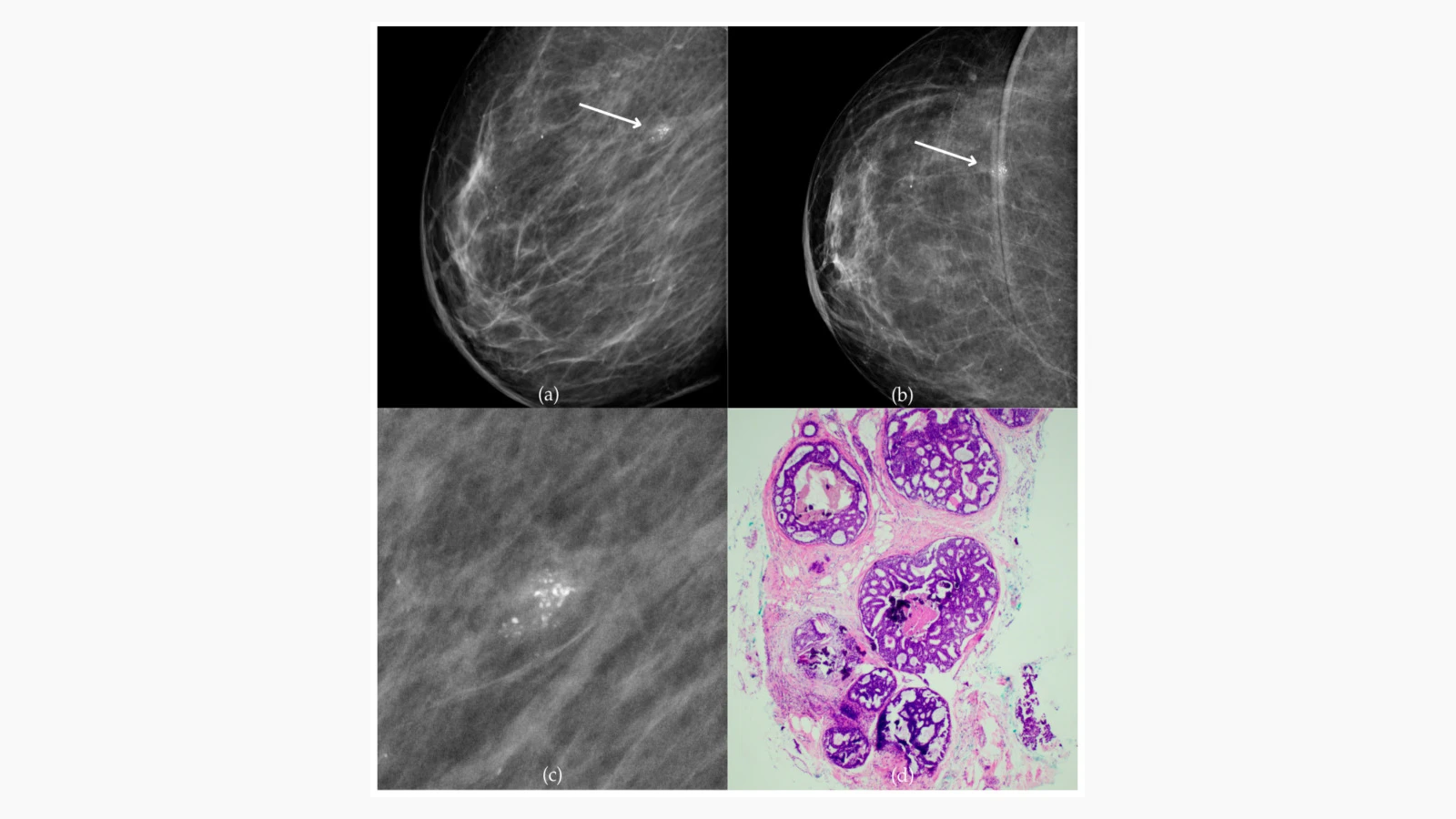
Image source and reuse details
Source: Histopathological Analysis of Vacuum-Assisted Breast Biopsy in Relation to Microcalcification Findings on Mammography: A Pictorial Review — Figure 1. Framed and converted to WebP at the original panel size. All panels, arrows and original colors are preserved.
In this guide
What in situ means
Milk ducts are small tubes that carry milk toward the nipple. In ductal carcinoma in situ (DCIS), abnormal cells stay inside these ducts. This is why it is also called stage 0. If cells have reached the nearby tissue, the lab report describes an invasive component.
The outlook after treatment is generally very good. Some areas stay within the ducts and others become invasive over time. Tests help estimate that risk. They still cannot tell with certainty what will happen for each person.
Source: National Cancer Institute — What Is Ductal Carcinoma in Situ (DCIS)? · National Cancer Institute — Breast Cancer Treatment (PDQ®) — Health Professional Version
How it is found and confirmed
There are often no symptoms. A mammogram can show small white spots caused by calcium deposits. Some patterns need extra tests. A new lump or fluid from the nipple should also be checked. These changes can have other causes.
A biopsy collects a small tissue sample. A doctor looks at it under a microscope to see if cells stay within the ducts and how different they look from normal cells. The second finding is called the grade. The report may also show whether the cells respond to hormones. Taking a larger sample sometimes reveals a small invasive area.
Source: National Cancer Institute — What Is Ductal Carcinoma in Situ (DCIS)? · Biomedicines — University Hospital Dubrava — Histopathological Analysis of Vacuum-Assisted Breast Biopsy in Relation to Microcalcification Findings on Mammography: A Pictorial Review
Surgery and radiation
Breast-conserving surgery removes the affected area with a small rim of surrounding tissue, called a margin. Removing the whole breast, a mastectomy, may be advised if the area is large or in several places. If a mastectomy is planned, the doctor may also consider testing the first lymph node that drains the breast.
After breast-conserving surgery, radiation can lower the chance that the condition comes back in the same breast. Ask how much it may change your risk and what side effects to expect. Radiation is usually unnecessary after a mastectomy for pure DCIS.
Source: National Cancer Institute — What Is Ductal Carcinoma in Situ (DCIS)? · National Cancer Institute — Breast Cancer Treatment (PDQ®) — Health Professional Version · American Society of Clinical Oncology — Sentinel Lymph Node Biopsy in Early-Stage Breast Cancer: ASCO Guideline Update
When hormone therapy is considered
If the cells have estrogen receptors, the doctor may offer medicine that blocks the effect of this hormone or lowers its production. The aim is to reduce the chance of a new problem in the treated breast or the other breast. Options to discuss include tamoxifen or, after menopause, an aromatase inhibitor.
Ask how much benefit you can expect and what side effects or personal health conditions matter for the decision. Chemotherapy is not used for pure DCIS. If an invasive tumor is also found, the care plan is reviewed.
Source: National Cancer Institute — What Is Ductal Carcinoma in Situ (DCIS)? · National Cancer Institute — Breast Cancer Treatment (PDQ®) — Health Professional Version
What active monitoring research found
The US COMET trial compared scheduled monitoring with standard care in women aged 40 and over with grade 1 or 2 disease, hormone-sensitive cells, and no invasive cancer on biopsy. At 2 years, invasive cancer in the same breast was diagnosed in 4.2% of the group assigned to monitoring and 5.9% of the group assigned to standard care.
These are short-term results for selected people. They do not establish that monitoring is better and do not apply to every type of DCIS. Monitoring in the study included planned mammograms and further checks if something changed. Talk to your care team before putting off or changing a treatment.
Source: Journal of the American Medical Association — Active Monitoring With or Without Endocrine Therapy for Low-Risk Ductal Carcinoma In Situ: The COMET Randomized Clinical Trial · National Cancer Institute — Comparing an Operation to Monitoring, With or Without Endocrine Therapy (COMET) Trial For Low Risk DCIS
Follow-up and daily life
Ask when the next mammogram is due, which breast needs checking and who will review the result. After surgery, follow instructions on wound care, moving your arm and returning to your usual activities. Use your care team's contact if a fever, spreading redness or increasing pain develops.
Ask for support if the diagnosis or the treatment choice makes it hard to sleep or focus. A varied diet can help you recover. Diets and supplements cannot remove the lesion. Check before taking a supplement because it may interact with a medicine.
Source: American Society of Clinical Oncology — Breast Cancer Follow-Up and Surveillance After Primary Treatment: ASCO Guideline Update · Royal United Hospitals Bath National Health Service Foundation Trust — Day case breast surgery: discharge advice · National Cancer Institute — Nutrition During Cancer Treatment · National Cancer Institute — Popular Diets, Supplements, and Cancer · National Cancer Institute — Adjustment to Cancer: Anxiety and Distress
How to find a center and get another opinion
Look for a breast center with radiology, pathology, surgery and radiation specialists. Use the filter for country, city or postal code. Ask how to send the report, mammograms and, if needed, biopsy slides securely.
A second opinion can help you understand if the report and scans agree and what treatment is offered. Ask the center how to book, what wait to expect and whether there are costs. Check with your current care team by when you should make a decision.
Find a specialist breast center →
Source: Istituto Europeo di Oncologia — Radiologia Senologica · Memorial Sloan Kettering Cancer Center — What Is Ductal Carcinoma In Situ (DCIS), and How Do I Decide on the Right Treatment? · Gustave Roussy — Comité de sénologie
Questions to take to your appointment
- Does the sample show only in situ disease, or is there an invasive area as well?
- How large is the affected area and what grade is it?
- What are the benefits and risks of each operation for me?
- Would radiation or hormone therapy lower my chance of the condition coming back?
- Do I meet the low-risk criteria studied with active monitoring?
- When is my next mammogram and who will tell me the results?
Sources and verification
- National Cancer Institute — What Is Ductal Carcinoma in Situ (DCIS)?
- National Cancer Institute — Breast Cancer Treatment (PDQ®) — Health Professional Version
- American Society of Clinical Oncology — Sentinel Lymph Node Biopsy in Early-Stage Breast Cancer: ASCO Guideline Update
- Journal of the American Medical Association — Active Monitoring With or Without Endocrine Therapy for Low-Risk Ductal Carcinoma In Situ: The COMET Randomized Clinical Trial
- National Cancer Institute — Comparing an Operation to Monitoring, With or Without Endocrine Therapy (COMET) Trial For Low Risk DCIS
- American Society of Clinical Oncology — Breast Cancer Follow-Up and Surveillance After Primary Treatment: ASCO Guideline Update
- Royal United Hospitals Bath National Health Service Foundation Trust — Day case breast surgery: discharge advice
- National Cancer Institute — Nutrition During Cancer Treatment
- National Cancer Institute — Popular Diets, Supplements, and Cancer
- National Cancer Institute — Adjustment to Cancer: Anxiety and Distress
- Istituto Europeo di Oncologia — Radiologia Senologica
- Memorial Sloan Kettering Cancer Center — What Is Ductal Carcinoma In Situ (DCIS), and How Do I Decide on the Right Treatment?
- Gustave Roussy — Comité de sénologie
- Biomedicines — University Hospital Dubrava — Histopathological Analysis of Vacuum-Assisted Breast Biopsy in Relation to Microcalcification Findings on Mammography: A Pictorial Review
Sources checked: 2026-11-21