


Cervical cancer: diagnosis, treatments and specialist care
Cervical cancer can often be treated with the aim of cure, especially before it spreads widely. The right pathway starts with a tissue diagnosis, staging and a gynecologic cancer team. HPV infection or an abnormal screening result alone does not mean invasive cancer.
MyMedNest editorial guide · Sources checked:
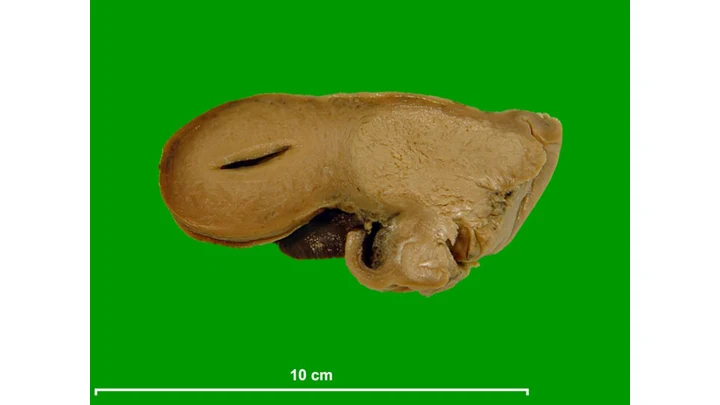
Image source and reuse details
Source: (UNESP-FMB DEO 20180927-03) Carcinoma of the cervix, human.jpg. The full 720 × 540 photograph was proportionally reduced into 720 × 405 with external white side margins and converted to WebP. No upscaling, tissue cropping, recoloring or retouching. The image adaptation is also available under CC BY-SA 4.0.
In this guide
What part of the body is affected?
The cervix is the lower part of the uterus, opening into the vagina. Cervical cancer begins there. It differs from cancer of the uterine lining, called endometrial cancer, and from ovarian or vaginal cancer. The exact site matters because the treatments differ.
Most cases are squamous cell carcinomas or adenocarcinomas, names for the cells involved. Less common types, including neuroendocrine and some HPV-independent cancers, need specialist review. A treatment suitable for the common types may not suit these rare forms.
Bleeding or discharge that needs assessment
Possible signs include bleeding after sex, between periods or after menopause, a change in discharge, pain during sex, and persistent pelvic or lower back pain. These symptoms often have other causes. Arrange an assessment rather than trying to identify cancer from symptoms alone.
Early cancer and precancer may cause no symptoms. Do not wait for the next screening invitation if something has changed. During an examination you can ask for an explanation, a support person or for the examination to stop.
Source: National Health Service — United Kingdom — Symptoms of cervical cancer — reviewed September 4, 2024
HPV: infection is not the same as cancer
Persistent infection with certain high-risk types of human papillomavirus, or HPV, causes almost all cervical cancers. HPV is common and most infections clear without treatment. A positive test cannot tell when infection began and is not proof of a recent exposure.
Smoking and a weakened immune system, including untreated HIV, increase risk. Cervical intraepithelial neoplasia, or CIN, and adenocarcinoma in situ, or AIS, are changes that have not invaded deeper tissue. Their grade and persistence guide monitoring or treatment; they are not all invasive cancer.
Source: World Health Organization — Cervical cancer — November 10, 2026 · Centers for Disease Control and Prevention — United States — Human Papillomavirus Infection: HPV-Associated Cancers and Precancers — Sexually Transmitted Infections Treatment Guidelines · National Cancer Institute — United States — Cervical Cancer Treatment (PDQ®)–Health Professional Version — updated May 13, 2025
Vaccination, screening and precancer treatment
HPV vaccination prevents new infections with targeted virus types; it does not treat an existing invasive cancer. Vaccinated people still need screening when eligible. National programs differ in starting age, test, interval and follow-up, especially with HIV or immunosuppression.
An HPV test looks for virus and a Pap test looks for cell changes. A self-collected HPV sample can be useful where an approved program offers it, but does not replace a tissue biopsy when cancer is suspected. Follow up abnormal results and keep copies of previous tests.
Source: World Health Organization — Cervical cancer — November 10, 2026 · Centers for Disease Control and Prevention — United States — Human Papillomavirus Infection: HPV-Associated Cancers and Precancers — Sexually Transmitted Infections Treatment Guidelines
How the diagnosis is confirmed
Assessment may include a pelvic examination and colposcopy, which uses a light and magnifying instrument outside the vagina to examine the cervix. A biopsy takes tissue for laboratory examination. Sometimes a cone-shaped piece is removed to measure a very small lesion and its depth.
After cancer is confirmed, pelvic MRI helps define its local extent. PET-CT or CT may assess lymph nodes and distant organs, depending on the situation. Blood tests assess blood counts and organ function. Bladder or rectal scopes are used when indicated, not routinely for everyone.
Source: National Health Service — United Kingdom — Tests and next steps for cervical cancer — reviewed September 4, 2024 · National Cancer Institute — United States — Cervical Cancer Diagnosis — March 1, 2024 · European Society of Gynaecological Oncology; European Society for Radiotherapy and Oncology; European Society of Pathology — Pocket Guidelines: Cervical Cancer — Update 2023
What to look for in the pathology report
Ask for the cell type, whether invasion is present, tumor size, depth, and whether the cut edges are clear. Cancer cells in small lymph or blood vessels are called lymphovascular space invasion, or LVSI. Lymph node findings also influence the plan.
For a rare type, uncertain result or major change in treatment, an expert review of slides and tissue blocks can help. HPV-related stains and other tests help classify some cancers. In advanced disease, PD-L1 testing may determine eligibility for a particular immunotherapy combination.
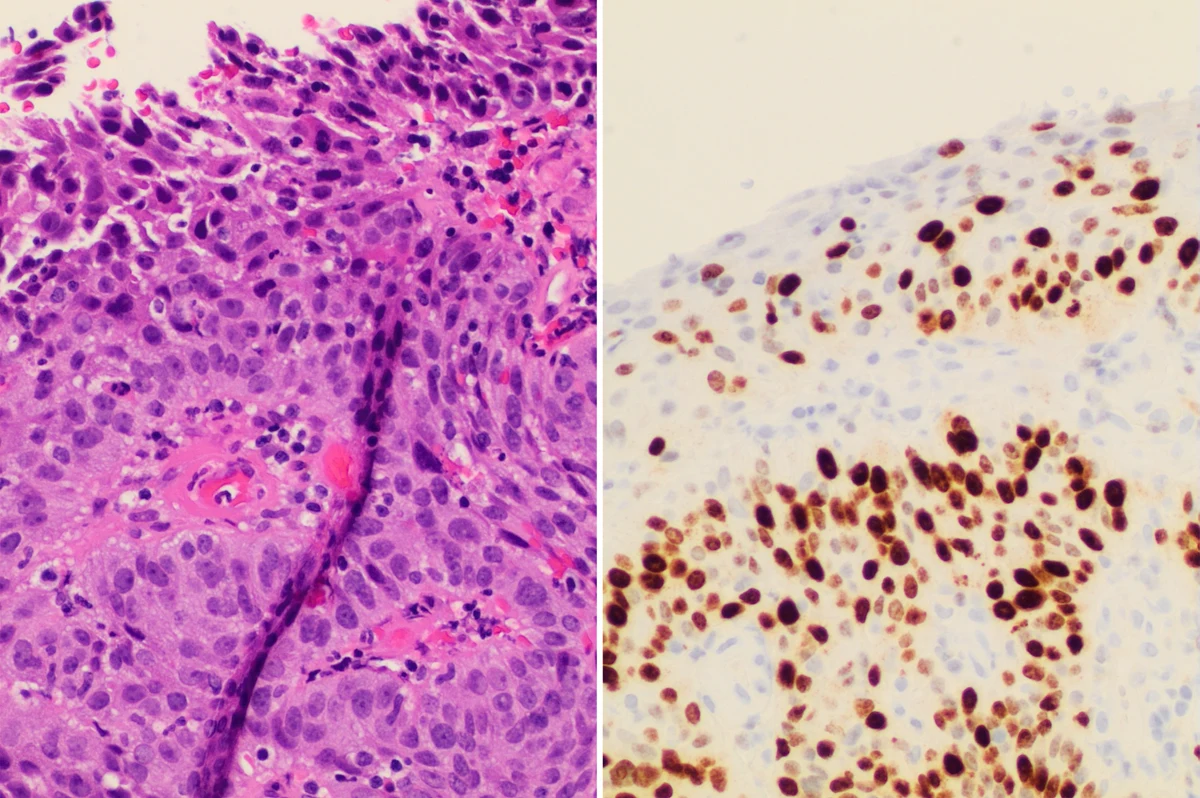
Image source and reuse details
Source: Invasive cervical squamous cell carcinoma on H&E histopathology and Ki-67 immunohistochemistry.jpg. Both full panels proportionally reduced from 3079 × 2048 to 1200 × 798 and converted to WebP. No panel cropping, recoloring, retouching or alteration of diagnostic content.
Source: European Society of Gynaecological Oncology; European Society for Radiotherapy and Oncology; European Society of Pathology — Pocket Guidelines: Cervical Cancer — Update 2023 · European Society of Gynaecological Oncology; European Society of Human Reproduction and Embryology; European Society for Gynaecological Endoscopy — Pocket Guidelines: Fertility-Sparing Treatment — published 2024 · European Medicines Agency — European Union — Keytruda — EPAR, cervical cancer indications
Understanding stage without confusing different systems
Stage I is limited to the cervix. Stage II extends beyond it without reaching the pelvic wall or lower third of the vagina. Stage III may involve those areas, obstruct urine flow or involve regional lymph nodes. Stage IVA reaches nearby organs; IVB involves distant spread.
Modern staging separates pelvic nodes, IIIC1, from nodes near the aorta, IIIC2. These findings do not automatically mean IVB. Ask which FIGO edition is being used: trials and drug labels may use FIGO 2014, which does not classify nodal disease in the same way as the newer system.
Source: National Cancer Institute — United States — Cervical Cancer Stages · Food and Drug Administration — United States — FDA approves pembrolizumab with chemoradiotherapy for FIGO 2014 Stage III-IVA cervical cancer — January 12, 2024
When surgery may be the main treatment
Some very small cancers can be removed by conization. Other early cancers may need removal of the uterus and cervix, with the extent tailored to risk, plus appropriate lymph node assessment. Removing the ovaries is a separate decision; it is not inevitable with every hysterectomy.
Planning should reduce the chance of needing both extensive pelvic surgery and radiotherapy, because combined treatment adds harm. Positive nodes, involved margins or other high-risk findings may change the plan. Discuss the surgical approach and its evidence; a robot is not automatically the safer cancer operation.
Source: National Cancer Institute — United States — Cervical Cancer Treatment · National Health Service — United Kingdom — Treatment for cervical cancer — reviewed September 4, 2024 · European Society of Gynaecological Oncology; European Society for Radiotherapy and Oncology; European Society of Pathology — Pocket Guidelines: Cervical Cancer — Update 2023
Less extensive surgery: what SHAPE actually showed
The randomized SHAPE trial included 700 people with low-risk cancers no larger than 2 cm and limited tissue invasion. Both groups had lymph node assessment. At three years, pelvic recurrence was 2.52% after simple hysterectomy and 2.17% after radical hysterectomy; median follow-up was 4.5 years.
Simple surgery met the trial’s noninferiority criterion and caused fewer urinary problems. This does not apply to every early cancer or preserve the uterus. The study was publicly and charitably funded, including by the Canadian Cancer Society; some populations were underrepresented. Its result is not a blanket endorsement of every minimally invasive technique.
Discuss future pregnancy before treatment starts
Selected small tumors, often no larger than 2 cm, may allow conization or removal of the cervix while keeping the uterus. Cell type, negative margins, depth and lymph nodes matter. Preserving the uterus does not guarantee pregnancy, and more extensive or aggressive tumors may rule this out.
Ask for a gynecologic oncology and fertility consultation before treatment. Options for eggs or embryos and the effects of radiation need individual discussion. Pregnancy after fertility-sparing surgery needs specialist follow-up. If already pregnant, involve a team experienced in both cancer and pregnancy promptly.
Source: European Society of Gynaecological Oncology; European Society of Human Reproduction and Embryology; European Society for Gynaecological Endoscopy — Pocket Guidelines: Fertility-Sparing Treatment — published 2024 · National Health Service — United Kingdom — Treatment for cervical cancer — reviewed September 4, 2024
Chemoradiation and why brachytherapy matters
For many locally advanced cancers, treatment aims at cure with external radiation plus chemotherapy, commonly cisplatin when suitable, followed by image-guided brachytherapy. Brachytherapy places a radiation source close to the tumor using applicators; it is an essential part of this pathway.
It should not routinely be replaced by extra external radiation. Ask whether the center can provide it or arrange referral, pain relief and coordinated appointments. The team checks kidney function and other risks before chemotherapy. Routine hysterectomy after completed chemoradiation is not the standard next step.
Source: The University of Texas MD Anderson Cancer Center — United States — Cervical Cancer Treatment · European Society of Gynaecological Oncology; European Society for Radiotherapy and Oncology; European Society of Pathology — Pocket Guidelines: Cervical Cancer — Update 2023 · National Health Service — United Kingdom — Treatment for cervical cancer — reviewed September 4, 2024
Pembrolizumab with radiation: benefit and eligibility
KEYNOTE-A18 randomized 1,060 people with high-risk locally advanced cancer. In its 2024 survival analysis, median follow-up was 29.9 months. Estimated survival at 36 months was 82.6% with pembrolizumab plus chemoradiation versus 74.8% with placebo plus chemoradiation. These are group results, not an individual prediction.
Grade 3 or worse adverse events occurred in 78% versus 70%; immune reactions also increased. Merck funded the trial. Verified United States and European Union indications cover FIGO 2014 stage III–IVA without prior definitive treatment. They do not require PD-L1 positivity for this setting, and do not automatically cover every earlier-stage participant in the trial.
Source: European Network of Gynaecological Oncological Trial Groups; Gynecologic Oncology Group and international KEYNOTE-A18 investigators — Pembrolizumab or placebo with chemoradiotherapy followed by pembrolizumab or placebo for newly diagnosed, high-risk, locally advanced cervical cancer (ENGOT-cx11/GOG-3047/KEYNOTE-A18): overall survival results from a randomised, double-blind, placebo-controlled, phase 3 trial — Lancet, 2024 · Food and Drug Administration — United States — FDA approves pembrolizumab with chemoradiotherapy for FIGO 2014 Stage III-IVA cervical cancer — January 12, 2024 · European Medicines Agency — European Union — Keytruda — EPAR, cervical cancer indications
Induction chemotherapy: the INTERLACE approach
INTERLACE tested six weeks of chemotherapy before standard chemoradiation and brachytherapy in 500 people. With median follow-up of 67 months, five-year survival was 80% versus 72%, and survival without progression was 72% versus 64%. Grade 3 or worse adverse events occurred in 59% versus 48%.
Most participants had stage IIB disease; people with para-aortic nodes were excluded. Cancer Research UK and the University College London–University College London Hospitals Biomedical Research Centre funded the study. This is not extra chemotherapy after radiation. It was not directly compared with KEYNOTE-A18, and combining both intensified approaches is not automatically supported.
Persistent, recurrent or metastatic disease
When a cure with local treatment is not feasible, systemic treatment can shrink or control disease and relieve symptoms. A platinum drug with paclitaxel is a common backbone. Bevacizumab may be added when bleeding, fistula, clotting and other risks allow. A fistula is an abnormal opening between organs.
Pembrolizumab with chemotherapy, with or without bevacizumab, has verified United States and European Union indications for tumors with PD-L1 CPS of at least 1. CPS is a laboratory score, not a cancer stage. The best sequence also depends on previous treatment, including any immunotherapy already given with radiation.
Source: National Cancer Institute — United States — Cervical Cancer Treatment (PDQ®)–Health Professional Version — updated May 13, 2025 · Food and Drug Administration — United States — Keytruda — Supplement approval BLA 125514/S-121 and S-122, 2021 · European Medicines Agency — European Union — Keytruda — EPAR, cervical cancer indications
Tisotumab vedotin after previous treatment
Tisotumab vedotin links an antibody to a cancer-killing drug. In innovaTV 301, 502 people were randomized after previous treatment. Median survival was 11.5 months versus 9.5 months with selected chemotherapy. The study was funded by Genmab and Seagen, now part of Pfizer. It does not show that everyone benefits.
The United States granted traditional approval in 2024 after chemotherapy; European Union authorization followed in 2025 after systemic therapy. Eye damage, nerve injury and bleeding require specific precautions. An eye assessment and the prescribed eye-protection plan are essential. New eye symptoms need prompt contact; PD-L1 positivity is not a condition in these indications.
Source: University Hospitals Leuven and international innovaTV 301 investigators — Tisotumab Vedotin as Second- or Third-Line Therapy for Recurrent Cervical Cancer — New England Journal of Medicine, 2024 · Food and Drug Administration — United States — FDA approves tisotumab vedotin-tftv for recurrent or metastatic cervical cancer — April 29, 2024 · European Medicines Agency — European Union — Tivdak — EPAR, European Union authorisation March 28, 2025
Other options after relapse
Some recurrences confined to a small area may still be treated with a curative aim using radiation, specialized surgery or carefully selected reirradiation. Previous treatment and the exact sites matter. Major surgery such as pelvic exenteration is reserved for selected cases after specialist assessment.
Cemiplimab has a European Union indication after platinum chemotherapy for recurrent or metastatic disease. Evidence and prior immunotherapy must be considered; this does not establish the same indication in every country. A trial or another chemotherapy may be more appropriate. Early palliative care can accompany active cancer treatment.
Source: European Society of Gynaecological Oncology; European Society for Radiotherapy and Oncology; European Society of Pathology — Pocket Guidelines: Cervical Cancer — Update 2023 · European Medicines Agency — European Union — Libtayo — EPAR, cervical cancer indication · National Health Service — United Kingdom — Treatment for cervical cancer — reviewed September 4, 2024
New treatments and realistic timelines
Clinical trials test a specific question in a defined group. A registered study or encouraging early response does not prove longer survival or a cure. Approval, local coverage and availability are separate steps. There is no reliable universal date when a new treatment will reach all patients.
Ask the team about trials for your stage, tissue findings and previous treatments. Check the current registry entry, recruiting center, eligibility, travel and costs directly. Do not delay an established curative treatment while waiting for an unproven option. Consent should explain alternatives and the right to withdraw.
Source: National Cancer Institute — United States — What Are Clinical Trials? — November 3, 2024 · National Cancer Institute — United States — Who Pays for Clinical Trials? · National Cancer Institute — United States — Treatment Trials for Cancer — November 3, 2024
When to contact the team urgently
During cancer treatment, fever of 38 °C or higher, chills or other signs of infection need urgent contact with the treating team. Low white blood cells can make infection dangerous. Ask for a written out-of-hours plan rather than waiting for the next appointment or masking fever with medicine.
Report new breathlessness, severe diarrhea, jaundice, unusual bleeding or eye symptoms promptly, especially during immunotherapy or tisotumab vedotin. These may reflect serious toxicity and need assessment. Follow your team’s emergency instructions; online advice cannot determine severity or decide whether to stop a drug.
Source: National Cancer Institute — United States — Infection and Neutropenia during Cancer Treatment · European Medicines Agency — European Union — Libtayo — EPAR, cervical cancer indication · European Medicines Agency — European Union — Tivdak — EPAR, European Union authorisation March 28, 2025
Food, supplements and activity
There is no food, supplement or restrictive diet proven to cure cervical cancer. Tell the team about vitamins, herbs and other products because some interfere with treatment. Use supplements for a documented need and agreed plan, not as a replacement for cancer therapy.
Maintain enough calories, protein and fluids. Nausea, diarrhea, weight loss or poor intake merit a cancer dietitian’s help; radiation may require temporary dietary adjustments. Choose activity suited to strength and symptoms, and get support to stop smoking. A difficult day or imperfect diet is not a personal failure.
Source: National Cancer Institute — United States — Nutrition During Cancer Treatment · National Cancer Institute — United States — Complementary and Alternative Medicine — October 31, 2024 · European Society of Gynaecological Oncology; European Society for Radiotherapy and Oncology; European Society of Pathology — Pocket Guidelines: Cervical Cancer — Update 2023
Sexual health, menopause and daily life
Treatment can cause vaginal dryness or narrowing, pain with sex, bladder or bowel changes, leg swelling and early menopause. Ask about pelvic-floor care, lymphedema support, sexual health and psychological help. These problems are part of cancer care and should not be dismissed as something to endure.
Lubricants, moisturizers, vaginal dilators or hormone treatment may help selected people, but timing and suitability need an individual plan. Do not force painful intercourse or use a dilator without instruction. A specialist nurse can also help with local support, work, practical needs and family concerns.
Source: National Cancer Institute — United States — Sexual Health Issues in Women with Cancer · National Health Service — United Kingdom — Help and support for cervical cancer — reviewed September 4, 2024 · European Society of Gynaecological Oncology; European Society for Radiotherapy and Oncology; European Society of Pathology — Pocket Guidelines: Cervical Cancer — Update 2023
Follow-up after treatment
The team should give a written follow-up plan based on treatment and recurrence risk. Visits review symptoms, recovery and examination findings; scans and blood tests are selected for risk or concerns rather than done identically for everyone. New bleeding, pain or persistent symptoms should be assessed between visits.
After definitive chemoradiation, response imaging is generally done no earlier than three months after completion. If the result is uncertain, repeat assessment after another two to three months may be appropriate. A routine biopsy or Pap test after radiation is not a substitute for this specialist assessment.
Source: European Society of Gynaecological Oncology; European Society for Radiotherapy and Oncology; European Society of Pathology — Pocket Guidelines: Cervical Cancer — Update 2023 · National Health Service — United Kingdom — Treatment for cervical cancer — reviewed September 4, 2024
Useful questions before agreeing to the plan
Ask: is this invasive cancer or precancer? Which cell type and FIGO edition describe it? Is the aim cure, longer control or symptom relief? Would a second pathology review change the choice? Can fertility or ovarian function be preserved safely?
For radiation, ask where and when brachytherapy will happen. For medicines, ask about expected benefit, serious risks, tests, alternatives and local coverage. Get a contact for urgent problems and ask how pain, nutrition and emotional needs will be managed alongside treatment.
Source: National Cancer Institute — United States — Cervical Cancer Diagnosis — March 1, 2024 · National Cancer Institute — United States — Cervical Cancer Treatment · National Health Service — United Kingdom — Help and support for cervical cancer — reviewed September 4, 2024
What the numbers can and cannot tell you
There is real reason for hope: some cancers can be cured, and treatments for advanced disease have improved. The outlook depends on extent, cell type, lymph nodes, response and overall health. A trial median is neither a deadline nor the outcome of every participant.
Results from SHAPE, KEYNOTE-A18, INTERLACE and innovaTV 301 concern different groups and cannot be used to rank treatments against each other. Ask what the evidence means for your own findings, what is uncertain and what would make the team change course.
Source: European Network of Gynaecological Oncological Trial Groups; Gynecologic Oncology Group and international KEYNOTE-A18 investigators — Pembrolizumab or placebo with chemoradiotherapy followed by pembrolizumab or placebo for newly diagnosed, high-risk, locally advanced cervical cancer (ENGOT-cx11/GOG-3047/KEYNOTE-A18): overall survival results from a randomised, double-blind, placebo-controlled, phase 3 trial — Lancet, 2024 · University College London and international Gynecologic Cancer InterGroup INTERLACE investigators — Induction chemotherapy followed by standard chemoradiotherapy versus standard chemoradiotherapy alone in patients with locally advanced cervical cancer (GCIG INTERLACE): an international, multicentre, randomised phase 3 trial — Lancet, 2024 · Canadian Cancer Trials Group and international SHAPE investigators — Simple versus Radical Hysterectomy in Women with Low-Risk Cervical Cancer — New England Journal of Medicine, 2024 · University Hospitals Leuven and international innovaTV 301 investigators — Tisotumab Vedotin as Second- or Third-Line Therapy for Recurrent Cervical Cancer — New England Journal of Medicine, 2024
Finding a team and a second opinion
Seek a gynecologic cancer team with expert pathology, surgery, radiation and brachytherapy, medical oncology and supportive care. Documented routes include Istituto Europeo di Oncologia, The University of Texas MD Anderson Cancer Center and Princess Margaret Cancer Centre. These are examples, not a world ranking.
The country filter searches selected documented contacts, not every hospital. Confirm cervical expertise, referral rules, public or private access, costs and language support. Bring pathology reports, slides or blocks, scans and treatment records. Arrange secure document review and an appointment before traveling.
Find documented cervical cancer services →
Source: Istituto Europeo di Oncologia — Italy — Tumori della cervice · The University of Texas MD Anderson Cancer Center — United States — Cervical Cancer Treatment · University Health Network — Canada — Gynecologic Site Group — Princess Margaret Cancer Centre · National Cancer Institute — United States — Cervical Cancer Diagnosis — March 1, 2024
Questions to take to your appointment
- Does a positive HPV test mean cancer? No. Most HPV infections clear. Follow-up depends on the virus type, cell changes, prior results and your local screening program.
- Is brachytherapy optional? It is a core part of definitive radiation treatment for many locally advanced cancers. If unavailable locally, ask about referral to a center that provides it.
- Can every early cancer have a smaller operation? No. The SHAPE result applies to carefully selected low-risk tumors with lymph node assessment. The full pathology and staging findings matter.
- Does all pembrolizumab treatment require PD-L1 positivity? No. The advanced-disease combination uses CPS of at least 1; the verified FIGO 2014 III–IVA chemoradiation indication does not require it.
- Will a clinical trial guarantee a new cure? No. Benefits, risks and recruitment must be checked for the specific trial. There is no guaranteed benefit or universal arrival date.
- Can I choose a center by country? Yes, within the selected directory. A missing result means no matching contact is listed, not that the country has no specialist care.
Sources and verification
- National Cancer Institute — United States — Cervical Cancer Treatment (PDQ®)–Health Professional Version — updated May 13, 2025
- World Health Organization — Cervical cancer — November 10, 2026
- National Health Service — United Kingdom — Symptoms of cervical cancer — reviewed September 4, 2024
- National Health Service — United Kingdom — Tests and next steps for cervical cancer — reviewed September 4, 2024
- National Health Service — United Kingdom — Treatment for cervical cancer — reviewed September 4, 2024
- National Cancer Institute — United States — Cervical Cancer Diagnosis — March 1, 2024
- National Cancer Institute — United States — Cervical Cancer Stages
- European Society of Gynaecological Oncology; European Society for Radiotherapy and Oncology; European Society of Pathology — Pocket Guidelines: Cervical Cancer — Update 2023
- European Society of Gynaecological Oncology; European Society of Human Reproduction and Embryology; European Society for Gynaecological Endoscopy — Pocket Guidelines: Fertility-Sparing Treatment — published 2024
- Canadian Cancer Trials Group and international SHAPE investigators — Simple versus Radical Hysterectomy in Women with Low-Risk Cervical Cancer — New England Journal of Medicine, 2024
- European Network of Gynaecological Oncological Trial Groups; Gynecologic Oncology Group and international KEYNOTE-A18 investigators — Pembrolizumab or placebo with chemoradiotherapy followed by pembrolizumab or placebo for newly diagnosed, high-risk, locally advanced cervical cancer (ENGOT-cx11/GOG-3047/KEYNOTE-A18): overall survival results from a randomised, double-blind, placebo-controlled, phase 3 trial — Lancet, 2024
- University College London and international Gynecologic Cancer InterGroup INTERLACE investigators — Induction chemotherapy followed by standard chemoradiotherapy versus standard chemoradiotherapy alone in patients with locally advanced cervical cancer (GCIG INTERLACE): an international, multicentre, randomised phase 3 trial — Lancet, 2024
- Food and Drug Administration — United States — FDA approves pembrolizumab with chemoradiotherapy for FIGO 2014 Stage III-IVA cervical cancer — January 12, 2024
- European Medicines Agency — European Union — Keytruda — EPAR, cervical cancer indications
- Food and Drug Administration — United States — Keytruda — Supplement approval BLA 125514/S-121 and S-122, 2021
- University Hospitals Leuven and international innovaTV 301 investigators — Tisotumab Vedotin as Second- or Third-Line Therapy for Recurrent Cervical Cancer — New England Journal of Medicine, 2024
- Food and Drug Administration — United States — FDA approves tisotumab vedotin-tftv for recurrent or metastatic cervical cancer — April 29, 2024
- European Medicines Agency — European Union — Tivdak — EPAR, European Union authorisation March 28, 2025
- European Medicines Agency — European Union — Libtayo — EPAR, cervical cancer indication
- National Cancer Institute — United States — Infection and Neutropenia during Cancer Treatment
- National Cancer Institute — United States — Nutrition During Cancer Treatment
- National Cancer Institute — United States — Complementary and Alternative Medicine — October 31, 2024
- National Cancer Institute — United States — What Are Clinical Trials? — November 3, 2024
- Istituto Europeo di Oncologia — Italy — Tumori della cervice
- The University of Texas MD Anderson Cancer Center — United States — Cervical Cancer Treatment
- University Health Network — Canada — Gynecologic Site Group — Princess Margaret Cancer Centre
- National Health Service — United Kingdom — Help and support for cervical cancer — reviewed September 4, 2024
- National Cancer Institute — United States — Cervical Cancer Treatment
- National Cancer Institute — United States — Sexual Health Issues in Women with Cancer
- Centers for Disease Control and Prevention — United States — Human Papillomavirus Infection: HPV-Associated Cancers and Precancers — Sexually Transmitted Infections Treatment Guidelines
- National Cancer Institute — United States — Who Pays for Clinical Trials?
- National Cancer Institute — United States — Treatment Trials for Cancer — November 3, 2024
Sources checked: 2026-11-16