


Breast cancer: understanding your results and treatment choices
The first useful question after a breast cancer diagnosis is not simply which drug is newest. It is which type of cancer you have, where it is and which treatment can help in your situation. This guide helps you prepare that discussion.
MyMedNest editorial guide · Sources checked:
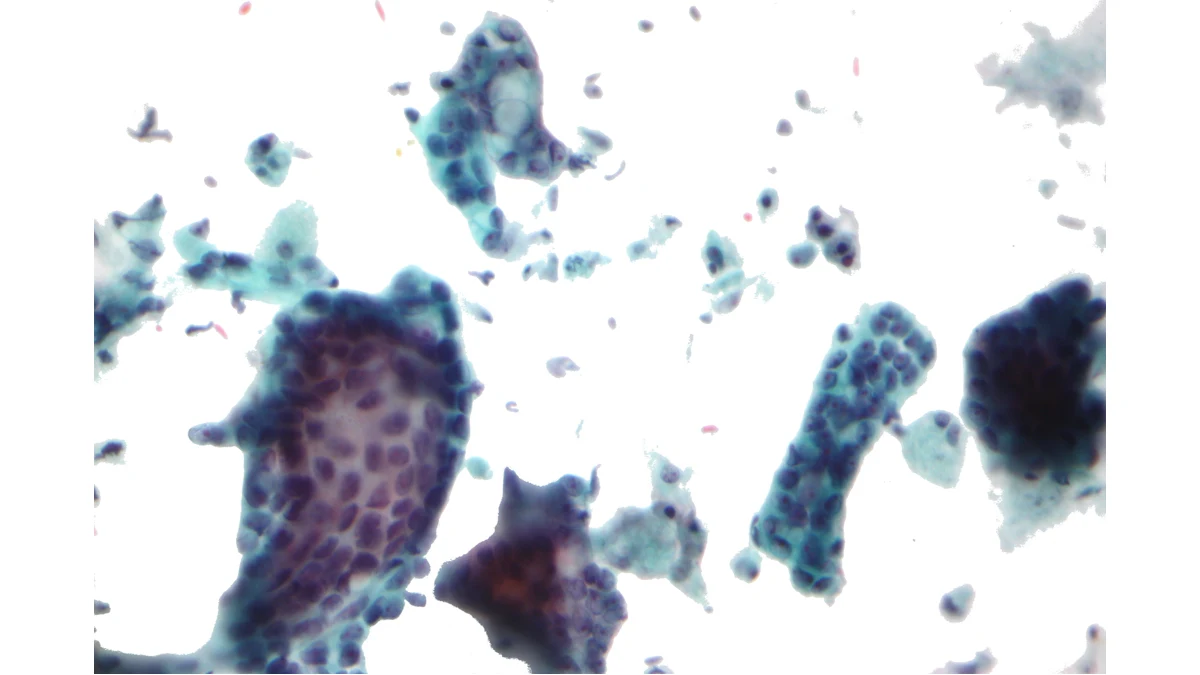
Image source and reuse details
Source: Ductal carcinoma 2 – cytology.jpg. Proportional reduction, white side margins and WebP conversion only. Entire original microscopic field preserved; no colour editing or clinical detail removed. The image remains under CC BY-SA 3.0.
In this guide
Start with your reports and a coordinated team
Ask for copies of the biopsy report, breast imaging and the proposed care plan. Write down which results are still pending and when you will discuss them. A breast team may include surgery, medical oncology, radiation oncology, pathology, radiology and a specialist nurse. A second opinion can clarify choices; ask the team how much time is reasonable before starting care.
This guide mainly covers adult invasive breast cancer. Ductal carcinoma in situ, often called DCIS or stage 0, remains inside the ducts and needs a separate risk discussion. Inflammatory cancer, Paget disease and rare breast tumours also need specific assessment. Men can develop breast cancer too; pregnancy or breastfeeding requires coordinated specialist advice.
Source: National Cancer Institute — United States — How Breast Cancer Is Diagnosed · The University of Texas MD Anderson Cancer Center — Breast Cancer · National Cancer Institute — United States — Male Breast Cancer · National Cancer Institute — United States — Breast Cancer During Pregnancy
A new change needs assessment, even after a normal mammogram
Arrange an assessment for a new breast or underarm lump, a change in breast shape, a newly pulled-in nipple, unusual discharge or skin dimpling. Persistent redness, swelling or an orange-peel appearance also needs prompt attention, even without a lump. Many changes have a benign cause; appearance alone cannot distinguish them from cancer.
Screening looks for cancer before symptoms. Mammography is the usual screening test; MRI is added for some higher-risk people. Screening ages and intervals depend on national guidance and personal risk. A recent normal screen does not make a new symptom safe to ignore, and checking your breasts does not replace recommended screening.
Source: National Cancer Institute — United States — Breast Cancer Signs and Symptoms · National Cancer Institute — United States — Breast Cancer Screening
Imaging finds an abnormality; tissue establishes the diagnosis
Diagnostic mammography, ultrasound and sometimes MRI help investigate a change. A core biopsy removes small tissue samples, often guided by imaging, for a pathologist to examine. The report identifies the tissue type and whether cells have invaded nearby breast tissue. A scan or blood test alone cannot provide all this information.
Grade describes how abnormal the cells look, usually from 1 to 3. Stage describes the extent of disease and also takes tumour biology into account. Nearby lymph nodes may be assessed with imaging, needle sampling or sentinel-node surgery. CT, PET or bone scans are selected when the findings and clinical situation justify them; not every early cancer needs every scan.
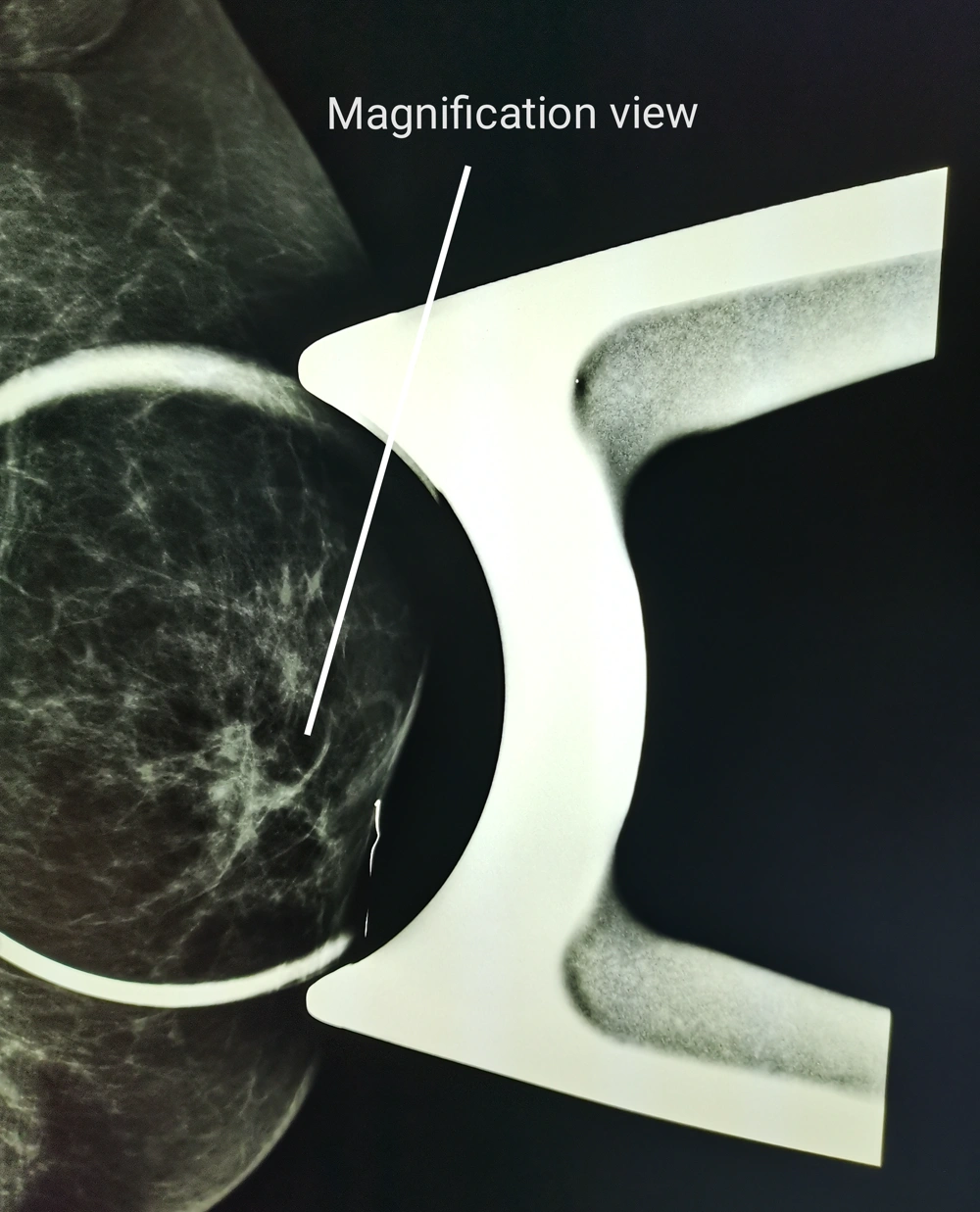
Image source and reuse details
Source: Magnification view mammography.jpg. Proportional reduction and WebP conversion only. No crop, recolouring, diagnostic alteration or added annotation. Image remains under CC BY-SA 4.0.
Source: National Cancer Institute — United States — How Breast Cancer Is Diagnosed
ER, PR and HER2 guide different treatment paths
ER and PR are receptors that can allow hormones to stimulate cancer cells. A positive result can make endocrine treatment useful. HER2 is a protein involved in growth; high expression or gene amplification can support HER2-directed treatment. Triple-negative means the cancer lacks ER, PR and HER2 positivity. It does not mean there are no treatments.
Ask for the actual HER2 score and any confirmatory test, not just the word negative. HER2-low and HER2-ultralow can matter for particular antibody-drug conjugates in advanced disease. They do not make ordinary trastuzumab suitable for every HER2-negative tumour. Ki-67 measures cell proliferation, but should not be used alone to choose treatment or predict an individual outcome.
Source: National Cancer Institute — United States — Tests for Breast Cancer Biomarkers · United States Food and Drug Administration — FDA approves fam-trastuzumab deruxtecan-nxki for unresectable or metastatic HR-positive, HER2-low or HER2-ultralow breast cancer
Inherited tests and tumour tests answer different questions
Testing blood or saliva for an inherited variant, such as BRCA1 or BRCA2, can affect treatment and relatives' risk. Testing the tumour looks at cancer-cell features. Some early hormone-sensitive cancers also have a multigene expression test to help judge recurrence risk and whether chemotherapy may add benefit. This is different from an inherited cancer test.
In advanced disease, changes such as ESR1, PIK3CA or alterations in the AKT pathway may influence drug choices. Eligibility also depends on previous treatment and the precise local drug label. Results can change over time, so the team may suggest a new biopsy or a blood-based tumour test. A positive marker does not guarantee response; discuss inherited findings with a genetics service.
Source: National Cancer Institute — United States — How Breast Cancer Is Diagnosed · National Cancer Institute — United States — Advances in Breast Cancer Research · United States Food and Drug Administration — FDA approves imlunestrant in combination with abemaciclib for ER-positive, HER2-negative, ESR1-mutated advanced or metastatic breast cancer
Early treatment: why the order can differ
For disease confined to the breast or nearby nodes, treatment often aims to cure. Surgery may come first, followed by treatment to reduce recurrence risk. Treatment before surgery, called neoadjuvant therapy, can shrink a tumour and show how it responds. It is common in some higher-risk HER2-positive and triple-negative cancers, and other selected situations.
Adjuvant treatment is given after surgery. The plan may include radiation, endocrine therapy, chemotherapy, HER2-directed drugs or selected immunotherapy. Some patients need only part of this list. The amount of residual cancer after preoperative treatment can change the next step. Ask why your sequence is recommended and which results could alter it.
Source: National Cancer Institute — United States — Breast Cancer Treatment by Stage
Breast conservation, mastectomy and reconstruction
Breast-conserving surgery removes the tumour with a margin of nearby tissue and is usually combined with radiotherapy. Mastectomy removes the breast. For suitable early cancers, a larger operation does not automatically improve survival compared with breast conservation plus appropriate radiation. Tumour extent, inherited risk, previous treatment and your preferences affect the choice.
Ask whether sentinel-node assessment or further node surgery is needed and what this means for arm swelling and movement. Reconstruction can use an implant or your own tissue and may be immediate or delayed. Choosing no reconstruction is also valid. Mastectomy does not always remove the need for radiotherapy, and reconstruction does not eliminate recurrence risk.
Source: National Cancer Institute — United States — Breast Cancer Surgery · National Cancer Institute — United States — Choosing Between a Lumpectomy and Mastectomy
Medicines are matched to the cancer, not chosen from one universal list
For hormone-sensitive disease, examples include tamoxifen, aromatase inhibitors and medicines that suppress ovarian function. An aromatase inhibitor before menopause generally needs ovarian suppression. CDK4/6 inhibitors, medicines targeting the PI3K/AKT pathway and PARP inhibitors are options in defined settings. HER2-positive disease has several HER2-directed options. Chemotherapy and selected pembrolizumab-based treatment are important for some triple-negative cancers.
Antibody-drug conjugates link an antibody to a cell-killing drug; they can still cause serious effects outside the tumour. Trastuzumab, trastuzumab emtansine and trastuzumab deruxtecan are different medicines and are not interchangeable. The linked National Cancer Institute list is a US reference, not a worldwide prescription catalogue. Confirm the exact indication and funding locally.
Source: National Cancer Institute — United States — Hormone Therapy for Breast Cancer · National Cancer Institute — United States — Targeted Therapy for Breast Cancer · National Cancer Institute — United States — Immunotherapy for Breast Cancer · National Cancer Institute — United States — Drugs Approved for Breast Cancer · European Medicines Agency — Enhertu — European public assessment report
Selected 2026 approvals: what the results do and do not show
On September 18, 2026, the United States Food and Drug Administration approved imlunestrant with abemaciclib for ER-positive, HER2-negative, ESR1-mutated advanced or metastatic cancer after progression on at least one endocrine treatment line. In the exploratory ESR1-mutated comparison within EMBER-3, median progression-free survival was 11.1 versus 5.5 months with imlunestrant alone; overall-survival data were immature. Important risks include diarrhoea, low neutrophils, lung inflammation, liver injury and blood clots. EMBER-3 enrolled 874 adults overall; the exploratory ESR1-mutated combination comparison involved 159 patients.
On October 7, 2026, the same regulator approved tucatinib with trastuzumab and pertuzumab as maintenance after induction for unresectable locally advanced or metastatic HER2-positive disease. HER2CLIMB-05 enrolled 654 people; median progression-free survival was 24.9 versus 16.3 months, with overall survival not yet mature. Liver injury and diarrhoea are important risks. These are selected US updates, not all new options or promised months of benefit for one person. Other countries may make different decisions.
Source: United States Food and Drug Administration — FDA approves imlunestrant in combination with abemaciclib for ER-positive, HER2-negative, ESR1-mutated advanced or metastatic breast cancer · United States Food and Drug Administration — FDA approves tucatinib with trastuzumab and pertuzumab for the maintenance treatment of HER2-positive breast cancer
New uses of trastuzumab deruxtecan need precise eligibility
A US decision on May 15, 2026 added two early HER2-positive settings: treatment before surgery for stage II or III disease, in a specified sequence, and treatment after surgery when invasive disease remains after specified preoperative therapy. In the latter DESTINY-Breast05 trial, involving 1,635 adults, three-year invasive disease-free survival was 92.4% versus 83.7% with trastuzumab emtansine. This is not the same endpoint as overall survival or a personal cure rate.
HER2-low or ultralow advanced disease has separate eligibility requirements. The European Medicines Agency assessment also describes defined advanced-disease uses; an authorisation is not proof of reimbursement everywhere. Trastuzumab deruxtecan can cause serious lung inflammation, reduced blood cells and heart dysfunction. New cough, breathlessness or fever during treatment needs prompt contact with the oncology team.
Source: United States Food and Drug Administration — FDA approves two separate indications for fam-trastuzumab deruxtecan-nxki in HER2-positive early-stage breast cancer · United States Food and Drug Administration — FDA approves fam-trastuzumab deruxtecan-nxki for unresectable or metastatic HR-positive, HER2-low or HER2-ultralow breast cancer · European Medicines Agency — Enhertu — European public assessment report
Recurrence or metastases do not mean that care stops
A recurrence near the original site and cancer in distant organs are different situations. Metastatic breast cancer is usually treated to control disease, prolong life and maintain quality of life, rather than with a promise of cure. A new biopsy may help confirm the diagnosis and recheck receptors. Treatment choice depends on symptoms, organs affected, prior drugs, markers and your priorities.
Radiotherapy, surgery or bone-directed treatment can help selected local problems. Pain relief and palliative care can be offered alongside active anticancer treatment at any stage. Ask what a proposed treatment is likely to achieve, when response will be assessed and what the next option would be if it fails or becomes too burdensome.
Source: National Cancer Institute — United States — Breast Cancer Treatment by Stage
Protect function, fertility and quality of life
Ask about fertility before treatment if having biological children may matter to you. Pregnancy and breastfeeding change which treatments can be used and when; do not apply a standard drug plan without a specialist discussion. Men also need advice tailored to their cancer and health. Ask for help with menopausal symptoms, intimacy, anxiety and body-image concerns.
Report swelling or heaviness in the arm or breast early: lymphoedema is easier to manage when assessed promptly. Shoulder rehabilitation, skin care and specialist support may help. Depending on treatment, the team may monitor heart function, bones, blood counts and liver tests. Bring a full medicine list, including antidepressants and supplements, because interactions can affect treatment.
Source: National Cancer Institute — United States — Female Fertility and Cancer Treatment · National Cancer Institute — United States — Breast Cancer During Pregnancy · National Cancer Institute — United States — Male Breast Cancer · National Cancer Institute — United States — Lymphedema · National Cancer Institute — United States — Hormone Therapy for Breast Cancer
Survival statistics describe groups, not your future
The US Surveillance, Epidemiology, and End Results programme reports five-year relative survival for women diagnosed in 2016–2022 of 100.0% for localised breast cancer, 87.5% for regional disease and 33.8% for distant disease. These categories are broader than an individual clinical stage. The figures are not worldwide statistics and should not be transferred directly to men.
Relative survival compares a cancer group with a comparable general population. A figure of 100.0% is not a guarantee that nobody relapses or dies. Subtype, treatment response, general health and access to newer care change the outlook. Ask your oncologist to explain the range of uncertainty in your case rather than treating a population percentage as a deadline.
Source: National Cancer Institute — United States — Breast Cancer Prognosis and Survival Rates
Research: ask about eligibility, not a promised cure date
Clinical trials test new treatments, combinations and ways to personalise care. A trial may require a specific marker, previous treatment or organ-function result. Check current recruitment with the study team, not only a news article. Ask about randomisation, standard-care alternatives, extra visits, travel, costs and the right to withdraw.
A laboratory finding is not proof of benefit in people. A tumour response or longer time without progression is not automatically longer life. Studies may still need follow-up or confirmatory evidence. Neither a trial completion date nor a company announcement gives a reliable date when a cure will become available. Do not delay indicated care while waiting for a headline therapy.
Source: National Cancer Institute — United States — What Are Clinical Trials? · National Cancer Institute — United States — Advances in Breast Cancer Research
Food, supplements and activity support care; they do not replace it
There is no special diet, food or supplement proved to replace breast cancer treatment. Tell your team about herbs, vitamins and concentrated extracts; natural does not mean free of interactions. A dietitian can help if appetite, weight change, mouth problems or bowel effects make eating difficult. Restrictive diets may make it harder to meet nutritional needs.
Discuss an activity plan that fits your energy, surgery recovery and other illnesses. Arm problems or bone metastases may require specific precautions. Ask for support with smoking, alcohol, sleep, work and emotional wellbeing. These steps aim to support health and everyday function; difficulty following a lifestyle plan is not a reason to blame yourself for the cancer.
Source: National Cancer Institute — United States — Complementary and Alternative Medicine
Choose a breast team and prepare a second opinion
Look for a team experienced in your subtype, with coordinated pathology, imaging, surgery, radiotherapy and medical oncology. Ask about genetics, reconstruction, rehabilitation, fertility services and suitable trials when relevant. No single hospital is best for every person, country or breast cancer subtype; a general accreditation is not a guarantee of an individual result.
The directory offers selected documented pathways and official contacts, not a complete worldwide ranking. Verify referral rules, costs, waiting times, language support and whether remote review is possible. Ask which reports, pathology slides and scan files are required. Send medical records only through the centre's official secure channel, not to MyMedNest.
Find documented breast cancer care pathways →
Source: The University of Texas MD Anderson Cancer Center — Breast Cancer · National Cancer Institute — United States — How Breast Cancer Is Diagnosed
Leave treatment with a written follow-up plan
Your plan should name the clinician responsible, planned imaging, review of ongoing endocrine treatment and symptoms to report. Tests depend on the treatment, remaining breast tissue, inherited risk and symptoms. A whole-body scan or tumour-marker blood test is not automatically needed at every visit. New symptoms deserve assessment rather than waiting for the next planned test.
During treatment that weakens infection defences, fever of 38°C or higher, shaking chills or feeling acutely unwell requires an urgent call according to your team's instructions. Contact them before taking medicine that could mask fever. Severe breathlessness, chest pain or new neurological symptoms need emergency assessment. Keep the local emergency number and the oncology team's out-of-hours contact available.
Source: National Cancer Institute — United States — Follow-Up Medical Care · National Cancer Institute — United States — Infection and Neutropenia during Cancer Treatment · European Medicines Agency — Enhertu — European public assessment report
Questions to take to your appointment
- What are my exact diagnosis, grade, stage, ER, PR and HER2 results?
- Would further biopsy, inherited testing or a tumour test change my treatment?
- What is the aim of treatment, and why is this sequence recommended?
- Can I choose breast-conserving surgery, and what are my reconstruction options?
- What benefit and important harms should I expect from each reasonable option?
- Should fertility, heart health, bones, lymphoedema or sexual health be addressed before treatment?
- Is a suitable trial recruiting, and who checks eligibility, costs and local access?
- Who coordinates follow-up, and whom do I call urgently outside office hours?
Sources and verification
- National Cancer Institute — United States — How Breast Cancer Is Diagnosed
- National Cancer Institute — United States — Breast Cancer Signs and Symptoms
- National Cancer Institute — United States — Breast Cancer Screening
- National Cancer Institute — United States — Tests for Breast Cancer Biomarkers
- National Cancer Institute — United States — Breast Cancer Treatment by Stage
- National Cancer Institute — United States — Breast Cancer Surgery
- National Cancer Institute — United States — Choosing Between a Lumpectomy and Mastectomy
- National Cancer Institute — United States — Hormone Therapy for Breast Cancer
- National Cancer Institute — United States — Targeted Therapy for Breast Cancer
- National Cancer Institute — United States — Immunotherapy for Breast Cancer
- National Cancer Institute — United States — Drugs Approved for Breast Cancer
- United States Food and Drug Administration — FDA approves imlunestrant in combination with abemaciclib for ER-positive, HER2-negative, ESR1-mutated advanced or metastatic breast cancer
- United States Food and Drug Administration — FDA approves tucatinib with trastuzumab and pertuzumab for the maintenance treatment of HER2-positive breast cancer
- United States Food and Drug Administration — FDA approves two separate indications for fam-trastuzumab deruxtecan-nxki in HER2-positive early-stage breast cancer
- United States Food and Drug Administration — FDA approves fam-trastuzumab deruxtecan-nxki for unresectable or metastatic HR-positive, HER2-low or HER2-ultralow breast cancer
- European Medicines Agency — Enhertu — European public assessment report
- National Cancer Institute — United States — Breast Cancer Prognosis and Survival Rates
- National Cancer Institute — United States — Male Breast Cancer
- National Cancer Institute — United States — Breast Cancer During Pregnancy
- National Cancer Institute — United States — Female Fertility and Cancer Treatment
- National Cancer Institute — United States — Lymphedema
- National Cancer Institute — United States — Complementary and Alternative Medicine
- National Cancer Institute — United States — Follow-Up Medical Care
- National Cancer Institute — United States — What Are Clinical Trials?
- National Cancer Institute — United States — Advances in Breast Cancer Research
- The University of Texas MD Anderson Cancer Center — Breast Cancer
- National Cancer Institute — United States — Infection and Neutropenia during Cancer Treatment
Sources checked: 2026-11-15