


Bladder cancer: diagnosis, treatment and specialist care
The first question is whether the tumor has reached the bladder muscle. That finding, the tumor type and your general health guide the next steps. This adult guide explains the main choices and the questions to take to your specialist team.
MyMedNest editorial guide · Sources checked:
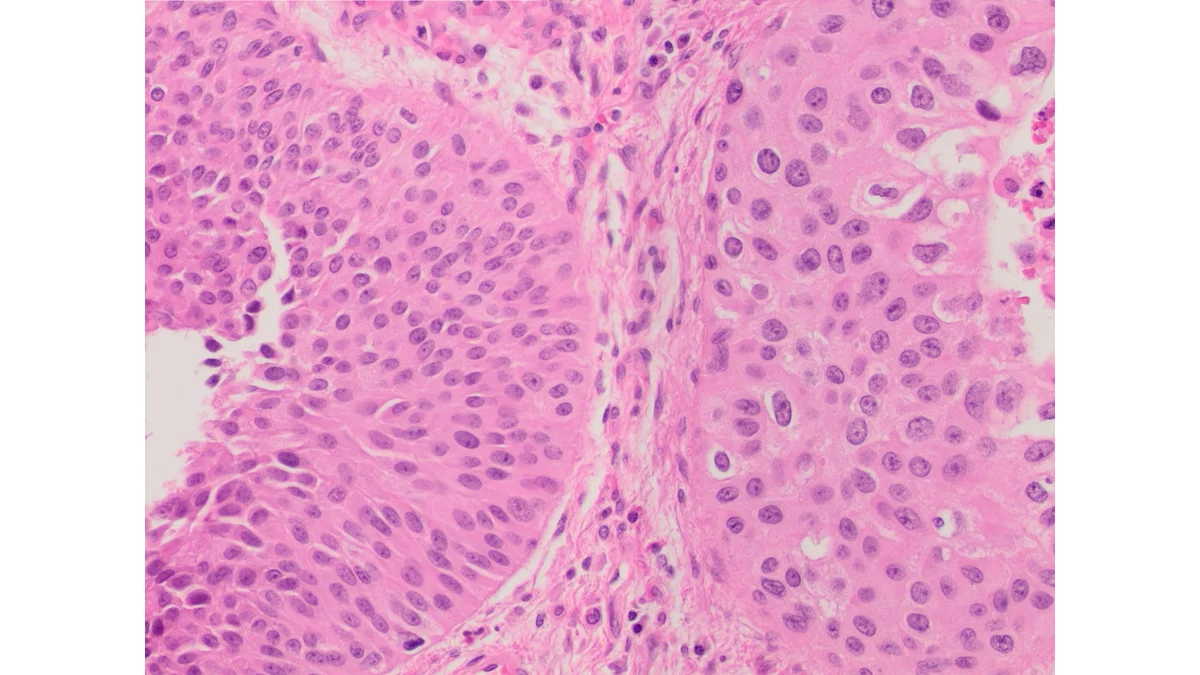
Image source and reuse details
Source: Low- and high-grade urothelial carcinoma (original).jpg. Full 2691 × 1997 microscopic field proportionally reduced into 1200 × 675 with external white side margins and converted to WebP. No tissue cropped, recolored or annotated.
In this guide
Start with the exact diagnosis
Most bladder cancers start in the urothelium, the lining that touches urine. They are called urothelial carcinomas. Squamous cancers, adenocarcinomas and small-cell or other rare tumors need a more specific plan. A urothelial cancer in the ureter or kidney drainage system is a different site; it is not automatically treated like a bladder tumor.
This guide separates cancer confined above the bladder muscle, cancer growing into that muscle, and cancer that has spread. A flat carcinoma in situ, or CIS, is high-grade cancer in the lining. Being flat or not reaching muscle does not make it harmless.
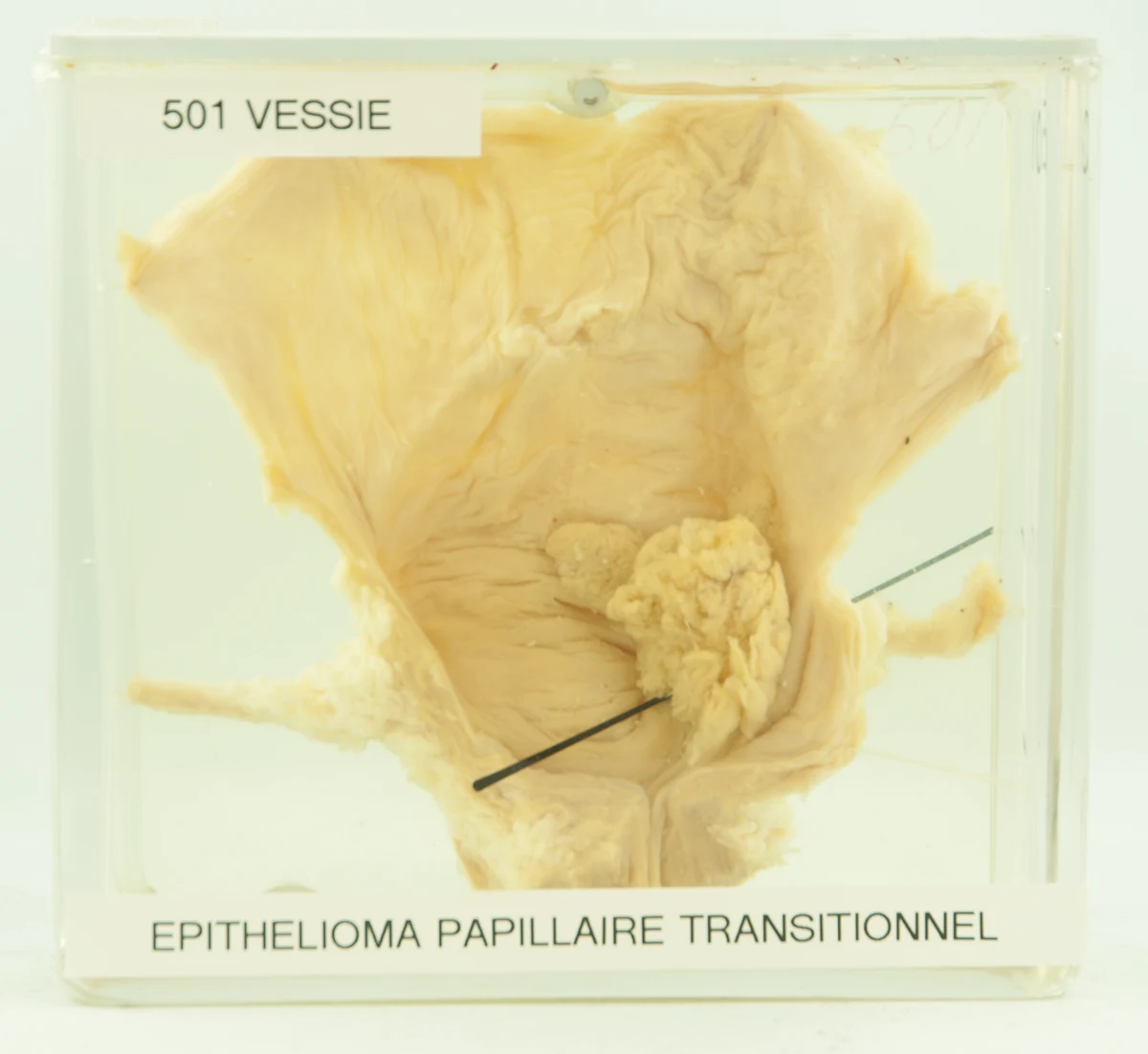
Image source and reuse details
Source: Vessie — Épithelioma papillaire transitionnel (vue antérieure), 55-o.apatho-501a-vessie. Whole 2460 × 2259 photograph proportionally reduced to 1200 × 1102 and converted to WebP. Original labels, pointers, tissue and color preserved.
Source: National Cancer Institute — United States — Bladder Cancer Treatment · Gustave Roussy — France — Cancer de la vessie
Blood in the urine needs assessment
Arrange prompt medical assessment for blood in the urine, even once, without pain or in a small amount. Burning, repeated urinary infections or an urgent need to urinate can also occur. Infection and stones can cause similar symptoms. Persistent or returning symptoms still need an explanation; a website cannot distinguish the causes.
Seek urgent care for inability to pass urine, heavy bleeding with clots, faintness or severe pain. During cancer treatment, follow the team's emergency instructions for fever or sudden deterioration. Do not wait for the next routine appointment when you are very unwell.
Source: National Health Service — United Kingdom — Symptoms of bladder cancer · National Institute of Diabetes and Digestive and Kidney Diseases — United States — Urinary Diversion
Cystoscopy and tissue samples
A cystoscopy uses a thin camera passed through the urethra to inspect the bladder. Urine tests, including cytology to look for abnormal cells, and scans add information. A negative urine test alone does not exclude every bladder tumor. The specialist chooses imaging of the kidneys, urinary tract and other areas according to the findings.
A transurethral resection of bladder tumor, or TURBT, removes visible growth through the urethra and provides tissue for the laboratory. A second resection may be needed after incomplete removal, for T1 disease or when essential muscle tissue is missing, with specific exceptions. When indicated, European guidance recommends it within 2–6 weeks.
Source: National Health Service — United Kingdom — Tests and next steps for bladder cancer · European Association of Urology — Guidelines on Non-muscle-invasive Bladder Cancer 2026 — Diagnosis
What to ask about the pathology report
Ask for the tumor type, grade and depth, whether bladder muscle was present and involved, and whether CIS or an unusual variant was found. Grade describes how abnormal the cells look. Stage describes where cancer has grown or spread. These are different pieces of information.
Bring the operation note, pathology report and scan images to a second opinion. Difficult cases can benefit from review by a pathologist experienced in urinary cancers. Ask whether the sample gives enough information to choose treatment, rather than assuming a small visible tumor must be low risk.
Source: European Association of Urology — Guidelines on Non-muscle-invasive Bladder Cancer 2026 — Diagnosis
Three different treatment pathways
Ta tumors and CIS stay in the lining; T1 reaches tissue beneath it but not the main muscle. These are grouped as non-muscle-invasive bladder cancer. T2 reaches muscle. Higher local stages extend farther, and distant metastases mean spread to organs or distant lymph nodes. Scans and tissue findings are considered together.
For non-muscle-invasive cancer, the team also assigns a low, intermediate, high or very high risk group. Grade, CIS, tumor size, number and previous recurrences matter. Ask separately about recurrence, meaning cancer coming back, and progression, meaning it becoming more invasive. A personal prognosis cannot be read from a general survival table.
Source: National Cancer Institute — United States — Bladder Cancer Treatment · European Association of Urology — Guidelines on Non-muscle-invasive Bladder Cancer 2026 — Diagnosis · European Association of Urology — Guidelines on Non-muscle-invasive Bladder Cancer 2026 — Disease Management
Low- and intermediate-risk disease
After TURBT, a suitable low-risk tumor may need one bladder instillation of chemotherapy. An instillation puts medicine directly into the bladder through a catheter. Intermediate-risk disease may need a course of intravesical chemotherapy or BCG. Mitomycin and gemcitabine are chemotherapy drugs, not immunotherapy.
Selected small low-grade recurrences may be treated in the office or monitored under a defined specialist plan. In the United States, mitomycin intravesical solution, Zusduri, was approved June 12, 2025 for recurrent low-grade intermediate-risk disease. That indication does not cover CIS or every high-grade tumor, and availability elsewhere must be checked.
Source: European Association of Urology — Guidelines on Non-muscle-invasive Bladder Cancer 2026 — Disease Management · United States Food and Drug Administration — FDA approves mitomycin intravesical solution for recurrent low-grade intermediate-risk non-muscle invasive bladder cancer
High-risk disease and BCG
BCG, short for Bacillus Calmette-Guérin, is a live bacterial treatment placed in the bladder to stimulate an immune response. High-risk disease commonly needs an initial course and maintenance; European guidance uses 1–3 years according to benefit, side effects and supply. CIS cannot be managed by removal of visible growth alone.
For very high-risk disease, discuss early radical cystectomy as well as bladder-preserving options. Tell the team about immune-suppressing medicines, infection and recent procedures before BCG. Treatment must be postponed in certain situations. Fever with chills or feeling seriously ill after an instillation needs prompt medical advice; do not take antibiotics or stop the plan on your own.
If cancer returns after BCG
A recurrence after BCG is not a single diagnosis. The team checks grade, timing, previous doses and whether CIS is present. BCG-unresponsive disease means a defined high-grade persistence or early recurrence after adequate treatment. Some later recurrences may still benefit from BCG; a low-grade recurrence is not automatically BCG failure.
Radical cystectomy remains the preferred standard for patients with BCG-unresponsive disease who can undergo it. If surgery is unsuitable or declined, discuss a licensed bladder-preserving treatment or a clinical trial. Examples for defined CIS-containing disease include intravesical nadofaragene firadenovec and other local or systemic options. Delaying needed surgery can allow progression; agree on checks and a clear point for changing treatment.
Source: European Association of Urology — Guidelines on Non-muscle-invasive Bladder Cancer 2026 — Disease Management · United States Food and Drug Administration — FDA D.I.S.C.O. Burst Edition: FDA approval of Adstiladrin (nadofaragene firadenovec-vncg) for patients with high-risk Bacillus Calmette-Guérin unresponsive non-muscle invasive bladder cancer with carcinoma in situ with or without papillary tumors
New bladder-preserving medicines: who qualifies?
On May 28, 2026, the United States Food and Drug Administration approved durvalumab with BCG for BCG-naive high-risk disease. In POTOMAC, 1,018 people were assigned across three groups. Compared with BCG induction and maintenance alone, the combination improved disease-free survival: hazard ratio 0.68, 95% confidence interval 0.50–0.93. This result alone does not prove longer overall survival. A hazard ratio compares the rate of events over follow-up; it is not the percentage of people cured. The confidence interval describes uncertainty in that estimate.
Different approvals concern BCG-unresponsive disease. Inlexzo, a gemcitabine-releasing intravesical system, was approved September 9, 2025 for CIS with or without papillary tumors. In a single-arm study of 83 people, 82% had a complete response; 51% of responders maintained it at least 12 months. Anktiva with BCG gained a papillary-only high-grade extension October 14, 2026, based on extrapolation from CIS evidence. These are not interchangeable indications, cure rates or head-to-head comparisons.
Source: United States Food and Drug Administration — FDA approves durvalumab in combination with Bacillus Calmette-Guérin for high-risk non-muscle invasive bladder cancer · United States Food and Drug Administration — FDA approves gemcitabine intravesical system for non-muscle invasive bladder cancer · United States Food and Drug Administration — FDA Approves First Treatment for Certain People with BCG-Unresponsive Bladder Cancer
When bladder removal is considered
Radical cystectomy removes the bladder and nearby lymph nodes. It is a main curative option for suitable muscle-invasive disease and some high-risk non-muscle-invasive cancers. The extent of surgery, possible preservation of nearby organs or nerves, and the way urine will leave the body need a discussion before consent.
Ask about the team's experience, complications, recovery, kidney function and practical support at home. Treatment before surgery is called neoadjuvant; treatment afterward is adjuvant. Both aim to reduce cancer risk beyond what surgery alone can address. Being unable to receive cisplatin does not mean no treatment is available.
Source: European Association of Urology — Guidelines on Muscle-invasive and Metastatic Bladder Cancer 2026 — Disease Management · National Health Service — United Kingdom — Treatment for bladder cancer
Urine drainage, recovery and intimate life
After bladder removal, an ileal conduit carries urine to a skin opening and an external bag. Other options include an internal reservoir emptied with a catheter or a neobladder connected to the urethra. A neobladder does not guarantee normal emptying or continence. Kidney function, anatomy, previous treatment and the ability to manage a catheter affect suitability.
Meet a stoma or specialist continence nurse before surgery when possible. Ask about supplies, leakage, infections, body image, sexual function and fertility preservation before treatment begins. Long-term checks may include kidney function, salts and vitamin B12. Fluid intake and catheter care need an individual plan, especially with kidney or heart disease.
Source: National Institute of Diabetes and Digestive and Kidney Diseases — United States — Urinary Diversion · European Association of Urology — Guidelines on Muscle-invasive and Metastatic Bladder Cancer 2026 — Disease Management
Treatment around surgery: changes in 2025–2026
Durvalumab with gemcitabine and cisplatin before surgery, then durvalumab afterward, received United States approval March 28, 2025. In NIAGARA, 1,063 participants were randomized. Event-free survival and overall survival improved, with hazard ratios 0.68 and 0.75 respectively. An event may include progression or recurrence; it is not the same measure as death alone.
On July 10, 2026, the United States expanded perioperative enfortumab vedotin plus pembrolizumab to all suitable adult muscle-invasive cystectomy candidates. In KEYNOTE-B15/EV-304, 808 cisplatin-eligible participants were compared with gemcitabine/cisplatin followed by surgery: event-free survival hazard ratio 0.53 and overall survival 0.65. The current European Padcev product information also includes resectable muscle-invasive disease. Neither trial directly compared these two modern regimens; local approval and funding still need confirmation.
Source: United States Food and Drug Administration — FDA approves durvalumab for muscle invasive bladder cancer · United States Food and Drug Administration — FDA approves pembrolizumab or pembrolizumab and berahyaluronidase alfa-pmph each with enfortumab vedotin-ejfv for muscle invasive bladder cancer · European Medicines Agency — Padcev — current European product information, sections 4.1 and 4.4
After surgery: tissue risk and tumor DNA
A separate postoperative decision concerns people at high risk of recurrence. Adjuvant nivolumab is an option in selected urothelial cancers after radical removal; the exact indication and previous treatment matter. It is not automatically added to every perioperative immune regimen. Ask which evidence applies to your pathology and country.
On May 15, 2026, the United States approved atezolizumab after cystectomy for muscle-invasive disease with molecular residual disease detected by an authorized circulating tumor DNA test, including Signatera CDx. This looks for cancer DNA traces in blood. IMvigor011 randomized 250 people: median disease-free survival was 9.9 versus 4.8 months with placebo, and overall survival 32.8 versus 21.1 months. This specific use is not general population screening or proof that any commercial blood test can replace scans and follow-up.
Source: United States Food and Drug Administration — Supplement approval letter BLA 125554/S-097 — Opdivo, adjuvant urothelial carcinoma · United States Food and Drug Administration — FDA approves atezolizumab for adjuvant treatment of muscle invasive bladder cancer in patients with molecular residual disease
Keeping the bladder can be a curative option
Trimodality treatment combines the fullest safe TURBT with radiotherapy and chemotherapy given together to make radiation work better. It is a guideline-supported curative option for carefully selected muscle-invasive tumors. Tumor extent, CIS, kidney drainage and existing bladder function help determine whether it fits.
Ask a team that can discuss both surgery and chemoradiation. Radiation alone is not equivalent to trimodality treatment, although it may help when combined treatment is unsuitable. Keeping the bladder requires continuing cystoscopies and a plan for salvage cystectomy if cancer persists or returns. It is not a way to avoid follow-up.
If cancer cannot be removed or has spread
Enfortumab vedotin plus pembrolizumab is an important first-line option for suitable advanced urothelial cancer. EV-302 randomized 886 people: median overall survival was 31.5 versus 16.1 months with platinum chemotherapy; hazard ratio 0.47, 95% confidence interval 0.38–0.58. These group results are not an individual deadline. European first-line product wording includes eligibility for platinum chemotherapy; do not assume identical criteria in every country.
If that combination is unsuitable or unavailable, options include platinum/gemcitabine followed by avelumab when disease has not progressed, or nivolumab with cisplatin/gemcitabine for suitable patients. Kidney function, hearing, nerve problems and general fitness influence the choice. Later treatment depends on what has already been used. Symptom relief and palliative care can start alongside anticancer treatment, including care for bleeding, pain or urinary blockage.
Source: United States Food and Drug Administration — FDA approves enfortumab vedotin-ejfv with pembrolizumab for locally advanced or metastatic urothelial cancer · European Medicines Agency — Padcev — current European product information, sections 4.1 and 4.4 · United States Food and Drug Administration — FDA approves avelumab for urothelial carcinoma maintenance treatment · United States Food and Drug Administration — FDA approves nivolumab in combination with cisplatin and gemcitabine for unresectable or metastatic urothelial carcinoma · European Association of Urology — Guidelines on Muscle-invasive and Metastatic Bladder Cancer 2026 — Metastatic Disease
Molecular tests and later treatment
Ask whether tumor testing could change a treatment decision. For example, the United States indication for erdafitinib covers certain FGFR3 alterations after at least one systemic treatment. It is not recommended before PD-1 or PD-L1 therapy for someone eligible to receive that treatment. An old FGFR2/FGFR3 label should not be used as the current rule.
Other markers, including HER2, may help identify a later treatment or trial in selected cases. A detected alteration does not guarantee benefit or access. Drug indications change: sacituzumab govitecan's United States urothelial indication was withdrawn November 22, 2024. A drug being approved for a different cancer does not make it a routine bladder cancer treatment.
Source: United States Food and Drug Administration — FDA approves erdafitinib for locally advanced or metastatic urothelial carcinoma · European Association of Urology — Guidelines on Muscle-invasive and Metastatic Bladder Cancer 2026 — Metastatic Disease · United States Food and Drug Administration — Withdrawn — Cancer Accelerated Approvals
Side effects to report without delay
Ask for a written emergency number and treatment-specific warning signs. Fever during chemotherapy, trouble breathing, severe diarrhea, confusion, new weakness, heavy bleeding or inability to drain urine need urgent advice. After BCG, serious infection is uncommon but possible. Do not wait several days with severe symptoms because a routine leaflet mentions mild burning.
Enfortumab can cause severe skin reactions, high blood sugar, nerve damage and eye problems. Immunotherapy can inflame the lungs, bowel, liver or hormone-producing glands, sometimes after treatment ends. Erdafitinib requires monitoring, including for eye problems and phosphate changes. Report new visual symptoms promptly. Dose changes and treatment interruptions belong to the clinical team.
Source: European Association of Urology — Guidelines on Non-muscle-invasive Bladder Cancer 2026 — Disease Management · European Medicines Agency — Padcev — current European product information, sections 4.1 and 4.4 · United States Food and Drug Administration — FDA approves erdafitinib for locally advanced or metastatic urothelial carcinoma · European Association of Urology — Guidelines on Muscle-invasive and Metastatic Bladder Cancer 2026 — Metastatic Disease
Which checks are needed afterward?
After TURBT for non-muscle-invasive cancer, European guidance recommends the first cystoscopy at 3 months. Later cystoscopy, urine cytology and upper-tract imaging depend on risk and treatment. High-risk disease may need lifelong surveillance. A urine biomarker does not automatically replace cystoscopy in every setting.
After cystectomy or chemoradiation, follow-up checks for recurrence and treatment effects, including urinary drainage and kidney health. Take new bleeding, worsening pain or drainage problems to the team between appointments. Ask for a written schedule, who orders each test, and who receives results. Do not copy another patient's scan schedule.
Source: European Association of Urology — Guidelines on Non-muscle-invasive Bladder Cancer 2026 — Follow-up of Patients with NMIBC · National Institute of Diabetes and Digestive and Kidney Diseases — United States — Urinary Diversion · European Association of Urology — Guidelines on Muscle-invasive and Metastatic Bladder Cancer 2026 — Disease Management
Food, movement and smoking
Ask for help to stop smoking; it remains worthwhile after diagnosis. Eat enough to maintain strength and seek a dietitian if weight falls or eating becomes difficult. There is no food, detox or supplement proven to cure bladder cancer. Bring all vitamins, herbs and over-the-counter products to the team because some interfere with treatment.
Adapt walking and strength work to recovery and symptoms with professional advice. Exercise can help fatigue and physical function; it is not a substitute for cancer treatment or proof of a bladder-cancer survival benefit. After bowel-based urinary reconstruction, vitamin B12 or other supplements may be needed for a documented problem. Avoid restrictive diets or a fixed high fluid target without checking your individual needs.
Source: European Association of Urology — Guidelines on Non-muscle-invasive Bladder Cancer 2026 — Disease Management · National Cancer Institute — United States — Nutrition During Cancer Treatment · National Cancer Institute — United States — Complementary and Alternative Medicine · National Cancer Institute — United States — Physical Activity and Cancer · National Institute of Diabetes and Digestive and Kidney Diseases — United States — Urinary Diversion
Clinical trials and realistic expectations
Research includes new medicines released inside the bladder, immune combinations, targeted treatments and blood tests for tiny traces of cancer DNA. A phase 1 study mainly explores safety and dose; later trials examine activity and comparative benefit. A promising response is not proof of cure, and an approval date cannot be promised.
Ask about trials before the next treatment starts, not only after all options are exhausted. Confirm the trial number, recruiting center, current eligibility, alternative standard care, extra visits, travel costs and data use. Enrollment and access to an experimental medicine are not guaranteed. Ask your own team to help assess the offer.
Source: National Cancer Institute — United States — What Are Clinical Trials? · European Association of Urology — Guidelines on Muscle-invasive and Metastatic Bladder Cancer 2026 — Disease Management
Choosing a specialist team and preparing contact
Look for a team with urology, medical oncology, radiation oncology, urinary pathology and stoma or continence support. A useful second opinion compares the reasonable options for your exact stage, including bladder preservation when appropriate. There is no single hospital that can honestly be called the world's best for every person and tumor.
The directory below links documented pathways, including Istituto Europeo di Oncologia in Italy, Gustave Roussy in France and The University of Texas MD Anderson Cancer Center in the United States. Choose your country independently of reading language. Ask the listed office about the relevant team, records, referral, costs and actual treatment site before traveling. The list is selective; a missing center does not mean no care exists there.
Find documented bladder cancer care contacts →
Source: Istituto Europeo di Oncologia — Italy — Tumori urologici (altri) · Gustave Roussy — France — Cancer de la vessie · The University of Texas MD Anderson Cancer Center — United States — Bladder Cancer
Questions to take to your appointment
- Is blood in urine always cancer? No. Infection, stones and other conditions can cause it, but even one episode needs prompt medical assessment.
- Does non-muscle-invasive mean harmless? No. High-grade disease and CIS can progress. The risk group determines the treatment and checks.
- Do I always need my bladder removed? No. Many early tumors are treated through the urethra with risk-based bladder medicines. Selected muscle-invasive tumors can receive trimodality treatment.
- Is every recurrence after BCG BCG-unresponsive? No. Timing, grade and the amount of previous BCG matter. Ask the team for the exact category.
- Can a neobladder work exactly like my old bladder? Not always. Leakage or incomplete emptying can occur, and some people need a catheter. Discuss suitability and long-term support.
- Does a complete response mean cure? It means no cancer was detected by the trial's specified tests at that assessment. Recurrence is still possible and follow-up continues.
- Are new United States approvals available everywhere? No. The permitted indication, supply and reimbursement must be checked with the regulator and treatment team in your country.
- Can I replace treatment with a diet or supplements? No diet or supplement has proved to cure bladder cancer. Nutrition and activity support care; products may also interact with medicines.
Sources and verification
- National Cancer Institute — United States — Bladder Cancer Treatment
- National Health Service — United Kingdom — Symptoms of bladder cancer
- National Health Service — United Kingdom — Tests and next steps for bladder cancer
- National Health Service — United Kingdom — Treatment for bladder cancer
- European Association of Urology — Guidelines on Non-muscle-invasive Bladder Cancer 2026 — Diagnosis
- European Association of Urology — Guidelines on Non-muscle-invasive Bladder Cancer 2026 — Disease Management
- European Association of Urology — Guidelines on Non-muscle-invasive Bladder Cancer 2026 — Follow-up of Patients with NMIBC
- European Association of Urology — Guidelines on Muscle-invasive and Metastatic Bladder Cancer 2026 — Disease Management
- European Association of Urology — Guidelines on Muscle-invasive and Metastatic Bladder Cancer 2026 — Metastatic Disease
- United States Food and Drug Administration — FDA approves mitomycin intravesical solution for recurrent low-grade intermediate-risk non-muscle invasive bladder cancer
- United States Food and Drug Administration — FDA D.I.S.C.O. Burst Edition: FDA approval of Adstiladrin (nadofaragene firadenovec-vncg) for patients with high-risk Bacillus Calmette-Guérin unresponsive non-muscle invasive bladder cancer with carcinoma in situ with or without papillary tumors
- United States Food and Drug Administration — FDA approves durvalumab in combination with Bacillus Calmette-Guérin for high-risk non-muscle invasive bladder cancer
- United States Food and Drug Administration — FDA approves gemcitabine intravesical system for non-muscle invasive bladder cancer
- United States Food and Drug Administration — FDA Approves First Treatment for Certain People with BCG-Unresponsive Bladder Cancer
- National Institute of Diabetes and Digestive and Kidney Diseases — United States — Urinary Diversion
- United States Food and Drug Administration — FDA approves durvalumab for muscle invasive bladder cancer
- United States Food and Drug Administration — FDA approves pembrolizumab or pembrolizumab and berahyaluronidase alfa-pmph each with enfortumab vedotin-ejfv for muscle invasive bladder cancer
- European Medicines Agency — Padcev — current European product information, sections 4.1 and 4.4
- United States Food and Drug Administration — Supplement approval letter BLA 125554/S-097 — Opdivo, adjuvant urothelial carcinoma
- United States Food and Drug Administration — FDA approves atezolizumab for adjuvant treatment of muscle invasive bladder cancer in patients with molecular residual disease
- United States Food and Drug Administration — FDA approves enfortumab vedotin-ejfv with pembrolizumab for locally advanced or metastatic urothelial cancer
- United States Food and Drug Administration — FDA approves avelumab for urothelial carcinoma maintenance treatment
- United States Food and Drug Administration — FDA approves nivolumab in combination with cisplatin and gemcitabine for unresectable or metastatic urothelial carcinoma
- United States Food and Drug Administration — FDA approves erdafitinib for locally advanced or metastatic urothelial carcinoma
- United States Food and Drug Administration — Withdrawn — Cancer Accelerated Approvals
- National Cancer Institute — United States — Nutrition During Cancer Treatment
- National Cancer Institute — United States — Complementary and Alternative Medicine
- National Cancer Institute — United States — Physical Activity and Cancer
- National Cancer Institute — United States — What Are Clinical Trials?
- Istituto Europeo di Oncologia — Italy — Tumori urologici (altri)
- Gustave Roussy — France — Cancer de la vessie
- The University of Texas MD Anderson Cancer Center — United States — Bladder Cancer
Sources checked: 2026-11-16