



Head and neck cancer: US accelerated approval for amivantamab
On November 5, 2026, the Food and Drug Administration, the US medicines regulator, granted accelerated approval to Rybrevant Faspro, containing amivantamab and hyaluronidase-lpuj, for selected adults with head and neck cancer. It provides another option after previous treatment, but its long-term clinical benefit still needs confirmation.
Who the new indication covers
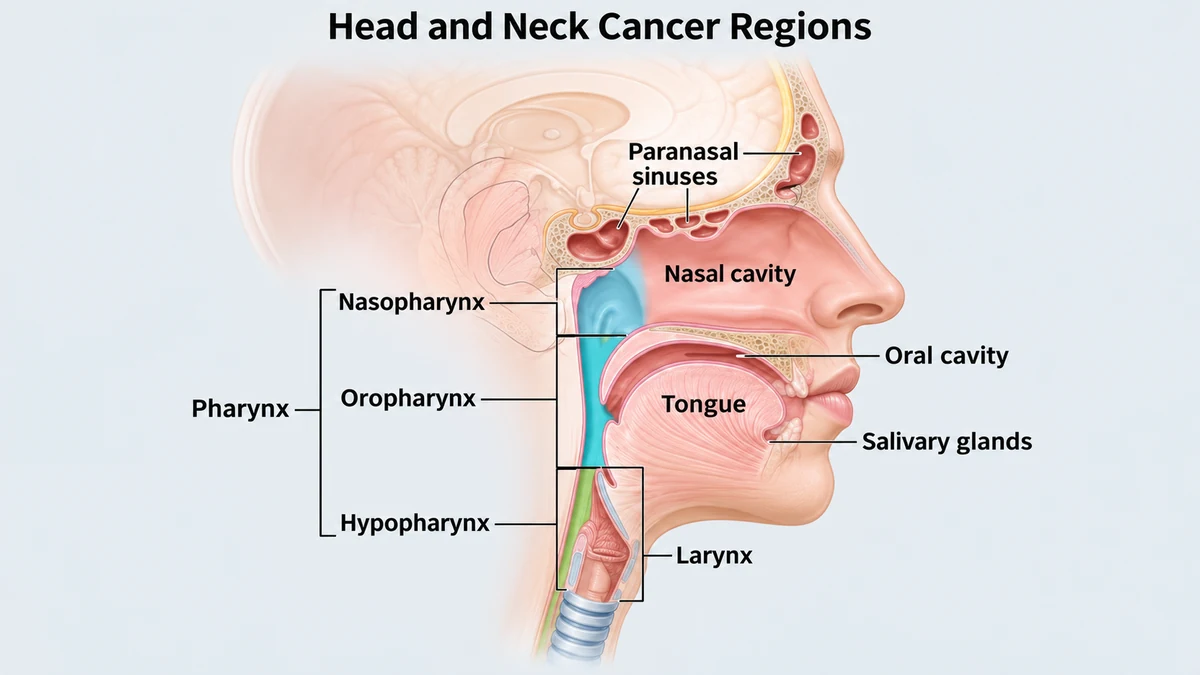
The authorization covers head and neck squamous cell carcinoma that has returned or spread to other parts of the body. The disease must have progressed during or after platinum-based chemotherapy and an anti-PD-(L)1 antibody, a type of immunotherapy. This indication excludes oropharyngeal squamous cell cancers associated with human papillomavirus, or HPV. The oropharynx is the part of the throat behind the mouth.
These cancers often start in the cells lining the mouth, throat or voice box. They are not the same as brain cancer. Amivantamab is an antibody that acts on two proteins, EGFR and MET, involved in cell growth signals. The approved formulation is given under the skin by healthcare professionals.
What the evidence shows
The decision rests on 102 participants in OrigAMI-4, a phase 1b/2 trial conducted at multiple centers. It was open-label: patients and clinicians knew the treatment being given. An independent assessment found a tumor response in 42% of participants, with a 95% confidence interval of 32% to 52%. A response means tumor shrinkage or disappearance under the study criteria, not a proven cure.
Among those who responded, 56% had a response lasting at least six months. That 56% refers to responders, not all 102 participants. The analyzed group did not include a randomized comparison with another therapy. These findings alone therefore do not establish longer survival than available treatments.
The new development is the approval
The study was published online in the Journal of Clinical Oncology on May 31, 2026, using data available on March 18, 2026. The November news is the regulatory decision. Accelerated approval uses signs of effectiveness, here tumor response and its duration, to allow earlier access for a serious disease. Further studies must confirm the clinical benefit.
Risks belong alongside the results
The Food and Drug Administration highlights allergic or administration-related reactions, lung inflammation, skin and eye problems, and possible harm to an unborn baby. The manufacturer’s safety summary reports serious adverse reactions in 39% of participants. Rash, fatigue, nail problems, inflammation in the mouth and swelling were among the most common reactions.
The scientific report describes six deaths associated with adverse events. One, from lung inflammation, was considered treatment-related; the other five were not. An event occurring during a study is not necessarily caused by the medicine. These findings call for specialist assessment of both benefits and risks.
What this means outside the United States
The decision applies to the United States. It does not automatically establish authorization, availability or reimbursement in other countries. For an individual, the tumor site, HPV association, previous treatments and overall health all matter. Do not change treatment because of this news; discuss its relevance with your oncology team.
Research funding
Janssen Research & Development, a Johnson & Johnson company, supported the trial. The manufacturer’s announcement has a commercial interest and is considered alongside the regulator’s documents and the scientific report.
Content details
- Study design
- Regulatory decision November 5, 2026; OrigAMI-4 cohort 1, multicenter open-label phase 1b/2, 102 participants, without a randomized comparison in this cohort. Online publication May 31, 2026; data cutoff March 18, 2026.
- Population and context
- General health news for adults and families. The new indication covers the specified cancer population, not every head and neck cancer.
- Evidence limitations
- US accelerated approval based on response and response duration; long-term clinical benefit requires confirmation. The 56% applies only to responders. Serious risks and industry support disclosed. No conclusions on other countries’ approvals or reimbursement.
📚 Sources
- Food and Drug Administration — FDA grants accelerated approval to amivantamab and hyaluronidase-lpuj for recurrent or metastatic head and neck squamous cell carcinoma
- Food and Drug Administration — FDA Grants Accelerated Approval to a New Treatment for Head and Neck Squamous Cell Carcinoma
- Barbara Burtness and colleagues — Journal of Clinical Oncology — Amivantamab in Recurrent/Metastatic Head and Neck Squamous Cell Cancer After Checkpoint Inhibitor and Chemotherapy: Pivotal Results From the Phase Ib/II OrigAMI-4 Study
- Food and Drug Administration — Accelerated Approval Program
- Johnson & Johnson — Johnson & Johnson announces U.S. FDA Approval of RYBREVANT FASPRO™ (amivantamab and hyaluronidase-lpuj) as First and Only Dual-Targeted Therapy for Advanced Head and Neck Cancer
- National Cancer Institute — Head and Neck Cancers
Sources checked on: 21 November 2026