



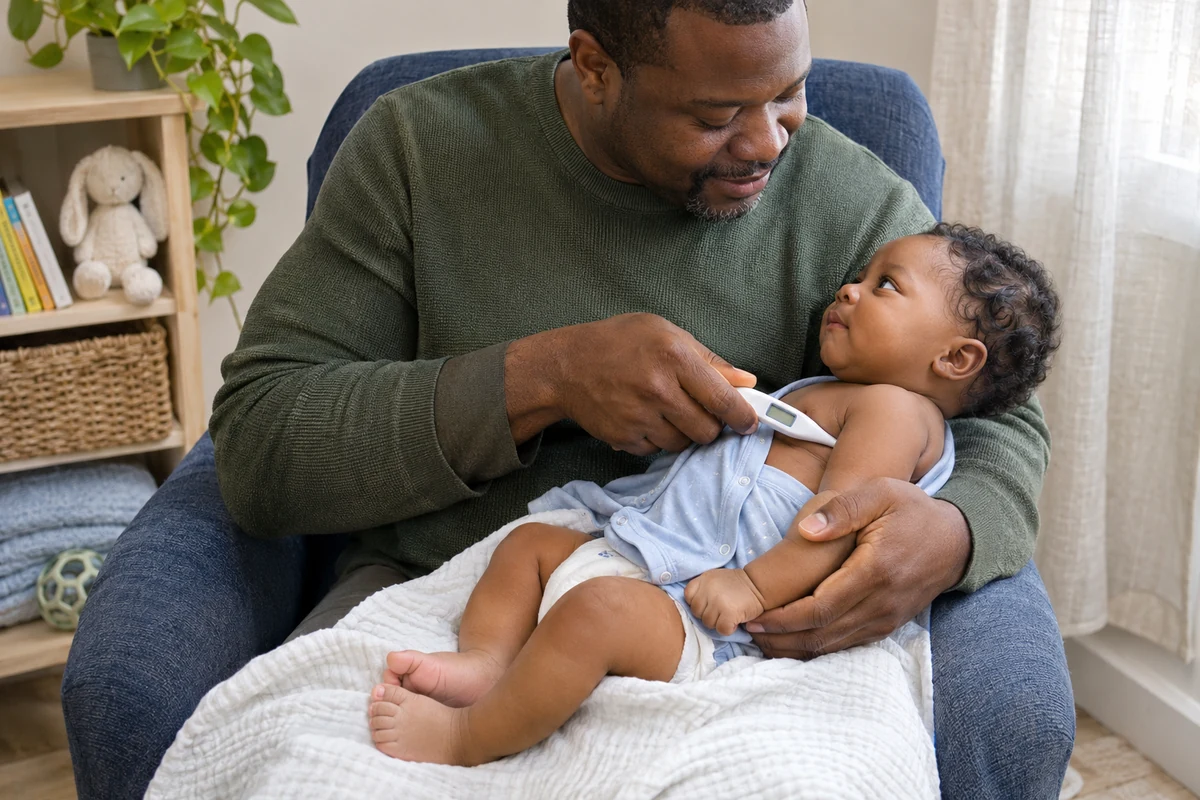
Fever in a young baby: when to seek help and how to measure it
A fever in a young baby deserves a different response from a fever in an older child. If your baby is three months old or younger and has a temperature of 38°C (100.4°F) or more, contact a pediatric clinician or urgent medical service immediately, even if the baby looks well. Say how you measured it. Do not wait overnight or for medicine to bring the temperature down. If you suspect fever in a baby under three months but cannot get a reliable reading, seek urgent advice too.
If the temperature comes down
Say your 7-week-old baby had a temperature of 100.8°F (38.2°C) at home and the next reading was lower. Still seek medical help right away. Give the care team both readings, when you took them and how you measured. The earlier fever matters even if the temperature is lower by the time your baby is seen.
Why a baby who looks well still needs assessment
Fever can accompany viral illnesses, ear or urinary infections and respiratory infections. Less commonly, it can signal serious conditions such as sepsis or meningitis. The number on the thermometer cannot identify the cause. A clinician may need to examine your baby and arrange tests. Teething does not explain a true fever; a recent vaccination should also be reported rather than used to dismiss it.
Measure carefully: recommendations vary by country
The American Academy of Pediatrics, a United States professional association, identifies rectal measurement as the most accurate in very young infants. The National Health Service in England recommends a digital thermometer in the armpit for children under five. These are different clinical pathways: follow your local clinician’s advice and the device instructions. Report the actual reading and measurement site; do not add or subtract a fixed number to convert between methods.
For an armpit reading, position the probe high in the armpit and gently hold the arm against the body for the time specified by the manufacturer. Touching the forehead and using forehead strips are unreliable. Ear thermometers are unsuitable below six months in the American guidance. Never use a mercury thermometer. A bath or heavy wrapping can briefly affect a reading; recheck after a few minutes without letting the baby get cold, but never delay urgent help for a sick baby.
Signs that require emergency help
Call local emergency services if the baby is difficult to wake, unresponsive, struggling to breathe, grunting or pulling in beneath the ribs; has blue, gray, unusually pale or blotchy coloring; develops a rash that does not fade under pressure; has a stiff neck, a seizure, unusually cold hands and feet, or crying that cannot be soothed. Color changes can be harder to recognize on brown or Black skin. Do not wait for several signs or for the temperature to rise further.
While you arrange medical care
Offer breast milk or formula and watch alertness, feeding and wet diapers. Fewer wet diapers or difficulty feeding need prompt attention. Do not replace milk feeds with juice. Avoid excessive layers, ice, cold baths and alcohol rubs. The English guidance also advises against sponging a child down to reduce fever. For babies under three months, speak to a clinician before giving fever medicine; age restrictions differ by country. Do not give aspirin or alternate medicines without professional instructions.
What to tell the care team
Have the baby’s exact age, any prematurity or health conditions, temperature and measurement method, time of the reading, feeding changes, wet diapers, recent vaccinations and any medicines ready to report. This guide covers early infancy, not treatment doses or rules for older children. Overheating and heatstroke are separate dangers: never leave a baby alone in a car, and seek emergency help if heatstroke is suspected.
Content details
- Study design
- Institutional guidance, not a new trial. American Academy of Pediatrics: September 23, 2025. National Health Service fever page: January 3, 2024; temperature page: July 18, 2023. MedlinePlus encyclopedia content by A.D.A.M.: reviewed October 1, 2025.
- Population and context
- Parents and caregivers of babies up to three months old. American and English measurement guidance is attributed separately; premature or medically vulnerable babies need individual advice.
- Evidence limitations
- General information cannot diagnose an infection. The English temperature page is past its scheduled July 2026 review and was cross-checked against the other sources. National recommendations differ; the English advice against sponging is identified explicitly. No personalized doses or guidance for older children.
📚 Sources
- American Academy of Pediatrics — United States pediatric professional association — Fever and Your Baby (HealthyChildren.org)
- National Health Service — public health service in England — High temperature (fever) in children
- National Health Service — public health service in England — How to take your baby's temperature
- U.S. National Library of Medicine — United States national medical library; encyclopedia content by A.D.A.M. — MedlinePlus Medical Encyclopedia — When your baby or infant has a fever
- Canadian Paediatric Society — Canada — Management of well-appearing febrile young infants aged ≤90 days
Sources checked on: 2 November 2026