



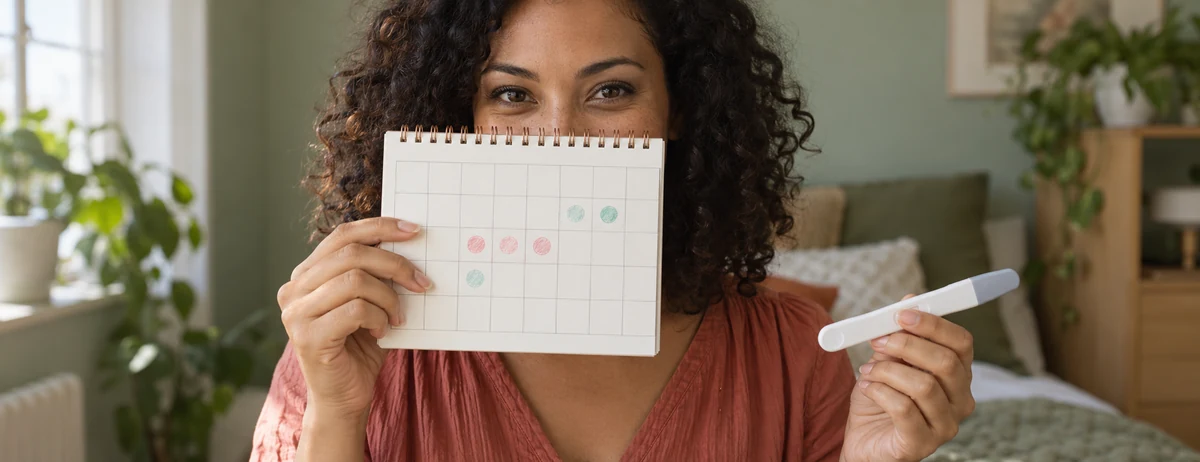
The fertile window: finding your most likely days without chasing a perfect date
Trying to conceive can turn an ordinary calendar into a source of pressure. The useful idea behind the fertile window is simpler: sperm need to be present around ovulation, when an ovary releases an egg. There is no single date that guarantees pregnancy, and missing a prediction from an app does not mean you have missed every opportunity.
Why the days before ovulation matter
Sperm can survive for several days, while an egg remains available for roughly 12 to 24 hours after release. The American Society for Reproductive Medicine defines the research-based fertile window as the five days before ovulation plus ovulation day. Johns Hopkins Medicine uses a broader practical interval that also includes the following day. These are descriptions of a biological process, not precise boundaries a calendar can establish. The highest chances tend to be in the days before ovulation; neither definition makes the next day a guaranteed opportunity or a safe day for contraception.
Count a cycle, then treat the prediction as an estimate
Cycle day one is the first day of a period. Count from that day to the beginning of the next period to understand cycle length. Ovulation is often around 12 to 14 days before the next period, rather than always on day 14 of every cycle. Recording several cycles can reveal patterns, but even usually regular cycles vary. Calendar apps therefore estimate timing; irregular cycles make those estimates less dependable.
Use signals as clues, not a verdict
Cervical mucus may become clearer, wetter and more slippery near ovulation. Urinary ovulation kits look for a rise in luteinizing hormone, which usually precedes ovulation; release can occur within the following one to two days, but a positive result does not prove that it happened. Some conditions, including polycystic ovary syndrome, can complicate interpretation. A sustained rise in basal body temperature generally appears after ovulation, so it mainly describes what has already happened rather than identifying the start of the fertile days.
Choose a rhythm you can sustain
The professional guidance associates sex every one to two days during the fertile window with the highest pregnancy rates. The National Health Service offers a less schedule-focused approach: sex every two to three days throughout the cycle. These approaches can both help avoid relying on a single predicted date. Daily sex is not compulsory; choose a frequency that works for both partners. No particular sexual position or routine of lying down afterward has demonstrated a fertility advantage. Tracking should help rather than become a test of commitment.
When a calendar is no longer the right next step
Seek advice earlier for absent or markedly irregular periods, a known fertility problem, relevant medical history or difficulty having sex. US professional guidance recommends evaluation after 12 months of trying for people under 35 and after six months from age 35, with earlier assessment when indicated; local pathways differ. Preconception care also includes checking medicines, vaccinations and supplements, stopping smoking and avoiding alcohol. Do not stop prescribed treatment without discussing it with a clinician. If pregnancy is not wanted, use an appropriate contraceptive method: predicting fertile days neither reliably excludes pregnancy on other days nor protects against sexually transmitted infections.
Content details
- Study design
- Patient information drawing on a US professional committee opinion published in 2022 and institutional patient guidance, including the National Health Service page reviewed June 2, 2026; not a new trial.
- Population and context
- Adults planning pregnancy through vaginal intercourse. British and US guidance is described; insemination and fertility treatment require an individualized clinical schedule.
- Evidence limitations
- A predicted fertile window is an estimate, not confirmation of ovulation or an individual pregnancy probability. Definitions and tracking accuracy vary; this guide is not contraceptive instruction.
📚 Sources
- American Society for Reproductive Medicine — professional society for reproductive medicine, United States — Optimizing natural fertility: a committee opinion (2022)
- National Health Service — public health service, England — Trying to get pregnant
- Johns Hopkins Medicine — academic medical institution, United States — Calculating Your Monthly Fertility Window
Sources checked on: 21 November 2026