



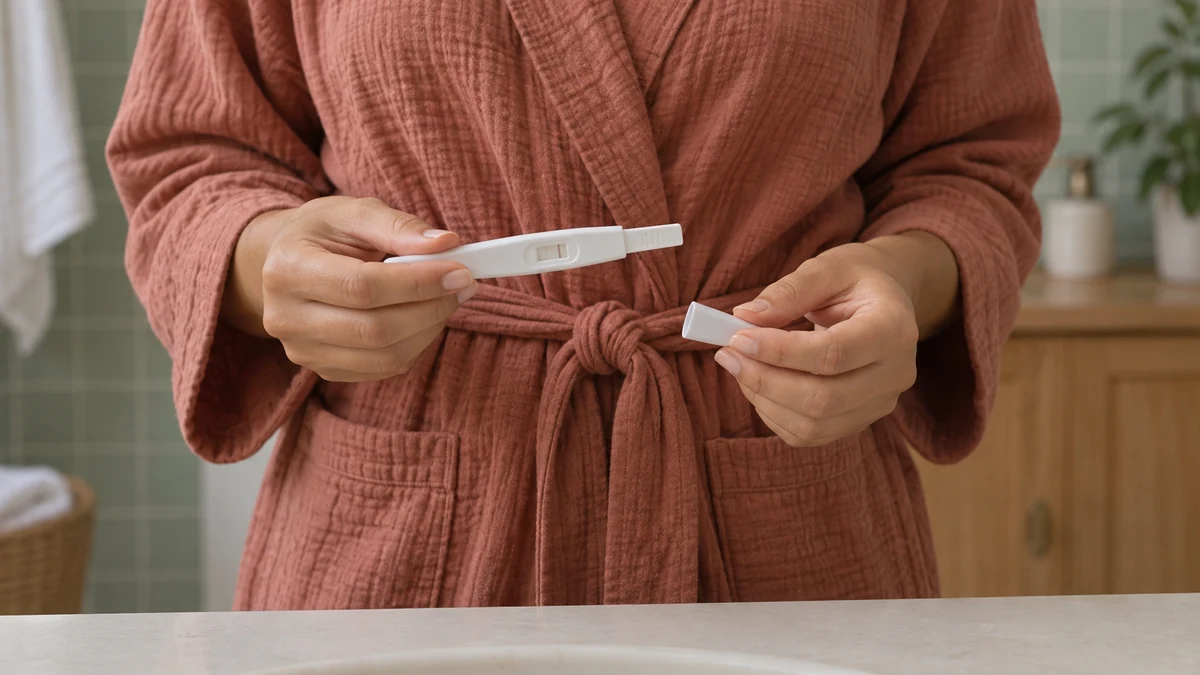
Home pregnancy tests: when to test and what the result can tell you
A home pregnancy test looks for human chorionic gonadotropin, usually written hCG, in urine. This hormone rises after implantation. The test answers a limited question: is enough hCG present for that device to detect? It does not establish where a pregnancy is located, how it is developing or its exact gestational age. Timing and correct use matter more than an impressive claim on the box.
Choose the testing day with care
England’s National Health Service advises using most tests from the first day of a missed period. If you do not know when the next period is due, its practical advice is to test at least 21 days after the last unprotected sex. Some sensitive tests can be used earlier, but an early negative is less reassuring. Ovulation and implantation do not follow an identical schedule every month. The US Food and Drug Administration estimates that 10 to 20 out of every 100 pregnant women will not detect pregnancy on the first day of a missed period. This describes missed detection among pregnant women, not the chance that every test result is wrong.
Follow the instructions for the actual kit
Check the expiry date and read the leaflet before starting. Kits differ: some go into the urine stream, some are dipped into a collected sample, and others use drops. Follow the specified collection method, exposure time and reading window, using a timer. There is no single waiting time that suits every brand. The National Health Service says urine can be collected at any time of day; first-morning urine can improve early detection because it is usually more concentrated, as the Food and Drug Administration and Mayo Clinic explain.
Read the control as well as the result
A missing control indicator means the test has not worked: use a new one. Interpret lines, symbols or words exactly as the leaflet explains and within its reading window. A faint positive line can still indicate pregnancy when the control is valid; ask a pharmacist or clinician if the display is unclear. A positive result is usually correct, whereas a negative taken too soon can miss a pregnancy. Advertised accuracy of up to 99% should not be read as a guarantee at every testing time or with every use.
Decide what to do after the result
If the result is negative but pregnancy remains possible, repeat after a few days. If a second test is negative and your period has not arrived, contact a healthcare professional rather than repeating tests indefinitely. The Food and Drug Administration notes that testing one to two weeks after a missed period improves reliability; this is not a reason to delay care for symptoms or wait to arrange pregnancy care after a positive result. With a positive result or conflicting results, seek advice about confirmation and next steps. Blood testing or ultrasound may be appropriate depending on timing and symptoms; they are not automatically required in the same way for everyone.
Medicines containing hCG, including some fertility treatments, can produce a false positive. Most medicines, including antibiotics and contraceptive pills, do not invalidate a pregnancy test. A recent early pregnancy loss and, more rarely, ovarian conditions or menopause can also complicate interpretation. Tell the clinician about treatment and recent pregnancy history. Do not stop prescribed medicines on your own. If you plan to continue the pregnancy, arrange prenatal care promptly; if you are uncertain, ask a qualified local service about available options and confidentiality.
Symptoms take priority over another home test
If pregnancy is possible, lower abdominal pain, particularly on one side, bleeding or unusual shoulder-tip pain needs prompt medical assessment. These symptoms have several possible causes, including ectopic pregnancy. Sudden severe abdominal pain with marked dizziness, fainting or collapse is an emergency: contact local emergency services immediately. Do not wait for a positive test or another testing day before seeking help when concerning symptoms occur.
Content details
- Study design
- Institutional patient guidance, not a clinical trial. Mayo Clinic article dated April 1, 2026; Office on Women’s Health page updated October 24, 2025. National Health Service testing and ectopic-pregnancy pages last reviewed in 2022, with their displayed review deadlines passed; core testing advice was cross-checked against the other listed sources.
- Population and context
- General information for people who may be pregnant. British and US guidance is identified; local services, access and confidentiality rules vary.
- Evidence limitations
- Sensitivity depends on the product, timing and correct use. Institutional timing advice has different aims: the National Health Service gives a practical first testing point; the Food and Drug Administration describes greater reliability with later testing. A home test cannot establish pregnancy location or viability.
📚 Sources
- Food and Drug Administration — medicines and medical devices regulator, United States — Pregnancy
- National Health Service — public health service, England — Doing a pregnancy test
- Mayo Clinic — nonprofit academic medical center, United States — Home pregnancy tests: Can you trust the results?
- Office on Women’s Health, United States Department of Health and Human Services — federal women’s health office, United States — Pregnancy tests
- National Health Service — public health service, England — Ectopic pregnancy
- National Health Service — public health service, England — Medicines in pregnancy
Sources checked on: 30 October 2026