




Ovulation tests: how to use the result without asking it to predict everything
An ovulation test can help identify a useful time to try for pregnancy. It answers a narrower question than its name sometimes suggests: has a particular hormone risen in this urine sample? Understanding that distinction makes the result more useful and less alarming.
What the test actually measures
Most home ovulation kits detect luteinizing hormone, usually shortened to LH. The surge typically occurs about 24 to 36 hours before ovulation, though the interval varies. Some devices also assess estrone-3-glucuronide, a marker related to estrogen. These are hormone signals, not direct observation of an egg being released. An ovulation test does not measure egg quality, investigate every cause of infertility or establish that pregnancy has begun; pregnancy tests detect a different hormone, human chorionic gonadotropin.
Follow the instructions for your particular kit
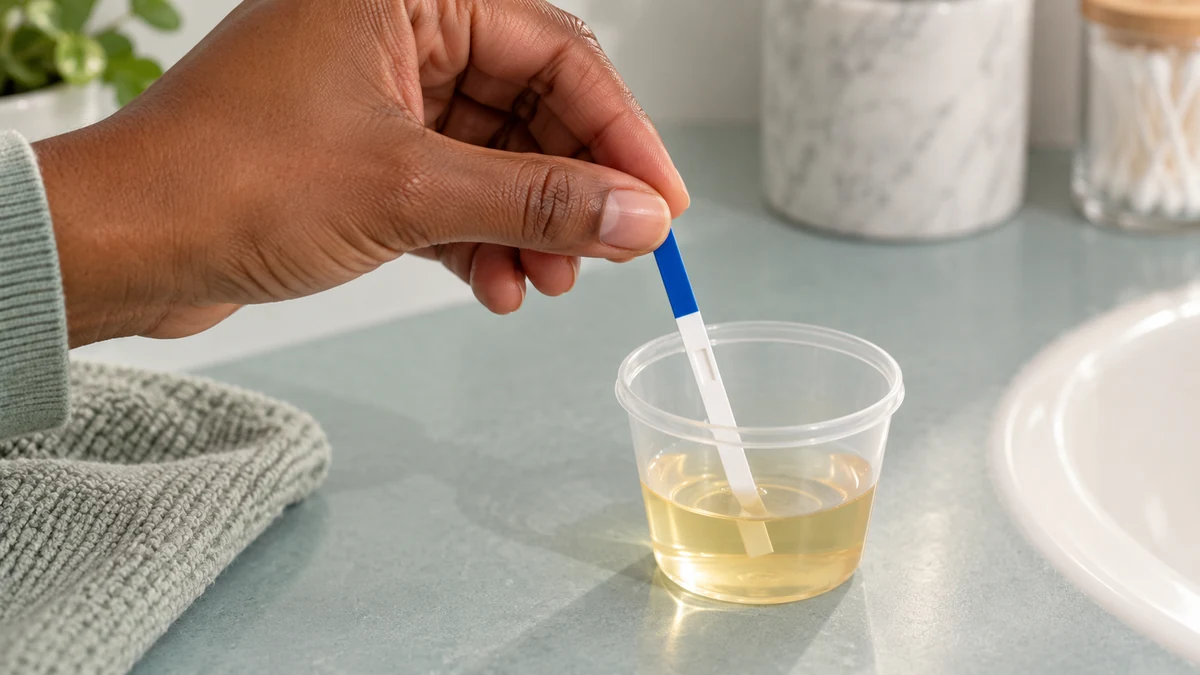
The starting day depends on cycle length. Testing often begins several days before expected ovulation, and more than one day of testing may be needed. A calendar estimate is less dependable with irregular cycles. Follow the kit’s directions for time of day, urine collection, dipping depth and duration, and the reading window. Some products are dipped into collected urine; others are held in the urine stream or read by a monitor. A single universal schedule does not fit every device. Avoid drinking unusually large amounts of fluid just before testing, because dilution can make the surge harder to detect.
Read a positive result as an opportunity, not a promise
For line-based tests, the control and test lines have different functions. Follow the illustrated instructions to decide whether the test line meets that product’s positive threshold; simply seeing a faint line is not enough to apply the rules of a pregnancy test. A missing required control or an error display should be handled as directed for an invalid result. A valid positive can help time intercourse, but cannot guarantee ovulation or conception. If insemination or fertility medicines are part of your care, use the clinic’s schedule and do not change doses yourself.
A negative test does not settle the question
The surge may have been missed because testing started too early or late, a day was skipped, urine was diluted or cycles are irregular. A negative result alone does not diagnose a failure to ovulate. False-positive results can also occur. Medicines and hormonal treatments can alter interpretation; tell your clinician what you take rather than stopping treatment to obtain a different result.
When to ask for help
Discuss repeated difficulty detecting a surge, irregular or absent periods, uncertainty about the results or continued difficulty conceiving with a healthcare professional. A clinical assessment can combine history, examination and selected laboratory or imaging tests. The Food and Drug Administration explicitly cautions against using ovulation tests to prevent pregnancy. They do not identify all potentially fertile days reliably enough for contraception and do not protect against sexually transmitted infections.
Content details
- Study design
- Institutional patient information and regulatory advice; not a new clinical trial.
- Population and context
- Adults planning pregnancy; US institutional guidance. Follow local clinical advice and the instructions of the particular product.
- Evidence limitations
- Hormone detection does not prove ovulation, diagnose overall fertility or guarantee pregnancy. Timing, technique, medicines and cycle variation affect results.
📚 Sources
- Food and Drug Administration — US medicines and medical devices regulator — Ovulation (Urine Test)
- MedlinePlus — National Library of Medicine, National Institutes of Health — US public medical information service — Ovulation home test
- Cleveland Clinic — nonprofit academic medical center, United States — How (and Why) to Use At-Home Ovulation Tests To Get Pregnant
Sources checked on: 30 October 2026