


Pheochromocytoma and paraganglioma. Tests, treatment and centers
These tumors can make hormones that raise blood pressure and speed up the heart. Tests help doctors locate the tumor and choose the right treatment.
MyMedNest editorial guide · Sources checked:
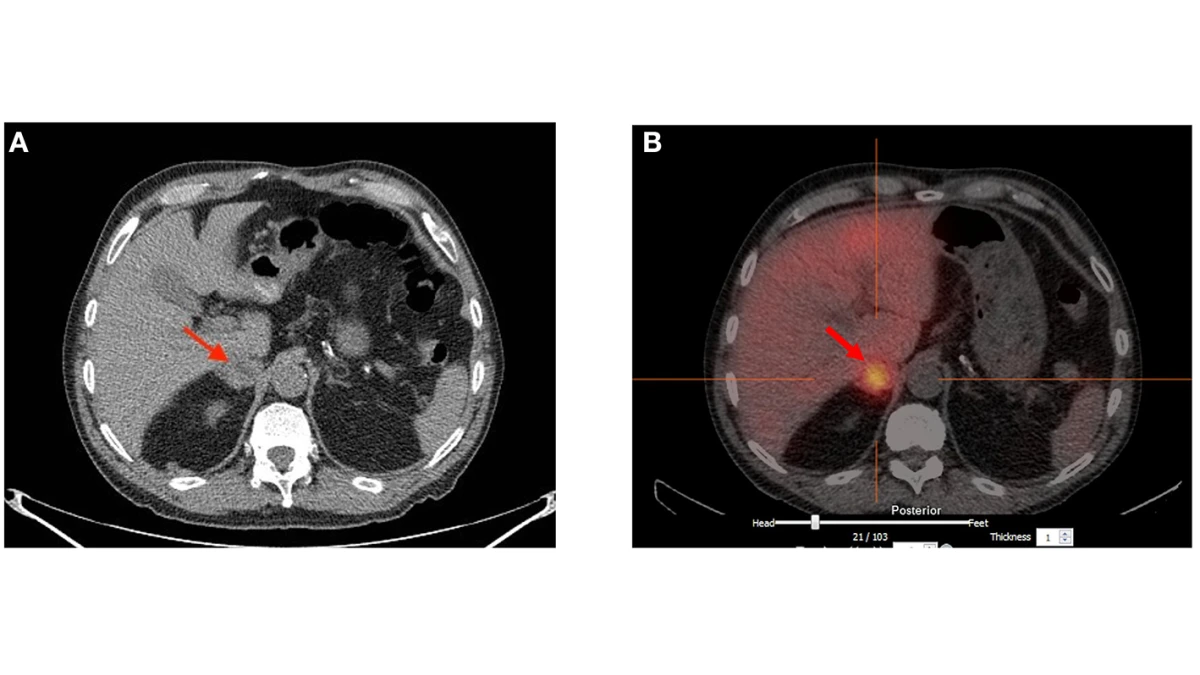
Image source and reuse details
Source: Isolated Pheochromocytoma in a 73-Year-Old Man With No Clinical Manifestations of Type 1 Neurofibromatosis Carrying an Unsuspected Deletion of the Entire NF1 Gene — Figure 1. Scaled proportionally, framed and converted to WebP. The original marks and both panels are intact.
In this guide
Where they start
Pheochromocytoma starts inside an adrenal gland, above a kidney. Paraganglioma starts in similar cells outside the adrenal glands. It can also appear in the head or neck.
Some of these tumors stay in one place. Others spread. Genetic counseling can help find an inherited change, for example in SDHB, SDHD, RET or VHL. The result may change the checks for you and some relatives.
Source: National Cancer Institute — Pheochromocytoma and Paraganglioma Treatment (PDQ®) — Patient Version · GeneReviews — University of Washington, Seattle — Hereditary Paraganglioma-Pheochromocytoma Syndromes
Signs and emergencies
Some tumors make adrenaline or similar hormones. This can cause bursts of headache, sweating, a pounding heart and high blood pressure. A lump in the neck can change the voice. Some tumors are found by chance.
Get medical help right away for chest pain, severe trouble breathing or sudden weakness on one side of the body. If episodes keep happening, tell your doctor and bring a list of your medicines.
Source: National Cancer Institute — Pheochromocytoma and Paraganglioma Treatment (PDQ®) — Patient Version · Japan Endocrine Society — Japan Endocrine Society Clinical Practice Guideline for the Diagnosis and Management of Pheochromocytoma and Paraganglioma 2025
What the tests show
Doctors can measure metanephrines in blood or urine. The body makes these substances when it breaks down adrenaline and similar hormones. Medicines and the way the sample is taken can affect the result.
A CT scan, magnetic resonance imaging or a nuclear medicine scan can show where the tumor is and whether it has spread. The figure shows a CT and an iobenguane scan, also known as MIBG, from one case. If pheochromocytoma is suspected, an adrenal mass needs specialist assessment before biopsy.
Source: National Cancer Institute — Pheochromocytoma and Paraganglioma Treatment (PDQ®) — Health Professional Version · Japan Endocrine Society — Japan Endocrine Society Clinical Practice Guideline for the Diagnosis and Management of Pheochromocytoma and Paraganglioma 2025 · Frontiers in Endocrinology — Isolated Pheochromocytoma in a 73-Year-Old Man With No Clinical Manifestations of Type 1 Neurofibromatosis Carrying an Unsuspected Deletion of the Entire NF1 Gene
How doctors treat them
Surgery is often an option if the tumor is in one place and can be removed. If it makes extra hormones, the team uses medicines and checks before surgery to reduce the chance of dangerous blood pressure changes.
When the disease has spread, the team considers ways to control hormones, pain and tumor growth. Options may include radiation, chemotherapy, a targeted drug or radioactive medicine that reaches the tumor. The scans and rate of growth help guide the choice.
Source: National Cancer Institute — Pheochromocytoma and Paraganglioma Treatment (PDQ®) — Health Professional Version · Japan Endocrine Society — Japan Endocrine Society Clinical Practice Guideline for the Diagnosis and Management of Pheochromocytoma and Paraganglioma 2025
Medicines and research
In the United States, belzutifan is approved from age 12 for these advanced tumors when they are locally advanced, cannot be removed or have spread. In LITESPARK-015, the tumors shrank enough to meet the study’s measure for a response in 26% of 72 participants. The trial had no comparison group. The drug can cause anemia or low blood oxygen. The United States authorization differs from the European indications.
In FIRSTMAPPP, a phase 2 trial of 78 people with growing metastatic tumors, 36% on sunitinib and 19% on a placebo were free of progression at 12 months. This measures control of tumor growth. Access to the medicine depends on local rules.
Source: United States Food and Drug Administration — FDA approves belzutifan for pheochromocytoma or paraganglioma · European Medicines Agency — Welireg — European public assessment report · The New England Journal of Medicine — Belzutifan for Advanced Pheochromocytoma or Paraganglioma · The Lancet — Sunitinib for metastatic progressive phaeochromocytomas and paragangliomas: results from FIRSTMAPPP, an academic, multicentre, international, randomised, placebo-controlled, double-blind, phase 2 trial
Follow-up and daily life
After surgery, ask which tests you will have and when. Follow-up can last many years. People with inherited or higher-risk disease may need lifelong checks. Keep your reports and tell the team about new symptoms.
Walking and light activity may be possible if the team says they are safe. If your blood pressure is unstable, check which activities are suitable. Speak to a clinician before taking supplements or changing your medicines. No diet removes these tumors.
Source: National Cancer Institute — Pheochromocytoma and Paraganglioma Treatment (PDQ®) — Health Professional Version · Japan Endocrine Society — Japan Endocrine Society Clinical Practice Guideline for the Diagnosis and Management of Pheochromocytoma and Paraganglioma 2025 · National Cancer Institute — Diets, Supplements, and Cancer
Where to look for care
In Italy, the endocrinology team at Careggi in Florence treats these conditions. In France, Gustave Roussy has a specialist endocrine tumor program. In the United States, The University of Texas MD Anderson Cancer Center has a pathway for hereditary forms.
Ask the center whether you need a referral and how to send records securely. Ask about endocrinology, adrenal surgery and genetics. For disease that has spread, a specialist team can explain treatment options and relevant studies.
Source: Azienda Ospedaliero Universitaria Careggi — Endocrinologia · Azienda Ospedaliero Universitaria Careggi — Informazioni per visita endocrinologica con quesito diagnostico · Gustave Roussy — Comité des tumeurs endocrines · Gustave Roussy — International Department · The University of Texas MD Anderson Cancer Center — Multiple Endocrine Neoplasia Clinic · The University of Texas MD Anderson Cancer Center — International Referrals
Questions to take to your appointment
- Where do these tumors start?
- Which signs need immediate help?
- What do metanephrine tests measure?
- Why is preparation important before surgery?
- When may belzutifan be used?
- How can I find a specialist center?
Sources and verification
- National Cancer Institute — Pheochromocytoma and Paraganglioma Treatment (PDQ®) — Patient Version
- National Cancer Institute — Pheochromocytoma and Paraganglioma Treatment (PDQ®) — Health Professional Version
- GeneReviews — University of Washington, Seattle — Hereditary Paraganglioma-Pheochromocytoma Syndromes
- Japan Endocrine Society — Japan Endocrine Society Clinical Practice Guideline for the Diagnosis and Management of Pheochromocytoma and Paraganglioma 2025
- United States Food and Drug Administration — FDA approves belzutifan for pheochromocytoma or paraganglioma
- European Medicines Agency — Welireg — European public assessment report
- The New England Journal of Medicine — Belzutifan for Advanced Pheochromocytoma or Paraganglioma
- The Lancet — Sunitinib for metastatic progressive phaeochromocytomas and paragangliomas: results from FIRSTMAPPP, an academic, multicentre, international, randomised, placebo-controlled, double-blind, phase 2 trial
- National Cancer Institute — Diets, Supplements, and Cancer
- Azienda Ospedaliero Universitaria Careggi — Endocrinologia
- Azienda Ospedaliero Universitaria Careggi — Informazioni per visita endocrinologica con quesito diagnostico
- Azienda Ospedaliero Universitaria Careggi — Carta dei servizi del Centro Trapianti di Rene — recapiti dell’Ufficio Relazioni con il Pubblico
- Gustave Roussy — Comité des tumeurs endocrines
- Gustave Roussy — International Department
- The University of Texas MD Anderson Cancer Center — Multiple Endocrine Neoplasia Clinic
- The University of Texas MD Anderson Cancer Center — International Referrals
- Frontiers in Endocrinology — Isolated Pheochromocytoma in a 73-Year-Old Man With No Clinical Manifestations of Type 1 Neurofibromatosis Carrying an Unsuspected Deletion of the Entire NF1 Gene
Sources checked: 2026-11-21