


Neuroblastoma in children. Tests, treatment and care centers
Neuroblastoma mainly affects young children. Some children need close checks. Others need several kinds of treatment. The tests help the team tell which approach fits.
MyMedNest editorial guide · Sources checked:
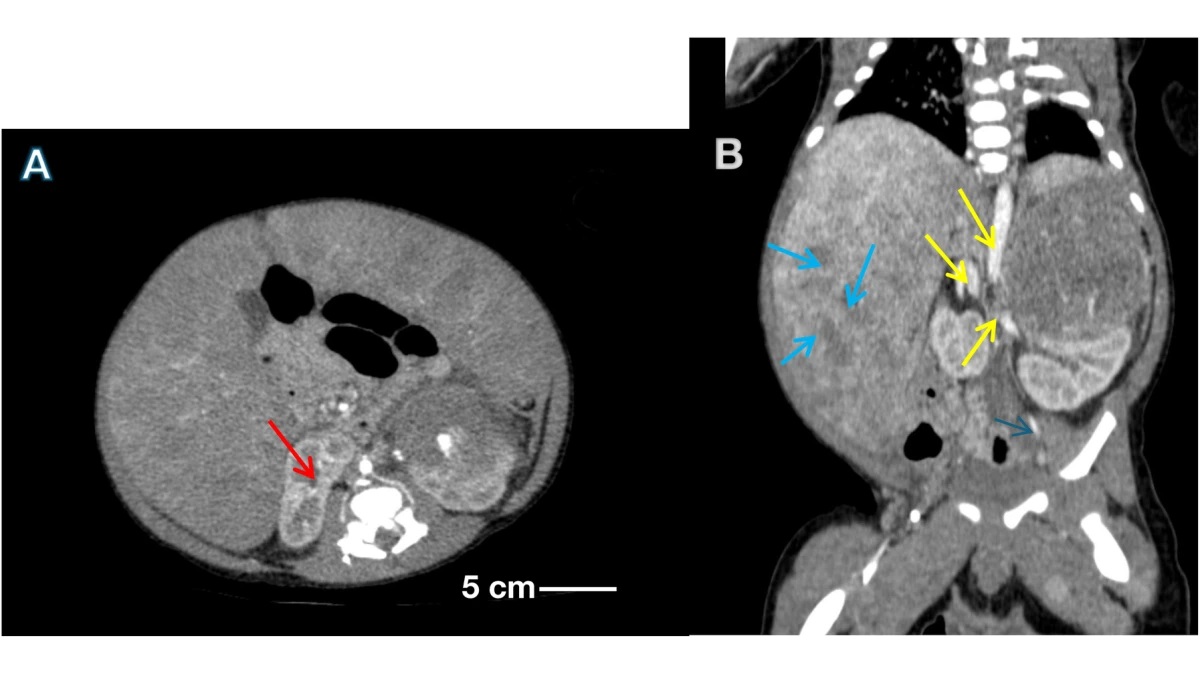
Image source and reuse details
Source: Case Report: Complete remission in a neonate with high-risk neuroblastoma harboring MYCN amplification and 1p deletion: a case for aggressive early intervention, and literature review — Figure 1. Scaled proportionally, framed and converted to WebP. The original arrows, scale and both panels are intact.
In this guide
Where it starts
Neuroblastoma starts in nerve cells that are still developing. It often starts in an adrenal gland above a kidney. It can also start near the spine or in the chest.
Doctors look at the child’s age, where the disease has spread and what the cells are like. They also look for extra copies of the MYCN gene. These clues help them work out the risk group and plan treatment.
Source: National Cancer Institute — Neuroblastoma Treatment (PDQ®) — Patient Version · National Cancer Institute — Neuroblastoma Treatment (PDQ®) — Health Professional Version
Signs to watch for
A swollen or painful belly, bone pain and unusual bruises can be signs. They can also have many other causes. Tell the child’s doctor if these signs last or get worse.
Get medical help right away if the child struggles to breathe, has new leg weakness, or has new bladder or bowel trouble with back pain or weakness. If fever occurs during chemotherapy, follow the cancer center’s instructions right away.
Source: National Cancer Institute — Neuroblastoma Treatment (PDQ®) — Patient Version · National Cancer Institute — Support for Families When a Child Has Cancer
How doctors test for it
A urine test looks for substances the tumor can make. Ultrasound, magnetic resonance imaging or a CT scan can show where it is. The team usually studies a small piece of tissue, called a biopsy.
A scan with iobenguane, often called MIBG, helps look for disease in the body. The team may also check the bone marrow. The figure shows two CT images from one published case. That child’s course cannot predict another child’s outcome.
Source: National Cancer Institute — Neuroblastoma Treatment (PDQ®) — Patient Version · Children’s Oncology Group and Society for Pediatric Radiology — Imaging of pediatric neuroblastoma: A COG Diagnostic Imaging Committee/SPR Oncology Committee White Paper · Frontiers in Pediatrics — Case Report: Complete remission in a neonate with high-risk neuroblastoma harboring MYCN amplification and 1p deletion: a case for aggressive early intervention, and literature review
Treatment by risk group
The team may watch some infants with a low-risk tumor closely. Some of these tumors shrink on their own. Other children need surgery. Children with intermediate-risk disease may also need chemotherapy.
High-risk treatment may include several medicines, surgery, high-dose chemotherapy followed by a return of the child’s own stem cells, radiation and immunotherapy. Anti-GD2 antibodies attach to a target on the surface of tumor cells. The team can explain the order and purpose of each step.
Source: National Cancer Institute — Neuroblastoma Treatment (PDQ®) — Patient Version · National Cancer Institute — Neuroblastoma Treatment (PDQ®) — Health Professional Version
Medicines and research
In the United States, eflornithine is approved to reduce the chance of high-risk neuroblastoma returning after at least a partial response to prior treatment that included anti-GD2 immunotherapy. The European application for Ifinwil was withdrawn on July 18, 2025. In the European Union, dinutuximab beta is authorized for defined high-risk cases from 12 months of age.
The phase 3 study NCT03126916 tests whether adding iodine-131 iobenguane or lorlatinib helps, depending on the group and the tumor's features. The iodine used for treatment differs from the iodine used for many diagnostic scans. A trial open at a site cannot promise a place or a benefit for an individual child.
Source: United States Food and Drug Administration — FDA approves eflornithine for adult and pediatric patients with high-risk neuroblastoma · European Medicines Agency — Withdrawal of application for the marketing authorisation of Ifinwil (eflornithine) · European Medicines Agency — Qarziba — Product information · National Cancer Institute — Testing the Addition of 131I-MIBG or Lorlatinib to Intensive Therapy in People with High-Risk Neuroblastoma (NBL)
Daily life and follow-up
Keep the center’s numbers handy and ask what to do about fever, pain or trouble drinking. If eating is hard, ask for a pediatric dietitian. Speak to the care team before giving vitamins or supplements.
After treatment, the team may check growth, hearing, kidneys and other effects based on the treatment the child received. Ask for a written plan. Work with the care team on when and how to return to school or physical activity.
Source: National Cancer Institute — Support for Families When a Child Has Cancer · National Cancer Institute — Late Effects of Treatment for Childhood Cancer (PDQ®) — Patient Version
How to find care
In Italy, the Istituto Giannina Gaslini in Genoa has a neuroblastoma center. In the United States, St. Jude Children’s Research Hospital takes physician referrals. In the United Kingdom, Great Ormond Street Hospital has a pediatric team that treats neuroblastoma.
Ask the child’s doctor how to send reports, scans and biopsy results. Use the secure route given by the hospital. The center can explain wait times, second opinions and trials that may fit.
Source: Istituto Giannina Gaslini — Centro di riferimento Regionale per la diagnosi e la cura del Neuroblastoma · Istituto Giannina Gaslini — Oncologia · St. Jude Children’s Research Hospital — Neuroblastoma Treatment · Great Ormond Street Hospital for Children National Health Service Foundation Trust — About the Specialist Neonatal and Paediatric Surgery (SNAPS) department · Great Ormond Street Hospital for Children National Health Service Foundation Trust — Contact the Haematology and Oncology department
Questions to take to your appointment
- Where does neuroblastoma start?
- Which signs need urgent help?
- What can a urine test show?
- Why does treatment depend on risk?
- Is eflornithine approved everywhere?
- How do I contact a specialist center?
Sources and verification
- National Cancer Institute — Neuroblastoma Treatment (PDQ®) — Patient Version
- National Cancer Institute — Neuroblastoma Treatment (PDQ®) — Health Professional Version
- Children’s Oncology Group and Society for Pediatric Radiology — Imaging of pediatric neuroblastoma: A COG Diagnostic Imaging Committee/SPR Oncology Committee White Paper
- United States Food and Drug Administration — FDA approves eflornithine for adult and pediatric patients with high-risk neuroblastoma
- European Medicines Agency — Withdrawal of application for the marketing authorisation of Ifinwil (eflornithine)
- European Medicines Agency — Qarziba — Product information
- National Cancer Institute — Testing the Addition of 131I-MIBG or Lorlatinib to Intensive Therapy in People with High-Risk Neuroblastoma (NBL)
- National Cancer Institute — Support for Families When a Child Has Cancer
- National Cancer Institute — Late Effects of Treatment for Childhood Cancer (PDQ®) — Patient Version
- Istituto Giannina Gaslini — Centro di riferimento Regionale per la diagnosi e la cura del Neuroblastoma
- Istituto Giannina Gaslini — Oncologia
- St. Jude Children’s Research Hospital — Neuroblastoma Treatment
- Great Ormond Street Hospital for Children National Health Service Foundation Trust — About the Specialist Neonatal and Paediatric Surgery (SNAPS) department
- Great Ormond Street Hospital for Children National Health Service Foundation Trust — Contact the Haematology and Oncology department
- Frontiers in Pediatrics — Case Report: Complete remission in a neonate with high-risk neuroblastoma harboring MYCN amplification and 1p deletion: a case for aggressive early intervention, and literature review
Sources checked: 2026-11-21