


Gestational trophoblastic disease: molar pregnancy, tumors and care
Gestational trophoblastic disease starts in cells that form the placenta. Most molar pregnancies are not cancer. In some people the tissue keeps growing after the pregnancy ends, so they need more tests or treatment.
MyMedNest editorial guide · Sources checked:
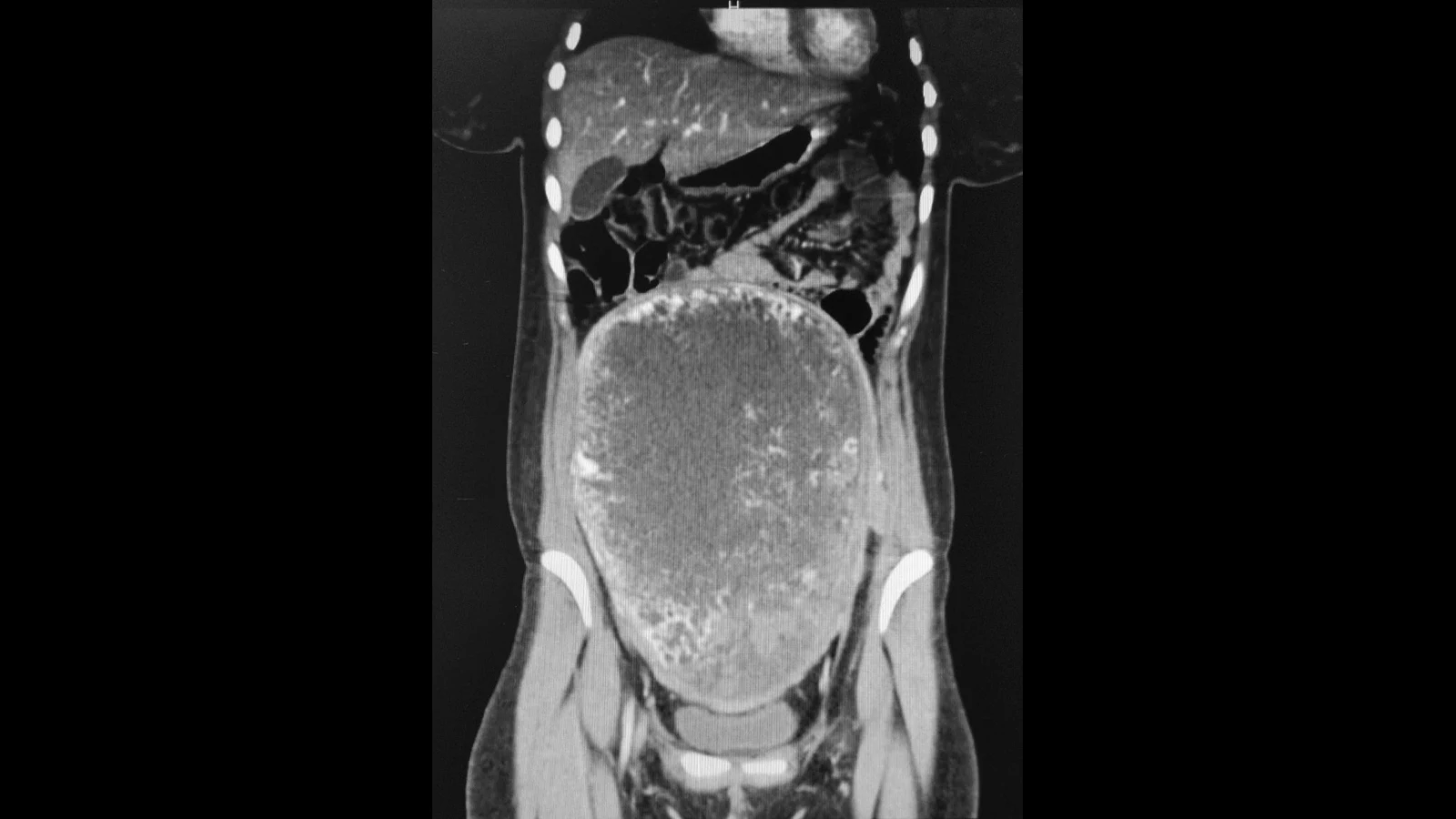
Image source and reuse details
Source: Giant complete hydatidiform mole: a case report and review of the literature — Figure 1. Converted to WebP, scaled proportionally and framed. The entire original view is visible.
In this guide
The different forms
The placenta is the organ that supports a developing fetus during pregnancy. Trophoblasts are the cells that help form it. In a complete mole, abnormal tissue usually grows without an embryo developing. In a partial mole, an embryo may start to develop, but the molar pregnancy cannot continue normally. A mole starts with a problem at fertilization. It is not caused by anything you did.
Forms that can grow into nearby tissue or spread are called gestational trophoblastic neoplasia. They include invasive mole, choriocarcinoma, placental-site trophoblastic tumor and epithelioid trophoblastic tumor. They can follow a molar pregnancy, miscarriage, ectopic pregnancy or birth. The placental-site and epithelioid types are very rare.
Source: National Cancer Institute — Gestational Trophoblastic Disease Treatment (PDQ®) — Patient Version · National Cancer Institute — Gestational Trophoblastic Disease Treatment (PDQ®) — Health Professional Version
When to get checked
Bleeding during pregnancy or bleeding that continues or returns after a pregnancy needs a medical check. Some people have severe nausea or vomiting. Others have no symptoms and the first sign is found on an ultrasound or a test after the pregnancy ends. There are other causes of these symptoms.
If bleeding is heavy, you faint or it is very hard to breathe, call your local emergency service right away. If you get a fever during chemotherapy, use your centre’s instructions and emergency contact right away.
Source: National Cancer Institute — Gestational Trophoblastic Disease Treatment (PDQ®) — Patient Version · Health Service Executive — National Cancer Control Programme — Diagnosis, staging and treatment of patients with gestational trophoblastic disease · National Cancer Institute — Infection and Neutropenia during Cancer Treatment
Tests and what hCG means
Doctors may order an ultrasound and a blood test for human chorionic gonadotropin (hCG), the hormone pregnancy tests detect. Examining tissue under a microscope can tell a complete mole from a partial mole. A pathologist, the doctor who examines tissue, may use additional tests to confirm the type.
After a mole is removed, doctors track hCG over time. If the level stops falling or rises across several tests, contact your centre and follow its plan. Some rare types of tumor produce little hCG. If the care team suspects an invasive form, it may use chest or other scans to find where the disease is. The CT image in this guide shows an unusual case of a very large complete mole.
Source: International Federation of Gynecology and Obstetrics — Diagnosis and management of gestational trophoblastic disease: 2025 update · International Federation of Gynecology and Obstetrics — FIGO staging for gestational trophoblastic neoplasia: 2026 · Journal of Medical Case Reports — Giant complete hydatidiform mole: a case report and review of the literature
How treatment is chosen
A molar pregnancy is often treated with a suction procedure to remove the tissue from the uterus. Most people with a mole do not need chemotherapy. For low-risk neoplasia, a centre may choose methotrexate or dactinomycin. For higher-risk disease, it may combine several medicines.
Surgery often plays a central role for placental-site and epithelioid tumors limited to the uterus. Many forms respond well to treatment. An individual outlook depends on the type, how far the disease has spread and how it responds. Your team can explain the aim of each treatment.
Source: National Cancer Institute — Gestational Trophoblastic Disease Treatment (PDQ®) — Health Professional Version · International Federation of Gynecology and Obstetrics — Diagnosis and management of gestational trophoblastic disease: 2025 update
Research when the first treatment stops working
In 2020, the phase 2 TROPHIMMUN study tested avelumab, an immunotherapy, in 15 people whose disease resisted chemotherapy with one drug. hCG returned to normal in 8 out of 15. This was a small study without a direct comparison with other treatments.
Avelumab is not an automatic first treatment. A specialist can explain which medicine or trial might fit your case and is available in your country. Ask what is known about likely benefits, possible harm and other options you already have.
Source: Journal of Clinical Oncology — American Society of Clinical Oncology — Avelumab in Patients With Gestational Trophoblastic Tumors With Resistance to Single-Agent Chemotherapy: Cohort A of the TROPHIMMUN Phase II Trial · International Federation of Gynecology and Obstetrics — Diagnosis and management of gestational trophoblastic disease: 2025 update
Follow-up, fertility and everyday life
Ask for a written schedule for blood tests and a number to call for results. The length of follow-up depends on the type of mole or tumor, the response to treatment and the centre’s protocol. A new pregnancy raises hCG and can make the tests harder to interpret. Talk with the team about birth control and when you can try again.
You can ask for support with pregnancy loss, tiredness or anxiety before a test. Tell your team if it is hard to eat or you are losing weight. Agree when to resume normal activities and ask before taking supplements during treatment.
Source: International Federation of Gynecology and Obstetrics — Diagnosis and management of gestational trophoblastic disease: 2025 update · Health Service Executive — National Cancer Control Programme — Diagnosis, staging and treatment of patients with gestational trophoblastic disease · National Cancer Institute — Nutrition During Cancer Treatment · Hôpitaux universitaires de Genève — Procédure de prise en charge
Making the first contact
The filter searches for centres by country, city or postal code. Ask if a centre can review your tissue report and hCG results and arrange follow-up close to home. Careggi in Florence has a dedicated centre. The Geneva and London programs have specific pathways for this disease.
Keep your report, test dates and hCG results handy. Ask for a secure way to send your documents. A second opinion can help if the exact type is uncertain or the first treatment has not worked.
Find a centre for gestational trophoblastic disease →
Source: Azienda Ospedaliero Universitaria Careggi — Centro diagnosi e terapia delle neoplasie trofoblastiche e gestazionali · Azienda Ospedaliero Universitaria Careggi — Prenotare una visita oncologica a Careggi · Hôpitaux universitaires de Genève — Centre des maladies trophoblastiques · Hôpitaux universitaires de Genève — Procédure de prise en charge · Imperial College Healthcare National Health Service Trust — Molar pregnancy clinic guide for clinicians
Questions to take to your appointment
- Does the report show a partial mole, a complete mole or another condition?
- Which centre should I contact and who can refer me?
- When is my next hCG test and who will tell me the result?
- Which symptoms need urgent help?
- What treatment might I need if hCG stops falling or rises?
- When can I try for another pregnancy?
Sources and verification
- National Cancer Institute — Gestational Trophoblastic Disease Treatment (PDQ®) — Patient Version
- National Cancer Institute — Gestational Trophoblastic Disease Treatment (PDQ®) — Health Professional Version
- International Federation of Gynecology and Obstetrics — Diagnosis and management of gestational trophoblastic disease: 2025 update
- International Federation of Gynecology and Obstetrics — FIGO staging for gestational trophoblastic neoplasia: 2026
- Health Service Executive — National Cancer Control Programme — Diagnosis, staging and treatment of patients with gestational trophoblastic disease
- Journal of Clinical Oncology — American Society of Clinical Oncology — Avelumab in Patients With Gestational Trophoblastic Tumors With Resistance to Single-Agent Chemotherapy: Cohort A of the TROPHIMMUN Phase II Trial
- National Cancer Institute — Infection and Neutropenia during Cancer Treatment
- National Cancer Institute — Nutrition During Cancer Treatment
- Azienda Ospedaliero Universitaria Careggi — Centro diagnosi e terapia delle neoplasie trofoblastiche e gestazionali
- Azienda Ospedaliero Universitaria Careggi — Prenotare una visita oncologica a Careggi
- Hôpitaux universitaires de Genève — Centre des maladies trophoblastiques
- Hôpitaux universitaires de Genève — Procédure de prise en charge
- Imperial College Healthcare National Health Service Trust — Molar pregnancy clinic guide for clinicians
- Journal of Medical Case Reports — Giant complete hydatidiform mole: a case report and review of the literature
Sources checked: 2026-11-21