


Rare cancers in children: diagnosis, treatment and specialist centers
If the report says your child has a rare tumor, ask for its exact name, where it started and which results are still needed. Find out who is coordinating care. If another review is planned, ask how to get the sample already taken to the center.
MyMedNest editorial guide · Sources checked:
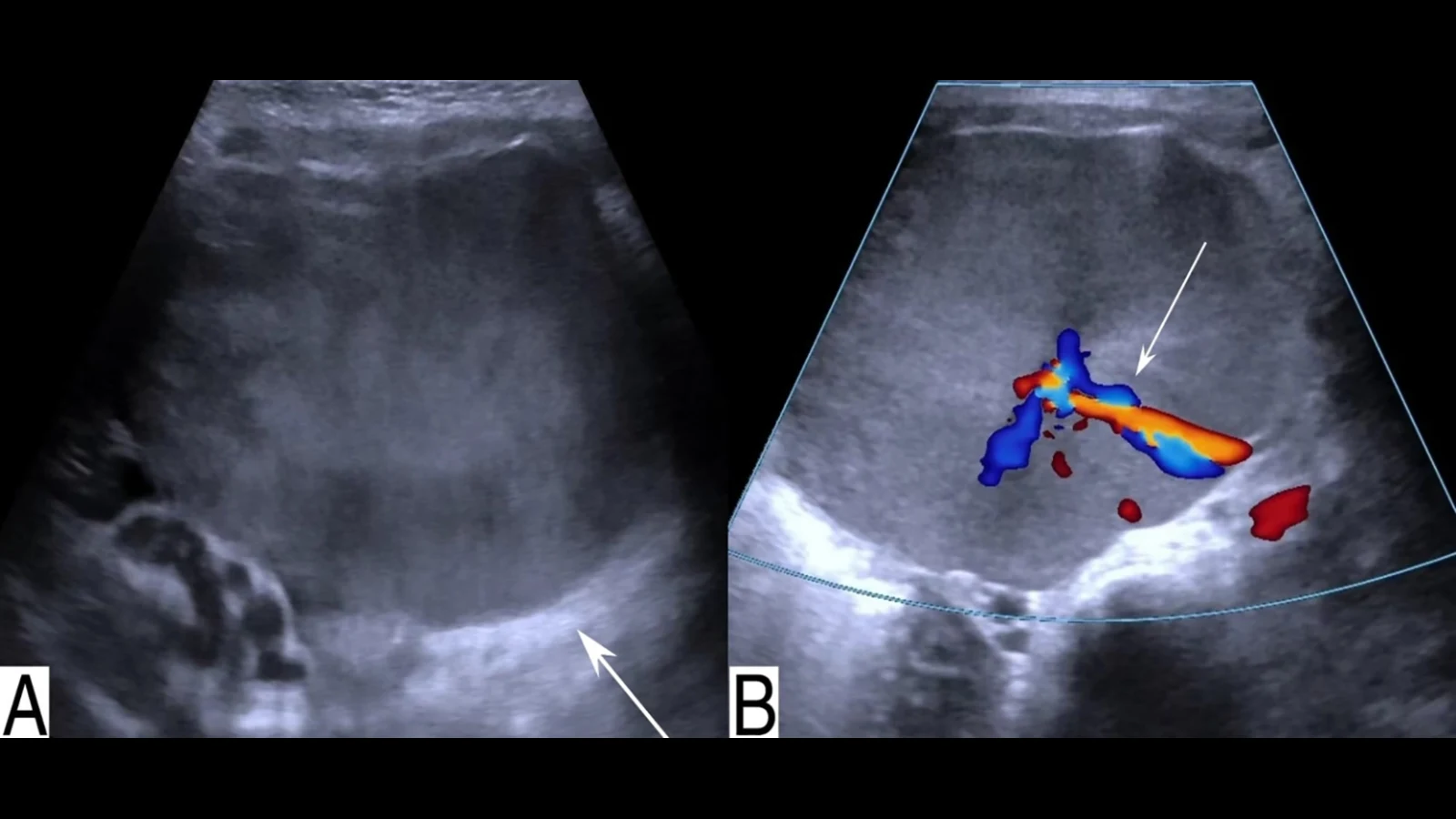
Image source and reuse details
Source: ALK-positive inflammatory myofibroblastic tumor in the pelvis of a child: a case report and literature review — Figure 1. Proportionally reduced and framed in WebP. Both original panels, arrows and colors are preserved.
In this guide
What a rare tumor means
Very rare childhood tumors are a group of different diseases. One European definition uses fewer than 2 new cases per million children per year as a guide, with some exceptions. Other groups use different criteria. Rare describes how often a tumor occurs. Your child's exact diagnosis tells you more about what comes next.
Examples include pleuropulmonary blastoma, which can begin in or around the lung, and some tumors in the glands that make saliva. An inflammatory myofibroblastic tumor is another rare growth. These conditions need different tests and treatment.
Source: National Cancer Institute — Unusual Cancers of Childhood Treatment (PDQ®) — Patient Version · National Cancer Institute — Unusual Cancers of Childhood Treatment (PDQ®) — Health Professional Version · European Reference Network on Paediatric Cancer — PARTNER Study — An international prospective observational study on paediatric patients with very rare tumours
How doctors identify the exact tumor
Signs depend on the organ. A growing lump, ongoing pain or a breathing problem that gets worse deserves a check. Many common problems can look similar. A doctor decides whether blood tests, an ultrasound or another scan may help.
A small sample of tissue can show what kind of tumor it is. A pathologist, a doctor who studies cells, examines it under a microscope and may order more tests. Ask if it would help to have the sample checked by someone who knows that tumor well. Sometimes the microscope slides can be sent to another center.
Source: National Cancer Institute — Unusual Cancers of Childhood Treatment (PDQ®) — Patient Version · National Cancer Institute — Unusual Cancers of Childhood Treatment (PDQ®) — Health Professional Version · Frontiers in Oncology — ALK-positive inflammatory myofibroblastic tumor in the pelvis of a child: a case report and literature review
When genetic tests may help
Some tests look for changes in the tumor's cells that may guide treatment. Others check for changes that were present from birth and may matter for relatives. These two kinds of test answer different questions.
For example, after a diagnosis of pleuropulmonary blastoma the team may check the DICER1 gene. A genetics team can explain the result, what it means for relatives and what follow-up may help. Discuss the result with the center before drawing conclusions from the name of the gene.
Source: National Cancer Institute — Childhood Pleuropulmonary Blastoma Treatment (PDQ®) — Patient Version · National Cancer Institute — Unusual Cancers of Childhood Treatment (PDQ®) — Health Professional Version
How treatment is chosen
Care depends on the tumor type, location and how far it has spread. A team may consider surgery for a growth in a limited area. Other tumors also need chemotherapy, radiation or targeted drugs. Ask what is known about outcomes for that diagnosis and where the evidence is limited.
In the United States, crizotinib is approved from age 1 for an ALK-positive inflammatory myofibroblastic tumor that cannot be removed with surgery, has come back or has not responded to treatment. ALK is a protein that some tumors use to grow. The team needs to confirm the test result and the approved uses in your country.
Source: National Cancer Institute — Unusual Cancers of Childhood Treatment (PDQ®) — Health Professional Version · United States Food and Drug Administration — Xalkori (crizotinib): Approval Letter — Inflammatory Myofibroblastic Tumor
What researchers are studying
Registries help researchers study diseases that one hospital rarely sees. They compare information about diagnosis, care and follow-up. Ask what information or samples would be collected, who can use them and how you give permission.
The United States National Cancer Institute rare cancer study for children and young people collects information, answers to surveys and samples. It gives no experimental treatment. Ask your child's doctor or the study team whether your child meets the criteria.
Source: National Cancer Institute — Childhood Cancer Data Initiative Pediatric, Adolescent, and Young Adult Rare Cancer Study · European Reference Network on Paediatric Cancer — PARTNER Study — An international prospective observational study on paediatric patients with very rare tumours
Daily life and follow-up
If your child eats very little or loses weight, ask the care team for help. A pediatric dietitian can help when treatment makes eating hard. Ask what games or activity are suitable and check with the team before giving vitamins or supplements.
Ask for a written summary of treatment, upcoming tests and changes that should prompt a call. Talk with the team about school and returning to activities. Some effects of treatment can show up later. The follow-up plan depends on the diagnosis and the treatment your child received.
Source: National Cancer Institute — Late Effects of Treatment for Childhood Cancer (PDQ®) — Patient Version · National Cancer Institute — Nutrition During Cancer Treatment · National Cancer Institute — Popular Diets, Supplements, and Cancer
How to find a specialist center
Look for a pediatric cancer center with experience in your child's exact diagnosis. Doctors may ask experts at other hospitals to discuss the case. In Europe, with the family's consent, the doctor can consider remote advice through the European Reference Network on Paediatric Cancer.
Search by country, city or postal code. Ask how to send reports, scans and samples securely. If your child is already in treatment and suddenly feels unwell, use the urgent contact given by the care team.
Find a center for rare childhood tumors →
Source: European Commission — European Reference Networks · Azienda Ospedale–Università Padova — Clinica di Oncoematologia Pediatrica — Segreteria · St. Jude Children’s Research Hospital — Solid Tumor Treatment Program · Gustave Roussy — Comité de cancérologie de l’enfant et de l’adolescent
Questions to take to your appointment
- What is the exact name of the tumor and where did it start?
- Do we need a specialist to review the tissue sample again?
- What do the tests tell us about the tumor and how far it has spread?
- Could a genetic test change treatment or checks for our family?
- Which treatments are available now and which are still in research?
- Who can help with eating, school, travel and follow-up?
Sources and verification
- National Cancer Institute — Unusual Cancers of Childhood Treatment (PDQ®) — Patient Version
- National Cancer Institute — Unusual Cancers of Childhood Treatment (PDQ®) — Health Professional Version
- European Reference Network on Paediatric Cancer — PARTNER Study — An international prospective observational study on paediatric patients with very rare tumours
- National Cancer Institute — Childhood Pleuropulmonary Blastoma Treatment (PDQ®) — Patient Version
- United States Food and Drug Administration — Xalkori (crizotinib): Approval Letter — Inflammatory Myofibroblastic Tumor
- National Cancer Institute — Childhood Cancer Data Initiative Pediatric, Adolescent, and Young Adult Rare Cancer Study
- National Cancer Institute — Late Effects of Treatment for Childhood Cancer (PDQ®) — Patient Version
- National Cancer Institute — Nutrition During Cancer Treatment
- National Cancer Institute — Popular Diets, Supplements, and Cancer
- European Commission — European Reference Networks
- Azienda Ospedale–Università Padova — Clinica di Oncoematologia Pediatrica — Segreteria
- St. Jude Children’s Research Hospital — Solid Tumor Treatment Program
- Gustave Roussy — Comité de cancérologie de l’enfant et de l’adolescent
- Frontiers in Oncology — ALK-positive inflammatory myofibroblastic tumor in the pelvis of a child: a case report and literature review
Sources checked: 2026-11-21