


Heart tumors in children: signs, tests, treatment and specialist care
A report may mention a mass in the heart. Ask where it is and whether it affects the heartbeat or blood flow. Find out who to call if your child’s condition changes and when the next check is due.
MyMedNest editorial guide · Sources checked:
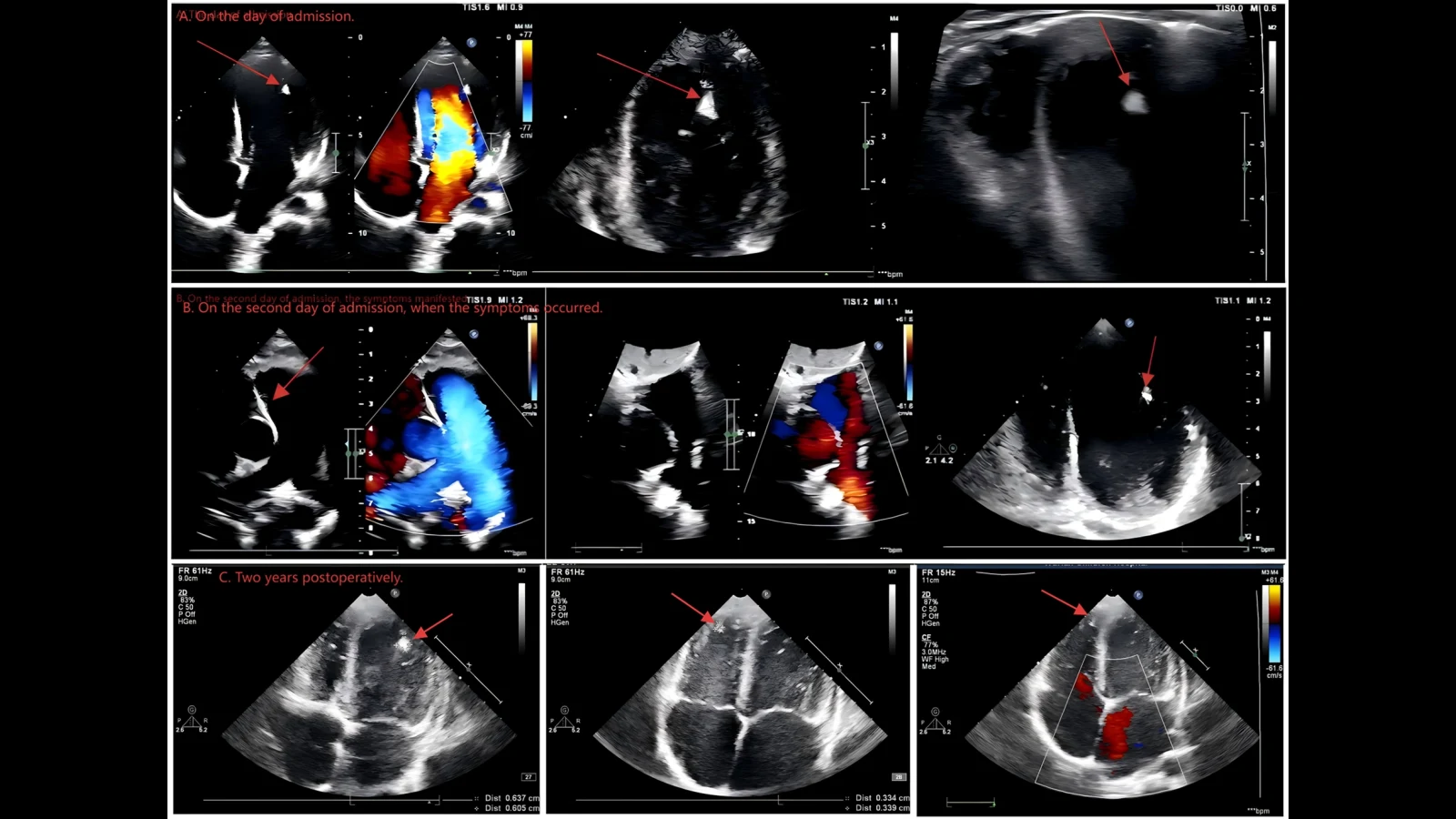
Image source and reuse details
Source: Case Report: A patient with cardiac rhabdomyoma associated with embryonal developmental dysplasia of neuroepithelial tumors, presenting with recurrent cyanosis of the face and lips — Figure 1. Proportionally reduced and framed in WebP. All views, colors and annotations are preserved.
In this guide
What can grow in the heart
Heart tumors are rare in children. Most are benign, which means they are not cancer and do not spread to other organs. A benign mass can still cause problems if it blocks blood flow or changes the heartbeat.
Rhabdomyomas, which start in muscle, and fibromas are among the more common masses. Other examples are myxomas and teratomas. Cancerous tumors that start in the heart, such as some sarcomas, are very rare. The diagnosis guides treatment.
Source: National Cancer Institute — Childhood Heart Tumors (PDQ) — Patient Version · National Cancer Institute — Childhood Cardiac Tumors Treatment (PDQ) — Health Professional Version
Signs to know
A mass may be found on a scan before birth or during a check for another reason. After birth, some children may have trouble breathing, an irregular heartbeat or get tired while feeding. Your pediatrician will consider other possible causes as well.
If a child is struggling to breathe, collapses or has blue or gray lips or face, call your local emergency number. For less sudden changes, such as more tiring feeds, contact your child’s care team and say when the changes began.
Source: National Cancer Institute — Childhood Heart Tumors (PDQ) — Patient Version · National Health Service — Blue or grey skin or lips (cyanosis) · National Health Service — Congenital heart disease
How doctors check the heart
An echocardiogram uses sound waves to show the heart moving. It can show how many masses there are, where they are and how blood flows. An electrocardiogram records the heartbeat. The doctor may suggest a longer recording or a magnetic resonance scan of the heart for more detail.
If there is one or more rhabdomyomas, the team may check for tuberous sclerosis. It is a genetic condition that can also affect the brain, kidneys and other organs. Ask if a genetics specialist can help you understand testing and follow-up.
Source: National Cancer Institute — Childhood Cardiac Tumors Treatment (PDQ) — Health Professional Version · Ospedale Pediatrico Bambino Gesù — Tumori cardiaci · Frontiers in Pediatrics — Case Report: A patient with cardiac rhabdomyoma associated with embryonal developmental dysplasia of neuroepithelial tumors, presenting with recurrent cyanosis of the face and lips
When to monitor and when to treat
Many rhabdomyomas get smaller on their own. If blood flows well and the child is doing well, the team may suggest heartbeat checks and repeat scans. If a mass blocks blood flow or affects the heartbeat, the team discusses care based on its type, location and the child's health.
Surgery may help for some masses. For cancerous tumors such as sarcomas, the team may consider chemotherapy. Some centers have used everolimus or sirolimus for certain rhabdomyomas. Everolimus is approved in the United States for other effects of tuberous sclerosis. Its United States prescribing information does not list cardiac rhabdomyoma as an approved use.
Source: National Cancer Institute — Childhood Cardiac Tumors Treatment (PDQ) — Health Professional Version · United States Food and Drug Administration — Afinitor and Afinitor Disperz (everolimus) — Full prescribing information
What researchers are studying
The phase 2 ORACLE study protocol was designed to compare everolimus with a placebo in children who have tuberous sclerosis and a rhabdomyoma that causes symptoms. It aims to measure how much the mass shrinks and to track side effects. A placebo is a look-alike treatment without the drug being studied.
Some case reports describe the mass shrinking after treatment. Many rhabdomyomas also shrink on their own. Reports on a few children cannot predict how much a medicine will help one child or when a new treatment will be available.
Source: Cardiology in the Young — Everolimus for cardiac rhabdomyomas in children with tuberous sclerosis. The ORACLE study protocol: a randomised, multicentre, placebo-controlled, double-blind phase II trial · Saudi Pharmaceutical Journal — Early use of everolimus for neonatal cardiac rhabdomyoma: a pharmacotherapeutic case with pharmacist-led monitoring
Daily life and follow-up
If a baby struggles to feed or is not gaining enough weight, tell the pediatrician or care team. Ask how to track growth and whether your baby needs feeding support. For older children, discuss safe play and activity with the heart team.
Ask for a written plan with checkup dates, tests and contacts. If your child takes medicine, check with the team before giving vitamins, herbal products or supplements. Keep an up-to-date list of what your child takes.
Source: National Health Service — Congenital heart disease · National Cancer Institute — Popular Diets, Supplements, and Cancer
How to find a specialist team
Look for a team with pediatric cardiologists and heart surgeons. Depending on the mass, it can involve pediatric cancer doctors and genetics specialists. If the mass was found before birth, ask whether a fetal heart team can help plan delivery and the first checks.
You can search by country, city or postal code. To request a consultation, ask how to send reports and the original scan images securely. In an emergency, use your local emergency service.
Find a pediatric heart center →
Source: Ospedale Pediatrico Bambino Gesù — Tumori cardiaci · Great Ormond Street Hospital — Refer a patient to the Paediatric Cardiology department · Boston Children’s Hospital — Cardiac Rhabdomyoma · Boston Children’s Hospital — International Contact Us
Questions to take to your appointment
- What kind of mass does it seem to be and what is still uncertain?
- Does it affect the heartbeat or blood flow?
- Which signs need urgent help and whom should we call?
- Should we check for a genetic condition?
- When can we monitor it and when does it need treatment?
- What reports and images are needed for a second opinion?
Sources and verification
- National Cancer Institute — Childhood Heart Tumors (PDQ) — Patient Version
- National Cancer Institute — Childhood Cardiac Tumors Treatment (PDQ) — Health Professional Version
- National Health Service — Blue or grey skin or lips (cyanosis)
- National Health Service — Congenital heart disease
- United States Food and Drug Administration — Afinitor and Afinitor Disperz (everolimus) — Full prescribing information
- Cardiology in the Young — Everolimus for cardiac rhabdomyomas in children with tuberous sclerosis. The ORACLE study protocol: a randomised, multicentre, placebo-controlled, double-blind phase II trial
- Saudi Pharmaceutical Journal — Early use of everolimus for neonatal cardiac rhabdomyoma: a pharmacotherapeutic case with pharmacist-led monitoring
- National Cancer Institute — Popular Diets, Supplements, and Cancer
- Ospedale Pediatrico Bambino Gesù — Tumori cardiaci
- Great Ormond Street Hospital — Refer a patient to the Paediatric Cardiology department
- Boston Children’s Hospital — Cardiac Rhabdomyoma
- Boston Children’s Hospital — International Contact Us
- Frontiers in Pediatrics — Case Report: A patient with cardiac rhabdomyoma associated with embryonal developmental dysplasia of neuroepithelial tumors, presenting with recurrent cyanosis of the face and lips
Sources checked: 2026-11-21