


Multiple myeloma: understand your tests and treatment choices
Multiple myeloma is a cancer of plasma cells in the bone marrow. An abnormal protein in a blood test does not by itself mean active cancer. The first step is to identify the condition, assess organ damage and discuss a plan with a hematology team.
MyMedNest editorial guide · Sources checked:
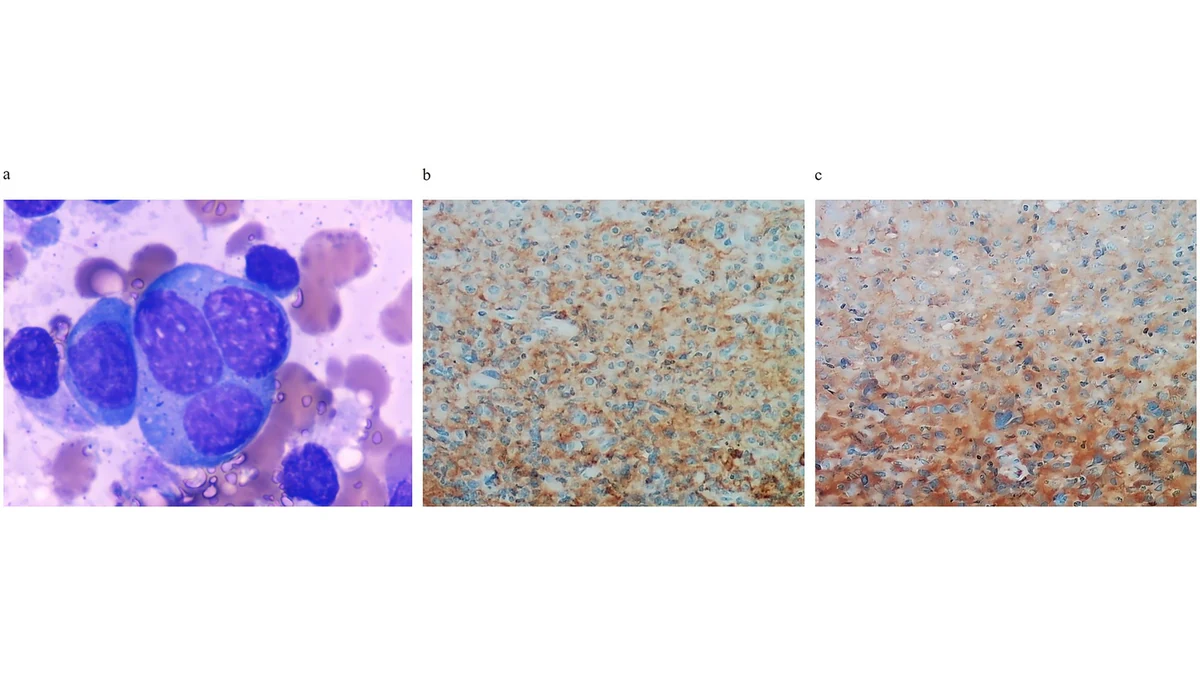
Image source and reuse details
Source: Fatigue as main symptom in an elderly multiple myeloma patient: a Case Report — Figures 3 and 4 — Figure 4. Whole original reduced proportionally from 1535 × 441 to 1200 × 345 inside a 1200 × 675 white frame. All three panels and labels retained; no clinical crop, recoloring, retouching or enlargement.
In this guide
What the diagnosis means
Plasma cells normally make antibodies, proteins that help fight infection. In myeloma, an abnormal group of these cells grows in the bone marrow, where blood cells are made. It can weaken bones, reduce normal blood-cell production, damage the kidneys and make infections more likely.
Myeloma is different from a cancer that starts in bone-forming cells or spreads to bone from another organ. A solitary plasmacytoma is a localized plasma-cell tumor and needs assessment for disease elsewhere. Light-chain amyloidosis and plasma-cell leukemia require their own specialist evaluation, even when related to myeloma.
Source: National Cancer Institute — United States — Plasma Cell Neoplasms (Including Multiple Myeloma) Treatment (PDQ®)–Patient Version · National Cancer Institute — United States — Plasma Cell Neoplasms (Including Multiple Myeloma) Treatment (PDQ®)–Health Professional Version
Symptoms and the first assessment
Persistent back or rib pain, a fracture after a small injury, unusual fatigue, repeated infections, thirst, frequent urination or unexplained weight loss deserve medical assessment. Anemia means too few healthy red blood cells; it can cause breathlessness and tiredness. These symptoms also have other causes.
Some people have no symptoms and are investigated after an abnormal blood test. A clinician decides which tests are appropriate from the symptoms, medical history and examination. Do not assume that ordinary back pain or a single protein result proves myeloma.
Source: National Health Service — United Kingdom — Symptoms of myeloma · National Cancer Institute — United States — Plasma Cell Neoplasms (Including Multiple Myeloma) Treatment (PDQ®)–Patient Version
Warning signs that should not wait
New weakness or numbness in the legs, trouble walking or loss of bladder or bowel control can indicate pressure on the spinal cord. Seek emergency help. Severe confusion, major breathing difficulty, rapidly worsening illness or a sudden major reduction in urine also need urgent assessment.
During treatment, contact your team immediately for a temperature of 38 °C or higher, or a lower threshold they specified. Do not wait for your next visit or simply hide the fever with medication. Keep an emergency number and a list of your treatment available.
Source: National Health Service — United Kingdom — Symptoms of myeloma · National Cancer Institute — United States — Infection and Neutropenia during Cancer Treatment
Blood, urine, marrow and imaging tests
Assessment usually includes blood counts, calcium and kidney tests, protein electrophoresis, immunofixation and free light chains. Electrophoresis separates proteins; immunofixation helps identify the abnormal type. Urine testing may include a collection over 24 hours. Some myelomas release little measurable protein, so a small result cannot always exclude disease.
A marrow aspirate and biopsy assess plasma cells and provide samples for genetic tests. Low-dose whole-body CT, MRI or PET/CT may be used according to the question and local resources. An ordinary bone-density test cannot replace appropriate myeloma imaging. Ask for copies of the reports and actual scan images.
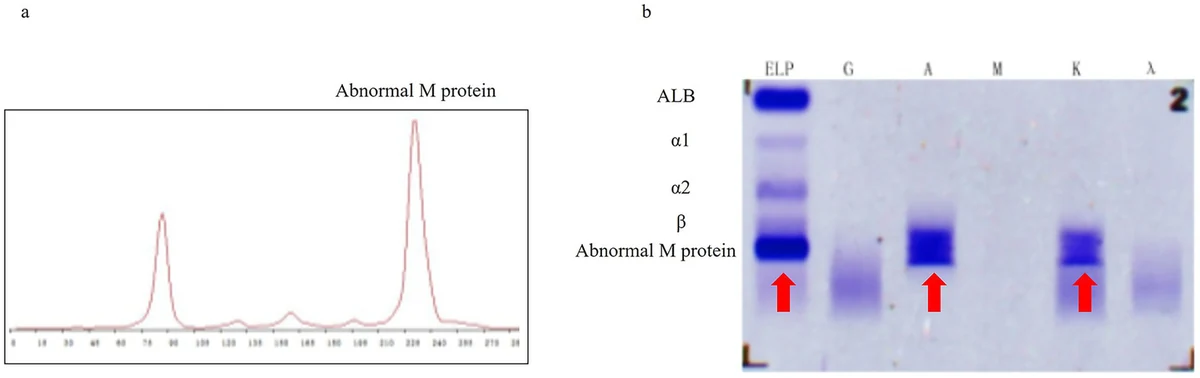
Image source and reuse details
Source: Fatigue as main symptom in an elderly multiple myeloma patient: a Case Report — Figures 3 and 4 — Figure 3. Whole original proportionally reduced from 1535 × 483 to 1200 × 378 and saved as WebP. Panels, graph, scale, labels and arrows preserved. No clinical alteration, crop or enlargement.
Source: International Myeloma Working Group — International Myeloma Foundation — International Myeloma Working Group criteria for the diagnosis of multiple myeloma · National Health Service — United Kingdom — Tests and next steps for myeloma · National Cancer Institute — United States — Plasma Cell Neoplasms (Including Multiple Myeloma) Treatment (PDQ®)–Health Professional Version
When does myeloma require treatment?
Active myeloma is diagnosed from findings together, usually at least 10% clonal marrow plasma cells or a biopsy-proven plasmacytoma, plus a defining event. CRAB refers to high calcium, kidney impairment, anemia or destructive bone lesions caused by the plasma-cell disorder. An unrelated low blood count does not automatically meet these criteria. If clonal marrow plasma cells are below 10%, more than one bone lesion is required to distinguish myeloma from a solitary plasmacytoma with minimal marrow involvement.
Treatment can also be needed before symptoms when a defining biomarker is present: at least 60% clonal marrow plasma cells; an involved-to-uninvolved free-light-chain ratio of at least 100, with the involved light chain at least 100 mg/L; or more than one MRI focal lesion, each at least 5 mm. A specialist must interpret borderline results.
Source: International Myeloma Working Group — International Myeloma Foundation — International Myeloma Working Group criteria for the diagnosis of multiple myeloma · National Cancer Institute — United States — Plasma Cell Neoplasms (Including Multiple Myeloma) Treatment (PDQ®)–Health Professional Version
MGUS and smoldering myeloma are different situations
Monoclonal gammopathy of undetermined significance, called MGUS, is not active myeloma. It usually needs risk-based monitoring rather than anticancer treatment. Smoldering myeloma has more abnormal plasma cells or protein but lacks a myeloma-defining event. Its risk of progression varies; not everyone should receive the same treatment.
Monitoring remains an option in selected smoldering disease. On November 6, 2025, the Food and Drug Administration approved daratumumab with hyaluronidase for adults with high-risk smoldering myeloma in the United States. This indication does not include other risk groups. Discuss the risk definition, adverse effects, alternatives and local authorization before choosing early treatment.
Source: National Cancer Institute — United States — Plasma Cell Neoplasms (Including Multiple Myeloma) Treatment (PDQ®)–Patient Version · Food and Drug Administration — United States — FDA approves daratumumab and hyaluronidase-fihj for high-risk smoldering multiple myeloma — November 6, 2025
Risk assessment is more than a stage number
Risk scores combine blood results, such as albumin, beta-2-microglobulin and sometimes lactate dehydrogenase, with chromosome findings. Marrow fluorescence in situ hybridization, or FISH, looks for changes such as deletion 17p and abnormalities of chromosome 1q. Ask which scoring system was used and what it changes in your plan.
These scores are not the same as stages of a solid tumor spreading from one organ. Fitness, kidney function, other illnesses and response to treatment also matter. A high-risk finding is a reason to discuss the right treatment and research options, not a reliable personal countdown.
Building the first treatment plan
Active myeloma is usually treated with a combination. Options include a proteasome inhibitor such as bortezomib, an immunomodulatory drug such as lenalidomide, an anti-CD38 antibody such as daratumumab or isatuximab, and a steroid such as dexamethasone. The combination and doses depend on fitness, organ function, disease features and availability.
For example, on January 27, 2026, the Food and Drug Administration approved daratumumab with hyaluronidase plus bortezomib, lenalidomide and dexamethasone for newly diagnosed adults ineligible for autologous transplantation. Its notice says effectiveness was not established for people who merely refused transplant. Frail people may need adjusted or simpler treatment; more drugs are not automatically better for everyone.
Source: National Cancer Institute — United States — Plasma Cell Neoplasms (Including Multiple Myeloma) Treatment (PDQ®)–Health Professional Version · Food and Drug Administration — United States — FDA approves daratumumab and hyaluronidase-fihj with bortezomib, lenalidomide, and dexamethasone for newly diagnosed multiple myeloma — January 27, 2026
What an autologous transplant involves
For suitable patients, treatment may include collecting their own blood stem cells, giving high-dose chemotherapy, often melphalan, and returning the cells through a vein. The cells help the marrow recover. This is not a surgical bone-marrow replacement, and it is different from CAR T-cell therapy.
Eligibility depends on overall fitness and organ function, not age alone. Discuss infection risk, low blood counts, mouth and gut problems, fertility, recovery time and support at home. A donor transplant has different risks and is not the usual approach for most myeloma patients. Transplant does not remove the need for follow-up.
Source: National Cancer Institute — United States — Stem Cell Transplants in Cancer Treatment · National Cancer Institute — United States — Plasma Cell Neoplasms (Including Multiple Myeloma) Treatment (PDQ®)–Health Professional Version
Why treatment can continue after a good response
Maintenance aims to keep myeloma controlled after the initial treatment, often with lenalidomide or another risk-adapted approach. The choice depends on previous medicines, chromosome findings, transplant history and tolerance. It is a separate decision from whether the initial treatment worked.
Ask how long treatment is planned, what tests will be used and when doses should change. Blood counts, infections, fatigue, clot risk and other effects need attention. Do not stop because a protein result becomes normal or because you feel well; agree any change with your team.
If myeloma returns or resists treatment
Relapsed means disease has returned or increased after a response. Refractory means it does not respond adequately to a treatment. A rising protein may prompt repeat tests; new organ damage needs faster action. The team considers the pattern and speed of change, not just one isolated number.
The next plan depends on which drug classes were used, which no longer work, how long the response lasted, and kidney function and fitness. Different combinations, cellular therapy, bispecific antibodies, a selected later transplant or a trial may be discussed. Ask why a proposed option fits your previous treatment history.
Source: National Cancer Institute — United States — Plasma Cell Neoplasms (Including Multiple Myeloma) Treatment (PDQ®)–Health Professional Version · National Cancer Institute — United States — Drugs Approved for Multiple Myeloma
CAR T cells: a specialist pathway
CAR T-cell therapy uses a person's T cells, modified to recognize a target on myeloma cells, often BCMA. Collection, manufacturing, treatment while waiting and chemotherapy before infusion may be needed. In the United States, ciltacabtagene autoleucel is indicated after at least one prior line including a proteasome inhibitor and an immunomodulatory drug, with lenalidomide-refractory disease.
Serious risks include cytokine release syndrome, nerve or brain effects, prolonged low blood counts, infection and secondary blood cancers. Severe or persistent diarrhea weeks or months after ciltacabtagene needs urgent review: potentially fatal enterocolitis is a recognized warning. Eligibility, access, caregiver requirements and long-term monitoring must be checked at an authorized center.
Source: National Cancer Institute — United States — CAR T Cells: Engineering Patients’ Immune Cells to Treat Their Cancers · Food and Drug Administration — United States — CARVYKTI — current product indication and safety information · Food and Drug Administration — United States — FDA approves labeling changes that include a Boxed Warning for Immune Effector Cell-associated Enterocolitis following treatment with Ciltacabtagene Autoleucel — October 10, 2025
Bispecific antibodies and recent indications
Bispecific antibodies connect immune cells to a target on myeloma cells. Examples include teclistamab, elranatamab and linvoseltamab; their authorized settings differ. Initial step-up doses and close observation reduce, but do not remove, risks such as cytokine release syndrome, neurological toxicity and serious infections. These medicines are not ordinary supplements or home injections chosen independently.
On March 5, 2026, the Food and Drug Administration approved teclistamab with daratumumab and hyaluronidase after at least one prior line containing a proteasome inhibitor and an immunomodulatory drug. Teclistamab alone has a different indication, after at least four prior lines including those classes and an anti-CD38 antibody. United States approval does not establish access elsewhere.
Source: National Cancer Institute — United States — Plasma Cell Neoplasms (Including Multiple Myeloma) Treatment (PDQ®)–Health Professional Version · Food and Drug Administration — United States — FDA approves teclistamab in combination with daratumumab hyaluronidase-fihj for relapsed or refractory multiple myeloma — March 5, 2026 · Food and Drug Administration — United States — FDA grants accelerated approval to linvoseltamab-gcpt for relapsed or refractory multiple myeloma — July 2, 2025
Other newer options have specific limits
Linvoseltamab received accelerated United States approval on July 2, 2025, after at least four prior lines including a proteasome inhibitor, an immunomodulatory drug and an anti-CD38 antibody. Confirmatory evidence remains required. Accelerated approval, tumor response and a cure are different things; ask about the current local indication and evidence.
Belantamab mafodotin with bortezomib and dexamethasone was approved in the United States on October 23, 2025, after at least two prior lines including a proteasome inhibitor and an immunomodulatory drug. It carries a major risk of corneal injury and impaired vision and needs eye monitoring and dose management. This guide is not a complete drug or prescribing catalogue.
Source: Food and Drug Administration — United States — FDA grants accelerated approval to linvoseltamab-gcpt for relapsed or refractory multiple myeloma — July 2, 2025 · Food and Drug Administration — United States — Ongoing | Cancer Accelerated Approvals — linvoseltamab confirmatory requirement · Food and Drug Administration — United States — FDA approves belantamab mafodotin-blmf for relapsed or refractory multiple myeloma — October 23, 2025
Protecting bones and managing pain
Bisphosphonates such as zoledronic acid, or denosumab in suitable circumstances, can reduce bone complications. Kidney function, calcium and dental health affect the choice. A dental assessment helps reduce jaw complications. Calcium and vitamin D must be individualized, especially with high blood calcium or kidney disease; do not start them automatically.
Pain control, radiotherapy, orthopedic assessment or selected procedures for vertebral fractures can help. New severe pain or a possible fracture needs assessment. Agree safe exercise with the team or physiotherapist before lifting, twisting or high-impact activity when bones are fragile. Bone-directed treatment supports, rather than replaces, treatment of myeloma.
Source: National Cancer Institute — United States — Plasma Cell Neoplasms (Including Multiple Myeloma) Treatment (PDQ®)–Health Professional Version · Evangelos Terpos and colleagues — International Myeloma Working Group, The Lancet Oncology — Treatment of multiple myeloma-related bone disease: recommendations from the Bone Working Group of the International Myeloma Working Group — 2021
Kidney problems need prompt attention
Abnormal light chains, dehydration, high calcium, infection and medicines can injure the kidneys. The team checks creatinine, estimated filtration, light chains and urine findings. New kidney impairment may require rapid myeloma treatment and a nephrology opinion. Dialysis is sometimes needed; kidney recovery cannot be promised.
Do not self-treat pain with ibuprofen or similar anti-inflammatory drugs. Tell the team about all prescriptions, supplements and planned contrast scans. Fluid intake must fit kidney and heart function; a blanket instruction to drink large amounts can be unsafe. Some myeloma medicines require dose changes when kidney function is reduced.
Source: Meletios A. Dimopoulos and colleagues — International Myeloma Working Group, The Lancet Oncology — Management of multiple myeloma-related renal impairment: recommendations from the International Myeloma Working Group — published abstract, 2023 · Myeloma UK — United Kingdom — Ask the Nurse: Myeloma and the kidneys — June 2022 · National Cancer Institute — United States — Plasma Cell Neoplasms (Including Multiple Myeloma) Treatment (PDQ®)–Health Professional Version
Preventing and recognizing infection
Myeloma and its treatment can reduce normal antibodies and protective blood cells. Ask about vaccination timing, antiviral or other preventive medicines, and whether immunoglobulin replacement is appropriate. Prevention varies with the treatment and your results; do not copy another patient's antibiotic or vaccination schedule.
Wash hands, follow food-safety advice and report infection symptoms promptly. Fever, shaking chills, new breathlessness or rapid deterioration needs immediate contact with the team. Infection risk can persist after cellular or antibody therapy, even when myeloma tests look better. Keep the emergency plan during follow-up as well.
Source: National Cancer Institute — United States — Infection and Neutropenia during Cancer Treatment · National Cancer Institute — United States — Plasma Cell Neoplasms (Including Multiple Myeloma) Treatment (PDQ®)–Health Professional Version
Practical precautions with medicines
Lenalidomide and related drugs can increase clot risk; prevention must be prescribed according to individual risk. Bortezomib can cause nerve symptoms, and steroids can affect sleep, mood and blood sugar. Report numbness, pain, swelling or other new symptoms early so the team can assess dose changes and supportive treatment.
Daratumumab can interfere with tests used to match blood for transfusion. Inform the blood bank and other hospitals that you receive or previously received it. Keep an updated treatment card. Do not independently stop a prescribed anticoagulant, steroid or anti-infection medicine when another treatment changes.
Source: National Cancer Institute — United States — Plasma Cell Neoplasms (Including Multiple Myeloma) Treatment (PDQ®)–Health Professional Version · Food and Drug Administration — United States — FDA approves daratumumab and hyaluronidase-fihj with bortezomib, lenalidomide, and dexamethasone for newly diagnosed multiple myeloma — January 27, 2026
Fertility, pregnancy and sexual health
Before treatment, discuss fertility preservation if relevant. High-dose treatment and some medicines may affect fertility. Several myeloma drugs can harm an embryo or fetus; lenalidomide and related medicines have strict pregnancy-prevention requirements. These precautions can concern both patients who can become pregnant and their partners.
Ask about suitable contraception, duration of precautions and breastfeeding restrictions for the exact regimen. Do not use general internet advice to decide when pregnancy is safe. Pain, fatigue, body-image changes and sexual difficulties also deserve care; the team can arrange practical and psychological support.
Source: National Cancer Institute — United States — Male Fertility and Cancer Treatment · National Cancer Institute — United States — Female Fertility and Cancer Treatment · Food and Drug Administration — United States — FDA approves daratumumab and hyaluronidase-fihj with bortezomib, lenalidomide, and dexamethasone for newly diagnosed multiple myeloma — January 27, 2026
Food, activity and everyday support
No diet, herb or supplement has been shown to cure myeloma. Aim for adequate food and protein with a dietitian's help when appetite, weight or kidney function is a problem. Avoid restrictive anticancer diets and unverified high-dose products. Check supplements for interactions before taking them.
Movement can help function and mood when adapted to bone safety, anemia and fatigue. Ask about rehabilitation, work, travel, transport, financial help and psychological support. Palliative care treats symptoms and distress alongside active treatment; it does not mean that treatment has necessarily ended.
Source: National Cancer Institute — United States — Nutrition During Cancer Treatment · National Cancer Institute — United States — Complementary and Alternative Medicine · Evangelos Terpos and colleagues — International Myeloma Working Group, The Lancet Oncology — Treatment of multiple myeloma-related bone disease: recommendations from the Bone Working Group of the International Myeloma Working Group — 2021 · National Cancer Institute — United States — Palliative Care in Cancer
Research and realistic timeframes
CARTITUDE-6, NCT05257083, is an open-label randomized phase 3 study comparing initial daratumumab, bortezomib, lenalidomide and dexamethasone followed by ciltacabtagene with the same initial regimen followed by autologous transplant. The registry lists 759 enrolled participants, Stichting European Myeloma Network as sponsor and Janssen Research & Development as an industry collaborator.
The record last posted on March 17, 2026 says active, not recruiting, with no results posted. Primary completion is estimated for June 2033 and overall completion for August 2040. These are study estimates, not approval dates or proof of benefit. Ask about currently recruiting studies, eligibility, alternatives, extra visits and costs before travel.
Source: United States National Library of Medicine — ClinicalTrials.gov — NCT05257083 — CARTITUDE-6 study record, last posted March 17, 2026 · National Cancer Institute — United States — Who Pays for Clinical Trials?
Finding a suitable specialist service
Look for a myeloma hematology service with specialist pathology, transplant or cellular-therapy referral when needed, and support for bone, kidney and infection problems. The directory links documented pathways at the Istituto Nazionale dei Tumori in Milan, University Hospital Zurich, Heidelberg and MD Anderson. These examples are not a ranking or a complete worldwide list.
Filter by country and myeloma, then use the service's official contact. Zurich requires a medical referral; Heidelberg's listed channel handles myeloma appointments and general questions. Confirm age group, records, international-patient access, costs and available treatment before traveling. Postal-code distance search is not currently available here.
Documented myeloma and hematology services →
Source: Fondazione IRCCS Istituto Nazionale dei Tumori — Italy — Ematologia — adult hematology service and outpatient contacts · Universitätsspital Zürich — Switzerland — Myeloma treatment — physician referral and contact information · The University of Texas MD Anderson Cancer Center — United States — Lymphoma and Myeloma Center — documented clinical service · The University of Texas MD Anderson Cancer Center — United States — International Referrals — international appointment contact · Nationales Centrum für Tumorerkrankungen Heidelberg and Universitätsklinikum Heidelberg — Germany — Multiples Myelom — appointments, general questions and first-visit requirements
Response, remission and uncertainty
Modern treatments can control myeloma for long periods in many people, but it is usually a relapsing disease and is not generally considered curable. Individual outcomes vary with biology, organ damage, fitness, treatment response and access. A population survival figure cannot say how long one person will live.
Measurable residual disease, or MRD, testing looks for very small amounts of disease. A negative result means none was found within that test's detection limit; it is not proof that every myeloma cell has gone. It does not by itself justify stopping maintenance. Discuss what a result changes in your particular plan.
Source: National Health Service — United Kingdom — Treatment for myeloma · National Cancer Institute — United States — Plasma Cell Neoplasms (Including Multiple Myeloma) Treatment (PDQ®)–Health Professional Version
Leave with a written follow-up plan
Ask when to repeat blood counts, kidney and calcium tests, monoclonal protein, free light chains and any urine tests. Imaging or another marrow examination is used when indicated, not on the same schedule for everyone. Keep reports together so changes can be compared across hospitals.
Before leaving, clarify the treatment goal, next appointment, emergency symptoms and number to call. Ask which effects can appear later and who handles vaccines, dental care and other illnesses. Bring a person you trust or request an interpreter when useful; understanding the plan is part of good care.
Source: National Cancer Institute — United States — Plasma Cell Neoplasms (Including Multiple Myeloma) Treatment (PDQ®)–Patient Version · National Cancer Institute — United States — Plasma Cell Neoplasms (Including Multiple Myeloma) Treatment (PDQ®)–Health Professional Version
Questions to take to your appointment
- Does an abnormal monoclonal protein always mean cancer? No. MGUS, smoldering myeloma and active myeloma need different assessments and plans.
- Can treatment be needed without symptoms? Yes. A myeloma-defining biomarker can justify treatment before organ damage; high-risk smoldering disease is another distinct discussion.
- Does everyone need a stem-cell transplant? No. Fitness, organ function, disease features and preferences must be assessed, with other treatment options discussed.
- Are CAR T cells the same as a stem-cell transplant? No. CAR T cells are modified immune cells; autologous stem cells help marrow recover after high-dose chemotherapy.
- Can I start calcium or an anticancer supplement myself? No. Calcium may already be high and kidney problems matter. Supplements do not replace treatment and can interact with it.
- Can an estimated trial completion date tell me when a cure will arrive? No. Results, safety, regulatory review and local access are separate steps, with uncertain timing.
Sources and verification
- National Cancer Institute — United States — Plasma Cell Neoplasms (Including Multiple Myeloma) Treatment (PDQ®)–Patient Version
- National Cancer Institute — United States — Plasma Cell Neoplasms (Including Multiple Myeloma) Treatment (PDQ®)–Health Professional Version
- International Myeloma Working Group — International Myeloma Foundation — International Myeloma Working Group criteria for the diagnosis of multiple myeloma
- National Health Service — United Kingdom — Symptoms of myeloma
- National Health Service — United Kingdom — Tests and next steps for myeloma
- National Health Service — United Kingdom — Treatment for myeloma
- Food and Drug Administration — United States — FDA approves daratumumab and hyaluronidase-fihj for high-risk smoldering multiple myeloma — November 6, 2025
- Food and Drug Administration — United States — FDA approves daratumumab and hyaluronidase-fihj with bortezomib, lenalidomide, and dexamethasone for newly diagnosed multiple myeloma — January 27, 2026
- Food and Drug Administration — United States — FDA approves teclistamab in combination with daratumumab hyaluronidase-fihj for relapsed or refractory multiple myeloma — March 5, 2026
- Xuanna Li, Shuang Li and Junrong Chen — Frontiers in Medicine — Fatigue as main symptom in an elderly multiple myeloma patient: a Case Report — Figures 3 and 4
- The University of Texas MD Anderson Cancer Center — United States — Lymphoma and Myeloma Center — documented clinical service
- Fondazione IRCCS Istituto Nazionale dei Tumori — Italy — Ematologia — adult hematology service and outpatient contacts
- Universitätsspital Zürich — Switzerland — Myeloma treatment — physician referral and contact information
- Nationales Centrum für Tumorerkrankungen Heidelberg and Universitätsklinikum Heidelberg — Germany — Multiples Myelom — appointments, general questions and first-visit requirements
- United States National Library of Medicine — ClinicalTrials.gov — NCT05257083 — CARTITUDE-6 study record, last posted March 17, 2026
- Food and Drug Administration — United States — FDA approves belantamab mafodotin-blmf for relapsed or refractory multiple myeloma — October 23, 2025
- Food and Drug Administration — United States — Drug Trials Snapshot: LYNOZYFIC — original July 2, 2025 indication and study limitations
- National Cancer Institute — United States — Drugs Approved for Multiple Myeloma
- Food and Drug Administration — United States — FDA grants accelerated approval to linvoseltamab-gcpt for relapsed or refractory multiple myeloma — July 2, 2025
- Food and Drug Administration — United States — Ongoing | Cancer Accelerated Approvals — linvoseltamab confirmatory requirement
- Food and Drug Administration — United States — CARVYKTI — current product indication and safety information
- Food and Drug Administration — United States — FDA approves labeling changes that include a Boxed Warning for Immune Effector Cell-associated Enterocolitis following treatment with Ciltacabtagene Autoleucel — October 10, 2025
- Meletios A. Dimopoulos and colleagues — International Myeloma Working Group, The Lancet Oncology — Management of multiple myeloma-related renal impairment: recommendations from the International Myeloma Working Group — published abstract, 2023
- Myeloma UK — United Kingdom — Ask the Nurse: Myeloma and the kidneys — June 2022
- Evangelos Terpos and colleagues — International Myeloma Working Group, The Lancet Oncology — Treatment of multiple myeloma-related bone disease: recommendations from the Bone Working Group of the International Myeloma Working Group — 2021
- The University of Texas MD Anderson Cancer Center — United States — International Referrals — international appointment contact
- National Cancer Institute — United States — CAR T Cells: Engineering Patients’ Immune Cells to Treat Their Cancers
- National Cancer Institute — United States — Female Fertility and Cancer Treatment
- National Cancer Institute — United States — Stem Cell Transplants in Cancer Treatment
- National Cancer Institute — United States — Palliative Care in Cancer
- National Cancer Institute — United States — Male Fertility and Cancer Treatment
- National Cancer Institute — United States — Infection and Neutropenia during Cancer Treatment
- National Cancer Institute — United States — Nutrition During Cancer Treatment
- National Cancer Institute — United States — Complementary and Alternative Medicine
- National Cancer Institute — United States — Who Pays for Clinical Trials?
Sources checked: 2026-11-19