


Anal cancer: diagnosis, treatment and specialist care
Anal squamous cancer can often be treated with the aim of cure, especially before it spreads. Many people can keep their anus because chemotherapy and radiation are given together. This guide explains what needs confirming first, when surgery or other medicines enter the plan, and how to find specialist support.
MyMedNest editorial guide · Sources checked:
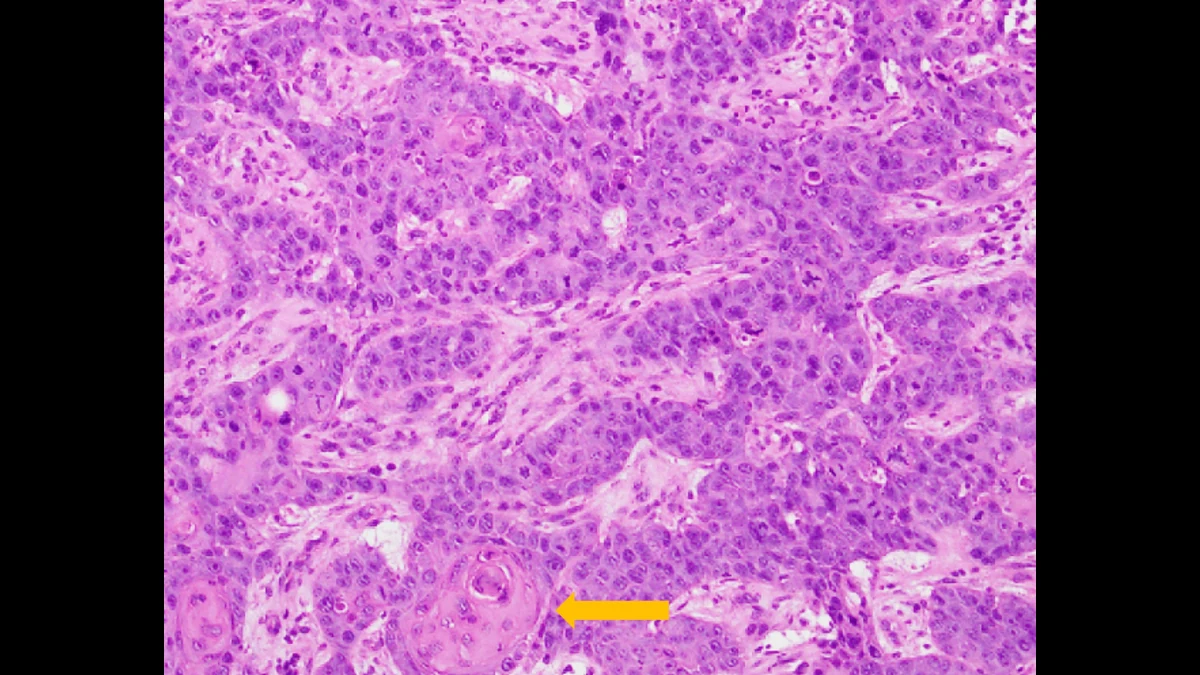
Image source and reuse details
Source: Anal Canal Squamous Cell Carcinoma Following Low-Dose-Rate Prostate Brachytherapy — Figure 3, Case 1. Whole 2892 × 2239 image proportionally reduced to 872 × 675, centered in 1200 × 675 with 164-pixel black side margins. WebP conversion. Original arrow retained; no clinical crop, recoloring, diagnostic retouching or enlargement.
In this guide
First, confirm which cancer this is
The anus is the last opening of the digestive tract. The anal canal is the short passage inside it; the anal margin is the nearby outer skin. Most anal cancers are squamous carcinomas, arising from lining cells. Their treatment differs from the usual adenocarcinoma of the colon or rectum.
Ask for the exact site and tissue diagnosis. Older terms such as basaloid or cloacogenic commonly belong to the squamous group. Anal adenocarcinoma, melanoma, lymphoma and neuroendocrine tumors need other specialist pathways. Stage and health matter more than a label alone, and population statistics cannot predict one person’s outcome.
Source: National Cancer Institute — United States — Anal Cancer Treatment (PDQ®) — Health Professional Version · National Cancer Institute — United States — Anal Cancer Diagnosis & Prognosis · The University of Texas MD Anderson Cancer Center — United States — Anal Cancer Treatment
Bleeding or pain should not be assumed to be hemorrhoids
Possible symptoms include anal bleeding, pain, itching, a lump, mucus discharge, a persistent wound, changes in bowel movements or difficulty controlling stool. Hemorrhoids and fissures can cause similar problems. A new or persistent change needs an examination, even if an earlier episode was called hemorrhoids.
Some tumors cause few symptoms. Tell the clinician how long the change has lasted, whether it is growing, and about weight loss or new groin lumps. Heavy bleeding, faintness or severe worsening pain needs urgent assessment. Embarrassment should never prevent you from asking for an examination.
Source: National Health Service — United Kingdom — Symptoms of anal cancer
HPV, immune health and prevention
Persistent infection with high-risk human papillomavirus, or HPV, is the main cause of anal squamous cancer. Smoking, HIV, medicines that suppress immunity, organ transplantation and a history of certain HPV-related precancers or cancers can raise risk. Having a risk factor does not mean cancer is inevitable.
HPV is common and can remain unnoticed for years. A diagnosis cannot establish when infection happened or which partner transmitted it. Vaccination helps prevent new infections; it does not remove an existing cancer. Discuss vaccination and stopping smoking with your clinician, alongside appropriate surveillance rather than as substitutes for treatment.
Source: National Cancer Institute — United States — Anal Cancer Prevention (PDQ®) — Health Professional Version · National Cancer Institute — United States — Anal Cancer Treatment (PDQ®) — Health Professional Version
Who should discuss anal screening?
There is no universal anal screening program equivalent to bowel screening. United States guidance recommends yearly symptom assessment and a digital anorectal examination for adults with HIV. Additional laboratory screening with referral for high-resolution anoscopy is recommended from age 35 for men who have sex with men and transgender women with HIV, and from 45 for other adults with HIV.
High-resolution anoscopy uses magnification to inspect the anal lining and guide biopsy. International guidance also identifies selected higher-risk groups without HIV, including some transplant recipients and people with prior vulvar precancer or cancer. Timing depends on risk and local services. Symptoms need assessment at any age; a normal cervical test or colonoscopy does not replace assessment of a suspicious anal lesion.
Source: National Institutes of Health, Office of AIDS Research — United States — HIV Clinical Guidelines Now Recommend High Resolution Anoscopy as Part of Anal Cancer Screening Program for People with HIV · International Anal Neoplasia Society — International Anal Neoplasia Society’s consensus guidelines for anal cancer screening
Precancer can be treated before invasion
High-grade squamous intraepithelial lesions, called HSIL or AIN 2–3, are abnormal cells that have not yet invaded deeper tissue. They are different from invasive cancer. Specialist options include destroying the affected tissue, excision or selected creams after biopsy has excluded invasion. Follow-up remains necessary because lesions can return.
In the National Cancer Institute-funded ANCHOR trial, 4,459 adults with HIV aged at least 35 were randomized; 4,446 entered the main analysis. At a median 25.8 months, there were 9 anal cancers after HSIL treatment versus 21 with monitoring. The relative incidence reduction was 57%, not 57 percentage points. Treatment did not prevent every cancer, and the exact benefit cannot simply be assigned to other populations.
Source: National Cancer Institute — United States — In people with HIV, treating precancerous anal lesions cuts risk of anal cancer by more than half · National Cancer Institute — United States — Anal Cancer Prevention (PDQ®) — Health Professional Version
The examinations that establish the diagnosis
Assessment normally includes a medical history, inspection of the skin, a gloved-finger examination of the anus and rectum, and checking groin lymph nodes. Anoscopy or proctoscopy uses a short instrument to see the lining. The clinician takes a biopsy so a pathologist can examine tissue under a microscope.
Pain or a difficult examination may require anesthesia. Tell the team about previous pelvic radiation, other cancers, immune treatment and all medicines. If the diagnosis or a major operation is uncertain, a second opinion can review the biopsy slides, report and scans without assuming every test must be repeated.
Source: National Cancer Institute — United States — Anal Cancer Diagnosis & Prognosis · National Health Service — United Kingdom — Tests and next steps for anal cancer
What to look for in the pathology report
The report should distinguish an invasive squamous carcinoma from a precancer and from a different tumor. It may describe how abnormal the cells look and whether an excised lesion has clear edges. Lymph-vessel, blood-vessel or nerve involvement can affect decisions about a small lesion treated by excision.
Testing for HPV or the protein p16 may help characterize the tumor. These findings do not guarantee a response to immunotherapy, and p16 is not itself a drug target. Blood markers such as carcinoembryonic antigen cannot establish an anal cancer diagnosis. Ask the team to explain which findings actually change your plan.
Source: National Cancer Institute — United States — Anal Cancer Treatment (PDQ®) — Health Professional Version · Sociedad Española de Oncología Médica; Grupo Español Multidisciplinar en Cáncer Digestivo; Grupo de Tratamiento de los Tumores Digestivos — Spain — SEOM–GEMCAD–TTD clinical guidelines for anal cancer (2025)
Scans, lymph nodes and the stage
Pelvic magnetic resonance imaging helps map the tumor and nearby structures. Computed tomography of the chest and abdomen looks for distant spread. A positron emission tomography scan may clarify lymph nodes or help radiation planning in selected cases. Scans complement the examination and biopsy; an unusual area can have another cause.
The TNM record describes tumor size and local invasion, regional lymph nodes and distant metastases. Ask which staging edition was used and where disease was actually found. Nearby lymph nodes or sphincter involvement are not automatically distant metastases. The stage helps choose treatment but is not a timetable for an individual’s life.
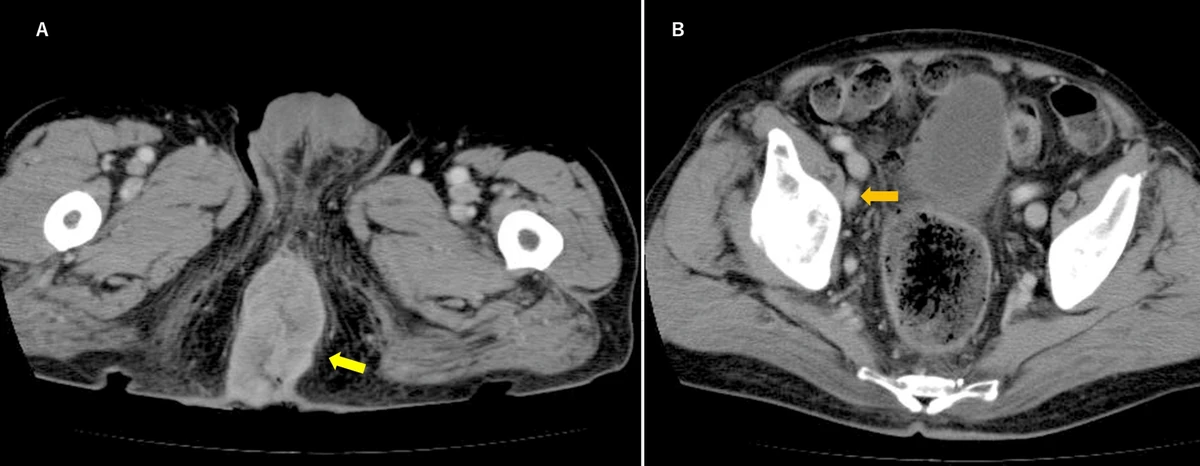
Image source and reuse details
Source: Anal Canal Squamous Cell Carcinoma Following Low-Dose-Rate Prostate Brachytherapy — Figure 2, Case 1. Complete 2892 × 1124 two-panel source CT reduced proportionally to 1200 × 466 and converted to WebP. Both panels, arrows and labels retained; no cropping, recoloring, diagnostic retouching or enlargement.
Source: National Cancer Institute — United States — Anal Cancer Treatment (PDQ®) — Health Professional Version · Sociedad Española de Oncología Médica; Grupo Español Multidisciplinar en Cáncer Digestivo; Grupo de Tratamiento de los Tumores Digestivos — Spain — SEOM–GEMCAD–TTD clinical guidelines for anal cancer (2025)
Choose a team that treats anal cancer together
A useful team brings together colorectal surgery, radiation oncology, medical oncology, pathology and imaging. Access to a stoma nurse, dietitian, pelvic rehabilitation and psychological support matters too. If you have HIV, involve the clinician managing antiretroviral treatment so cancer care, infection prevention and medicine interactions are coordinated.
Before treatment, ask about the goal: cure, long-term control or symptom relief. Discuss likely bowel and sexual effects, fertility, travel, work and costs. Supportive or palliative care can be provided alongside active cancer treatment. A second opinion is particularly useful before extensive surgery or treatment in an already irradiated pelvis.
Source: The University of Texas MD Anderson Cancer Center — United States — Anal Cancer Treatment · Istituto Oncologico Veneto — Italy — Tumore del canale anale · National Cancer Institute — United States — Palliative Care in Cancer
Why chemotherapy and radiation are usually combined
For most localized anal squamous cancers, definitive chemoradiation is used to destroy the tumor while aiming to preserve the anus. Common combinations are fluorouracil or oral capecitabine with mitomycin during radiation. Fluorouracil with cisplatin is an alternative in selected patients. The choice depends on immune function, blood counts and other health conditions.
Modern intensity-modulated radiation shapes the dose around the tumor and at-risk nodes while limiting exposure to healthy tissue. Treatment often takes about 5–6 weeks, with the exact schedule prescribed individually. Additional chemotherapy before or after this course is not routinely recommended for localized disease. Report side effects early so avoidable interruptions can be prevented safely.
Source: American Society for Radiation Oncology — United States — Radiation Therapy for Anal Squamous Cell Carcinoma: An ASTRO Clinical Practice Guideline · American Society of Clinical Oncology — United States — Systemic Therapy for Stage I-III Anal Squamous Cell Carcinoma: ASCO Guideline · University Health Network, Princess Margaret Cancer Centre — Canada — Your 5fu and Mitomycin Chemotherapy and Radiation Schedule
Checks before treatment can prevent serious harm
Before fluorouracil or capecitabine, discuss testing for reduced activity of the enzyme DPD, often through the DPYD gene. Current United States labeling advises genetic testing unless immediate treatment is necessary. Complete deficiency can make these drugs dangerously toxic; partial deficiency requires an individualized approach. Testing does not remove every treatment risk.
The team also checks blood counts, kidney and liver function and relevant heart, nerve or hearing problems. Cisplatin may be unsuitable with kidney impairment, significant neuropathy or hearing loss. HIV alone should not lead to an automatic reduction of effective treatment, but significant immune suppression may change drug choice and monitoring. Do not adjust chemotherapy or antiretroviral medicines yourself.
Source: Food and Drug Administration — United States — Safety labeling update for capecitabine and fluorouracil (5-FU) on risks associated with dihydropyrimidine dehydrogenase (DPD) deficiency · National Cancer Institute — United States — Infection and Neutropenia during Cancer Treatment
When a small operation or a stoma may be appropriate
Local excision can be considered for carefully selected small anal-margin cancers and very superficially invasive canal cancers. The team needs clear tissue edges, acceptable cell features, preserved sphincter function and reliable follow-up. A small size alone does not mean every anal-canal tumor can safely be treated by surgery alone.
A diverting colostomy creates an abdominal opening for stool. It may be needed before chemoradiation if obstruction, a fistula or severe incontinence would make treatment unsafe. It does not automatically mean the anticancer treatment has failed, and reversal is not always possible. Ask why it is needed and meet the stoma nurse beforehand when feasible.
Source: American Society for Radiation Oncology — United States — Radiation Therapy for Anal Squamous Cell Carcinoma: An ASTRO Clinical Practice Guideline · National Health Service — United Kingdom — Treatment for anal cancer · The University of Texas MD Anderson Cancer Center — United States — Anal Cancer Treatment
A slow response is not always treatment failure
The first reassessment is often around 8–12 weeks after chemoradiation ends. A shrinking tumor may continue to improve for approximately 6 months after treatment, with close examination. Do not confuse this with the ACT II study’s assessment at 26 weeks from treatment start. Clear growth or new concerning findings need earlier investigation rather than automatic waiting.
If persistent or recurrent cancer is suspected, biopsy and new staging help confirm the situation. Selected patients may benefit from salvage abdominoperineal resection, removing the anus and rectum and creating a permanent colostomy. Reconstruction, reirradiation or more extensive surgery require an experienced team. Scar tissue alone should not trigger a major operation without appropriate assessment.
Source: American Society for Radiation Oncology — United States — Radiation Therapy for Anal Squamous Cell Carcinoma: An ASTRO Clinical Practice Guideline · Sociedad Española de Oncología Médica; Grupo Español Multidisciplinar en Cáncer Digestivo; Grupo de Tratamiento de los Tumores Digestivos — Spain — SEOM–GEMCAD–TTD clinical guidelines for anal cancer (2025)
Medicines for inoperable recurrence or metastatic disease
In the United States, retifanlimab with carboplatin and paclitaxel is approved as first treatment for adults with inoperable locally recurrent or metastatic squamous cancer of the anal canal. Retifanlimab alone is also approved after progression on, or intolerance to, platinum-based chemotherapy. This is different from the usual curative chemoradiation pathway for localized disease.
The European Commission register also confirms the first-line combination indication; it does not list the same anal-cancer monotherapy indication. Approval does not establish availability or reimbursement in every country. Ask which indication applies, whether prior immunotherapy changes the choice, and what alternatives are reasonable if immune treatment or intensive chemotherapy is unsuitable.
Source: Food and Drug Administration — United States — FDA approves retifanlimab-dlwr with carboplatin and paclitaxel and as a single agent for squamous cell carcinoma of the anal canal · Food and Drug Administration — United States — ZYNYZ (retifanlimab-dlwr) — Prescribing Information, revised May 2026 · European Commission — European Union — Union Register of medicinal products — ZYNYZ, EU/1/24/1800
What the retifanlimab results actually show
The manufacturer-funded POD1UM-303 trial randomly assigned 308 patients, 154 per group, to retifanlimab or placebo alongside carboplatin–paclitaxel. Median time without progression was 9.3 versus 7.4 months; the hazard ratio was 0.63, with a 95% confidence interval of 0.47–0.84. Incyte contributed to study design, data work and reporting. Participants were generally fit and few had known HIV.
The 2026 update reported median overall survival of 32.8 versus 22.2 months, but the current Food and Drug Administration label states that this difference was not statistically significant. These are group estimates, not extra months promised to a person; crossover complicates interpretation. In the 2025 safety analysis, severe events (grade 3 or higher) occurred in 128 of 154 versus 114 of 152 treated patients. One fatal pancytopenia event, with dangerously low red cells, white cells and platelets, was attributed to retifanlimab by the investigator. The hazard ratio compares event risk during follow-up; it is not a percentage cured.
Source: POD1UM-303/InterAACT-2 investigators; The Lancet — Retifanlimab with carboplatin and paclitaxel for locally recurrent or metastatic squamous cell carcinoma of the anal canal (POD1UM-303/InterAACT-2): a global, phase 3 randomised controlled trial · POD1UM-303/InterAACT-2 investigators; Annals of Oncology — Survival outcomes in POD1UM-303/InterAACT-2: a phase III study of retifanlimab plus carboplatin–paclitaxel in first-line advanced squamous anal cancer · Food and Drug Administration — United States — ZYNYZ (retifanlimab-dlwr) — Prescribing Information, revised May 2026
Research includes disappointing results as well as progress
More immunotherapy is not automatically better. In the 2026 randomized phase 2 NCI9673 Part B study of 100 previously treated patients, adding ipilimumab to nivolumab did not establish better tumor response, progression-free survival or overall survival. Severe treatment-related effects occurred in 12% with nivolumab alone and 25% with the combination. Public, institutional and philanthropic support was reported, alongside authors’ industry relationships.
The 2025 phase 2 PLATO-ACT4 study tested reduced treatment for selected early cancers. Of 163 recruited patients, 160 entered the analysis: 55 standard-dose and 105 reduced-dose. At 6 months, complete responses including missing assessments in the denominator were 46 of 55 and 89 of 105. Funded by Cancer Research UK and Stand Up to Cancer, these early results do not prove equal long-term control for everyone or justify reducing a prescribed dose yourself.
Source: Experimental Therapeutics Clinical Trials Network; Journal of Clinical Oncology — NCI9673 (Part B): ETCTN Randomized Phase II Study of Nivolumab With or Without Ipilimumab in Refractory, Metastatic Squamous Cell Carcinoma of the Anal Canal · PLATO trial study group; The Lancet Oncology — Standard versus reduced-dose chemoradiotherapy in anal cancer (PLATO-ACT4): short-term results of a phase 2 randomised controlled trial
Can molecular tests open another treatment option?
For advanced disease, the team may discuss testing for rare features such as deficient DNA mismatch repair or high microsatellite instability, called dMMR or MSI-H. Selected United States pembrolizumab indications can apply across tumor sites after prior treatment when satisfactory alternatives are lacking. HPV positivity alone is not the same finding.
Other findings can include high tumor mutational burden or an NTRK gene fusion. The updated United States TMB-H indication uses at least 13 mutations per megabase, so an older threshold should not be assumed current. Selected NTRK-fusion tumors may qualify for a targeted drug under specific national criteria. A molecular finding is an opening for discussion, not proof of benefit or local access.
Source: Food and Drug Administration — United States — Verified Clinical Benefit — Cancer Accelerated Approvals; pembrolizumab MSI-H/dMMR solid tumors · Food and Drug Administration — United States — FDA grants traditional approval for pembrolizumab or pembrolizumab and berahyaluronidase alfa-pmph for unresectable or metastatic TMB-H solid tumors with updated indication · European Medicines Agency — European Union — Vitrakvi — therapeutic indication and conditional authorisation
Clinical studies: what is open and what is still uncertain?
The National Cancer Institute’s AMC-110 study, NCT04929028, examines risk-adapted treatment in people with HIV. EA2165, NCT03233711, compares nivolumab with observation after combined treatment in high-risk anal cancer. Both official records were active but not recruiting at this check. Their estimated primary completion dates were in 2031 and 2027 respectively, not dates when a new treatment will be approved.
These studies address different questions and are not interchangeable with treatment for metastatic disease. Ask about current studies that fit your exact stage, previous treatment, immune health and country. Registry entries can change. Confirm eligibility, alternatives, extra visits, tests, travel and which costs are covered before consent; participation never guarantees an effective medicine or free care.
Source: National Cancer Institute; United States National Library of Medicine — NCT04929028 — Risk-Adapted Therapy for HIV-Associated Anal Cancer · National Cancer Institute; United States National Library of Medicine — NCT03233711 — A Randomized Phase III Study of Nivolumab After Combined Modality Therapy in High Risk Anal Cancer · National Cancer Institute — United States — Who Pays for Clinical Trials?
Get a written plan for side effects and urgent symptoms
During treatment, sore skin around the anus or groin, painful bowel movements, diarrhea, urinary irritation, nausea and fatigue are common. Falling blood counts can increase infection or bleeding risk. Tell the team early about symptoms, and ask for skin care, pain relief, hydration and food advice that fit the treatment area.
Follow the team’s urgent-contact instructions for fever, including 38°C or its stated threshold, heavy bleeding, inability to pass urine, repeated vomiting or dehydration. New severe diarrhea or breathlessness during immunotherapy can signal an immune reaction, even after treatment ends. Do not wait for the next appointment or rely only on over-the-counter remedies when serious symptoms develop.
Source: National Cancer Institute — United States — Infection and Neutropenia during Cancer Treatment · National Cancer Institute — United States — Diarrhea and Cancer Treatment · Food and Drug Administration — United States — ZYNYZ (retifanlimab-dlwr) — Prescribing Information, revised May 2026
Bowel recovery and living with a stoma
Urgency, leakage, painful bowel movements, narrowing or bleeding can persist after pelvic treatment. They may be treatable effects rather than recurrence, but they still deserve assessment. Keep a symptom and stool record. Depending on the cause, help may include diet changes, prescribed medicines, pelvic-floor rehabilitation or specialist investigation.
A stoma nurse can help with pouch fit, skin protection, supplies, travel and returning to daily activities. A stoma does not make intimacy or an active life impossible. Recovery and reversal prospects depend on the operation and your health. Report a sudden painful change, persistent vomiting or problems with output promptly rather than trying to solve every complication alone.
Source: National Health Service — United Kingdom — Recovery and lifestyle changes after a colostomy · National Cancer Institute — United States — Diarrhea and Cancer Treatment · The University of Texas MD Anderson Cancer Center — United States — Anal Cancer Treatment
Sexual health, fertility and menopause belong in the plan
Pelvic treatment may affect erections, vaginal comfort or width, desire and the ability to have children. Some people develop early menopause. Ask about fertility preservation before treatment if future biological children matter to you: sperm, egg or embryo storage may be considered when feasible. Reduced fertility does not reliably prevent pregnancy.
Discuss contraception and when sexual activity is safe. Pain, bleeding or unhealed tissue should not be pushed through. Pelvic rehabilitation, sexual-health care, treatment for erectile problems, and individually advised vaginal moisturizers or dilators can help. Timing matters, and no exercise or device should be forced. Partners and people of every gender deserve clear, respectful support.
Source: National Cancer Institute — United States — Sexual Health Issues in Women with Cancer · National Cancer Institute — United States — Sexual Health Issues in Men with Cancer · National Cancer Institute — United States — Female Fertility and Cancer Treatment · National Cancer Institute — United States — Male Fertility and Cancer Treatment
Food, movement and supplements during recovery
The priority during treatment is enough energy, protein and fluid, not a restrictive anticancer diet. A dietitian can adapt meals if diarrhea, weight loss or poor appetite makes eating difficult. Fiber may need temporary adjustment during bowel symptoms; advice for a person with diarrhea can differ from advice for someone with constipation or a new stoma.
Build activity around energy, pain and healing, with your team’s advice. Gentle movement may be easier than prolonged sitting or strenuous exercise at first. Ask for help to stop smoking. No supplement, herb or fasting program has been shown to replace anal cancer treatment; some products interact with medicines. Take a complete list to the pharmacist before starting anything.
Source: National Cancer Institute — United States — Nutrition During Cancer Treatment · National Cancer Institute — United States — Complementary and Alternative Medicine · National Cancer Institute — United States — Diarrhea and Cancer Treatment
Follow-up should check function as well as recurrence
A common follow-up pattern is examination every 3–6 months for the first 2 years, then every 6–12 months up to 5 years, adapted to risk and local guidance. It includes the anus, groin nodes and sometimes anoscopy. Scans are selected by stage and findings; repeated positron emission tomography scans are not automatically useful because inflammation can look abnormal.
Ask for a written plan covering bowel and urinary function, sexual health, menopause or bone health when relevant, emotional support and late treatment effects. Report new bleeding, a growing lump or worsening pain before the next visit. Supportive and palliative teams can help with symptoms and family needs while anticancer treatment continues.
Source: Sociedad Española de Oncología Médica; Grupo Español Multidisciplinar en Cáncer Digestivo; Grupo de Tratamiento de los Tumores Digestivos — Spain — SEOM–GEMCAD–TTD clinical guidelines for anal cancer (2025) · American Society for Radiation Oncology — United States — Radiation Therapy for Anal Squamous Cell Carcinoma: An ASTRO Clinical Practice Guideline · National Cancer Institute — United States — Palliative Care in Cancer
Find the right pathway and prepare for the consultation
Use the country filter to explore documented services rather than a claimed world ranking. Examples include the Istituto Oncologico Veneto multidisciplinary rectal/anal pathway in Italy, The University of Texas MD Anderson Cancer Center in the United States, Gustave Roussy in France and Princess Margaret Cancer Centre in Canada. The linked official pages explain the documented service, not a promise of admission.
Bring the pathology report, biopsy slides if requested, scans, previous radiation plans and medicine list. Ask who coordinates the team, what goal and alternatives are realistic, and how costs or a second opinion work. Call the listed office to confirm the proper referral route. Do not email sensitive records without secure instructions. The directory is selective; a postcode-distance search is not currently available.
Centres with documented pathways for anal cancer →
Source: Istituto Oncologico Veneto — Italy — UOC Oncologia 1 — Contatti e attività clinica · Istituto Oncologico Veneto — Italy — Ambulatorio multidisciplinare del retto/ano · Istituto Oncologico Veneto — Italy — Tumore del canale anale · The University of Texas MD Anderson Cancer Center — United States — Anal Cancer Treatment · Gustave Roussy — France — Les cancers traités à Gustave Roussy · University Health Network, Princess Margaret Cancer Centre — Canada — Your 5fu and Mitomycin Chemotherapy and Radiation Schedule
Questions to take to your appointment
- Can anal cancer be cured? Localized squamous cancer is often treated with curative intent. The chance depends on stage, response and health; no individual outcome is guaranteed.
- Does anal bleeding mean cancer? No. Hemorrhoids and fissures are common, but persistent or new bleeding still needs examination.
- Will I always need a permanent stoma? No. Chemoradiation often preserves the anus. Some complications or salvage operations require a stoma, which may be permanent.
- Why may the team wait before declaring treatment failure? A shrinking tumor can continue responding for months. Close monitoring is different from ignoring clear progression.
- Is retifanlimab available for every anal tumor? No. The indication concerns particular advanced anal-canal squamous cancers, and national approval, access and prior treatment matter.
- Do a trial completion date and a new cure mean the same thing? No. Dates may change, results can be negative, and regulatory review and access are separate steps.
Sources and verification
- National Cancer Institute — United States — Anal Cancer Treatment (PDQ®) — Health Professional Version
- National Cancer Institute — United States — Anal Cancer Diagnosis & Prognosis
- National Health Service — United Kingdom — Symptoms of anal cancer
- National Health Service — United Kingdom — Tests and next steps for anal cancer
- National Health Service — United Kingdom — Treatment for anal cancer
- National Cancer Institute — United States — Anal Cancer Prevention (PDQ®) — Health Professional Version
- National Institutes of Health, Office of AIDS Research — United States — HIV Clinical Guidelines Now Recommend High Resolution Anoscopy as Part of Anal Cancer Screening Program for People with HIV
- International Anal Neoplasia Society — International Anal Neoplasia Society’s consensus guidelines for anal cancer screening
- National Cancer Institute — United States — In people with HIV, treating precancerous anal lesions cuts risk of anal cancer by more than half
- American Society for Radiation Oncology — United States — Radiation Therapy for Anal Squamous Cell Carcinoma: An ASTRO Clinical Practice Guideline
- American Society of Clinical Oncology — United States — Systemic Therapy for Stage I-III Anal Squamous Cell Carcinoma: ASCO Guideline
- Sociedad Española de Oncología Médica; Grupo Español Multidisciplinar en Cáncer Digestivo; Grupo de Tratamiento de los Tumores Digestivos — Spain — SEOM–GEMCAD–TTD clinical guidelines for anal cancer (2025)
- Food and Drug Administration — United States — Safety labeling update for capecitabine and fluorouracil (5-FU) on risks associated with dihydropyrimidine dehydrogenase (DPD) deficiency
- Food and Drug Administration — United States — FDA approves retifanlimab-dlwr with carboplatin and paclitaxel and as a single agent for squamous cell carcinoma of the anal canal
- Food and Drug Administration — United States — ZYNYZ (retifanlimab-dlwr) — Prescribing Information, revised May 2026
- POD1UM-303/InterAACT-2 investigators; The Lancet — Retifanlimab with carboplatin and paclitaxel for locally recurrent or metastatic squamous cell carcinoma of the anal canal (POD1UM-303/InterAACT-2): a global, phase 3 randomised controlled trial
- POD1UM-303/InterAACT-2 investigators; Annals of Oncology — Survival outcomes in POD1UM-303/InterAACT-2: a phase III study of retifanlimab plus carboplatin–paclitaxel in first-line advanced squamous anal cancer
- Experimental Therapeutics Clinical Trials Network; Journal of Clinical Oncology — NCI9673 (Part B): ETCTN Randomized Phase II Study of Nivolumab With or Without Ipilimumab in Refractory, Metastatic Squamous Cell Carcinoma of the Anal Canal
- PLATO trial study group; The Lancet Oncology — Standard versus reduced-dose chemoradiotherapy in anal cancer (PLATO-ACT4): short-term results of a phase 2 randomised controlled trial
- National Cancer Institute; United States National Library of Medicine — NCT04929028 — Risk-Adapted Therapy for HIV-Associated Anal Cancer
- National Cancer Institute; United States National Library of Medicine — NCT03233711 — A Randomized Phase III Study of Nivolumab After Combined Modality Therapy in High Risk Anal Cancer
- European Commission — European Union — Union Register of medicinal products — ZYNYZ, EU/1/24/1800
- National Cancer Institute — United States — Diarrhea and Cancer Treatment
- National Health Service — United Kingdom — Recovery and lifestyle changes after a colostomy
- National Cancer Institute — United States — Palliative Care in Cancer
- National Cancer Institute — United States — Sexual Health Issues in Men with Cancer
- National Cancer Institute — United States — Male Fertility and Cancer Treatment
- Istituto Oncologico Veneto — Italy — Tumore del canale anale
- Istituto Oncologico Veneto — Italy — UOC Oncologia 1 — Contatti e attività clinica
- Istituto Oncologico Veneto — Italy — Ambulatorio multidisciplinare del retto/ano
- The University of Texas MD Anderson Cancer Center — United States — Anal Cancer Treatment
- Gustave Roussy — France — Les cancers traités à Gustave Roussy
- University Health Network, Princess Margaret Cancer Centre — Canada — Your 5fu and Mitomycin Chemotherapy and Radiation Schedule
- Naoto Shibuya and colleagues; Cureus — Anal Canal Squamous Cell Carcinoma Following Low-Dose-Rate Prostate Brachytherapy: A Report of Two Cases and Literature Review
- Food and Drug Administration — United States — Verified Clinical Benefit — Cancer Accelerated Approvals; pembrolizumab MSI-H/dMMR solid tumors
- Food and Drug Administration — United States — FDA grants traditional approval for pembrolizumab or pembrolizumab and berahyaluronidase alfa-pmph for unresectable or metastatic TMB-H solid tumors with updated indication
- European Medicines Agency — European Union — Vitrakvi — therapeutic indication and conditional authorisation
- National Cancer Institute — United States — Infection and Neutropenia during Cancer Treatment
- National Cancer Institute — United States — Nutrition During Cancer Treatment
- National Cancer Institute — United States — Complementary and Alternative Medicine
- National Cancer Institute — United States — Sexual Health Issues in Women with Cancer
- National Cancer Institute — United States — Female Fertility and Cancer Treatment
- National Cancer Institute — United States — Who Pays for Clinical Trials?
Sources checked: 2026-11-18