


Vaginal cancer: diagnosis, treatments and specialist care
Primary vaginal cancer can often be treated, especially when it is found before it spreads. The first step is to confirm where it began and what type it is. This guide explains the decisions to discuss with a specialist team, including treatment, recovery and research.
MyMedNest editorial guide · Sources checked:
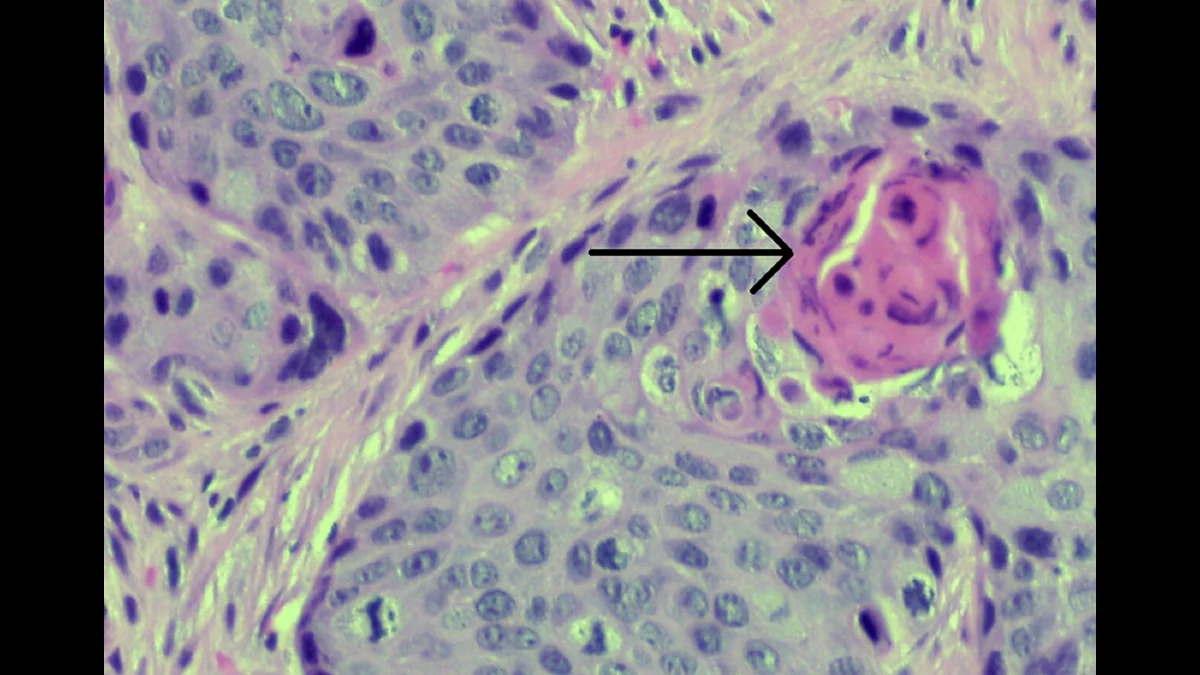
Image source and reuse details
Source: A Lymphoma Almost Overlooked — Figure 1. Whole 1617 × 1100 micrograph proportionally reduced to 992 × 675, centered in 1200 × 675 with 104-pixel black side margins. Original arrow retained. WebP conversion; no clinical crop, recoloring, retouching or enlargement.
In this guide
First confirm where the cancer started
The vagina is the internal canal between the cervix and the outside of the body. The vulva is the external genital area. A primary vaginal cancer starts in vaginal tissue. A tumor that reaches the vagina from the cervix, vulva, uterus or another organ needs the treatment pathway for its actual origin. A previous cancer history helps the pathologist make that distinction.
This guide mainly covers adult squamous cell carcinoma, the most common vaginal cancer. Adenocarcinoma starts in gland cells. Clear cell carcinoma, melanoma, sarcoma, lymphoma and neuroendocrine tumors need additional specialist assessment. Childhood tumors have different protocols. The word vaginal alone does not tell you which treatment is right.
Source: National Cancer Institute — United States — Vaginal Cancer Treatment (PDQ®)–Health Professional Version · Adams, Maluleke and Cuello — International Federation of Gynecology and Obstetrics Cancer Report — Cancer of the vagina: 2025 update
Changes that deserve an examination
Seek medical assessment for bleeding after menopause, between periods or after sex; bloodstained or unusual discharge; a lump or sore inside the vagina; persistent itching; pain during sex; or new pelvic or urinary symptoms. Many noncancerous conditions cause these changes. A symptom is a reason to be examined, not a diagnosis.
A clinician may examine the vulva, vagina and cervix. You can ask for a chaperone, bring a support person and ask to stop if the examination hurts. Heavy bleeding with faintness, inability to pass urine or severe new pain needs urgent care. Do not wait for the next screening invitation or repeatedly treat a persistent change without reassessment.
Source: National Health Service — United Kingdom — Vaginal cancer — Symptoms
HPV, other risk factors and screening
Persistent infection with high-risk human papillomavirus, or HPV, is linked to many vaginal squamous cancers. Smoking, immune suppression and a history of high-grade genital lesions also matter. Some clear cell cancers are associated with exposure before birth to diethylstilbestrol, or DES, a medicine used in the past. Most people with HPV never develop vaginal cancer.
HPV vaccination prevents new infections and related precancers; it does not treat an existing cancer. Routine vaginal screening is not recommended for everyone after a hysterectomy for a benign condition. Follow-up can be different after cervical precancer, cancer or DES exposure. A normal cervical screening result cannot rule out a symptomatic vaginal lesion. Ask which follow-up applies to your history.
Source: Adams, Maluleke and Cuello — International Federation of Gynecology and Obstetrics Cancer Report — Cancer of the vagina: 2025 update · National Cancer Institute — United States — Human Papillomavirus (HPV) Vaccine
Precancer is different from invasive cancer
Vaginal squamous intraepithelial lesions are abnormal cells confined to the lining. A low-grade lesion, LSIL or VaIN 1, can often be observed. A high-grade lesion, HSIL or VaIN 2–3, usually needs treatment and long-term follow-up. These labels do not mean that an invasive cancer has already spread through the body.
Specialists may use excision, laser or a prescribed local treatment such as imiquimod for selected confirmed precancers. Biopsy must exclude invasion before a treatment that destroys tissue without a full specimen. Creams or laser for precancer are not substitutes for treating invasive cancer. Lesions can recur, so discharge from treatment should include a clear surveillance plan.
Source: Adams, Maluleke and Cuello — International Federation of Gynecology and Obstetrics Cancer Report — Cancer of the vagina: 2025 update · The University of Texas MD Anderson Cancer Center — United States — Vaginal Cancer Treatment
Biopsy gives the diagnosis
A specialist examines the whole vaginal canal and may use colposcopy, a magnified view from outside the body, to map abnormal areas. A biopsy removes a small piece for laboratory examination. A cervical or vulvar origin must be considered. Sometimes anesthesia is needed to obtain adequate tissue or assess an area that is painful or difficult to see.
Ask when the result should arrive and who will explain it. A biopsy, cervical smear and HPV test answer different questions. Blood tests and scans help assess health or spread, but do not replace tissue diagnosis. If findings disagree or the tumor is unusual, a specialist pathology review can prevent treatment for the wrong disease.
Source: European Society of Gynaecological Oncology, European Society for Radiotherapy and Oncology, European Society of Paediatric Oncology — Pocket Guidelines — Vaginal Cancer, 2023 · National Health Service — United Kingdom — Vaginal cancer — Tests and next steps
What to look for in the pathology report
The report should identify the cancer type and the tissue sampled. HPV-related classification may use p16 staining and other HPV tests. If tissue has been removed, the report can describe tumor size, depth, margins, lymphatic or blood vessel invasion and lymph node findings. A positive margin means cancer reaches a cut edge of the specimen.
Ask which findings change the plan. p16 is not a treatment on its own, and HPV positivity does not guarantee response to immunotherapy. For recurrent or metastatic disease, the team may request tests that could guide medicines or trial eligibility. The required test, tissue quality and interpretation depend on the question being asked.
Source: European Society of Gynaecological Oncology, European Society for Radiotherapy and Oncology, European Society of Paediatric Oncology — Pocket Guidelines — Vaginal Cancer, 2023 · Adams, Maluleke and Cuello — International Federation of Gynecology and Obstetrics Cancer Report — Cancer of the vagina: 2025 update
Stage describes spread, not a personal deadline
In broad terms, stage I is confined to the vaginal wall; stage II extends into nearby tissue; stage III involves the pelvic wall or regional spread under the staging system used. Stage IVA involves nearby organs or extension beyond the pelvis, while IVB means distant spread. Ask for both the named staging system and the actual findings rather than relying on a number alone.
The team records the primary tumor, lymph nodes and distant spread, often described as TNM, alongside the International Federation of Gynecology and Obstetrics classification. Tumor size, site, health and earlier treatment also influence choices. A survival statistic from an older mixed group cannot predict exactly what will happen to one person. Ask whether the goal is cure, disease control or symptom relief.
Source: National Cancer Institute — United States — Vaginal Cancer Treatment (PDQ®)–Health Professional Version · European Society of Gynaecological Oncology, European Society for Radiotherapy and Oncology, European Society of Paediatric Oncology — Pocket Guidelines — Vaginal Cancer, 2023 · Adams, Maluleke and Cuello — International Federation of Gynecology and Obstetrics Cancer Report — Cancer of the vagina: 2025 update
Which scans are useful
Pelvic magnetic resonance imaging, MRI, helps show the local extent and relation to the bladder, urethra and rectum. Computed tomography, CT, checks the chest, abdomen and pelvis. Positron emission tomography combined with CT, PET-CT, may add information, particularly for more advanced disease or suspected recurrence. Not everyone needs every scan.
The upper vagina usually drains toward pelvic lymph nodes; lower vaginal tumors may also involve groin nodes. This affects treatment planning. A scan finding is not always cancer. Infection or a second condition can look similar, so the team may biopsy a suspicious site when the result would change treatment. Bring the original scan files as well as the written report for a second opinion.
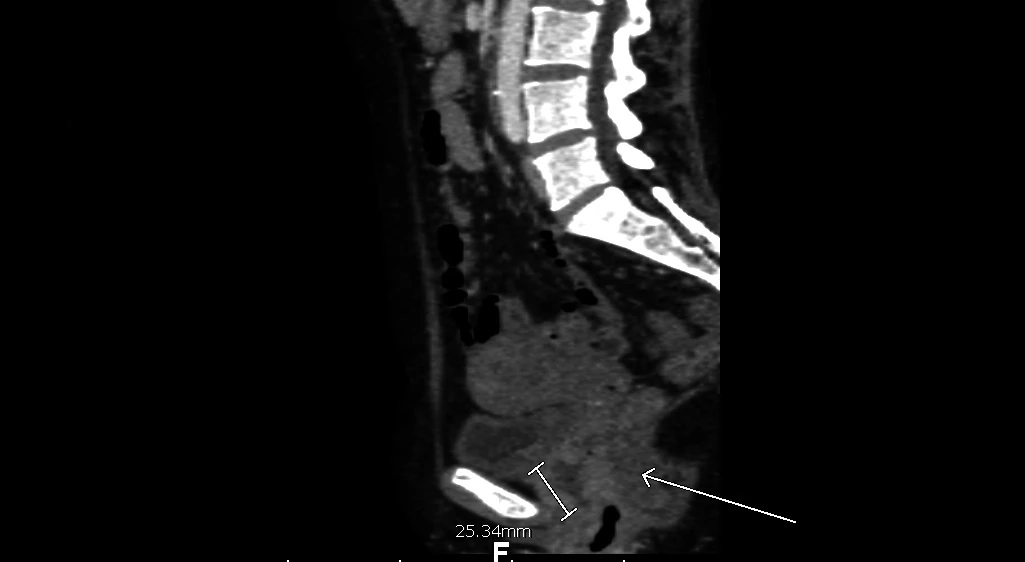
Image source and reuse details
Source: A Lymphoma Almost Overlooked — Figure 2. Complete 1025 × 562 source CT converted to WebP at native size. Original arrow, caliper, orientation marker and full frame preserved. No cropping, enlargement, recoloring or diagnostic retouching.
Source: European Society of Gynaecological Oncology, European Society for Radiotherapy and Oncology, European Society of Paediatric Oncology — Pocket Guidelines — Vaginal Cancer, 2023 · Jeremy Lorber and Martina Zalom — Cureus, original case report — A Lymphoma Almost Overlooked — Figures 1 and 2; image source only
Choose a team familiar with this rare cancer
Decisions should involve gynecologic oncology, radiation oncology with brachytherapy expertise, pathology and medical oncology. Imaging specialists, nurses, rehabilitation staff and supportive care can contribute. Because vaginal cancer is rare, a regional referral network or specialist center can help review a difficult diagnosis or treatment plan.
Ask whether the team regularly treats this cancer and can provide the proposed radiation technique. A second opinion is particularly useful before major surgery, treatment after previous pelvic radiation or an unusual drug combination. Compare the reasons, likely benefits, risks and practical demands of each option. Referral should not become an unexplained delay in necessary care.
Source: European Society of Gynaecological Oncology, European Society for Radiotherapy and Oncology, European Society of Paediatric Oncology — Pocket Guidelines — Vaginal Cancer, 2023 · National Comprehensive Cancer Network — United States — Vaginal Cancer, Version 2.2026, NCCN Clinical Practice Guidelines In Oncology
When surgery can be appropriate
Surgery is mainly considered for selected early tumors up to 2 cm when clear margins are achievable without unacceptable damage to nearby organs. It may remove part or all of the vagina. Upper vaginal disease can require removal of the uterus and adjacent tissue, depending on anatomy. Lymph node assessment depends on the location. A sentinel-node-only approach is not established for vaginal cancer.
Planning usually aims to avoid combining radical surgery and radiation when an equally suitable single main approach would reduce complications. Positive margins or involved nodes may nevertheless require postoperative radiation, sometimes with chemotherapy. Ask about urinary and bowel effects, reconstruction and recovery. Pelvic exenteration removes several organs and is reserved for carefully selected situations, not a routine operation for every diagnosis.
Source: European Society of Gynaecological Oncology, European Society for Radiotherapy and Oncology, European Society of Paediatric Oncology — Pocket Guidelines — Vaginal Cancer, 2023 · National Health Service — United Kingdom — Vaginal cancer — Treatment
External radiation and brachytherapy
Radiotherapy is a main treatment for invasive vaginal cancer. External radiation treats the tumor and selected lymph node areas. Brachytherapy places a radiation source near the tumor through an applicator or needles. Image-guided planning helps deliver the dose while limiting exposure to the bladder and bowel. The technique depends on tumor depth and shape; a simple vaginal cylinder is not suitable for every case.
For locally advanced or node-positive disease, a platinum medicine, often cisplatin, is usually given with radiation to make cancer cells more sensitive, followed or accompanied by brachytherapy as planned. Kidney function and other health issues may change the approach. Ask about the complete schedule, pain control for procedures, travel and support. New treatment before or after this course is not automatically beneficial outside a trial.
Source: European Society of Gynaecological Oncology, European Society for Radiotherapy and Oncology, European Society of Paediatric Oncology — Pocket Guidelines — Vaginal Cancer, 2023 · National Health Service — United Kingdom — Vaginal cancer — Treatment
Medicines for disease that cannot be controlled locally
For metastatic disease or recurrence unsuitable for surgery or further radiation, options may include cisplatin or carboplatin with paclitaxel. In selected circumstances, the team considers pembrolizumab and/or bevacizumab. Much of this practice comes from cervical cancer studies because large vaginal cancer trials are scarce. A guideline option, a country authorization and reimbursement are separate questions.
Choice depends on previous drugs, tumor tests, kidney function, nerve symptoms, bleeding and general health. Bevacizumab can increase bleeding, fistula and wound-healing risks, especially in previously treated pelvic tissue. Supportive and palliative care can be given alongside cancer treatment to relieve pain, bleeding, discharge or obstruction. It does not mean that all active treatment must stop.
Source: European Society of Gynaecological Oncology, European Society for Radiotherapy and Oncology, European Society of Paediatric Oncology — Pocket Guidelines — Vaginal Cancer, 2023 · American Cancer Society and American Society of Clinical Oncology — United States — Immunotherapy for Vaginal Cancer
Immunotherapy: useful in selected situations
Pembrolizumab releases an immune-system brake called PD-1. In the United States, some previously treated unresectable or metastatic solid tumors qualify through MSI-H or dMMR, signs of faulty DNA repair, when satisfactory alternatives are lacking. The updated US TMB-H indication uses at least 13 mutations per megabase, not the older threshold of 10. An appropriate authorized test and the full eligibility criteria are required.
European pembrolizumab indications are cancer-site specific and do not create a blanket vaginal cancer approval. PD-L1 or HPV alone does not settle access or benefit. Specialists may also discuss nivolumab, sometimes with ipilimumab, or cemiplimab in later treatment; evidence and authorization must be checked for the actual use. These medicines can inflame the lungs, bowel, liver or hormone glands. Report new symptoms promptly.
Source: American Cancer Society and American Society of Clinical Oncology — United States — Immunotherapy for Vaginal Cancer · Food and Drug Administration — United States — Verified Clinical Benefit — Cancer Accelerated Approvals; pembrolizumab MSI-H/dMMR solid tumors · Food and Drug Administration — United States — FDA grants traditional approval for pembrolizumab or pembrolizumab and berahyaluronidase alfa-pmph for unresectable or metastatic TMB-H solid tumors with updated indication · European Medicines Agency — European Union — Keytruda — therapeutic indications
Targeted medicines depend on an exact finding
A molecular review may identify an uncommon actionable change. US selpercatinib approval covers qualifying locally advanced or metastatic RET fusion-positive solid tumors after prior treatment or when satisfactory alternatives are lacking. A fusion is not the same as any RET mutation. NTRK fusions can support discussion of drugs such as larotrectinib or entrectinib; the European larotrectinib authorization has specific conditions and is conditional.
In the United States, trastuzumab deruxtecan has an accelerated indication for previously treated unresectable or metastatic HER2 IHC 3+ solid tumors without satisfactory alternatives. Lung inflammation, blood-count changes and heart effects need monitoring. Tisotumab vedotin is another later-line discussion based mainly on cervical cancer evidence; its cervical approval does not itself authorize every vaginal use. It needs eye precautions and monitoring for bleeding and nerve damage.
Source: American Cancer Society and American Society of Clinical Oncology — United States — Targeted Drug Therapy for Vaginal Cancer · Food and Drug Administration — United States — FDA grants traditional approval to selpercatinib for locally advanced or metastatic RET fusion-positive solid tumors · Food and Drug Administration — United States — FDA grants accelerated approval to fam-trastuzumab deruxtecan-nxki for unresectable or metastatic HER2-positive solid tumors · National Library of Medicine — DailyMed; Daiichi Sankyo prescribing information — ENHERTU — current prescribing information · European Medicines Agency — European Union — Vitrakvi — therapeutic indication and conditional authorisation · Food and Drug Administration — United States — FDA approves tisotumab vedotin-tftv for recurrent or metastatic cervical cancer
What recent studies show—and do not show
In a phase 2 pembrolizumab basket case series, only 2 participants had vaginal cancer. One had an 81% decrease in measured target lesions but developed other lesions, so the best overall result was stable disease; the other progressed. Neither had a confirmed objective response. There was no comparison group. Support included Merck and the National Cancer Institute. These cases do not establish a reliable chance of cure.
The 2025 PEVOsq phase 2 study combined pembrolizumab with vorinostat without randomization. In the combined vulvar/vaginal group, 3 of 16 evaluable patients responded, about 19%; this is not a vaginal-only result. Across 111 treated patients, grade 3 and grade 4 treatment-related events occurred in 39% and 5.4%, and 66% needed a vorinostat reduction or interruption. Unicancer sponsored the study, with public and charitable funding. The combination remains a research approach.
Source: How and investigators — Scientific Reports, original research — Pembrolizumab in vaginal and vulvar squamous cell carcinoma: a case series from a phase II basket trial · Borcoman and investigators — Nature Cancer, original research — Efficacy of pembrolizumab and vorinostat combination in patients with recurrent and/or metastatic squamous cell carcinomas: a phase 2 basket trial
Trials: check the actual cancer type and recruitment
DOVE, NCT06023862, is a randomized phase 2 trial comparing dostarlimab alone, dostarlimab plus bevacizumab and nonplatinum chemotherapy in recurrent gynecologic clear cell carcinoma. Vaginal clear cell cancer is eligible under its detailed criteria; ordinary squamous cancer is not the same diagnosis. The record updated on 18 November 2026 reports 199 participants actually enrolled and an active study that is no longer recruiting. No results are posted there.
The estimated primary completion is August 2027 and overall completion December 2029; these dates are not promises of approval. Yonsei University sponsors the trial with GlaxoSmithKline collaboration. Other basket studies may have different criteria. Ask the research team about open places, prior immunotherapy restrictions, benefits, risks, costs and local follow-up before arranging travel. A published registry entry does not guarantee access.
Source: National Library of Medicine — ClinicalTrials.gov — DOVE — randomized phase 2 study in recurrent gynecological clear cell carcinoma — NCT06023862 · National Library of Medicine — ClinicalTrials.gov — Pembrolizumab in advanced rare cancers — NCT02721732 · National Cancer Institute — United States — Who Pays for Clinical Trials?
If the cancer returns
A new lesion or scan finding should be reassessed and, when feasible, confirmed by biopsy. The team checks whether recurrence is local, in nodes or distant, whether another primary tumor is possible and which treatments were already given. Previous radiation dose records are important. A recurrence does not lead to the same plan for every patient.
If the pelvis has not been irradiated, chemoradiation and brachytherapy may still be considered. Selected central recurrences can be assessed for surgery or carefully planned reirradiation at an experienced center. Limited distant disease sometimes permits focused treatment, while more widespread disease usually calls for systemic and symptom-directed care. Ask what benefit is realistic and what complications each option could cause.
Source: European Society of Gynaecological Oncology, European Society for Radiotherapy and Oncology, European Society of Paediatric Oncology — Pocket Guidelines — Vaginal Cancer, 2023 · National Cancer Institute — United States — Vaginal Cancer Treatment (PDQ®)–Health Professional Version
Symptoms and treatment effects need active care
Radiation or surgery can affect the bladder, bowel, vaginal tissue and lymph drainage. Medicines can cause fatigue, nausea, low blood counts or nerve symptoms. Ask for a written plan for diarrhea, constipation, pain, wound care and any leg or genital swelling. Persistent symptoms may need a pelvic rehabilitation, urology, bowel or lymphedema specialist rather than simply being endured.
During treatment, fever of 38 °C or higher needs prompt contact with the oncology team. Follow its instructions even at a lower temperature if you feel acutely unwell. Severe bleeding, breathlessness, new chest pain, inability to drink or pass urine, or rapidly worsening pain needs urgent assessment. Keep an out-of-hours number and do not hide a fever with medicine before seeking advice.
Source: National Cancer Institute — United States — Infection and Neutropenia during Cancer Treatment · European Society of Gynaecological Oncology, European Society for Radiotherapy and Oncology, European Society of Paediatric Oncology — Pocket Guidelines — Vaginal Cancer, 2023 · National Cancer Institute — United States — Lymphedema and Cancer
Vaginal comfort, intimacy and reconstruction
Dryness, shortening, narrowing and pain can occur after treatment. Ask about lubricants, moisturizers, pelvic-floor therapy and a prescribed dilator plan once tissue has healed enough. Local estrogen may be appropriate after individual assessment. Do not force penetration or a dilator through pain or bleeding. New symptoms still need examination; not every change is a recurrence.
Reconstruction after removal of the vagina is a personal choice that depends on prior radiation, the operation, health and wishes. It can involve further surgery and ongoing care to keep the reconstructed canal open. Discuss likely function, recovery, body image and emotional support before deciding. Intimacy need not depend on penetration, and support should respect your relationships and preferences.
Source: National Cancer Institute — United States — Sexual Health Issues in Women with Cancer · European Society of Gynaecological Oncology, European Society for Radiotherapy and Oncology, European Society of Paediatric Oncology — Pocket Guidelines — Vaginal Cancer, 2023
Discuss fertility and menopause before treatment
If future biological parenthood matters to you, request an oncofertility consultation before treatment starts when feasible. Pelvic radiation, some medicines and removal of reproductive organs can affect eggs, hormones or the ability to carry a pregnancy. Preservation options depend on age, time, cancer extent and the treatment needed; they do not guarantee a future pregnancy.
Moving the ovaries outside a radiation field may be discussed in selected patients, but it cannot protect all reproductive organs or remove every risk. Ask about early menopause, bone health, symptom treatment and contraception during and after medicines. Cancer treatment should not be delayed without agreement from the treating team. Sexual function and fertility are related concerns, but they are not the same thing.
Source: National Cancer Institute — United States — Female Fertility and Cancer Treatment · European Society of Gynaecological Oncology, European Society for Radiotherapy and Oncology, European Society of Paediatric Oncology — Pocket Guidelines — Vaginal Cancer, 2023
Eating, movement and supplements
During treatment, the priority can be maintaining weight, strength and hydration rather than losing weight. A dietitian can adapt protein, calories, meal size and fiber to appetite, diarrhea, constipation or bowel surgery. Report weight loss or difficulty eating early. There is no single food, fasting plan or supplement shown to cure vaginal cancer or replace oncology treatment.
Tell the team about vitamins, herbs and other products because some interfere with medicines or increase bleeding. Supplements are used for a documented need, not as an anticancer promise. Stop smoking with support. Gentle activity and later strengthening can be adjusted to wounds, fatigue and swelling. Rest and rehabilitation are part of recovery; a rigid exercise target is not suitable for everyone.
Source: National Cancer Institute — United States — Nutrition During Cancer Treatment · National Cancer Institute — United States — Complementary and Alternative Medicine · European Society of Gynaecological Oncology, European Society for Radiotherapy and Oncology, European Society of Paediatric Oncology — Pocket Guidelines — Vaginal Cancer, 2023
A follow-up plan beyond the last treatment
Specialist follow-up checks symptoms, the vagina and vulva, relevant nodes and treatment effects. A common framework is visits every 3–4 months during the first 2 years, then every 6–12 months until 5 years, adjusted to risk and needs. Report new bleeding, discharge, a lump or persistent pain between visits. Do not wait for the next appointment when something changes.
After chemoradiation, the first formal response assessment is usually no earlier than 3 months after treatment; an unclear result may need reassessment 8–12 weeks later. Scans are chosen for findings, symptoms or risk, not automatically at every visit. Vaginal cytology after radiation is not a reliable routine response test. Keep an agreed plan for cervical screening if the cervix remains and for longer-term rehabilitation.
Source: European Society of Gynaecological Oncology, European Society for Radiotherapy and Oncology, European Society of Paediatric Oncology — Pocket Guidelines — Vaginal Cancer, 2023 · National Cancer Institute — United States — Vaginal Cancer Treatment (PDQ®)–Health Professional Version
Finding care in your country or abroad
The directory links documented pathways, including Regina Elena in Italy, MD Anderson in the United States, Princess Margaret in Canada and Gustave Roussy in France. It is a selection, not every hospital worldwide or a ranking of a single best center. A general information or international office helps with access; it is not necessarily the doctor who will treat you.
Confirm that the center treats your exact diagnosis and can provide the proposed surgery, brachytherapy or trial assessment. Ask about referrals, secure record transfer, interpreters, waiting times, costs and care near home. Ordinary email is not automatically a suitable channel for sensitive medical files. Country filters identify documented entries, not a guarantee of the nearest hospital or an available appointment.
Find documented vaginal cancer care pathways →
Source: Istituti Fisioterapici Ospitalieri — Istituto Nazionale Tumori Regina Elena, Italy — Ginecologia oncologica · Istituti Fisioterapici Ospitalieri — Italy — Ufficio Relazioni con il pubblico · The University of Texas MD Anderson Cancer Center — United States — Vaginal Cancer Treatment · University Health Network — Princess Margaret Cancer Centre, Canada — Gynecologic Site Group · Gustave Roussy — France — Cancers gynécologiques · National Cancer Institute — United States — Who Pays for Clinical Trials?
What to take to the consultation
Bring pathology and biopsy reports, instructions for transferring slides, original scan files, earlier operations and radiation dose summaries, medicines and allergies. Write down symptoms and their effect on urination, bowel movements, sleep and intimacy. Take a support person if you want. Ask for explanations in familiar words and a copy of the plan.
Before leaving, know the exact diagnosis, stage and treatment goal; why this option was chosen; what alternatives exist; and whom to call urgently. Ask whether a molecular test would change the next step, whether a trial is truly recruiting and when the plan will be reviewed. Ask what remains uncertain. You should not have to infer your own care plan from a drug list.
Source: National Health Service — United Kingdom — Vaginal cancer — Tests and next steps · European Society of Gynaecological Oncology, European Society for Radiotherapy and Oncology, European Society of Paediatric Oncology — Pocket Guidelines — Vaginal Cancer, 2023
Questions to take to your appointment
- Does a normal cervical screening result rule out vaginal cancer? No. A persistent vaginal symptom or lesion still needs examination and, when indicated, biopsy.
- Is vaginal cancer the same as vulvar or cervical cancer? No. The site where it started and the tissue diagnosis determine the treatment pathway.
- Can a cream treat invasive cancer? Local medicines can treat selected confirmed precancers. They do not replace treatment for invasive vaginal cancer.
- Must every patient have surgery? No. Radiation with brachytherapy is a main treatment. Surgery is used in selected situations.
- Does HPV or PD-L1 positivity guarantee immunotherapy? No. Evidence, exact test results, previous treatment, personal risks and country rules all matter.
- Can I join DOVE now? The record checked on 18 November 2026 says active, not recruiting. The research team must confirm any future access; the trial concerns clear cell carcinoma.
Sources and verification
- National Cancer Institute — United States — Vaginal Cancer Treatment (PDQ®)–Health Professional Version
- European Society of Gynaecological Oncology, European Society for Radiotherapy and Oncology, European Society of Paediatric Oncology — Pocket Guidelines — Vaginal Cancer, 2023
- Adams, Maluleke and Cuello — International Federation of Gynecology and Obstetrics Cancer Report — Cancer of the vagina: 2025 update
- National Health Service — United Kingdom — Vaginal cancer — Symptoms
- National Health Service — United Kingdom — Vaginal cancer — Tests and next steps
- National Health Service — United Kingdom — Vaginal cancer — Treatment
- American Cancer Society and American Society of Clinical Oncology — United States — Immunotherapy for Vaginal Cancer
- American Cancer Society and American Society of Clinical Oncology — United States — Targeted Drug Therapy for Vaginal Cancer
- National Comprehensive Cancer Network — United States — Vaginal Cancer, Version 2.2026, NCCN Clinical Practice Guidelines In Oncology
- How and investigators — Scientific Reports, original research — Pembrolizumab in vaginal and vulvar squamous cell carcinoma: a case series from a phase II basket trial
- Borcoman and investigators — Nature Cancer, original research — Efficacy of pembrolizumab and vorinostat combination in patients with recurrent and/or metastatic squamous cell carcinomas: a phase 2 basket trial
- National Library of Medicine — ClinicalTrials.gov — DOVE — randomized phase 2 study in recurrent gynecological clear cell carcinoma — NCT06023862
- National Library of Medicine — ClinicalTrials.gov — Pembrolizumab in advanced rare cancers — NCT02721732
- National Cancer Institute — United States — Human Papillomavirus (HPV) Vaccine
- Food and Drug Administration — United States — Verified Clinical Benefit — Cancer Accelerated Approvals; pembrolizumab MSI-H/dMMR solid tumors
- Food and Drug Administration — United States — FDA grants traditional approval for pembrolizumab or pembrolizumab and berahyaluronidase alfa-pmph for unresectable or metastatic TMB-H solid tumors with updated indication
- European Medicines Agency — European Union — Keytruda — therapeutic indications
- Food and Drug Administration — United States — FDA grants accelerated approval to fam-trastuzumab deruxtecan-nxki for unresectable or metastatic HER2-positive solid tumors
- National Library of Medicine — DailyMed; Daiichi Sankyo prescribing information — ENHERTU — current prescribing information
- European Medicines Agency — European Union — Vitrakvi — therapeutic indication and conditional authorisation
- National Cancer Institute — United States — Infection and Neutropenia during Cancer Treatment
- National Cancer Institute — United States — Nutrition During Cancer Treatment
- National Cancer Institute — United States — Complementary and Alternative Medicine
- National Cancer Institute — United States — Lymphedema and Cancer
- Food and Drug Administration — United States — FDA grants traditional approval to selpercatinib for locally advanced or metastatic RET fusion-positive solid tumors
- Food and Drug Administration — United States — FDA approves tisotumab vedotin-tftv for recurrent or metastatic cervical cancer
- National Cancer Institute — United States — Sexual Health Issues in Women with Cancer
- National Cancer Institute — United States — Female Fertility and Cancer Treatment
- National Cancer Institute — United States — Who Pays for Clinical Trials?
- The University of Texas MD Anderson Cancer Center — United States — Vaginal Cancer Treatment
- Istituti Fisioterapici Ospitalieri — Istituto Nazionale Tumori Regina Elena, Italy — Ginecologia oncologica
- Istituti Fisioterapici Ospitalieri — Italy — Ufficio Relazioni con il pubblico
- University Health Network — Princess Margaret Cancer Centre, Canada — Gynecologic Site Group
- Gustave Roussy — France — Cancers gynécologiques
- Jeremy Lorber and Martina Zalom — Cureus, original case report — A Lymphoma Almost Overlooked — Figures 1 and 2; image source only
Sources checked: 2026-11-18