


Ovarian and fallopian tube cancer: tests, treatment and centers
An ovarian cancer diagnosis first needs a precise name. This guide helps you understand test results, find an experienced team and discuss treatments and trials without treating group averages as a personal forecast.
MyMedNest editorial guide · Sources checked:
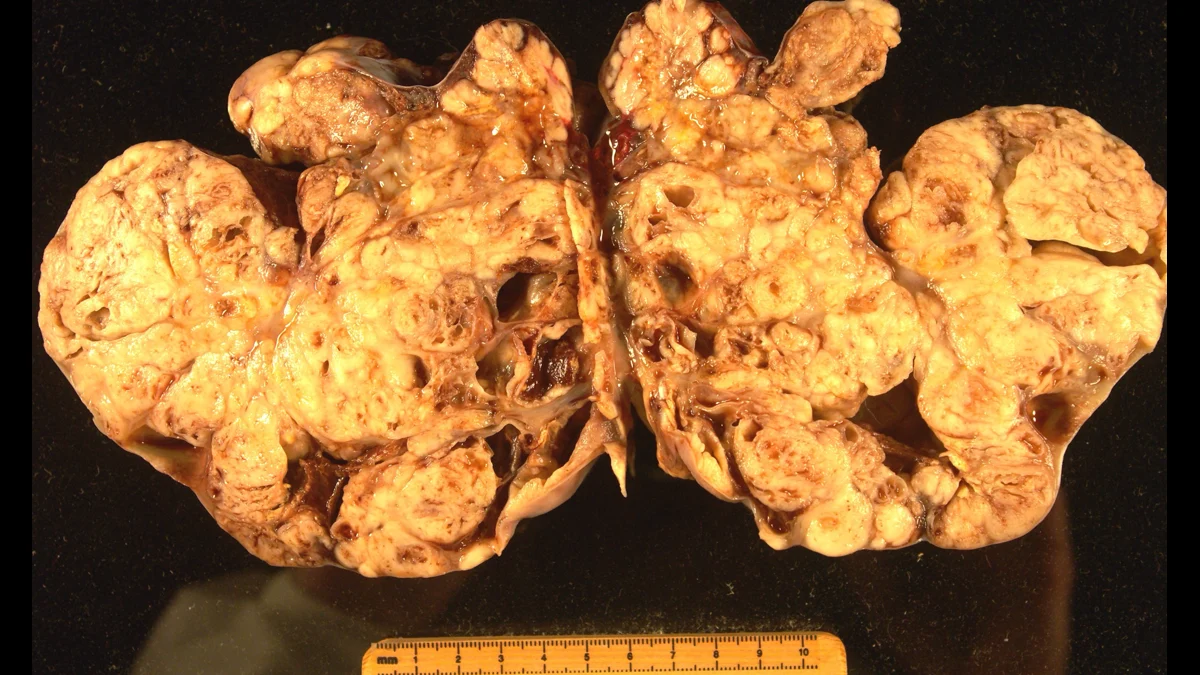
Image source and reuse details
Source: Ovarian carcinoma.JPG. Full 2995 × 1781 photograph proportionally reduced to 1135 × 675 and centered in 1200 × 675 with external black side margins. Converted to WebP under the same CC BY-SA 4.0 license. No cropping, recoloring or diagnostic retouching.
In this guide
The exact diagnosis changes the plan
This guide mainly covers epithelial cancers of the ovary, fallopian tube and peritoneum, the lining of the abdomen. Many high-grade serous cancers begin in the fallopian tubes. Low-grade serous, endometrioid, clear cell and mucinous cancers are different diseases, not interchangeable names.
A cyst is not automatically cancer. Borderline, germ cell and stromal tumors need their own care plans. For example, some germ cell cancers are treated with bleomycin, etoposide and cisplatin. The medicines discussed below do not automatically apply to these groups or to cancer from another organ that has spread to an ovary.
Source: National Cancer Institute — United States — Ovarian Epithelial, Fallopian Tube, and Primary Peritoneal Cancer Treatment (PDQ®)–Health Professional Version · National Cancer Institute — United States — Ovarian Germ Cell Tumors Treatment (PDQ®)–Health Professional Version
When to get checked
New, persistent bloating, lower abdominal pain, feeling full quickly or frequent urination should be assessed, particularly when they become regular. Tiredness, bowel changes, weight loss or unusual vaginal bleeding may also occur. These symptoms are common in noncancerous conditions too.
You do not need every symptom before contacting a clinician. Return if symptoms continue after an initial assessment, and explain what has changed. Recording their frequency, duration, your appetite and weight can help. Do not wait for a routine appointment when symptoms are worsening.
Source: National Health Service — United Kingdom — Ovarian cancer — Symptoms
Family history and prevention
Age, family history, inherited harmful BRCA1 or BRCA2 variants and Lynch syndrome can increase risk. Endometriosis is associated particularly with certain subtypes. Having a risk factor does not mean cancer will develop; many people diagnosed have no obvious family history.
For an inherited variant that raises risk, a genetics specialist can discuss preventive removal of the fallopian tubes and ovaries. Timing involves plans for children, age and menopause. Surgery greatly reduces risk but does not remove the risk of peritoneal cancer. Removing only the tubes and delaying ovarian removal is not automatically equally protective.
Source: National Cancer Institute — United States — BRCA Gene Changes: Cancer Risk and Genetic Testing Fact Sheet · National Cancer Institute — United States — Ovarian Epithelial, Fallopian Tube, and Primary Peritoneal Cancer Treatment (PDQ®)–Health Professional Version
What reliable screening cannot yet offer
For people without symptoms at average risk, routine ultrasound and CA-125 testing have not been shown to reduce ovarian cancer deaths. False alarms can lead to further tests or surgery. Pap and HPV tests screen the cervix; they do not rule out ovarian cancer.
Even for inherited high risk, no ovarian screening method has a proven survival benefit. Plan care with a genetics service. This does not mean ignoring symptoms: investigating an existing problem serves a different purpose from screening someone who has no symptoms.
Source: National Cancer Institute — United States — BRCA Gene Changes: Cancer Risk and Genetic Testing Fact Sheet · American Cancer Society — United States — Ovarian Cancer Early Detection, Diagnosis, and Staging
From suspicion to a diagnosis
Assessment may include an examination, transvaginal or abdominal ultrasound and a CA-125 blood test. A high result does not prove cancer, and a normal result does not exclude it. If concern remains, a gynecologic oncologist arranges further tests, often including chest, abdominal and pelvic CT scans.
Confirmation requires tissue examined by a pathologist. For an apparently confined mass, tissue is often obtained during surgery. Before starting chemotherapy ahead of surgery, histologic confirmation is needed, usually through a targeted biopsy or laparoscopy. A needle biopsy is not appropriate for every ovarian mass.
Source: National Health Service — United Kingdom — Ovarian cancer — Tests and next steps · American Cancer Society — United States — Ovarian Cancer Early Detection, Diagnosis, and Staging · American Society of Clinical Oncology — United States; endorsed by Society of Gynecologic Oncology — Neoadjuvant Chemotherapy for Newly Diagnosed, Advanced Ovarian Cancer: ASCO Guideline Update — January 22, 2025; DOI 10.1200/JCO-24-02589; indexed recommendations consulted
Questions for the pathology report
The report should identify the origin, subtype and grade, which describes how the cells look and their aggressiveness. Low-grade serous cancer is not simply high-grade cancer at an earlier stage. A specialist review of slides can change an uncertain diagnosis and therefore the treatment.
An ovarian mucinous tumor may need tests to exclude a bowel origin. Germ cell and stromal tumors can require different markers, such as alpha-fetoprotein, human chorionic gonadotropin or inhibin. The microscope photograph here shows low-grade serous carcinoma; it does not represent every subtype.
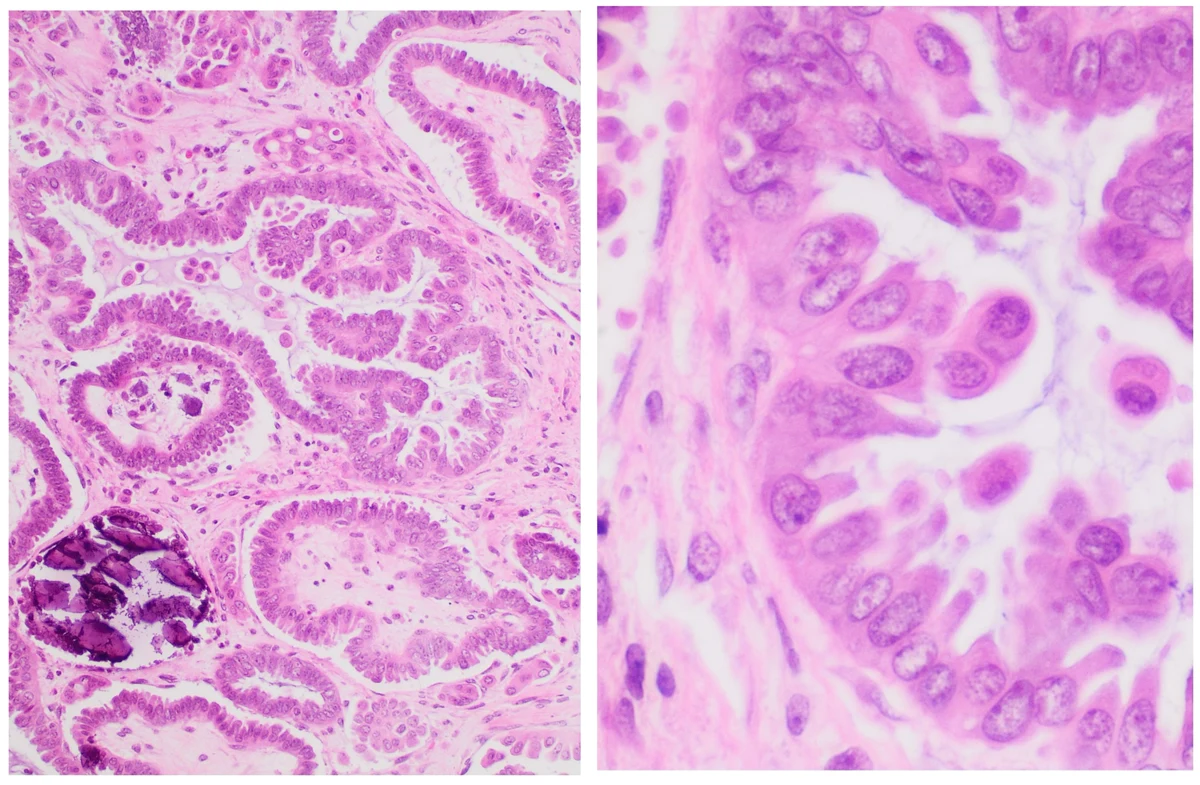
Image source and reuse details
Source: Histopathology of invasive low-grade serous carcinoma of ovary (original).jpg. Full 3205 × 2097 image proportionally reduced to 1200 × 785 and converted to WebP. Both panels and the original separator retained. No cropping, recoloring or diagnostic retouching.
Source: American Cancer Society — United States — Ovarian Cancer Early Detection, Diagnosis, and Staging · National Cancer Institute — United States — Ovarian Epithelial, Fallopian Tube, and Primary Peritoneal Cancer Treatment (PDQ®)–Health Professional Version · National Cancer Institute — United States — Ovarian Germ Cell Tumors Treatment (PDQ®)–Health Professional Version
Stage and grade describe different things
Stage describes where cancer is found. Broadly: I, confined to an ovary or tube; II, spread within the pelvis; III, abdominal peritoneum outside the pelvis and/or retroperitoneal lymph nodes; IV, distant spread. Ask the team to explain the exact details and substage in your report.
A deposit on the surface of the liver or spleen differs from cancer within those organs. Cancer cells in fluid around a lung also have a specific staging meaning. Stage, subtype, test results and treatment response are more useful than comparing photographs or someone else’s experience.
Source: American Cancer Society — United States — Ovarian Cancer Stages
BRCA, HRD and other useful tests
Appropriate genetic and molecular assessment should be offered at epithelial cancer diagnosis. Blood testing for BRCA looks for an inherited variant; tumor testing can also find a change present only in the cancer. HRD means a DNA repair weakness that can help guide maintenance treatment. An uncertain result is not the same as a harmful variant.
Specific treatments may require FRα, a cell-surface protein, and PD-L1 scored with CPS; KRAS matters in low-grade serous cancer. Selected cases may also need MMR repair, MSI instability or other tests. Ask which result would change treatment, what method is used and when it will be available.
Source: American Cancer Society — United States — Ovarian Cancer Early Detection, Diagnosis, and Staging · National Cancer Institute — United States — BRCA Gene Changes: Cancer Risk and Genetic Testing Fact Sheet · American Society of Clinical Oncology — United States; endorsed by Society of Gynecologic Oncology — Neoadjuvant Chemotherapy for Newly Diagnosed, Advanced Ovarian Cancer: ASCO Guideline Update — January 22, 2025; DOI 10.1200/JCO-24-02589; indexed recommendations consulted · European Society for Medical Oncology — Europe; A. González-Martín and J. A. Ledermann — ESMO Clinical Practice Guideline Express Update on the management of epithelial ovarian cancer — January 28, 2026; DOI 10.1016/j.esmoop.2025.106032 · European Medicines Agency — European Union — Keytruda — platinum-resistant ovarian cancer indication · Food and Drug Administration — United States — FDA grants accelerated approval to the combination of avutometinib and defactinib for KRAS-mutated recurrent low-grade serous ovarian cancer — May 8, 2025
Choose the team before the first operation
A gynecologic oncologist should assess the case before the first operation. Planning involves surgery, medical oncology, radiology, pathology, genetics and specialist nursing. Nutrition, fertility, rehabilitation and psychological support should be included according to individual needs.
For a second opinion, gather reports, original scan images, slides or tissue blocks when requested, and a treatment timeline. Ask about experience with complex ovarian surgery, team review and complication management. A general hospital ranking cannot determine the right team for an individual case.
Source: American Society of Clinical Oncology — United States; endorsed by Society of Gynecologic Oncology — Neoadjuvant Chemotherapy for Newly Diagnosed, Advanced Ovarian Cancer: ASCO Guideline Update — January 22, 2025; DOI 10.1200/JCO-24-02589; indexed recommendations consulted · National Health Service — United Kingdom — Ovarian cancer — Tests and next steps · Istituto Europeo di Oncologia — Italy — Tumori ovarici — Ovarian Cancer Center and access contacts · University Health Network, Princess Margaret Cancer Centre — Canada — Gynecologic Site Group — ovarian, tubal and gynecologic cancer care · The University of Texas MD Anderson Cancer Center — United States — Ovarian Cancer Treatment
Surgery: goals and possible consequences
When feasible with acceptable risks, the goal is to leave no visible cancer. Surgery may involve the ovaries, tubes, uterus, omentum and other affected tissue; bowel removal or a stoma is sometimes necessary. The extent of surgery and lymph node assessment depend on the case, not a standard checklist for everyone.
Preserving the uterus and an ovary is possible only in carefully selected early cancers after staging and specialist counseling. It is not a usual approach for advanced high-grade serous cancer. Discuss fertility, menopause, sexual health and possible bowel surgery consequences before treatment.
Source: American Cancer Society — United States — Surgery for Ovarian Cancer · American Society of Clinical Oncology — United States; endorsed by Society of Gynecologic Oncology — Neoadjuvant Chemotherapy for Newly Diagnosed, Advanced Ovarian Cancer: ASCO Guideline Update — January 22, 2025; DOI 10.1200/JCO-24-02589; indexed recommendations consulted · National Health Service — United Kingdom — Ovarian cancer — Treatment
Chemotherapy before or after surgery
Carboplatin and paclitaxel are commonly used for high-grade epithelial cancer. When complete removal is unlikely or surgical risk is high, chemotherapy can begin after tissue confirmation. Interval surgery is considered after no more than 4 cycles if cancer responds or remains stable; the plan often totals 6 cycles.
Treatment order should be decided by the team, not stage alone. Heated chemotherapy inside the abdomen, called HIPEC, may be discussed for selected patients with stage III disease at interval surgery. It is neither mandatory nor suitable for everyone. Radiation or other local treatments can help in selected situations or relieve symptoms.
Source: American Society of Clinical Oncology — United States; endorsed by Society of Gynecologic Oncology — Neoadjuvant Chemotherapy for Newly Diagnosed, Advanced Ovarian Cancer: ASCO Guideline Update — January 22, 2025; DOI 10.1200/JCO-24-02589; indexed recommendations consulted · National Health Service — United Kingdom — Ovarian cancer — Treatment
Maintenance: extending disease control
After a response to platinum, some people may receive bevacizumab or a PARP inhibitor, depending on subtype, BRCA, HRD, previous treatment and side effects. In the European Union, first-line olaparib alone has an indication for advanced BRCA-mutated cancers. Olaparib with bevacizumab requires HRD and a response to chemotherapy given with bevacizumab.
Labels differ: in the United States, first-line niraparib requires HRD, and recurrent maintenance requires inherited BRCA; the European indication is broader. European guidance in 2026 also includes rucaparib. Maintenance does not guarantee cure. Discuss expected benefit, duration, blood monitoring and rare bone marrow cancers.
Source: National Library of Medicine — United States; current United States prescribing information — DailyMed: ZEJULA — niraparib, revised July 2026; indications and safety · European Medicines Agency — European Union — Zejula — current therapeutic indications · European Medicines Agency — European Union — Lynparza — ovarian maintenance indications · European Society for Medical Oncology — Europe; A. González-Martín and J. A. Ledermann — ESMO Clinical Practice Guideline Express Update on the management of epithelial ovarian cancer — January 28, 2026; DOI 10.1016/j.esmoop.2025.106032
If cancer returns
Choices depend on symptoms, sites of disease, previous platinum response, time since treatment, side effects and preferences. Recurrence within 6 months of platinum is often called resistant, but decisions cannot rely on this cutoff alone. Further surgery may be considered for selected patients.
If platinum remains appropriate, a platinum combination may be used. Otherwise, options include weekly paclitaxel, liposomal doxorubicin or topotecan, sometimes with bevacizumab when suitable, or treatments chosen through biomarker testing. Some cancers can be cured; others require repeated treatment to control disease while protecting quality of life. Bevacizumab also requires assessment of bleeding, wound healing and bowel perforation risks, especially with bowel involvement.
Source: European Society for Medical Oncology — Europe; A. González-Martín and J. A. Ledermann — ESMO Clinical Practice Guideline Express Update on the management of epithelial ovarian cancer — January 28, 2026; DOI 10.1016/j.esmoop.2025.106032 · National Cancer Institute — United States — Ovarian Epithelial, Fallopian Tube, and Primary Peritoneal Cancer Treatment (PDQ®)–Health Professional Version
Mirvetuximab: the FRα test matters
Mirvetuximab soravtansine delivers a cell-killing drug through FRα. Its United States indication covers FRα-positive, platinum-resistant epithelial cancers after 1–3 regimens; the European indication specifies high-grade serous cancer. The required test matters: a positive result without a method is not enough. In the cited guidance, high expression means at least 75% of viable tumor cells with moderate (2+) or strong (3+) staining on a validated assay.
The regular United States approval in 2024 was supported by MIRASOL, an open-label randomized trial of 453 patients against physician-selected chemotherapy. It does not establish superiority over every later option. Eye examinations and preventive measures are important because eye damage, nerve problems and lung inflammation can occur.
Source: Food and Drug Administration — United States — FDA approves mirvetuximab soravtansine-gynx for FRα positive, platinum-resistant epithelial ovarian, fallopian tube, or primary peritoneal cancer — March 22, 2024 · European Medicines Agency — European Union — Elahere — current therapeutic indication · European Society for Medical Oncology — Europe; A. González-Martín and J. A. Ledermann — ESMO Clinical Practice Guideline Express Update on the management of epithelial ovarian cancer — January 28, 2026; DOI 10.1016/j.esmoop.2025.106032
Immunotherapy: a change in 2026
Pembrolizumab with paclitaxel, with or without bevacizumab, has a United States indication from February 2026 and appears in the current European indication for platinum-resistant cancer with PD-L1 CPS ≥1 after 1 or 2 regimens. This does not make pembrolizumab alone suitable for all ovarian cancers.
Merck-sponsored KEYNOTE-B96 randomized 643 patients in a double-blind trial. Among 466 with CPS ≥1, median survival was 18.2 versus 14.0 months; median time without progression was 8.3 versus 7.2 months. These are group results, not personal deadlines. Immunotherapy can inflame healthy organs, so new symptoms need prompt reporting.
Source: Food and Drug Administration — United States — FDA approves pembrolizumab with paclitaxel for platinum-resistant epithelial ovarian, fallopian tube, or primary peritoneal carcinoma — February 10, 2026 · European Medicines Agency — European Union — Keytruda — platinum-resistant ovarian cancer indication
Relacorilant: indication and limits
Since March 2026, the United States has approved relacorilant with nab-paclitaxel for platinum-resistant cancer after 1–3 regimens, including at least one with bevacizumab. The European page checked still reports a favorable opinion from September 2026. That opinion alone does not establish European Commission authorization or national coverage.
Corcept-sponsored ROSELLA randomized 381 patients in an open-label trial. Median survival was 16 versus 11.9 months, and time without progression was 6.5 versus 5.5 months compared with nab-paclitaxel. Risks include neutropenia, severe infection and adrenal problems. Treatment is contraindicated when corticosteroids are needed for a lifesaving indication. Never stop steroids on your own.
Source: Food and Drug Administration — United States — FDA approves relacorilant with nab-paclitaxel for platinum-resistant epithelial ovarian, fallopian tube, or primary peritoneal cancer — March 25, 2026 · European Medicines Agency — European Union — Lifyorli — positive opinion September 17, 2026; not evidence by itself of European Commission authorization
Low-grade serous cancer needs its own approach
This cancer tends to be less responsive to chemotherapy. Surgery, hormone treatment or medicines targeting the MEK pathway, such as trametinib, may be considered under local rules. In May 2025, the United States granted accelerated approval to avutometinib with defactinib for KRAS-mutated recurrent cancer after prior systemic therapy.
The approval group included 57 patients with KRAS-mutated cancer, with a response rate of 44%. That group was not a randomized comparison and does not establish cure or a definite survival benefit. The manufacturer is Verastem. Eyes, skin, liver and muscles need monitoring; accelerated approval requires further confirmation.
Source: Food and Drug Administration — United States — FDA grants accelerated approval to the combination of avutometinib and defactinib for KRAS-mutated recurrent low-grade serous ovarian cancer — May 8, 2025 · National Cancer Institute — United States — Ovarian Epithelial, Fallopian Tube, and Primary Peritoneal Cancer Treatment (PDQ®)–Health Professional Version
Trials and uncertain timelines
RAMP 301, NCT06072781, compares avutometinib with defactinib against physician-selected treatment in recurrent low-grade serous cancer. This Verastem randomized phase III study was recruiting in the registry updated on November 2, 2026, with 270 planned participants and estimated primary completion in 2028.
GLORIOSA, NCT05445778, tests mirvetuximab with bevacizumab as maintenance in a different population: platinum-sensitive disease with high FRα. The registry updated on June 2, 2026 lists 520 participants, active without new recruitment, estimated primary completion in 2027 and sponsor AbbVie. Neither registry has posted results. Dates are not promises of drug availability. Ask the center about location, eligibility and costs.
Source: ClinicalTrials.gov, National Library of Medicine; Verastem — United States — NCT06072781 — RAMP 301; updated November 2, 2026; recruiting · ClinicalTrials.gov, National Library of Medicine; AbbVie — United States — NCT05445778 — GLORIOSA; updated June 2, 2026; active, not recruiting · National Cancer Institute — United States — Who Pays for Clinical Trials?
When to call urgently
During treatment, a temperature of 38 °C or higher needs urgent contact with the care team. Breathing difficulty, chest pain, major bleeding or severe abdominal pain with persistent vomiting also need prompt assessment. Do not wait for a scheduled visit or take fever-reducing medicine before asking for advice.
Monitoring depends on treatment: blood counts and blood pressure for some PARP inhibitors; pressure and urine with bevacizumab; eyes with mirvetuximab; and targeted checks with immunotherapy. Report tingling, severe diarrhea, visual changes or unusual exhaustion. Keep the team’s number and an out-of-hours emergency plan.
Source: National Cancer Institute — United States — Infection and Neutropenia during Cancer Treatment · National Library of Medicine — United States; current United States prescribing information — DailyMed: ZEJULA — niraparib, revised July 2026; indications and safety · Food and Drug Administration — United States — FDA approves mirvetuximab soravtansine-gynx for FRα positive, platinum-resistant epithelial ovarian, fallopian tube, or primary peritoneal cancer — March 22, 2024 · Food and Drug Administration — United States — FDA approves pembrolizumab with paclitaxel for platinum-resistant epithelial ovarian, fallopian tube, or primary peritoneal carcinoma — February 10, 2026 · National Cancer Institute — United States — Ovarian Epithelial, Fallopian Tube, and Primary Peritoneal Cancer Treatment (PDQ®)–Health Professional Version
Eating without promises of a cure
No diet or supplement has been proven to cure ovarian cancer or reliably prevent its return. If early fullness, nausea or weight loss make eating difficult, a dietitian can help with small meals, protein, calories and fluids. Avoid fasting or imposed weight-loss diets during treatment.
After bowel surgery or with bowel transit problems, fiber and food texture may need adjustment. Do not automatically increase fiber. Vitamins, herbs and natural products can interfere with medicines. Bring the packages or a complete list. Supplements should address a clinical need, not claims that they fight cancer.
Source: National Cancer Institute — United States — Nutrition During Cancer Treatment · National Cancer Institute — United States — Complementary and Alternative Medicine · American Cancer Society — United States — After Ovarian Cancer Treatment
Movement, menopause and support
Adapt activity to surgery, energy, anemia and complications. Short walks and guided rehabilitation may help; do not push through pain or feeling unwell. Removing both ovaries before natural menopause can cause sudden menopause. Discuss this before surgery, together with fertility and sexual health.
Pain with sex, dryness, anxiety and fatigue deserve treatment. Lubricants, rehabilitation and psychological support may help. Any hormone treatment needs a subtype-specific assessment. Palliative care can accompany cancer treatment to relieve pain, abdominal fluid and other symptoms; it does not automatically mean stopping anticancer treatment.
Source: National Cancer Institute — United States — Cancer Fatigue · National Cancer Institute — United States — Sexual Health Issues in Women and Cancer Treatment · National Health Service — United Kingdom — Ovarian cancer — Treatment
Care after treatment
The schedule depends on subtype, stage, treatment and symptoms. It includes visits and, when appropriate, blood tests or imaging. Agree on a written plan for appointments and whom to contact with new problems. Not everyone needs the same CT schedule or a PET scan at every visit.
CA-125 can help when it was informative initially, but it must not be interpreted alone. Starting treatment solely because it rises, before symptoms appear, has not been shown to extend life and can increase side effects. Discuss monitoring benefits and limits while still reporting clinical changes.
Source: American Cancer Society — United States — After Ovarian Cancer Treatment
Centers and access in your country
The button opens the directory filtered for this cancer group. Documented pathways include Istituto Europeo di Oncologia in Italy, Gustave Roussy in France, The University of Texas MD Anderson Cancer Center in the United States and Princess Margaret Cancer Centre in Canada. An existing general oncology contact in Nicaragua is also retained.
This is a verifiable selection, not every center worldwide or a ranking. Telephone numbers and email addresses may belong to international or new-patient offices. Ask about the subtype, referral requirements, costs and coverage. Send medical records only through the institution’s stated secure process.
Find centers for ovarian, fallopian tube and peritoneal cancer →
Source: Istituto Europeo di Oncologia — Italy — Tumori ovarici — Ovarian Cancer Center and access contacts · Gustave Roussy — France — Cancers gynécologiques — ovarian, tubal and peritoneal cancer care · The University of Texas MD Anderson Cancer Center — United States — Ovarian Cancer Treatment · University Health Network, Princess Margaret Cancer Centre — Canada — Gynecologic Site Group — ovarian, tubal and gynecologic cancer care
Prepare for the next appointment
Bring the full diagnosis, operation reports, scan images, BRCA and HRD results, medicine list and treatment timeline. Write down personal goals and practical difficulties. If time is limited, ask which decision is urgent and which can wait for a second opinion.
Useful questions include: What is my subtype? Can all visible disease realistically be removed? Which test changes treatment? Is the medicine authorized and covered here? What benefits and risks are realistic for me? Is there a suitable trial? Whom do I call if unwell, and when will we review the plan?
Source: American Cancer Society — United States — Ovarian Cancer Early Detection, Diagnosis, and Staging · National Health Service — United Kingdom — Ovarian cancer — Tests and next steps · National Cancer Institute — United States — Who Pays for Clinical Trials?
Questions to take to your appointment
- Is an ovarian cyst always cancer? No. Many cysts are benign. Symptoms, ultrasound and specialist assessment guide any further tests.
- Does a normal CA-125 exclude cancer? No. Interpret it with symptoms, scans and tissue examination when needed.
- Does a BRCA change in the tumor mean it is inherited? Not always. A blood or other nontumor test and genetic counseling clarify its meaning for relatives.
- Is chemotherapy before surgery worse care? Not automatically. It can be safer when complete initial removal is unlikely or surgical risk is high.
- Are the new 2026 treatments available everywhere? No. Indications, required tests, authorization and coverage must be checked in your country.
- Does the directory identify the world’s best center? No. It provides contacts supported by sources. Subtype expertise, access and individual assessment guide the choice.
Sources and verification
- National Cancer Institute — United States — Ovarian Epithelial, Fallopian Tube, and Primary Peritoneal Cancer Treatment (PDQ®)–Health Professional Version
- National Cancer Institute — United States — Ovarian Germ Cell Tumors Treatment (PDQ®)–Health Professional Version
- National Health Service — United Kingdom — Ovarian cancer — Symptoms
- National Health Service — United Kingdom — Ovarian cancer — Tests and next steps
- National Health Service — United Kingdom — Ovarian cancer — Treatment
- American Cancer Society — United States — Ovarian Cancer Early Detection, Diagnosis, and Staging
- American Cancer Society — United States — Ovarian Cancer Stages
- American Cancer Society — United States — Surgery for Ovarian Cancer
- American Cancer Society — United States — After Ovarian Cancer Treatment
- National Cancer Institute — United States — BRCA Gene Changes: Cancer Risk and Genetic Testing Fact Sheet
- American Society of Clinical Oncology — United States; endorsed by Society of Gynecologic Oncology — Neoadjuvant Chemotherapy for Newly Diagnosed, Advanced Ovarian Cancer: ASCO Guideline Update — January 22, 2025; DOI 10.1200/JCO-24-02589; indexed recommendations consulted
- European Society for Medical Oncology — Europe; A. González-Martín and J. A. Ledermann — ESMO Clinical Practice Guideline Express Update on the management of epithelial ovarian cancer — January 28, 2026; DOI 10.1016/j.esmoop.2025.106032
- National Library of Medicine — United States; current United States prescribing information — DailyMed: ZEJULA — niraparib, revised July 2026; indications and safety
- European Medicines Agency — European Union — Zejula — current therapeutic indications
- European Medicines Agency — European Union — Lynparza — ovarian maintenance indications
- European Medicines Agency — European Union — Elahere — current therapeutic indication
- European Medicines Agency — European Union — Keytruda — platinum-resistant ovarian cancer indication
- European Medicines Agency — European Union — Lifyorli — positive opinion September 17, 2026; not evidence by itself of European Commission authorization
- Food and Drug Administration — United States — FDA approves mirvetuximab soravtansine-gynx for FRα positive, platinum-resistant epithelial ovarian, fallopian tube, or primary peritoneal cancer — March 22, 2024
- Food and Drug Administration — United States — FDA approves pembrolizumab with paclitaxel for platinum-resistant epithelial ovarian, fallopian tube, or primary peritoneal carcinoma — February 10, 2026
- Food and Drug Administration — United States — FDA approves relacorilant with nab-paclitaxel for platinum-resistant epithelial ovarian, fallopian tube, or primary peritoneal cancer — March 25, 2026
- Food and Drug Administration — United States — FDA grants accelerated approval to the combination of avutometinib and defactinib for KRAS-mutated recurrent low-grade serous ovarian cancer — May 8, 2025
- ClinicalTrials.gov, National Library of Medicine; Verastem — United States — NCT06072781 — RAMP 301; updated November 2, 2026; recruiting
- ClinicalTrials.gov, National Library of Medicine; AbbVie — United States — NCT05445778 — GLORIOSA; updated June 2, 2026; active, not recruiting
- National Cancer Institute — United States — Infection and Neutropenia during Cancer Treatment
- National Cancer Institute — United States — Nutrition During Cancer Treatment
- National Cancer Institute — United States — Complementary and Alternative Medicine
- National Cancer Institute — United States — Sexual Health Issues in Women and Cancer Treatment
- National Cancer Institute — United States — Cancer Fatigue
- National Cancer Institute — United States — Who Pays for Clinical Trials?
- Istituto Europeo di Oncologia — Italy — Tumori ovarici — Ovarian Cancer Center and access contacts
- University Health Network, Princess Margaret Cancer Centre — Canada — Gynecologic Site Group — ovarian, tubal and gynecologic cancer care
- The University of Texas MD Anderson Cancer Center — United States — Ovarian Cancer Treatment
- Gustave Roussy — France — Cancers gynécologiques — ovarian, tubal and peritoneal cancer care
Sources checked: 2026-11-17