


Endometrial cancer: tests, treatments and care centers
Bleeding after menopause needs assessment. This guide explains cancer of the endometrium, the inner lining of the uterus, and helps you prepare questions for specialists.
MyMedNest editorial guide · Sources checked:
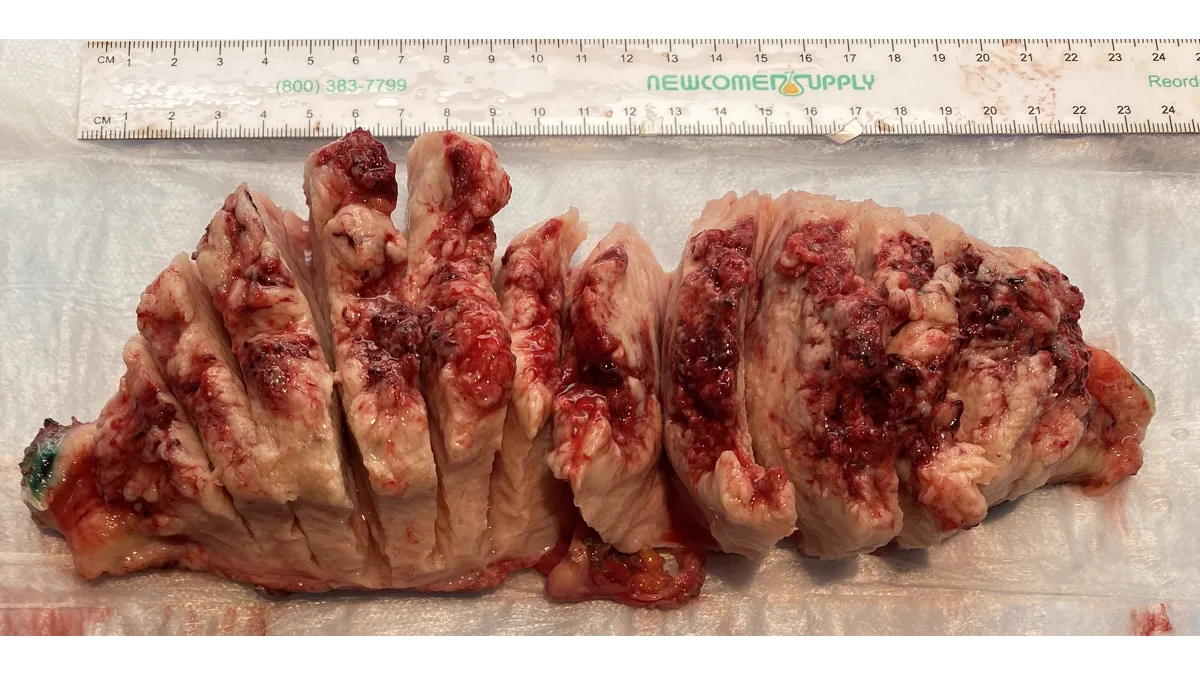
Image source and reuse details
Source: Gross pathology of endometrial adenocarcinoma.jpg. Full 2825 × 1406 photograph proportionally reduced to 1200 × 597, centered within 1200 × 675 with external white top and bottom margins, and converted to WebP. No tissue, ruler or marks cropped; no recoloring or diagnostic retouching.
In this guide
Endometrium, cervix and sarcomas: different diseases
Endometrial carcinoma starts in the lining of the body of the uterus. Endometrioid carcinoma is a common type. Other forms include serous, clear cell, undifferentiated and mixed cancers, which can behave differently. Your pathology report should name the exact type.
Cervical cancer starts in the neck of the uterus and has a separate guide. Uterine leiomyosarcoma and stromal sarcoma need their own treatment pathways. Despite its name, carcinosarcoma belongs to the aggressive endometrial carcinoma group; it should not be treated as synonymous with every uterine sarcoma.
Source: National Cancer Institute — United States — Endometrial Cancer Treatment (PDQ®)–Health Professional Version · National Cancer Institute — United States — Uterine Sarcoma Treatment · European Society of Gynaecological Oncology, European Society for Radiotherapy and Oncology, European Society of Pathology — Europe; original publication hosted by British Gynaecological Cancer Society — ESGO–ESTRO–ESP guidelines for the management of patients with endometrial carcinoma: update 2025 — The Lancet Oncology 26:e423–e435
Symptoms to have checked
Even slight bleeding after menopause warrants a medical visit. Before menopause, bleeding between periods, unusually heavy periods or persistent changes in vaginal discharge need assessment. Pelvic pain and urinary or bowel changes have many possible causes.
These signs do not prove cancer, but do not wait for your next routine check. Heavy bleeding with fainting or marked weakness, chest pain or severe breathing difficulty requires urgent care. Tell the clinician about your symptoms and any medicines you take.
Source: National Health Service — United Kingdom — Womb (uterus) cancer — Symptoms; reviewed October 29, 2024 · National Cancer Institute — United States — Infection and Neutropenia during Cancer Treatment
Risk and inherited susceptibility
Age, obesity, diabetes, prolonged estrogen exposure without appropriate progestogen protection and some endometrial conditions can raise risk. Tamoxifen and Lynch syndrome also need attention. Do not stop breast cancer or menopause treatment without discussing it with your clinician.
There is no population screening program equivalent to cervical screening. A Pap or HPV test does not rule out endometrial cancer. Lynch syndrome or a concerning family history calls for an individual genetics plan. Having a risk factor does not make you responsible for your illness.
Source: National Cancer Institute — United States — Endometrial Cancer Treatment (PDQ®)–Health Professional Version · European Society of Gynaecological Oncology, European Society for Radiotherapy and Oncology, European Society of Pathology — Europe; original publication hosted by British Gynaecological Cancer Society — ESGO–ESTRO–ESP guidelines for the management of patients with endometrial carcinoma: update 2025 — The Lancet Oncology 26:e423–e435
Ultrasound, hysteroscopy and biopsy
Assessment may include transvaginal ultrasound and sampling of the endometrium. Hysteroscopy uses a small camera to inspect the inside of the uterus and allows targeted biopsies. Ultrasound shows thickness and shape, but tissue examination is needed to confirm cancer.
If the sample is insufficient or bleeding continues, ask how the investigation will be completed. MRI and CT scans help assess spread when needed. Not everyone needs every test, and a CA-125 blood test cannot replace a biopsy.
Source: National Health Service — United Kingdom — Womb (uterus) cancer — Tests and next steps · National Cancer Institute — United States — Endometrial Cancer Treatment (PDQ®)–Health Professional Version · The University of Texas MD Anderson Cancer Center — United States — Endometrial Cancer Treatment
Understanding the pathology report
The pathologist describes the cancer type, grade and invasion of the uterine muscle, called the myometrium. After surgery, the report also assesses lymph nodes and cancer cells in small vessels, known as LVSI. High grade and advanced stage do not mean the same thing.
Ask about specialist review for a rare or unclear diagnosis. The microscopic photograph in this guide is an authentic example of grade 2 endometrioid carcinoma, not a test of your cancer. It cannot establish your stage or response to medicines.
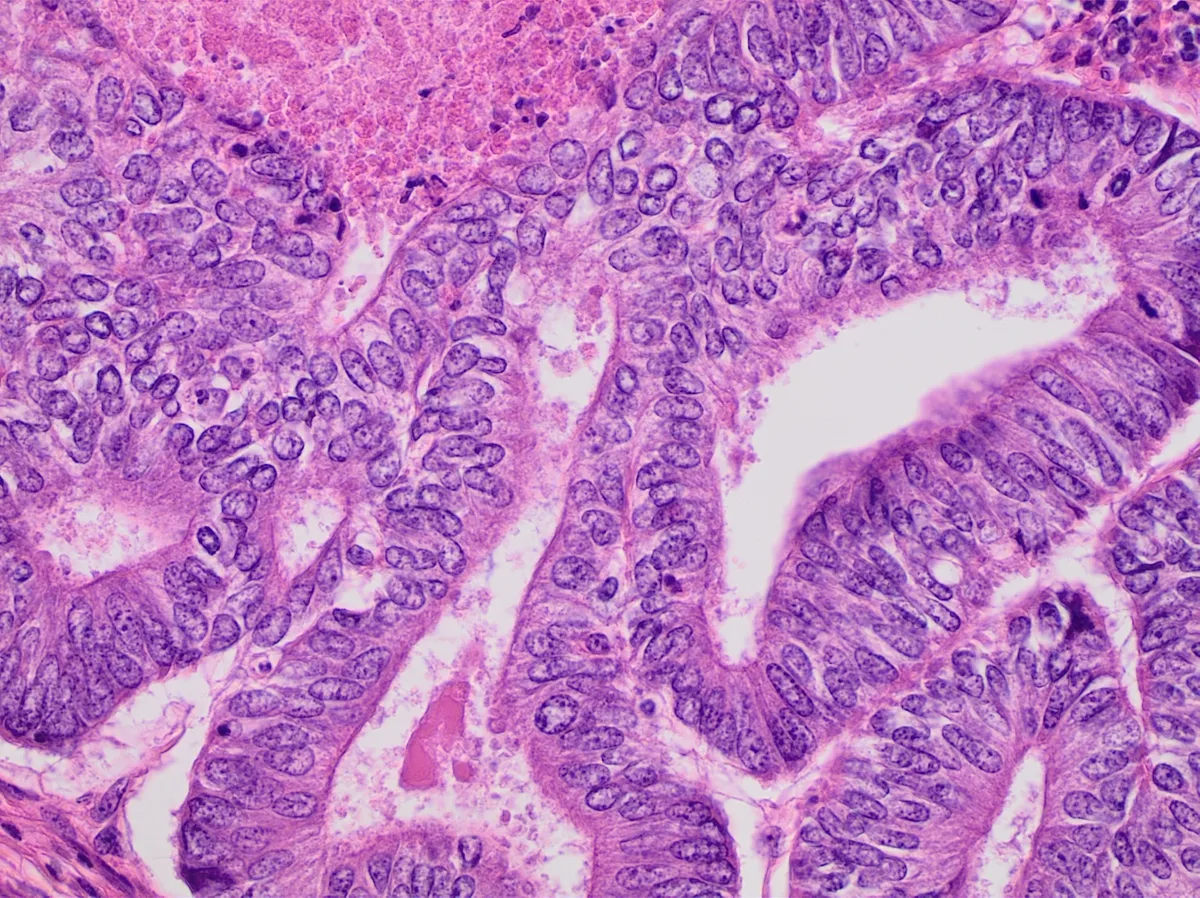
Image source and reuse details
Source: Histopathology of endometrial adenocarcinoma, endometrioid type.jpg. Full 2048 × 1532 image proportionally reduced to 1200 × 898 and converted to WebP. No cropping, recoloring or diagnostic retouching.
Source: European Society of Gynaecological Oncology, European Society for Radiotherapy and Oncology, European Society of Pathology — Europe; original publication hosted by British Gynaecological Cancer Society — ESGO–ESTRO–ESP guidelines for the management of patients with endometrial carcinoma: update 2025 — The Lancet Oncology 26:e423–e435 · American Cancer Society — United States — Endometrial Cancer Stages
Stage and risk of recurrence
Stage describes the extent of disease and helps guide treatment. The FIGO system was updated in 2023 to better incorporate tumor type, vessel invasion and molecular findings when available. An older report may use an earlier version.
Ask which version is used, whether staging is provisional or complete after surgery, and which risk group applies. Two cancers in the same organ can need different treatments. Statistics from groups of patients cannot predict how long one person will live.
Source: American Cancer Society — United States — Endometrial Cancer Stages · European Society of Gynaecological Oncology, European Society for Radiotherapy and Oncology, European Society of Pathology — Europe; original publication hosted by British Gynaecological Cancer Society — ESGO–ESTRO–ESP guidelines for the management of patients with endometrial carcinoma: update 2025 — The Lancet Oncology 26:e423–e435
POLE, MMR, p53, hormone receptors and HER2
The molecular groups include POLEmut, with a particular POLE gene alteration; MMRd, with faulty DNA repair; p53abn, with abnormal p53; and NSMP, with no specific molecular profile. They help guide care. dMMR and MSI-H describe related repair problems assessed through different tests.
Abnormal MMR does not by itself prove an inherited syndrome: MLH1 methylation testing and genetic counseling may be needed. Estrogen and progesterone receptors, ER and PR, and HER2 can matter in selected cases. Ask which tests will actually change your plan and which are unnecessary.
Source: European Society of Gynaecological Oncology, European Society for Radiotherapy and Oncology, European Society of Pathology — Europe; original publication hosted by British Gynaecological Cancer Society — ESGO–ESTRO–ESP guidelines for the management of patients with endometrial carcinoma: update 2025 — The Lancet Oncology 26:e423–e435 · European Medicines Agency — European Union — Imfinzi — EPAR: endometrial cancer and biomarker-specific maintenance
The team and a second opinion
Planning should involve a gynecologic oncologist, pathologist and radiologist, with medical and radiation oncologists when needed. A genetics specialist, fertility specialist, dietitian and psychological support address other needs. Ask who coordinates decisions and whom to contact about side effects.
For a second opinion, bring reports, scan images, treatment history and pathology slides or tissue when requested. Traveling abroad is not automatically necessary: expertise relevant to your cancer type and stage matters. Agree on timing and documents without delaying urgent care.
Source: National Health Service — United Kingdom — Womb (uterus) cancer — Treatment · Istituto Europeo di Oncologia — Italy — Tumori dell’endometrio — clinical service and selected fertility-sparing pathway · University Health Network, Princess Margaret Cancer Centre — Canada — Gynecologic Site Group — uterine cancer care · Gustave Roussy — France — Cancers gynécologiques — endometrial cancer care and contacts
When surgery is the main treatment
For operable disease, treatment often removes the uterus and cervix, fallopian tubes and ovaries. Lymph node assessment may use sentinel nodes, the first drainage points to check. The extent and technique depend on cancer risk and general health.
Minimally invasive surgery uses smaller incisions when appropriate. Keeping the ovaries is suitable only in selected cases and does not preserve the ability to carry a pregnancy if the uterus is removed. Ask about benefits, risks, blood-clot prevention and recovery.
Source: American Cancer Society — United States — Surgery for Endometrial Cancer · European Society of Gynaecological Oncology, European Society for Radiotherapy and Oncology, European Society of Pathology — Europe; original publication hosted by British Gynaecological Cancer Society — ESGO–ESTRO–ESP guidelines for the management of patients with endometrial carcinoma: update 2025 — The Lancet Oncology 26:e423–e435
Treatment after surgery
Adjuvant treatment aims to reduce recurrence risk. Low-risk disease may need no additional treatment. Other risk groups may need vaginal brachytherapy, pelvic radiation or chemotherapy, depending on stage, histology, vessel invasion and molecular findings.
European 2025 guidance also considers chemotherapy with immunotherapy for selected stage III–IVA MMRd cancers. This does not mean immunotherapy after every operation: KEYNOTE-B21 did not show benefit in the overall trial population. A clinical recommendation, regulatory indication and reimbursement are different questions.
Source: European Society of Gynaecological Oncology, European Society for Radiotherapy and Oncology, European Society of Pathology — Europe; original publication hosted by British Gynaecological Cancer Society — ESGO–ESTRO–ESP guidelines for the management of patients with endometrial carcinoma: update 2025 — The Lancet Oncology 26:e423–e435 · National Library of Medicine — United States; United States prescribing information — DailyMed: KEYTRUDA — pembrolizumab; endometrial indication section 1.17 and KEYNOTE-B21 lack of overall adjuvant effectiveness
Radiation and local recurrence
Brachytherapy places a radiation source near the treatment area, often through a vaginal applicator. External beam radiation comes from a machine outside the body. These treatments can follow surgery or provide definitive treatment when surgery is unsuitable.
Recurrence limited to the vagina or pelvis may have local treatment options, depending on previous care and whether the whole lesion can be treated. Repeat radiation needs expert assessment. Discuss bowel, urinary and vaginal irritation and ways to reduce it.
Source: American Cancer Society — United States — Radiation Therapy for Endometrial Cancer · European Society of Gynaecological Oncology, European Society for Radiotherapy and Oncology, European Society of Pathology — Europe; original publication hosted by British Gynaecological Cancer Society — ESGO–ESTRO–ESP guidelines for the management of patients with endometrial carcinoma: update 2025 — The Lancet Oncology 26:e423–e435
Preserving fertility: selected cases only
Fertility-sparing care may be discussed mainly for grade 1 endometrioid carcinoma without muscle invasion or spread outside the uterus. It requires specialist confirmation, fertility assessment and willingness to attend close follow-up. It is not the standard alternative for every early cancer.
Options can include progestogens, including an intrauterine device, and selected hysteroscopic resection. Follow-up biopsies are generally every 3–6 months. Complete response does not mean zero recurrence risk: definitive surgery is reconsidered after childbearing, lack of response or progression.
Source: European Society of Gynaecological Oncology, European Society of Human Reproduction and Embryology, European Society for Gynaecological Endoscopy — Europe — ESGO/ESHRE/ESGE Guidelines for the fertility-sparing treatment of patients with endometrial carcinoma — Human Reproduction Open, 2023, hoac057 · Istituto Europeo di Oncologia — Italy — Tumori dell’endometrio — clinical service and selected fertility-sparing pathway
Initial options for advanced disease
When treatment throughout the body is needed, carboplatin and paclitaxel are reference chemotherapy medicines. In the United States, pembrolizumab and dostarlimab are authorized with these drugs, followed by maintenance, for primary advanced or recurrent endometrial cancer, without restriction to dMMR alone. European Union indications also include first-line combinations in adults eligible for systemic treatment.
The United States restricts this durvalumab indication to dMMR disease. In the European Union, the pathway includes durvalumab alone as maintenance for dMMR or durvalumab with olaparib for pMMR. These regimens are not interchangeable: tests, previous treatment, personal health and local access matter.
Source: Food and Drug Administration — United States — FDA approves pembrolizumab with chemotherapy for primary advanced or recurrent endometrial carcinoma — June 17, 2024 · Food and Drug Administration — United States — FDA expands endometrial cancer indication for dostarlimab-gxly with chemotherapy — August 1, 2024 · Food and Drug Administration — United States — FDA approves durvalumab with chemotherapy for mismatch repair deficient primary advanced or recurrent endometrial cancer — June 14, 2024 · European Medicines Agency — European Union — Keytruda — EPAR: endometrial carcinoma and MSI-H/dMMR indications · European Medicines Agency — European Union — Jemperli — EPAR: therapeutic indications · European Medicines Agency — European Union — Imfinzi — EPAR: endometrial cancer and biomarker-specific maintenance
If cancer progresses after treatment
Pembrolizumab or dostarlimab alone can be options for previously treated dMMR/MSI-H cancers, within local indications and considering prior immunotherapy. European Union indications include progression after platinum-containing treatment. A positive PD-L1 test alone does not establish eligibility for this pathway.
Pembrolizumab with lenvatinib is another option after prior treatment: the United States endometrial indication requires pMMR or non-MSI-H disease after systemic therapy; the European Union requires progression after platinum without that same molecular restriction. Both require that curative surgery or radiation is unsuitable. Switching immunotherapy after progression does not guarantee benefit.
Source: National Library of Medicine — United States; United States prescribing information — DailyMed: KEYTRUDA — pembrolizumab; endometrial indication section 1.17 and KEYNOTE-B21 lack of overall adjuvant effectiveness · European Medicines Agency — European Union — Keytruda — EPAR: endometrial carcinoma and MSI-H/dMMR indications · European Medicines Agency — European Union — Jemperli — EPAR: therapeutic indications · European Society of Gynaecological Oncology, European Society for Radiotherapy and Oncology, European Society of Pathology — Europe; original publication hosted by British Gynaecological Cancer Society — ESGO–ESTRO–ESP guidelines for the management of patients with endometrial carcinoma: update 2025 — The Lancet Oncology 26:e423–e435
When hormone treatment is considered
For low-grade, slow-growing, low-volume cancers sensitive to hormones, endocrine treatment can help control disease. Options include progestogens and aromatase inhibitors. This is different from treatment used to relieve menopausal symptoms.
ER and PR results, growth rate and symptoms help guide the choice. Combinations with other medicines need specific assessment and may involve trials or off-label use. Blood-clot risk, metabolic effects and bone health must also be considered.
Source: American Cancer Society — United States — Hormone Therapy for Endometrial Cancer
Treatment aimed at a tumor target
HER2 can guide treatment in some cancers, particularly serous carcinoma and carcinosarcoma. Trastuzumab with chemotherapy is an option for selected HER2-positive cases; access and authorizations differ. This does not mean every endometrial cancer has that target.
On April 5, 2024, the United States regulator granted accelerated approval to trastuzumab deruxtecan for unresectable or metastatic HER2 IHC 3+ solid tumors after systemic treatment with no satisfactory alternatives. This is a specific decision, not worldwide approval. Serious lung inflammation and cardiac monitoring require attention.
Source: American Cancer Society — United States — Targeted Therapy for Endometrial Cancer · Food and Drug Administration — United States — FDA grants accelerated approval to fam-trastuzumab deruxtecan-nxki for unresectable or metastatic HER2-positive solid tumors — April 5, 2024
What newer studies show
RUBY randomized 494 people to dostarlimab plus chemotherapy or the same chemotherapy with placebo. In the updated analysis used by the United States regulator, median overall survival was 44.6 versus 28.2 months. GSK funded the trial. This is neither an individual prediction nor a direct comparison with other immunotherapies. Severe and serious adverse events were more frequent with dostarlimab in the original report.
KEYNOTE-C93 compared pembrolizumab alone with chemotherapy in advanced or recurrent dMMR disease. Its 2026 interim analysis reports median progression-free survival of 38.2 versus 8.4 months. The comparator was not chemo-immunotherapy; Merck sponsored it. These findings do not automatically make first-line monotherapy authorized everywhere.
Source: Mansoor Raza Mirza and RUBY investigators; The New England Journal of Medicine — Dostarlimab for Primary Advanced or Recurrent Endometrial Cancer — March 27, 2023, DOI 10.1056/NEJMoa2216334 · Food and Drug Administration — United States — FDA expands endometrial cancer indication for dostarlimab-gxly with chemotherapy — August 1, 2024 · Brian M. Slomovitz and KEYNOTE-C93 investigators; The Lancet; indexed by National Library of Medicine — First-line pembrolizumab versus carboplatin plus paclitaxel in participants with mismatch repair-deficient advanced or recurrent endometrial cancer (KEYNOTE-C93/GOG-3064/ENGOT-en15): interim analysis of a multicentre, open-label, randomised, active-comparator controlled, phase 3 trial — online October 26, 2026; issue November 14, 2026, DOI 10.1016/S0140-6736(26)02095-7 · ClinicalTrials.gov, National Library of Medicine; Merck Sharp & Dohme — United States — NCT05173987 — Study of Pembrolizumab Versus Chemotherapy in Mismatch Repair Deficient Advanced or Recurrent Endometrial Carcinoma (KEYNOTE-C93); updated May 5, 2026
Open trials and realistic timelines
Within RAINBO, GREEN (NCT05255653) studies radiation with durvalumab in MMRd; RED (NCT06712472) studies olaparib after chemoradiation in p53abn; ORANGE (NCT07831902) compares strategies for NSMP. These are phase III trials. BLUE and TAPER (NCT05640999), phase II, assess less adjuvant treatment in selected groups.
The four records list recruitment as open when checked on November 16, 2026, with no results posted in those records. This guarantees neither a local place nor effectiveness. Ask about eligibility, alternatives, risks, costs and travel. Estimated dates can change and are not dates for a treatment to reach the market.
Source: ClinicalTrials.gov, National Library of Medicine; Leiden University Medical Center — Netherlands — NCT05255653 — Refining Adjuvant Treatment IN Endometrial Cancer Based On Molecular Features (RAINBO-GREEN); updated October 8, 2026 · ClinicalTrials.gov, National Library of Medicine; Canadian Cancer Trials Group — Canada — NCT05640999 — Adjuvant Therapy in POLE-Mutated and p53-Wildtype/NSMP Early Stage Endometrial Cancer RAINBO BLUE & TAPER; updated November 12, 2026 · ClinicalTrials.gov, National Library of Medicine; Gustave Roussy — France — NCT06712472 — Randomized Phase III Trial Testing Maintenance Olaparib Versus Observation After Adjuvant Chemoradiation for p53abn Endometrial Cancer; updated January 20, 2026 · ClinicalTrials.gov, National Library of Medicine; University College London — United Kingdom — NCT07831902 — RAINBO NSMP-ORANGE: Radiotherapy With Oral Progestin Tablets vs Radiotherapy and Chemotherapy; updated September 21, 2026 · National Cancer Institute — United States — Who Pays for Clinical Trials?
Side effects and urgent warning signs
Chemotherapy and other medicines can cause low immune defenses, anemia, nausea and tingling. Immunotherapy can inflame the lungs, bowel, liver and hormone glands, including after the last dose. Lenvatinib requires blood-pressure, urine and other checks according to the center’s plan.
During treatment, fever of 38 °C or more requires urgent contact with the care team. Report severe diarrhea, breathlessness, chest pain, jaundice, confusion or inability to drink promptly. Do not wait for your next appointment or change doses or steroids yourself. Get an out-of-hours contact number in advance.
Source: National Cancer Institute — United States — Infection and Neutropenia during Cancer Treatment · National Library of Medicine — United States; United States prescribing information — DailyMed: KEYTRUDA — pembrolizumab; endometrial indication section 1.17 and KEYNOTE-B21 lack of overall adjuvant effectiveness · American Cancer Society — United States — Targeted Therapy for Endometrial Cancer · European Medicines Agency — European Union — Imfinzi — EPAR: endometrial cancer and biomarker-specific maintenance
Food, movement and supplements
Aim to maintain strength, weight and protein intake compatible with treatment. Nausea, diarrhea or poor appetite call for an individual dietitian plan. No diet, fast or supplement has been shown to replace treatment for endometrial carcinoma.
Tell the team about herbs, vitamins and nonprescription products: they may interact with medicines or surgery. Correcting a proven deficiency is different from an anticancer cure. Walking and adapted activity can help fatigue. Resume gradually with the team and avoid drastic weight-loss diets during a vulnerable treatment phase.
Source: National Cancer Institute — United States — Nutrition During Cancer Treatment · National Cancer Institute — United States — Complementary and Alternative Medicine · National Cancer Institute — United States — Cancer Fatigue
Sexual health, menopause and leg swelling
Surgery and radiation may affect menopause, lubrication, pain during sex and body image. Ask when sexual activity is safe, which moisturizers or dilators to use, and whether hormone treatment suits your cancer. This is not the same decision for every tumor.
Lymph node removal or radiation can cause lymphedema, persistent swelling. Report leg heaviness or swelling early and ask about rehabilitation. Sudden painful swelling or swelling with breathlessness needs urgent assessment for a clot. Psychological support and relief of symptoms are part of care.
Source: National Cancer Institute — United States — Sexual Health Issues in Women and Cancer Treatment · National Cancer Institute — United States — Lymphedema
Follow-up and outlook after treatment
Surveillance depends on risk, symptoms and treatment. One United States example uses visits every 3–6 months for the first 2–3 years, then every 6–12 months up to 5 years, then annually. This is not a universal prescription: tests and imaging are individualized.
Report new bleeding, persistent pain, swelling, cough or weight loss without waiting for a visit. Pap tests, markers and repeated scans are not automatically useful without an indication. Many early cancers are curable; advanced cancers can sometimes be controlled for long periods, with possibilities that vary by tumor biology.
Source: American Cancer Society — United States — Living as an Endometrial Cancer Survivor · National Health Service — United Kingdom — Womb (uterus) cancer — Treatment
Choosing a center in your country
The directory filters by country and uterine cancer. Istituto Europeo di Oncologia, Princess Margaret, The University of Texas MD Anderson Cancer Center and Gustave Roussy have documented gynecologic pathways. Contacts distinguish access offices from clinics and do not establish a worldwide ranking.
Confirm that the center treats your subtype, accepts new patients and provides the recommended care. Ask about referrals, waiting times, health coverage, costs and secure transfer of records. This is a selective directory: no listing in a country does not mean no specialists exist. Confirm an appointment before booking travel.
Find care centers for uterine cancer →
Source: Istituto Europeo di Oncologia — Italy — Tumori dell’endometrio — clinical service and selected fertility-sparing pathway · University Health Network, Princess Margaret Cancer Centre — Canada — Gynecologic Site Group — uterine cancer care · The University of Texas MD Anderson Cancer Center — United States — Endometrial Cancer Treatment · Gustave Roussy — France — Cancers gynécologiques — endometrial cancer care and contacts
What to bring and ask at the visit
Bring pathology, available POLE, MMR/MSI, p53, ER/PR and HER2 results, the operation report, scan images and previous treatment details. List medicines, allergies, other illnesses and cancers in your family. Ask whether slides or tissue are needed for review.
Clarify the treatment goal, expected benefits, alternatives, side effects and warning signs. Ask about suitable trials and how outstanding tests could change the plan. Agree who coordinates care and when results are due. Make decisions with the team according to your needs and preferences.
Source: National Health Service — United Kingdom — Womb (uterus) cancer — Tests and next steps · National Health Service — United Kingdom — Womb (uterus) cancer — Treatment · European Society of Gynaecological Oncology, European Society for Radiotherapy and Oncology, European Society of Pathology — Europe; original publication hosted by British Gynaecological Cancer Society — ESGO–ESTRO–ESP guidelines for the management of patients with endometrial carcinoma: update 2025 — The Lancet Oncology 26:e423–e435 · National Cancer Institute — United States — Who Pays for Clinical Trials?
Questions to take to your appointment
- Does a normal Pap test rule out endometrial cancer? No. It mainly screens the cervix. Abnormal bleeding may need ultrasound and an endometrial biopsy.
- Is chemotherapy always needed after surgery? No. Surgery alone can be enough for low-risk disease. Additional treatment depends on pathology, stage and molecular tests.
- Does MMRd always mean Lynch syndrome? No. The defect may be limited to the cancer. Further tests and genetic counseling clarify when it is inherited.
- Can the uterus be preserved? Only in selected cases with an expert team and repeat biopsies. It is not appropriate for every early cancer.
- Do newer immunotherapies work for everyone? No. The indication, tumor profile, prior treatment and possible harms guide the choice. A response is not guaranteed.
- How can I view the clinical photographs? They are blurred initially. You can reveal and hide them voluntarily; they are not tools for self-diagnosis.
Sources and verification
- National Cancer Institute — United States — Endometrial Cancer Treatment (PDQ®)–Health Professional Version
- National Cancer Institute — United States — Uterine Sarcoma Treatment
- National Health Service — United Kingdom — Womb (uterus) cancer — Symptoms; reviewed October 29, 2024
- National Health Service — United Kingdom — Womb (uterus) cancer — Tests and next steps
- National Health Service — United Kingdom — Womb (uterus) cancer — Treatment
- American Cancer Society — United States — Endometrial Cancer Stages
- American Cancer Society — United States — Surgery for Endometrial Cancer
- American Cancer Society — United States — Radiation Therapy for Endometrial Cancer
- American Cancer Society — United States — Hormone Therapy for Endometrial Cancer
- American Cancer Society — United States — Targeted Therapy for Endometrial Cancer
- American Cancer Society — United States — Living as an Endometrial Cancer Survivor
- European Society of Gynaecological Oncology, European Society for Radiotherapy and Oncology, European Society of Pathology — Europe; original publication hosted by British Gynaecological Cancer Society — ESGO–ESTRO–ESP guidelines for the management of patients with endometrial carcinoma: update 2025 — The Lancet Oncology 26:e423–e435
- European Society of Gynaecological Oncology, European Society of Human Reproduction and Embryology, European Society for Gynaecological Endoscopy — Europe — ESGO/ESHRE/ESGE Guidelines for the fertility-sparing treatment of patients with endometrial carcinoma — Human Reproduction Open, 2023, hoac057
- Food and Drug Administration — United States — FDA approves pembrolizumab with chemotherapy for primary advanced or recurrent endometrial carcinoma — June 17, 2024
- Food and Drug Administration — United States — FDA expands endometrial cancer indication for dostarlimab-gxly with chemotherapy — August 1, 2024
- Food and Drug Administration — United States — FDA approves durvalumab with chemotherapy for mismatch repair deficient primary advanced or recurrent endometrial cancer — June 14, 2024
- National Library of Medicine — United States; United States prescribing information — DailyMed: KEYTRUDA — pembrolizumab; endometrial indication section 1.17 and KEYNOTE-B21 lack of overall adjuvant effectiveness
- European Medicines Agency — European Union — Keytruda — EPAR: endometrial carcinoma and MSI-H/dMMR indications
- European Medicines Agency — European Union — Jemperli — EPAR: therapeutic indications
- European Medicines Agency — European Union — Imfinzi — EPAR: endometrial cancer and biomarker-specific maintenance
- Mansoor Raza Mirza and RUBY investigators; The New England Journal of Medicine — Dostarlimab for Primary Advanced or Recurrent Endometrial Cancer — March 27, 2023, DOI 10.1056/NEJMoa2216334
- Brian M. Slomovitz and KEYNOTE-C93 investigators; The Lancet; indexed by National Library of Medicine — First-line pembrolizumab versus carboplatin plus paclitaxel in participants with mismatch repair-deficient advanced or recurrent endometrial cancer (KEYNOTE-C93/GOG-3064/ENGOT-en15): interim analysis of a multicentre, open-label, randomised, active-comparator controlled, phase 3 trial — online October 26, 2026; issue November 14, 2026, DOI 10.1016/S0140-6736(26)02095-7
- ClinicalTrials.gov, National Library of Medicine; Leiden University Medical Center — Netherlands — NCT05255653 — Refining Adjuvant Treatment IN Endometrial Cancer Based On Molecular Features (RAINBO-GREEN); updated October 8, 2026
- ClinicalTrials.gov, National Library of Medicine; Canadian Cancer Trials Group — Canada — NCT05640999 — Adjuvant Therapy in POLE-Mutated and p53-Wildtype/NSMP Early Stage Endometrial Cancer RAINBO BLUE & TAPER; updated November 12, 2026
- ClinicalTrials.gov, National Library of Medicine; Gustave Roussy — France — NCT06712472 — Randomized Phase III Trial Testing Maintenance Olaparib Versus Observation After Adjuvant Chemoradiation for p53abn Endometrial Cancer; updated January 20, 2026
- ClinicalTrials.gov, National Library of Medicine; University College London — United Kingdom — NCT07831902 — RAINBO NSMP-ORANGE: Radiotherapy With Oral Progestin Tablets vs Radiotherapy and Chemotherapy; updated September 21, 2026
- ClinicalTrials.gov, National Library of Medicine; Merck Sharp & Dohme — United States — NCT05173987 — Study of Pembrolizumab Versus Chemotherapy in Mismatch Repair Deficient Advanced or Recurrent Endometrial Carcinoma (KEYNOTE-C93); updated May 5, 2026
- National Cancer Institute — United States — Infection and Neutropenia during Cancer Treatment
- National Cancer Institute — United States — Nutrition During Cancer Treatment
- National Cancer Institute — United States — Complementary and Alternative Medicine
- National Cancer Institute — United States — Sexual Health Issues in Women and Cancer Treatment
- National Cancer Institute — United States — Lymphedema
- National Cancer Institute — United States — Cancer Fatigue
- National Cancer Institute — United States — Who Pays for Clinical Trials?
- Istituto Europeo di Oncologia — Italy — Tumori dell’endometrio — clinical service and selected fertility-sparing pathway
- University Health Network, Princess Margaret Cancer Centre — Canada — Gynecologic Site Group — uterine cancer care
- The University of Texas MD Anderson Cancer Center — United States — Endometrial Cancer Treatment
- Gustave Roussy — France — Cancers gynécologiques — endometrial cancer care and contacts
- Food and Drug Administration — United States — FDA grants accelerated approval to fam-trastuzumab deruxtecan-nxki for unresectable or metastatic HER2-positive solid tumors — April 5, 2024
Sources checked: 2026-11-16