


Small intestine cancer: tests, treatment and specialist care
Small intestine cancer can sometimes be removed with the aim of cure. The first decisions depend on the exact tissue diagnosis, where the tumor started, its spread and whether surgery is possible. This guide focuses on adult small bowel adenocarcinoma. Other cancers in the same organ need different treatment.
MyMedNest editorial guide · Sources checked:
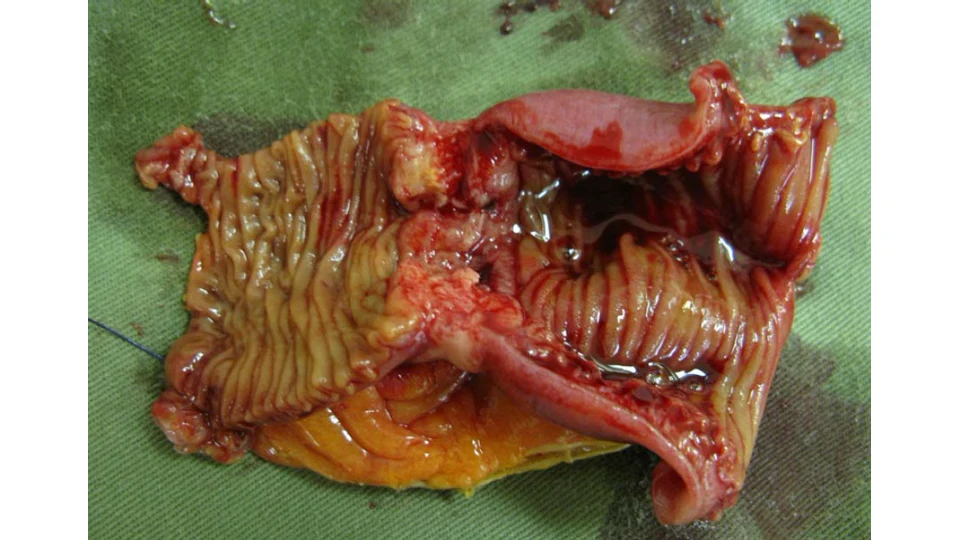
Image source and reuse details
Source: Gross pathology of small intestinal adenocarcinoma, luminal view.jpg. Full 982 × 677 photograph proportionally reduced into 960 × 540 with external white side margins and converted to WebP. No tissue cropping, upscaling, recoloring or diagnostic retouching.
In this guide
Start with the exact diagnosis
The small intestine connects the stomach to the large bowel. Its three parts are the duodenum, jejunum and ileum. Adenocarcinoma starts in gland-forming cells in the inner lining. The location matters: a duodenal operation can differ greatly from an operation farther down the bowel.
Neuroendocrine tumors, gastrointestinal stromal tumors (GIST), lymphomas and other sarcomas can also arise here. They are not interchangeable with adenocarcinoma. A tumor of the ampulla, where digestive ducts open into the duodenum, also needs its own assessment. Ask for the full name on the pathology report.
Source: National Cancer Institute — United States — Small Intestine Cancer Treatment (PDQ®)–Patient Version · National Cancer Institute — United States — Small Intestine Cancer Treatment (PDQ®)–Health Professional Version — updated March 6, 2025
Which symptoms need prompt help?
Possible signs include persistent or recurring abdominal pain, vomiting, unexplained weight loss, dark or bloody stools and tiredness from anemia. Yellow skin or eyes can occur with a blockage near the bile duct. These symptoms often have other causes, but persistent changes deserve a medical assessment.
Severe or worsening pain with repeated vomiting, a swollen abdomen, or inability to pass gas or stool may mean bowel obstruction. Seek urgent care. Major bleeding, fainting or a sudden severe abdominal pain also needs immediate help. Do not try to clear a suspected blockage with extra fiber or laxatives on your own.
Source: American Cancer Society — United States — Signs and Symptoms of Small Intestine Cancer (Adenocarcinoma) · National Cancer Institute — United States — Bowel Obstruction and Cancer Treatment — updated May 16, 2025
Risk and screening are different questions
Crohn’s disease, celiac disease and inherited conditions such as Lynch syndrome, familial adenomatous polyposis and Peutz–Jeghers syndrome can increase risk. Many patients have no known inherited condition. Having a risk factor does not mean that cancer is inevitable or that a person caused the disease.
There is no routine small-bowel cancer screening program for the general population. People with inherited risk need an individual surveillance plan, which may include specialized endoscopy or imaging. A colon screening test does not examine the whole small intestine and cannot rule out a small-bowel tumor.
Source: National Comprehensive Cancer Network — United States; public copy hosted by Vanderbilt-Ingram Cancer Center — NCCN Guidelines for Patients: Small Bowel Adenocarcinoma, 2026 — clinical version 2.2026, April 7, 2026 · American Cancer Society — United States — Small Intestine Cancer Early Detection, Diagnosis, and Staging · Société Nationale Française de Gastro-Entérologie and Thésaurus National de Cancérologie Digestive — France — Adénocarcinome de l’intestin grêle — chapter 13, updated November 28, 2024
What tests can find the problem?
Assessment may include a blood count for anemia, blood chemistry, liver tests and CT imaging. CT or MRI enterography gives a more detailed view of the small bowel in selected cases. Upper endoscopy can reach the duodenum; specialized enteroscopy can examine more distant sections and collect tissue.
A swallowed camera capsule can show parts that are difficult to reach, but it cannot take a biopsy. It may become trapped if the bowel is narrowed or blocked. Tell the team about vomiting, previous obstruction or Crohn’s disease before this test. The specialist chooses a safe sequence of investigations.
Source: Canadian Cancer Society — Canada — Diagnosis of small intestine cancer · National Cancer Institute — United States — Small Intestine Cancer Treatment (PDQ®)–Patient Version · American Cancer Society — United States — Small Intestine Cancer Early Detection, Diagnosis, and Staging
What the tissue report should explain
A biopsy, or tissue removed during surgery, is examined by a pathologist to confirm the cancer type. The report should distinguish a primary small-bowel adenocarcinoma from another tumor or cancer that spread there. An expert review can help when the diagnosis is unusual or uncertain.
After surgery, useful details include the depth of invasion, the number of lymph nodes examined and involved, the tumor grade and whether the cut edges are clear. Clear margins are called R0. Ask for copies of the report and scans; they make a second opinion easier.
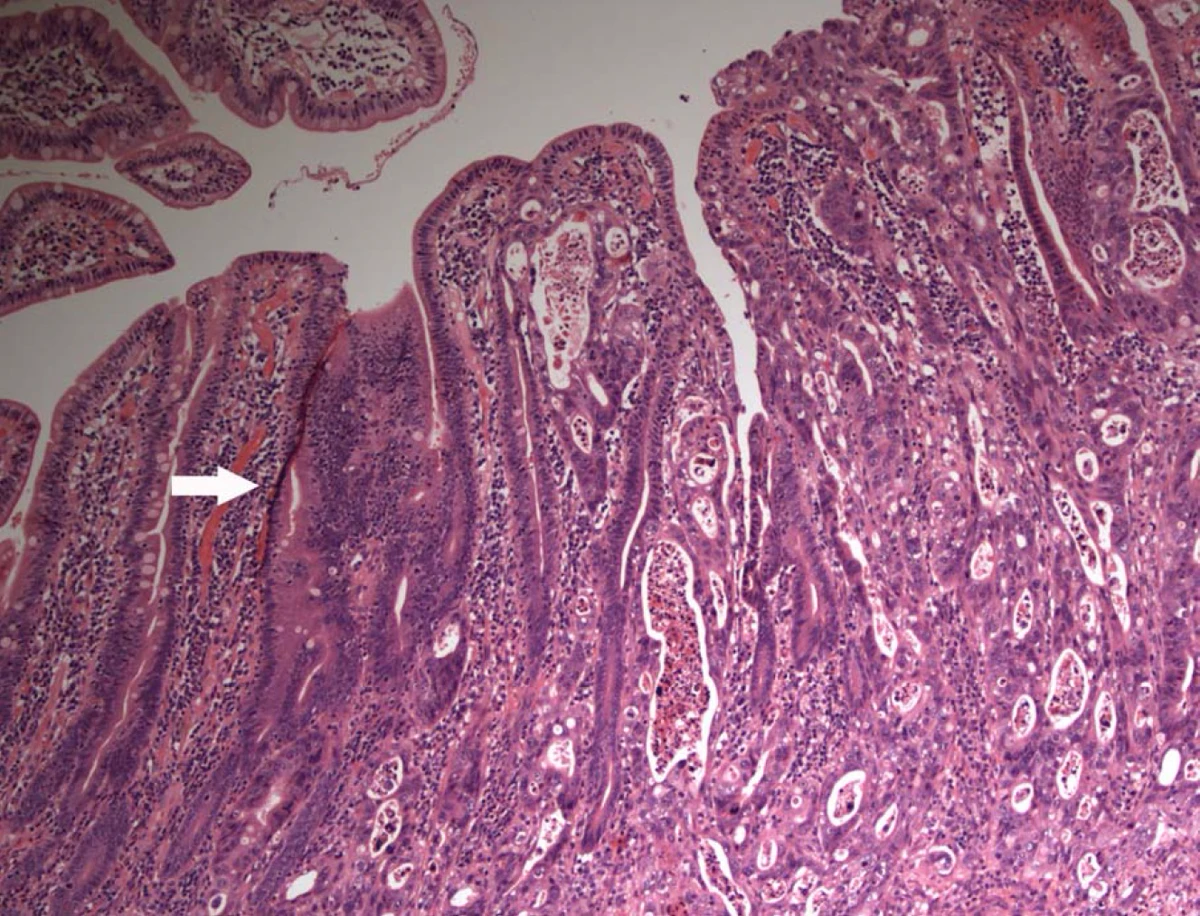
Image source and reuse details
Source: Light microscopy of small intestinal adenocarcinoma.jpg. Full 1327 × 1013 image proportionally reduced to 1200 × 916 and converted to WebP. No cropping, recoloring, retouching or change to the original arrow.
Source: National Cancer Institute — United States — Small Intestine Cancer Treatment (PDQ®)–Health Professional Version — updated March 6, 2025 · National Comprehensive Cancer Network — United States; public copy hosted by Vanderbilt-Ingram Cancer Center — NCCN Guidelines for Patients: Small Bowel Adenocarcinoma, 2026 — clinical version 2.2026, April 7, 2026 · Xilin Wu, Hester Y. S. Cheung, Cliff C. C. Chung and Michael K. W. Li; International Journal of Clinical Medicine — Primary Small Bowel Tumour Presenting as Bowel Obstruction in a Patient with a Virgin Abdomen — 2011, original case and image provenance
Stage describes spread, not just size
For small-bowel adenocarcinoma, stage I is limited disease within the bowel wall; stage II extends farther without regional node involvement. Stage III involves regional lymph nodes. Stage IV means distant spread, for example to the liver or abdominal lining. The team also assesses whether complete removal is feasible.
T, N and M describe local invasion, regional nodes and distant metastases. T4 local invasion is not automatically stage IV. Ask which staging edition and findings apply to you. These categories should not be used unchanged for neuroendocrine tumors, GIST, lymphoma or ampullary cancer.
Source: National Cancer Institute — United States — Small Intestine Cancer Treatment (PDQ®)–Health Professional Version — updated March 6, 2025 · Société Nationale Française de Gastro-Entérologie and Thésaurus National de Cancérologie Digestive — France — Adénocarcinome de l’intestin grêle — chapter 13, updated November 28, 2024
Ask about MMR, MSI and other tumor tests
Testing for mismatch repair deficiency (dMMR) or high microsatellite instability (MSI-H) looks for a problem in the tumor’s DNA repair system. It can affect treatment choices and prompt assessment for Lynch syndrome. A tumor result is not, by itself, proof of an inherited condition; genetic counseling may be needed.
For advanced disease, a broader tumor panel may look for changes such as HER2, BRAF, RAS and rare NTRK or RET fusions. A detected change does not guarantee an effective medicine. Ask which findings are actionable for this exact tumor, whether enough tissue remains and whether testing will change the plan.
Source: National Comprehensive Cancer Network — United States; public copy hosted by Vanderbilt-Ingram Cancer Center — NCCN Guidelines for Patients: Small Bowel Adenocarcinoma, 2026 — clinical version 2.2026, April 7, 2026 · Société Nationale Française de Gastro-Entérologie and Thésaurus National de Cancérologie Digestive — France — Adénocarcinome de l’intestin grêle — chapter 13, updated November 28, 2024
Choose a team familiar with a rare cancer
A useful review brings together gastrointestinal oncology, surgery, pathology, radiology and gastroenterology, with nutrition and supportive care. Duodenal surgery may require pancreatic surgery expertise. Ask how often the team treats small-bowel adenocarcinoma and whether the case will be discussed at a multidisciplinary meeting.
A second opinion is especially useful for uncertain pathology, a major operation, a tumor judged unresectable or a rare molecular finding. It should not delay treatment of bleeding or obstruction. Send reports and scan files before traveling, and confirm referral requirements, coverage and likely costs.
Source: National Comprehensive Cancer Network — United States; public copy hosted by Vanderbilt-Ingram Cancer Center — NCCN Guidelines for Patients: Small Bowel Adenocarcinoma, 2026 — clinical version 2.2026, April 7, 2026 · American Cancer Society — United States — Surgery for Small Intestine Cancer (Adenocarcinoma) · Hôpitaux universitaires de Genève — Switzerland — Les cancers digestifs — medical oncology and digestive tumor unit contacts
When surgery can aim for cure
For a removable tumor, surgery usually takes out the affected bowel segment and nearby lymph nodes, then joins the bowel ends. The aim is complete removal with clear margins while preserving as much healthy bowel as possible. The operation depends on the tumor’s position and local spread.
Some duodenal cancers require a pancreaticoduodenectomy, or Whipple operation; selected lesions may allow a more limited procedure. This is major surgery, with risks including leakage, infection, bleeding and digestive problems. Ask an experienced center to explain the alternatives, expected recovery and possible need for nutrition support.
Source: American Cancer Society — United States — Surgery for Small Intestine Cancer (Adenocarcinoma) · Société Nationale Française de Gastro-Entérologie and Thésaurus National de Cancérologie Digestive — France — Adénocarcinome de l’intestin grêle — chapter 13, updated November 28, 2024
Is treatment needed after the operation?
Stage I disease is generally managed with surgery and follow-up. When regional nodes contain cancer, postoperative chemotherapy is commonly discussed. In stage II, the decision depends on features such as deep invasion, margin status, node assessment, MMR/MSI findings, general health and the person’s preferences.
Options can include FOLFOX, which combines fluorouracil, leucovorin and oxaliplatin, or CAPOX, which combines capecitabine and oxaliplatin. Evidence specific to this rare cancer remains limited. The two BALLAD registry records checked had no posted results; do not treat chemotherapy benefit, duration or added immunotherapy as settled for every patient.
Source: Société Nationale Française de Gastro-Entérologie and Thésaurus National de Cancérologie Digestive — France — Adénocarcinome de l’intestin grêle — chapter 13, updated November 28, 2024 · National Comprehensive Cancer Network — United States; public copy hosted by Vanderbilt-Ingram Cancer Center — NCCN Guidelines for Patients: Small Bowel Adenocarcinoma, 2026 — clinical version 2.2026, April 7, 2026 · ClinicalTrials.gov, National Library of Medicine; Centre Hospitalier Universitaire Dijon — France — NCT02502370 — Phase III Trial Investigating the Potential Benefit of Adjvant Chemotherapy for Small Bowel Adenocarcinoma · ClinicalTrials.gov, National Library of Medicine; Belgian Group of Digestive Oncology — Belgium — NCT04257461 — A Trial to Evaluate the Potential Benefit of Adjuvant Chemotherapy for Small Bowel Adenocarcinoma
If a local tumor cannot be removed yet
A specialist team may recommend medicine first and reassess whether the tumor becomes removable. Treatment depends on fitness and molecular results; selected dMMR/MSI-H tumors may prompt discussion of immunotherapy. A guideline recommendation is not the same as an approved indication or reimbursement in your country.
Radiation is used selectively, sometimes with chemotherapy, or to relieve a particular symptom. It is not routine for every small-bowel tumor. If the bowel is blocked, stabilizing the person and relieving the blockage may come first. Surgery, bypass or a stent can sometimes help even when the cancer cannot all be removed.
Source: National Comprehensive Cancer Network — United States; public copy hosted by Vanderbilt-Ingram Cancer Center — NCCN Guidelines for Patients: Small Bowel Adenocarcinoma, 2026 — clinical version 2.2026, April 7, 2026 · Cancer Research UK — United Kingdom — Treatment for small bowel cancer · National Cancer Institute — United States — Bowel Obstruction and Cancer Treatment — updated May 16, 2025
Treatment when cancer has spread
For advanced adenocarcinoma without a suitable biomarker treatment, commonly used combinations include FOLFOX or CAPOX. Later options may include FOLFIRI, which contains fluorouracil, leucovorin and irinotecan, or a taxane. Previous treatment, nerve damage, bowel function and overall health influence the choice.
More intensive combinations or adding bevacizumab may be considered in selected settings, with limited small-bowel-specific evidence and country-dependent access. Some uses are off-label. Surgery or local treatment of a few metastases is reserved for carefully selected cases; it is not a general promise of cure for stage IV disease.
Source: Société Nationale Française de Gastro-Entérologie and Thésaurus National de Cancérologie Digestive — France — Adénocarcinome de l’intestin grêle — chapter 13, updated November 28, 2024 · American Cancer Society — United States — Chemotherapy for Small Intestine Cancer (Adenocarcinoma) · National Comprehensive Cancer Network — United States; public copy hosted by Vanderbilt-Ingram Cancer Center — NCCN Guidelines for Patients: Small Bowel Adenocarcinoma, 2026 — clinical version 2.2026, April 7, 2026
When immunotherapy is an option
Pembrolizumab can be useful for some MSI-H/dMMR cancers. In the United States, the relevant solid-tumor label requires unresectable or metastatic disease that progressed after prior treatment and no satisfactory alternatives. In the European Union, the small-intestine indication covers adults with unresectable or metastatic MSI-H/dMMR cancer after progression on or after at least one prior therapy.
These rules differ from first-line approvals for colorectal cancer. Some current guidance discusses earlier use for selected patients, but local approval and funding must be checked. PD-L1 alone does not replace MSI/MMR testing for this indication. Immune treatments can inflame healthy organs, including bowel, lungs, liver and hormone-producing glands.
Source: National Library of Medicine — United States; United States prescribing information — DailyMed: KEYTRUDA — pembrolizumab, section 1.8, Microsatellite Instability-High or Mismatch Repair Deficient Cancer · European Medicines Agency — European Union — Keytruda — EPAR, MSI-H/dMMR non-colorectal cancer indication · National Comprehensive Cancer Network — United States; public copy hosted by Vanderbilt-Ingram Cancer Center — NCCN Guidelines for Patients: Small Bowel Adenocarcinoma, 2026 — clinical version 2.2026, April 7, 2026
Rare molecular findings need an expert decision
A genuine NTRK gene fusion may open a tumor-agnostic treatment pathway. For example, the European Union authorizes larotrectinib for eligible advanced tumors, or when surgery would cause major harm, with no satisfactory treatment options. A fusion is not the same as any change in the NTRK gene.
In 2024, the United States granted accelerated approval to trastuzumab deruxtecan for eligible unresectable or metastatic HER2 IHC 3+ solid tumors after systemic treatment with no satisfactory alternatives. Serious lung inflammation is a key risk. This decision does not establish a universal small-bowel standard, local availability or benefit for every HER2 result.
Source: European Medicines Agency — European Union — Vitrakvi — EPAR, NTRK gene fusion solid tumors · Food and Drug Administration — United States — FDA grants accelerated approval to fam-trastuzumab deruxtecan-nxki for unresectable or metastatic HER2-positive solid tumors — April 5, 2024
What recent immunotherapy research actually showed
The small-bowel cohort of DART, published in October 2026, tested nivolumab plus ipilimumab without a comparison group. Of 26 registered patients, 23 received treatment and were evaluated: two had confirmed tumor responses, about 9%. One response lasted years, but most participants did not have tumor shrinkage.
Nine of the 23 patients had grade 3–5 toxicities. The study was small and cannot reliably identify which molecular subgroup benefits. It received National Cancer Institute support; study medicines were supplied through its agreement with Bristol Myers Squibb. These findings support further research, not the claim that dual immunotherapy cures small-bowel cancer.
Trials to discuss, with no promised launch date
Studies include modified FOLFIRINOX versus FOLFOX in France (NCT06278545) and Germany (FIRE-12, NCT07844057), and NALIRIFOX in the United States (NCT06835387). All are phase II research, not proof of a better treatment. Their records listed recruitment when checked; individual sites and eligibility must be confirmed.
The French record was last updated in 2024, so its status may be stale. The German record was updated on November 16, 2026; some sites were not yet recruiting. The United States study lists Ipsen as an industry collaborator. Ask about alternatives, risks, travel, payment and the right to withdraw. An estimated study completion date is not a medicine availability date.
Source: ClinicalTrials.gov, National Library of Medicine; Centre Hospitalier Universitaire Dijon — France — NCT06278545 — Trial Evaluating Modified FOLFIRINOX and Modified FOLFOX in the Treatment of Locally Advanced or Metastatic Small Bowel Adenocarcinoma · ClinicalTrials.gov, National Library of Medicine; Charité Universitätsmedizin Berlin — Germany — NCT07844057 — First-line Treatment in Locally Advanced or Metastastic Small Bowel Adenocarcinoma, FIRE-12 · ClinicalTrials.gov, National Library of Medicine; Hoosier Cancer Research Network and collaborating centers — United States — NCT06835387 — Study of NALIRIFOX in Advanced Unresectable Small Bowel Tumors · National Cancer Institute — United States — What Are Clinical Trials? · National Cancer Institute — United States — Who Pays for Clinical Trials?
Prepare a safety plan before medicine starts
Ask about blood counts, kidney and liver function, interactions and how side effects will be monitored. European recommendations call for DPD deficiency testing before fluorouracil or capecitabine: reduced activity can make treatment dangerously toxic. Testing and prescribing must follow the local protocol; do not adjust doses yourself.
Get a 24-hour oncology contact. During cancer treatment, a fever of 38 °C or more needs urgent advice, as do breathing trouble, major bleeding, severe diarrhea or inability to drink. Report hand-foot pain, tingling and cold sensitivity early. New diarrhea during immunotherapy may be immune-related, not an ordinary stomach upset.
Source: European Medicines Agency — European Union — Fluorouracil and fluorouracil related substances — recommendations on DPD testing prior to treatment · National Cancer Institute — United States — Infection and Neutropenia during Cancer Treatment · American Cancer Society — United States — Chemotherapy for Small Intestine Cancer (Adenocarcinoma) · National Library of Medicine — United States; United States prescribing information — DailyMed: KEYTRUDA — pembrolizumab, section 1.8, Microsatellite Instability-High or Mismatch Repair Deficient Cancer
Food advice must fit the bowel
Ask for a cancer dietitian if weight is falling, eating hurts or diarrhea persists. Enough energy, protein and fluid can help maintain strength. Small, frequent meals may be easier. The right foods depend on obstruction risk, surgery and absorption; a standard high-fiber diet can be unsuitable when the bowel is narrowed.
With suspected obstruction, seek urgent assessment rather than forcing food or drinks. A specialist may prescribe a temporary texture or low-residue plan, tube feeding or intravenous nutrition in particular situations. These are medical decisions. Celiac disease still requires its own gluten-free plan; restrictive diets should not be started to try to starve cancer.
Source: National Cancer Institute — United States — Nutrition During Cancer Treatment · National Cancer Institute — United States — Bowel Obstruction and Cancer Treatment — updated May 16, 2025
Diarrhea and absorption after surgery
Most limited resections do not cause short bowel syndrome, but removing a large amount of intestine can impair absorption. Persistent diarrhea, dehydration or weight loss needs review. The remaining bowel length, the segments removed and whether the colon remains all affect the nutrition plan.
After extensive surgery, the team may check vitamin and mineral deficiencies and arrange specialist intestinal rehabilitation. Prescribed supplements can replace a documented deficit; they do not treat the cancer. After a Whipple operation, ask whether digestive enzyme replacement or other measures are needed. Do not assume all diarrhea has the same cause.
Source: National Institute of Diabetes and Digestive and Kidney Diseases — United States — Treatment of Short Bowel Syndrome — reviewed April 2023 · American Cancer Society — United States — Surgery for Small Intestine Cancer (Adenocarcinoma)
Movement, support and supplements
Gentle walking and an activity plan adapted to recovery can help fatigue and function. Increase activity with the team’s advice, especially after abdominal surgery or with anemia, dehydration or nerve symptoms. There is no exercise program proven to cure this tumor. Rest and practical help remain part of recovery.
No special food, herb or supplement has been shown to cure small-bowel adenocarcinoma. Products can interfere with treatment; show the team everything you take. Ask for help with pain, nausea, sleep, anxiety, work and family care. Supportive and palliative care can be offered alongside anticancer treatment, not only at the end of life.
Source: National Cancer Institute — United States — Cancer Fatigue · National Cancer Institute — United States — Complementary and Alternative Medicine — updated October 31, 2024 · National Cancer Institute — United States — Nutrition During Cancer Treatment
Ask for a written follow-up plan
After potentially curative treatment, follow-up checks recovery and possible recurrence. A 2026 United States patient guideline describes visits and blood tests every 3–6 months for the first two years, then every six months through year five; CT intervals can be 6–12 months initially, then yearly. This is an example, not a schedule for everyone.
The team adapts testing to stage, previous findings, inherited risk and local guidance. CEA and CA 19-9 blood markers cannot prove or exclude recurrence on their own. Report new symptoms between appointments. People with Lynch syndrome, polyposis or inflammatory bowel disease may need additional surveillance of other organs or bowel areas.
Source: National Comprehensive Cancer Network — United States; public copy hosted by Vanderbilt-Ingram Cancer Center — NCCN Guidelines for Patients: Small Bowel Adenocarcinoma, 2026 — clinical version 2.2026, April 7, 2026 · Société Nationale Française de Gastro-Entérologie and Thésaurus National de Cancérologie Digestive — France — Adénocarcinome de l’intestin grêle — chapter 13, updated November 28, 2024 · American Cancer Society — United States — Small Intestine Cancer Early Detection, Diagnosis, and Staging
What can be said about the outlook?
Complete removal can offer a chance of cure, but recurrence remains possible. Outlook depends on the exact type, spread, margins, nodes, molecular findings, health and response to treatment. Statistics combining all small-intestine cancers can be misleading because neuroendocrine tumors and adenocarcinomas behave differently.
For advanced disease, treatment may shrink or slow cancer and improve symptoms; outcomes vary widely. A study median is not a personal deadline. Ask the oncologist for a realistic range, the aim of each treatment and what would prompt a change. It is reasonable to discuss both hopes and priorities for daily life.
Source: National Cancer Institute — United States — Small Intestine Cancer Treatment (PDQ®)–Patient Version · National Comprehensive Cancer Network — United States; public copy hosted by Vanderbilt-Ingram Cancer Center — NCCN Guidelines for Patients: Small Bowel Adenocarcinoma, 2026 — clinical version 2.2026, April 7, 2026
How to use the country and center search
The linked directory filters documented contacts by country and tumor topic. A listed gastrointestinal service may provide assessment or referral rather than every treatment. In Italy, the Istituto Oncologico Veneto gastroenterology service explicitly includes small-intestine diagnosis; confirm how to reach the oncology or surgical team when needed.
The directory is not a ranking or a complete list of all hospitals worldwide. Country selection does not prove which hospital is nearest, and no postal-code distance calculation is provided. Confirm the exact team, referral, appointment, costs and language support before traveling. Use a secure official channel for medical records, not an unsolicited email attachment.
Find documented services for small intestine cancer →
Source: Istituto Oncologico Veneto — Italy — UOC Gastroenterologia — Castelfranco Veneto: mission, contacts and services · Hôpitaux universitaires de Genève — Switzerland — Les cancers digestifs — medical oncology and digestive tumor unit contacts
What to take to the first specialist visit
Bring the tissue report, operative report, scan images and reports, previous treatment dates, molecular results and a list of medicines and supplements. Note weight change, bowel symptoms and family cancer history. Ask whether pathology review or more tissue is needed before deciding treatment.
Leave with the diagnosis and stage explained, the treatment aim, reasonable alternatives and a contact for urgent problems. If considering a trial, ask whether it fits your exact histology and previous treatment. Arrange nutrition and symptom support at the same time; you should not have to wait for every cancer decision to receive help.
Source: American Cancer Society — United States — Small Intestine Cancer Early Detection, Diagnosis, and Staging · National Comprehensive Cancer Network — United States; public copy hosted by Vanderbilt-Ingram Cancer Center — NCCN Guidelines for Patients: Small Bowel Adenocarcinoma, 2026 — clinical version 2.2026, April 7, 2026 · National Cancer Institute — United States — What Are Clinical Trials?
Questions to take to your appointment
- Is small intestine cancer the same as colon cancer? No. They arise in different bowel sections. Some medicines overlap, but evidence, molecular features and approvals must be checked for the exact cancer.
- Can a capsule replace a biopsy? No. It takes images but cannot collect tissue and may be unsafe with a narrowing or obstruction. A specialist decides whether it is suitable.
- Does T4 always mean stage IV? No. T4 describes local invasion. Stage IV requires distant spread; the full T, N and M assessment matters.
- Can everyone receive immunotherapy? No. Biomarkers, previous treatment, health, approval and local access matter. MSI-H/dMMR is not the same as PD-L1 positivity.
- Is an estimated trial end date a cure release date? No. A trial can fail, change or be delayed. Results, confirmation and regulatory review may still be needed.
- Which symptoms should not wait for the next visit? Severe pain with repeated vomiting, swelling or no gas or stool, major bleeding, fainting, and fever during treatment require urgent assessment.
Sources and verification
- National Cancer Institute — United States — Small Intestine Cancer Treatment (PDQ®)–Health Professional Version — updated March 6, 2025
- National Cancer Institute — United States — Small Intestine Cancer Treatment (PDQ®)–Patient Version
- Société Nationale Française de Gastro-Entérologie and Thésaurus National de Cancérologie Digestive — France — Adénocarcinome de l’intestin grêle — chapter 13, updated November 28, 2024
- National Comprehensive Cancer Network — United States; public copy hosted by Vanderbilt-Ingram Cancer Center — NCCN Guidelines for Patients: Small Bowel Adenocarcinoma, 2026 — clinical version 2.2026, April 7, 2026
- American Cancer Society — United States — Signs and Symptoms of Small Intestine Cancer (Adenocarcinoma)
- American Cancer Society — United States — Small Intestine Cancer Early Detection, Diagnosis, and Staging
- Canadian Cancer Society — Canada — Diagnosis of small intestine cancer
- American Cancer Society — United States — Surgery for Small Intestine Cancer (Adenocarcinoma)
- American Cancer Society — United States — Chemotherapy for Small Intestine Cancer (Adenocarcinoma)
- Cancer Research UK — United Kingdom — Treatment for small bowel cancer
- National Library of Medicine — United States; United States prescribing information — DailyMed: KEYTRUDA — pembrolizumab, section 1.8, Microsatellite Instability-High or Mismatch Repair Deficient Cancer
- European Medicines Agency — European Union — Keytruda — EPAR, MSI-H/dMMR non-colorectal cancer indication
- European Medicines Agency — European Union — Vitrakvi — EPAR, NTRK gene fusion solid tumors
- Food and Drug Administration — United States — FDA grants accelerated approval to fam-trastuzumab deruxtecan-nxki for unresectable or metastatic HER2-positive solid tumors — April 5, 2024
- SWOG Cancer Research Network and international DART investigators — A phase II basket trial of dual anti-CTLA-4 and anti-PD-1 blockade in rare tumors (DART) SWOG S1609: the small bowel tumor cohort — October 14, 2026
- ClinicalTrials.gov, National Library of Medicine; Centre Hospitalier Universitaire Dijon — France — NCT02502370 — Phase III Trial Investigating the Potential Benefit of Adjvant Chemotherapy for Small Bowel Adenocarcinoma
- ClinicalTrials.gov, National Library of Medicine; Belgian Group of Digestive Oncology — Belgium — NCT04257461 — A Trial to Evaluate the Potential Benefit of Adjuvant Chemotherapy for Small Bowel Adenocarcinoma
- ClinicalTrials.gov, National Library of Medicine; Centre Hospitalier Universitaire Dijon — France — NCT06278545 — Trial Evaluating Modified FOLFIRINOX and Modified FOLFOX in the Treatment of Locally Advanced or Metastatic Small Bowel Adenocarcinoma
- ClinicalTrials.gov, National Library of Medicine; Charité Universitätsmedizin Berlin — Germany — NCT07844057 — First-line Treatment in Locally Advanced or Metastastic Small Bowel Adenocarcinoma, FIRE-12
- ClinicalTrials.gov, National Library of Medicine; Hoosier Cancer Research Network and collaborating centers — United States — NCT06835387 — Study of NALIRIFOX in Advanced Unresectable Small Bowel Tumors
- European Medicines Agency — European Union — Fluorouracil and fluorouracil related substances — recommendations on DPD testing prior to treatment
- National Cancer Institute — United States — Infection and Neutropenia during Cancer Treatment
- National Cancer Institute — United States — Nutrition During Cancer Treatment
- National Cancer Institute — United States — Bowel Obstruction and Cancer Treatment — updated May 16, 2025
- National Institute of Diabetes and Digestive and Kidney Diseases — United States — Treatment of Short Bowel Syndrome — reviewed April 2023
- National Cancer Institute — United States — Complementary and Alternative Medicine — updated October 31, 2024
- National Cancer Institute — United States — Cancer Fatigue
- National Cancer Institute — United States — What Are Clinical Trials?
- National Cancer Institute — United States — Who Pays for Clinical Trials?
- Istituto Oncologico Veneto — Italy — UOC Gastroenterologia — Castelfranco Veneto: mission, contacts and services
- Hôpitaux universitaires de Genève — Switzerland — Les cancers digestifs — medical oncology and digestive tumor unit contacts
- Xilin Wu, Hester Y. S. Cheung, Cliff C. C. Chung and Michael K. W. Li; International Journal of Clinical Medicine — Primary Small Bowel Tumour Presenting as Bowel Obstruction in a Patient with a Virgin Abdomen — 2011, original case and image provenance
Sources checked: 2026-11-16