


Gallbladder cancer: diagnosis, treatment and centers
When the cancer is confined and can be removed completely, surgery may offer a chance of cure. Advanced disease requires discussion of medicines, tumor features and symptom relief. This adult guide separates evidence about biliary tract cancers as a group from information specific to the gallbladder.
MyMedNest editorial guide · Sources checked:
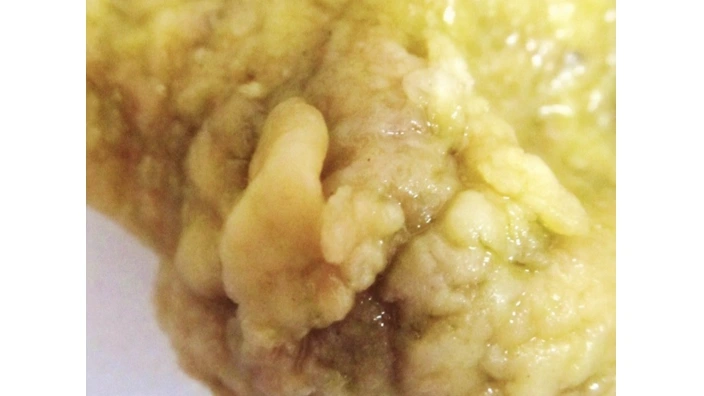
Image source and reuse details
Source: Gross pathology of gallbladder carcinoma.jpg — figure 4. Full 704 × 526 photograph proportionally reduced into 704 × 396 with external white side margins and converted to WebP. No upscaling, tissue cropping, recoloring or retouching.
In this guide
First distinguish the gallbladder from the bile ducts
The gallbladder is a small organ under the liver that stores bile. Cancer starting here differs from cancer of the bile ducts, liver or pancreas. A metastasis that has spread here from another organ also needs a different treatment pathway.
The most common form is adenocarcinoma, which starts in glandular cells. Rare neuroendocrine or squamous cancers do not automatically receive the same treatment. The pathology report, the examination of tissue, should identify the exact starting site and cell type.
Source: National Cancer Institute — United States — Gallbladder Cancer Treatment (PDQ®)–Health Professional Version — updated February 12, 2025 · Istituto Europeo di Oncologia — Italy — Tumori del fegato e delle vie biliari — Tumore della colecisti
Symptoms and when to seek urgent help
Persistent pain in the upper right abdomen, weight loss, nausea or poor appetite warrant medical assessment. Yellow skin or eyes, dark urine, pale stools and itching can signal blocked bile flow. These symptoms can also have causes other than cancer.
New jaundice needs urgent assessment. Fever or chills with jaundice, severe pain, persistent vomiting or confusion can signal serious infection. During cancer treatment, report a temperature of 38 °C or higher immediately. Do not wait for an appointment abroad.
Source: National Health Service — United Kingdom — Symptoms of gallbladder cancer — reviewed October 28, 2026 · National Cancer Institute — United States — Infection and Neutropenia during Cancer Treatment
Gallstones, risk factors and checks
Gallstones and long-standing inflammation are associated with higher risk, but most people with gallstones never develop this cancer. A risk factor does not establish the cause in an individual. It does not mean every gallbladder with stones must be removed to prevent cancer.
There is no standard population screening program for this cancer. Polyps or other ultrasound findings need assessment based on size, appearance and personal history. A clinician decides on monitoring or surgery; CA 19-9 should not be used as a stand-alone prevention test.
Source: National Cancer Institute — United States — Gallbladder Cancer Treatment (PDQ®)–Health Professional Version — updated February 12, 2025 · The University of Texas MD Anderson Cancer Center — United States — Gallbladder cancer: 9 facts about symptoms, diagnosis and treatment — December 6, 2023
Tests and the limits of CA 19-9
Ultrasound is often an initial test. Contrast CT or MRI and imaging of the bile ducts help define the disease. Blood tests also assess liver function and bilirubin. Other tests answer specific questions: not everyone needs every test.
CA 19-9 is a blood marker that may help monitoring, but stones, infection or obstruction can also raise it. Some people do not produce it. A high result does not confirm cancer and a low one does not exclude it. It is interpreted with imaging, symptoms and tissue.
Source: National Health Service — United Kingdom — Tests and next steps for gallbladder cancer — reviewed October 28, 2026 · National Library of Medicine — United States — CA 19-9 Blood Test (Pancreatic Cancer) — MedlinePlus
Biopsy and pathology: plan the pathway first
Cancer is sometimes found only after gallbladder removal for stones. If it is suspected beforehand and might be removable, the hepatobiliary team should decide whether and how tissue is needed. Do not arrange an invasive biopsy without that plan.
Advanced disease generally needs confirmation of the cancer type before medicines. Ask whether the sample is sufficient for molecular testing too. The pathologist assesses depth, surgical margins and available lymph nodes. Bring the full report and ask whether slides or tissue blocks need review.
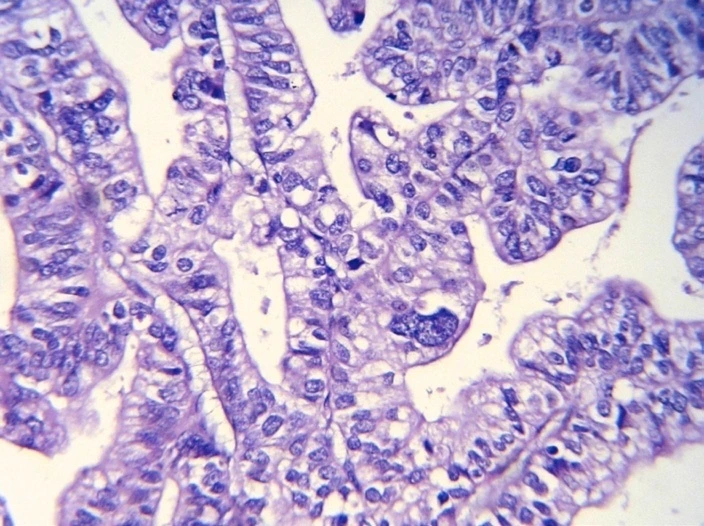
Image source and reuse details
Source: Histopathology of gallbladder carcinoma.jpg — figure 5. Full 704 × 526 field converted to WebP without resizing, cropping, recoloring or diagnostic alteration.
Source: International Hepato-Pancreato-Biliary Association and Asia-Pacific Hepato-Pancreato-Biliary Association — “IHPBA-APHPBA clinical practice guidelines”: international Delphi consensus recommendations for gallbladder cancer — 2024 · National Cancer Institute — United States — Gallbladder Cancer Treatment (PDQ®)–Health Professional Version — updated February 12, 2025
Stage and whether surgery is possible
T describes how far cancer grows through the wall: T1a involves its inner layer, T1b the muscle and T2 tissue outside the muscle. T3 can reach the surface, liver or one neighboring organ. T4 describes more extensive local invasion, such as involvement of major blood vessels.
Lymph nodes and distant metastases are assessed separately: T4 does not automatically mean distant spread. Surgery also depends on the tumor’s position and overall health. Staging laparoscopy may look for spread missed by scans before a larger operation.
Source: National Cancer Institute — United States — Gallbladder Cancer Treatment (PDQ®)–Health Professional Version — updated February 12, 2025 · International Hepato-Pancreato-Biliary Association and Asia-Pacific Hepato-Pancreato-Biliary Association — “IHPBA-APHPBA clinical practice guidelines”: international Delphi consensus recommendations for gallbladder cancer — 2024
Cancer discovered after surgery for stones
For a completely removed T1a lesion, the original operation may be sufficient. For T1b and beyond, the 2024 international surgical consensus recommends considering and offering completion surgery when appropriate, after repeat staging and specialist discussion.
This does not mean everyone needs the same second operation. Margins, spread, fitness and expected benefit matter. There is no single deadline after which reassessment is certainly pointless. Take the operation record and pathology report to an experienced hepatobiliary team.
Source: International Hepato-Pancreato-Biliary Association and Asia-Pacific Hepato-Pancreato-Biliary Association — “IHPBA-APHPBA clinical practice guidelines”: international Delphi consensus recommendations for gallbladder cancer — 2024 · Istituto Europeo di Oncologia — Italy — Tumori del fegato e delle vie biliari — Tumore della colecisti
What surgery involves
The aim is complete removal with clear margins, called R0. Nearby liver tissue and regional lymph nodes may need removal along with the gallbladder. The extent should achieve adequate removal without adding unnecessary major surgery.
Routine removal of bile ducts, large portions of liver or the scars from small laparoscopic entry sites is not required for everyone. Ask why each resection is proposed, about risks and recovery, and who will manage complications.
After surgery: capecitabine and safety
Capecitabine may be offered for about 6 months. BILCAP enrolled 447 patients after surgery for several biliary tract cancers. Its primary comparison of all assigned patients did not reach statistical significance; adjusted and per-protocol analyses favored the drug. It does not guarantee prevention of recurrence.
BILCAP, funded by Cancer Research UK and Roche, reported grade 3 toxicity in 44% of evaluable treated patients. Risks include diarrhea and hand and foot problems. Before capecitabine or fluorouracil, the European Union recommends testing for DPD deficiency, a problem with the enzyme that breaks down these medicines.
Source: University of Southampton and multicentre United Kingdom BILCAP investigators — Capecitabine compared with observation in resected biliary tract cancer (BILCAP): a randomised, controlled, multicentre, phase 3 study — 2019 · European Medicines Agency — European Union — EMA recommendations on DPD testing prior to treatment with fluorouracil, capecitabine, tegafur and flucytosine — April 30, 2020
Advanced cancer: choosing the first treatment
For suitable patients, gemcitabine and cisplatin may be combined with durvalumab or pembrolizumab. These combinations have United States approvals for advanced biliary tract cancer; durvalumab also has the corresponding European indication. Country, coverage, kidney function and general health affect the choice.
The trials also included bile duct cancers: their combined results are not gallbladder-only estimates. People unable to tolerate the combination need an individual alternative. No direct comparison establishes which of the two immunotherapy drugs is better.
Source: National Cancer Institute — United States — Gallbladder Cancer Treatment (PDQ®)–Health Professional Version — updated February 12, 2025 · Food and Drug Administration — United States — Durvalumab: approved indication for biliary tract cancer — September 2, 2022 · Food and Drug Administration — United States — FDA approves pembrolizumab with chemotherapy for biliary tract cancer — October 31, 2023 · European Medicines Agency — European Union — Imfinzi — EPAR, biliary tract cancer indication
Durvalumab: what TOPAZ-1 found
In the 2024 TOPAZ-1 update, 685 patients were compared between durvalumab plus chemotherapy and placebo plus chemotherapy. Median overall survival was 12.9 versus 11.3 months. The median is when half the group remains alive, not a personal deadline.
Grade 3–4 events from any cause occurred in 74% versus 75% of evaluable patients. These figures do not make treatment risk-free. AstraZeneca funded the trial. An average benefit does not show which individuals will respond or for how long.
Pembrolizumab: initial results and follow-up
KEYNOTE-966 assigned 1,069 patients to pembrolizumab or placebo with gemcitabine and cisplatin. In the analysis supporting the 2023 United States approval, median overall survival was 12.7 versus 10.9 months. Several biliary tract cancers were included.
The 2026 paper uses data through November 14, 2023: with median follow-up of 36.6 months, survival at 36 months was 13% versus 11%. Treatment-related grade 3–4 events were 70% versus 69%. Funding was from Merck Sharp & Dohme, part of Merck & Co. These are not comparisons with TOPAZ-1.
Source: Kanagawa Cancer Center and international KEYNOTE-966 investigators — Japan and participating countries — Pembrolizumab plus gemcitabine and cisplatin for advanced biliary tract cancer: longer-term follow-up from the randomised, double-blind, placebo-controlled, phase 3 KEYNOTE-966 trial — EClinicalMedicine, October 12, 2026 · Food and Drug Administration — United States — FDA approves pembrolizumab with chemotherapy for biliary tract cancer — October 31, 2023
Molecular testing: HER2 is not the only question
For advanced cancer, ask whether tumor testing should include HER2 and other markers, including DNA repair defects when relevant. These tests seek features that could guide medicines or trials. A tumor finding does not automatically mean a hereditary family variant.
Do not transfer every cholangiocarcinoma medicine to gallbladder cancer: targets such as FGFR2 or IDH1 have specific settings and indications. Discuss the report with the oncologist, checking the cancer site, alteration, test method and local authorization.
Source: National Cancer Institute — United States — Gallbladder Cancer Treatment (PDQ®)–Health Professional Version — updated February 12, 2025 · Food and Drug Administration — United States — FDA grants accelerated approval to zanidatamab-hrii for previously treated unresectable or metastatic HER2-positive biliary tract cancer — November 20, 2024
Zanidatamab and what HER2 IHC 3+ means
Zanidatamab has had accelerated United States approval since 2024 and conditional European Union authorization since 2025. It covers previously treated adults with unresectable or metastatic biliary tract cancer and HER2 IHC 3+, meaning strong protein expression on the test. Not every “HER2-positive” result qualifies.
In the single-arm efficacy group of 62 patients, 52% responded and median response duration was 14.9 months. This does not establish cure or a randomized survival advantage. Confirmatory evidence is needed. Heart monitoring, diarrhea, infusion reactions and pregnancy risks require attention.
Source: Food and Drug Administration — United States — FDA grants accelerated approval to zanidatamab-hrii for previously treated unresectable or metastatic HER2-positive biliary tract cancer — November 20, 2024 · Food and Drug Administration — United States — Ongoing Cancer Accelerated Approvals — Ziihera, confirmatory trial JZP598-302 · European Medicines Agency — European Union — Ziihera — EPAR, conditional authorisation June 27, 2025 · European Medicines Agency — European Union — Ziihera — Product information, updated June 16, 2026
Blocked bile and stents: relief and warning signs
A stent or drain can open a blocked duct and reduce jaundice or itching. It may also make some treatments possible. It does not remove the cancer by itself. Endoscopic, through-the-skin or surgical approaches depend on the blockage and specialist plan.
Ask how to recognize a blocked stent, whom to call, and whether checks or replacements are planned. Fever, chills, increasing jaundice or pain can signal cholangitis, a bile duct infection. Seek urgent care even when an oncology appointment is already scheduled.
Source: National Cancer Institute — United States — Gallbladder Cancer Treatment (PDQ®)–Health Professional Version — updated February 12, 2025 · National Health Service — United Kingdom — Treatment for gallbladder cancer — reviewed October 28, 2026 · National Cancer Institute — United States — Infection and Neutropenia during Cancer Treatment
Radiation therapy and symptom care
Radiation therapy may be considered in selected situations after surgery or to control pain and other local problems. It does not automatically replace possible surgery and is not required for everyone. The team explains its purpose, likely benefit and nearby organs needing protection.
Early palliative care treats pain, nausea, itching, anxiety and everyday difficulties. It can accompany cancer treatment. It is not giving up: it helps select care with realistic benefits and an acceptable burden.
Source: National Cancer Institute — United States — Gallbladder Cancer Treatment (PDQ®)–Health Professional Version — updated February 12, 2025 · National Health Service — United Kingdom — Treatment for gallbladder cancer — reviewed October 28, 2026
If cancer returns or progresses
The team reassesses spread, previous treatments, markers and fitness. ABC-06 studied FOLFOX after gemcitabine and cisplatin in 162 patients with biliary cancers and good functional status. Median survival was 6.2 versus 5.3 months compared with active symptom control alone.
Grade 3–5 events occurred in 69% versus 52%, with 3 chemotherapy-related deaths. Funders included Cancer Research UK, Stand Up To Cancer, AMMF and The Christie Charity. The trial does not establish the same benefit for everyone or directly after newer immunotherapy combinations.
Source: University of Manchester and United Kingdom National Cancer Research Institute ABC-06 investigators — Second-line FOLFOX chemotherapy versus active symptom control for advanced biliary tract cancer (ABC-06): a phase 3, open-label, randomised, controlled trial — 2021 · National Cancer Institute — United States — Gallbladder Cancer Treatment (PDQ®)–Health Professional Version — updated February 12, 2025
Clinical trials and treatments in development
Ask about trials matching the cancer site, marker and previous treatment. Check the protocol number, center, current recruitment, comparison and costs. Trials may have strict eligibility rules and do not guarantee benefit or access to the drug.
The Food and Drug Administration still lists an ongoing confirmatory study for zanidatamab. A promising drug has no certain availability date for everyone. Approval, coverage and special access need checking in the treatment country, rather than relying on a foreign news report.
Source: Food and Drug Administration — United States — Ongoing Cancer Accelerated Approvals — Ziihera, confirmatory trial JZP598-302 · National Cancer Institute — United States — Gallbladder Cancer Treatment (PDQ®)–Health Professional Version — updated February 12, 2025
Food, activity and supplements
If eating is difficult or weight is falling, ask early for an oncology dietitian. The priority may be preserving calories, protein and muscle with small meals adapted to tolerance. No diet cures this cancer. Avoid fasting or restrictions that worsen malnutrition.
Gentle, gradual activity should fit energy levels, anemia and recovery from surgery. Supplements, herbs and “natural” products can interfere with medicines or harm the liver. Show the team a full list. No supplement is approved as a treatment for this cancer.
Source: National Cancer Institute — United States — Nutrition During Cancer Treatment · National Cancer Institute — United States — Complementary and Alternative Medicine
Follow-up after treatment and during medicines
The plan depends on stage, treatment and recurrence risk. Ask which visits, scans and blood tests are needed and when, rather than copying a universal online schedule. CA 19-9 may help only if informative in your case and interpreted with other results.
Report new problems before the scheduled visit, especially jaundice, fever, increasing pain or weight loss. Keep a summary of surgery, pathology, medicines, adverse effects and stents. It supports follow-up and a possible second opinion.
Source: National Health Service — United Kingdom — Treatment for gallbladder cancer — reviewed October 28, 2026 · National Library of Medicine — United States — CA 19-9 Blood Test (Pancreatic Cancer) — MedlinePlus
Outlook and questions for the consultation
The outlook depends on extent, complete removal, cell type, response and overall health. Trial medians describe different groups, not how long one person will live. Ask about realistic goals in your situation and findings that could change the plan.
Bring practical questions: has a hepatobiliary team reviewed the case? Is completion surgery needed? Is there enough tissue and should HER2 be tested? What benefit, risks and alternatives are expected? Whom should you contact at night or on holidays?
Source: Seoul National University Hospital and international TOPAZ-1 investigators — Durvalumab or placebo plus gemcitabine and cisplatin in participants with advanced biliary tract cancer (TOPAZ-1): updated overall survival from a randomised phase 3 study — 2024 · Kanagawa Cancer Center and international KEYNOTE-966 investigators — Japan and participating countries — Pembrolizumab plus gemcitabine and cisplatin for advanced biliary tract cancer: longer-term follow-up from the randomised, double-blind, placebo-controlled, phase 3 KEYNOTE-966 trial — EClinicalMedicine, October 12, 2026 · University of Southampton and multicentre United Kingdom BILCAP investigators — Capecitabine compared with observation in resected biliary tract cancer (BILCAP): a randomised, controlled, multicentre, phase 3 study — 2019
Centers and a second opinion in your country
Look for a team bringing together hepatobiliary surgery, oncology, radiology, endoscopy and pathology. Documented pathways include Istituto Europeo di Oncologia and The University of Texas MD Anderson Cancer Center. These are not rankings or promises of acceptance or results.
The country filter searches the contacts included in a selective directory. Confirm gallbladder expertise, public or private access, costs and required records. Before traveling, request remote review and send documents through the center’s secure channels.
Find documented gallbladder cancer contact routes →
Source: Istituto Europeo di Oncologia — Italy — Tumori del fegato e delle vie biliari — Tumore della colecisti · The University of Texas MD Anderson Cancer Center — United States — Gallbladder cancer: 9 facts about symptoms, diagnosis and treatment — December 6, 2023
Questions to take to your appointment
- Do gallstones mean cancer? No. Gallstones are common and most people with them never develop this cancer. A clinician should assess symptoms or abnormal findings.
- Is a second operation always needed? No. A completely removed T1a cancer may not need one. From T1b onward, completion surgery is considered after staging and specialist discussion.
- Does CA 19-9 confirm the diagnosis? No. Obstruction or infection may raise it, and some people do not produce it. It does not replace imaging and tissue assessment.
- Does HER2 positivity mean zanidatamab can be used? Not always. Verified indications require HER2 IHC 3+, previously treated advanced disease and the other local access criteria.
- When will new treatments arrive? There is no certain deadline. Recruitment, results, approval and coverage are separate steps that must be checked in the treatment country.
- Does the directory list every best center? No. It provides selected documented routes, does not cover every hospital or country and does not award world rankings.
Sources and verification
- National Cancer Institute — United States — Gallbladder Cancer Treatment (PDQ®)–Health Professional Version — updated February 12, 2025
- National Health Service — United Kingdom — Symptoms of gallbladder cancer — reviewed October 28, 2026
- National Health Service — United Kingdom — Tests and next steps for gallbladder cancer — reviewed October 28, 2026
- National Health Service — United Kingdom — Treatment for gallbladder cancer — reviewed October 28, 2026
- National Library of Medicine — United States — CA 19-9 Blood Test (Pancreatic Cancer) — MedlinePlus
- International Hepato-Pancreato-Biliary Association and Asia-Pacific Hepato-Pancreato-Biliary Association — “IHPBA-APHPBA clinical practice guidelines”: international Delphi consensus recommendations for gallbladder cancer — 2024
- University of Southampton and multicentre United Kingdom BILCAP investigators — Capecitabine compared with observation in resected biliary tract cancer (BILCAP): a randomised, controlled, multicentre, phase 3 study — 2019
- European Medicines Agency — European Union — EMA recommendations on DPD testing prior to treatment with fluorouracil, capecitabine, tegafur and flucytosine — April 30, 2020
- Seoul National University Hospital and international TOPAZ-1 investigators — Durvalumab or placebo plus gemcitabine and cisplatin in participants with advanced biliary tract cancer (TOPAZ-1): updated overall survival from a randomised phase 3 study — 2024
- Kanagawa Cancer Center and international KEYNOTE-966 investigators — Japan and participating countries — Pembrolizumab plus gemcitabine and cisplatin for advanced biliary tract cancer: longer-term follow-up from the randomised, double-blind, placebo-controlled, phase 3 KEYNOTE-966 trial — EClinicalMedicine, October 12, 2026
- Food and Drug Administration — United States — FDA approves pembrolizumab with chemotherapy for biliary tract cancer — October 31, 2023
- Food and Drug Administration — United States — Durvalumab: approved indication for biliary tract cancer — September 2, 2022
- European Medicines Agency — European Union — Imfinzi — EPAR, biliary tract cancer indication
- Food and Drug Administration — United States — FDA grants accelerated approval to zanidatamab-hrii for previously treated unresectable or metastatic HER2-positive biliary tract cancer — November 20, 2024
- Food and Drug Administration — United States — Ongoing Cancer Accelerated Approvals — Ziihera, confirmatory trial JZP598-302
- European Medicines Agency — European Union — Ziihera — EPAR, conditional authorisation June 27, 2025
- European Medicines Agency — European Union — Ziihera — Product information, updated June 16, 2026
- University of Manchester and United Kingdom National Cancer Research Institute ABC-06 investigators — Second-line FOLFOX chemotherapy versus active symptom control for advanced biliary tract cancer (ABC-06): a phase 3, open-label, randomised, controlled trial — 2021
- National Cancer Institute — United States — Infection and Neutropenia during Cancer Treatment
- National Cancer Institute — United States — Nutrition During Cancer Treatment
- National Cancer Institute — United States — Complementary and Alternative Medicine
- The University of Texas MD Anderson Cancer Center — United States — Gallbladder cancer: 9 facts about symptoms, diagnosis and treatment — December 6, 2023
- Istituto Europeo di Oncologia — Italy — Tumori del fegato e delle vie biliari — Tumore della colecisti
- Geetika K. C. and O. P. Talwar — Journal of Pathology of Nepal — Histomorphological changes in gall bladder diseases and its association with helicobacter infection — 2014, 4(8):617–622
Sources checked: 2026-11-16