


Mesothelioma: diagnosis, treatment and specialist centers
Mesothelioma treatment depends on where it starts, its cell type and your health. For most pleural cases, medicines and symptom relief are central; surgery needs careful selection. This adult guide separates pleural and peritoneal care and explains what current studies and drug approvals actually mean.
MyMedNest editorial guide · Sources checked:
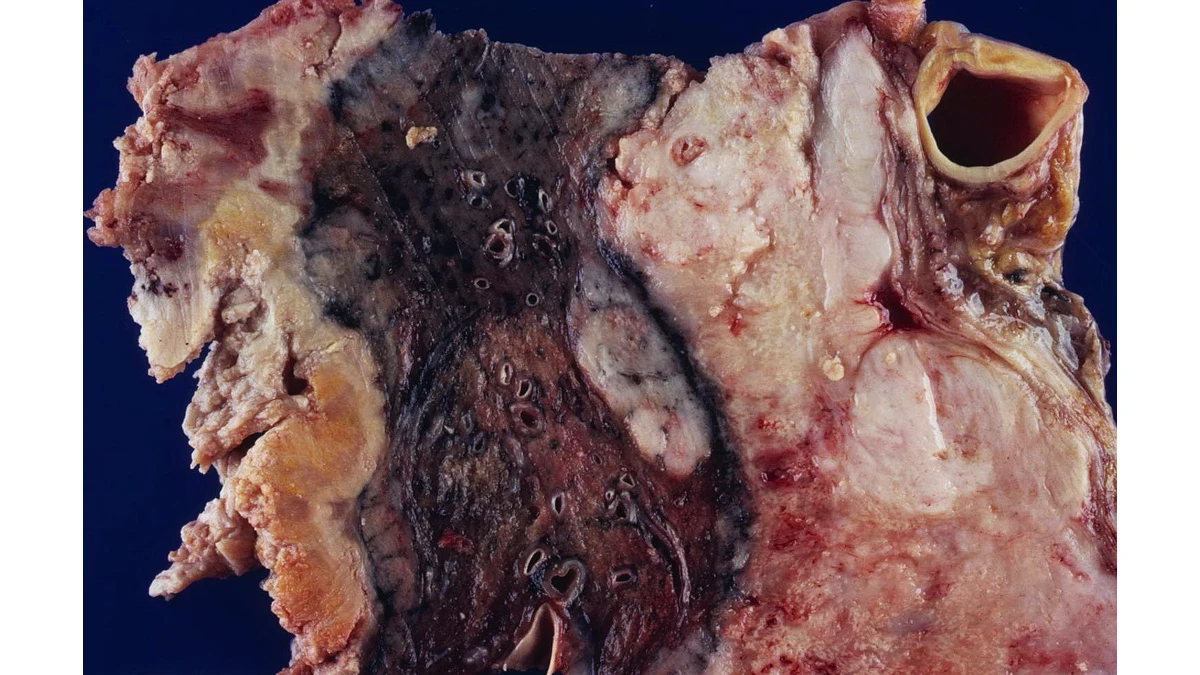
Image source and reuse details
Source: Mesothelioma Case 116 (3954797887).jpg. Full 1499 × 979 photograph proportionally reduced into 1200 × 675 with external white side margins and converted to WebP. No tissue cropped, recolored or retouched.
In this guide
Start with the exact site and cell type
Mesothelioma grows from the thin lining around organs. Pleural mesothelioma affects the lining of the lungs and chest wall; it is different from lung cancer. Peritoneal mesothelioma starts in the abdominal lining. Rare heart-lining or testicular-lining disease needs its own specialist assessment.
Epithelioid, sarcomatoid and biphasic describe the cells seen under a microscope. Biphasic means a mixture. These types can respond differently to treatment. A referral should state the site and confirmed type, rather than only “mesothelioma.” This guide concerns adults and mainly diffuse malignant disease.
Source: Istituto Superiore di Sanità — Italy — Mesotelioma: di cosa si tratta, cause e terapie · National Cancer Institute — United States — Mesothelioma Treatment · The University of Texas MD Anderson Cancer Center — United States — Mesothelioma Treatment — reviewed April 27, 2026
Symptoms and when to seek urgent help
Persistent one-sided chest pain, breathlessness, cough, fatigue or unexplained weight loss need medical assessment. Fluid around a lung can make breathing difficult. Peritoneal disease may cause abdominal swelling, pain, poor appetite or bowel problems. These symptoms also have other causes.
Severe or rapidly worsening breathlessness, major coughing of blood, fainting or sudden severe chest pain require emergency care locally. A swollen abdomen with persistent vomiting or inability to pass stool also needs urgent assessment. Do not wait for an overseas appointment or assume every new symptom is simply the cancer.
Source: Istituto Superiore di Sanità — Italy — Mesotelioma: di cosa si tratta, cause e terapie · National Cancer Institute — United States — Asbestos Exposure and Cancer Risk
Asbestos exposure and what prevention can do
Asbestos exposure is a major cause, often many decades before diagnosis. It can occur at work, in the environment or through fibers brought home on clothing. Some patients remember no exposure. Write down jobs, buildings and household contacts for the medical and occupational-health history; lack of a clear memory does not exclude disease.
Avoid further exposure and do not disturb suspected asbestos yourself. Qualified local services should assess materials. Tell your doctor about exposure and new symptoms. Blood markers are not a validated population screening program for mesothelioma, and lung-cancer screening rules are not automatically mesothelioma screening. Stopping smoking protects health, including the lung-cancer risk linked to asbestos.
Source: National Cancer Institute — United States — Asbestos Exposure and Cancer Risk · British Thoracic Society — United Kingdom — British Thoracic Society Guideline for the investigation and management of malignant pleural mesothelioma — Thorax 2018;73:i1–i30
Imaging, fluid sampling and biopsy
A contrast-enhanced chest CT usually defines pleural thickening, fluid and possible spread. Ultrasound can guide fluid drainage. PET-CT or MRI answer selected questions when they may change management. Tell the team about previous talc pleurodesis, which can affect PET interpretation.
Fluid cytology looks for cancer cells, but a negative sample does not reliably exclude mesothelioma. Adequate tissue is often obtained through thoracoscopy or an image-guided core biopsy. The choice depends on safety and whether the result changes care. Frail patients may need a less invasive plan agreed with the specialist team.
Source: The University of Texas MD Anderson Cancer Center — United States — Mesothelioma Diagnosis · British Thoracic Society — United Kingdom — British Thoracic Society Guideline for the investigation and management of malignant pleural mesothelioma — Thorax 2018;73:i1–i30
Have the pathology reviewed
Expert pathology distinguishes mesothelioma from reactive inflammation, lung cancer and cancers spread from elsewhere. Special tissue stains are interpreted together with the microscope appearance and scans. Ask for the histological subtype and whether the sample is large enough to assess it.
Blood mesothelin or other markers cannot replace this diagnostic assessment. They should not be treated as a stand-alone screening or exclusion test. If findings remain uncertain, a specialist review or further tissue may help. The medical photographs here illustrate separate historical cases; they cannot diagnose a reader.
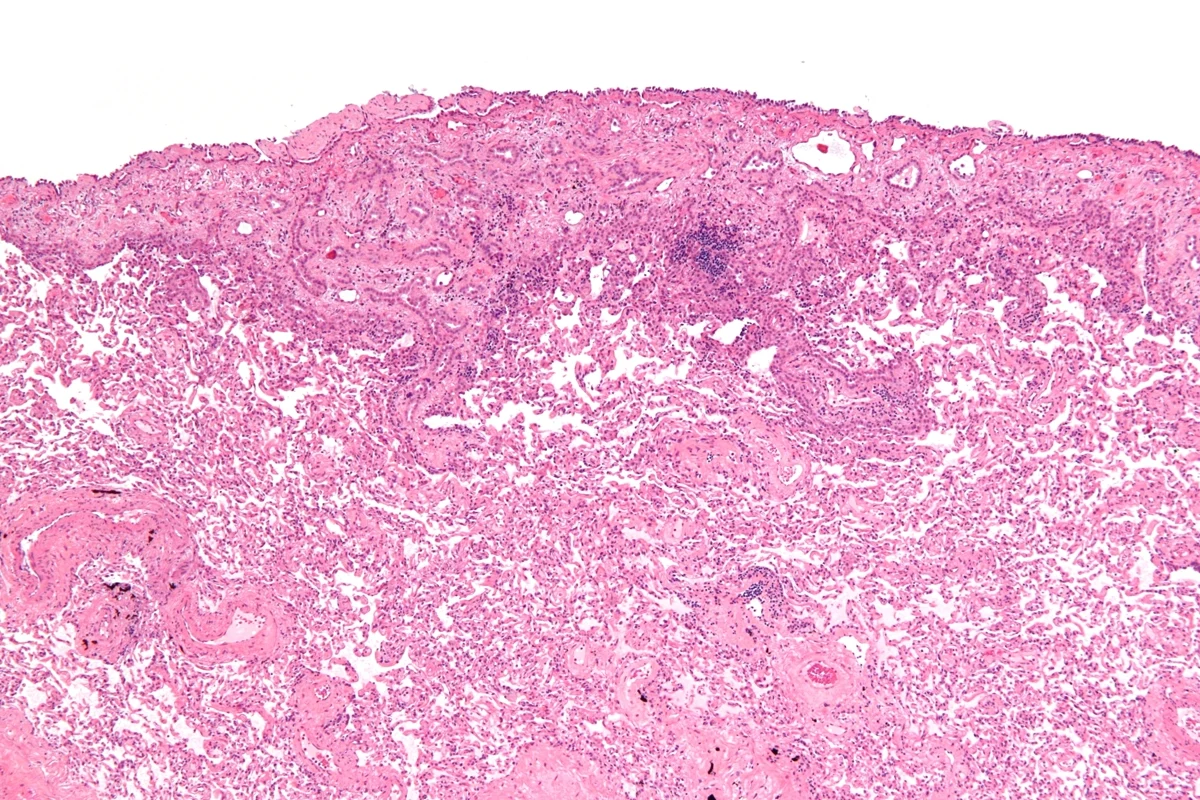
Image source and reuse details
Source: Malignant epithelioid mesothelioma – low mag.jpg. Full 4272 × 2848 field proportionally reduced to 1200 × 800 and converted to WebP. No crop, recoloring or diagnostic alteration.
Source: National Cancer Institute — United States — Malignant Mesothelioma Treatment (PDQ®)–Health Professional Version — updated May 12, 2025 · British Thoracic Society — United Kingdom — British Thoracic Society Guideline for the investigation and management of malignant pleural mesothelioma — Thorax 2018;73:i1–i30
Tumor tests and inherited risk are different
A change found in a tumor is not automatically inherited. BAP1 is a gene involved in protecting cells; some inherited harmful variants increase the risk of mesothelioma and other tumors. Genetic counseling explains whether blood or other germline testing is appropriate and what it could mean for relatives.
Discuss your personal and family cancer history and any tumor test suggesting inherited risk. In peritoneal mesothelioma, the 2025 consensus recommends assessment for germline testing. Testing practices differ between guidelines and health systems. A variant of uncertain significance does not prove a hereditary syndrome or justify predictive testing of relatives on its own.
Source: Cancer Institute New South Wales — Australia — eviQ: BAP1 – genetic testing · Yale School of Medicine and multidisciplinary Peritoneal Surface Malignancies Consortium — United States — Consensus guideline for the management of peritoneal mesothelioma — Cancer 2025;131:e35868
Stage, fitness and realistic goals
For pleural disease, TNM describes the tumor extent, lymph nodes and distant spread. Ask which edition is used; stage labels from different editions can differ. The pleural staging table should not be applied unchanged to peritoneal mesothelioma, where the pattern and amount of abdominal disease are assessed separately.
Cell type, breathing capacity, kidney and heart health, daily activity and your preferences also matter. Ask whether treatment aims to slow growth, extend life, relieve symptoms or achieve long-term control in a selected setting. A study median describes a group; it is not a personal deadline. Some people live substantially longer than the median.
Source: National Cancer Institute — United States — Malignant Mesothelioma Treatment (PDQ®)–Health Professional Version — updated May 12, 2025 · Yale School of Medicine and multidisciplinary Peritoneal Surface Malignancies Consortium — United States — Consensus guideline for the management of peritoneal mesothelioma — Cancer 2025;131:e35868
Choose a plan with a specialist team
A team may include a medical oncologist, respiratory physician, thoracic surgeon, radiation oncologist, pathologist, radiologist and symptom-control specialists. For peritoneal disease, involve a peritoneal-surface cancer team. Review the tissue and imaging before committing to major surgery or travel.
For unresectable pleural disease, options include nivolumab with ipilimumab, pembrolizumab with platinum and pemetrexed where indicated, or chemotherapy in appropriate circumstances. Histology and contraindications influence the choice. Autoimmune disease, an organ transplant and existing lung inflammation need specific discussion before immunotherapy. The regimens have not been proven interchangeable by comparing results from different trials.
Source: National Health Service — United Kingdom — Treatment for mesothelioma · The University of Texas MD Anderson Cancer Center — United States — Mesothelioma Treatment — reviewed April 27, 2026 · European Medicines Agency — European Union — Keytruda — therapeutic indications: malignant pleural mesothelioma
Nivolumab with ipilimumab: benefit and risks
CheckMate 743 randomly assigned 605 previously untreated patients with unresectable pleural mesothelioma. Median overall survival was 18.1 months with nivolumab plus ipilimumab versus 14.1 months with platinum-pemetrexed chemotherapy. The trial was sponsored by Bristol Myers Squibb. The apparent benefit was larger in non-epithelioid disease; this does not predict an individual response.
In the initial trial report, grade 3–4 treatment-related effects affected 30% versus 32%, respectively. Immunotherapy has different risks, including inflammation of the lungs, bowel, liver, hormones or, rarely, heart and nerves; serious effects can be fatal. A PD-L1 result alone should not be treated as a promise of benefit. The United States approved this combination in October 2020 for adults with unresectable pleural disease.
Source: Food and Drug Administration — United States — FDA Approval Summary: Nivolumab in Combination with Ipilimumab for the Treatment of Unresectable Malignant Pleural Mesothelioma · Health Research Authority — United Kingdom — CA209-743: Phase III unresectable Pleural Mesothelioma · National Cancer Institute — United States — Malignant Mesothelioma Treatment (PDQ®)–Health Professional Version — updated May 12, 2025
Pembrolizumab with chemotherapy: check the country
In the randomized phase 3 KEYNOTE-483/IND227 study, 440 patients received platinum-pemetrexed with or without pembrolizumab. Median overall survival was 17.3 versus 16.1 months; the hazard ratio was 0.79, with a 95% confidence interval of 0.64–0.98. Funding came from the Canadian Cancer Society and Merck & Co. These are group results, not a cure rate. The hazard ratio compares death rates over follow-up; the confidence interval expresses statistical uncertainty.
Grade 3–4 drug-related effects occurred in 60/222 patients (27%) versus 32/211 (15%); related serious-event hospital admissions were 40/222 (18%) versus 12/211 (6%). Drug-related deaths were two versus one. The Food and Drug Administration approved the combination in September 2024 for unresectable advanced or metastatic pleural disease. The current European Medicines Agency indication is narrower: adults with unresectable non-epithelioid pleural mesothelioma. Approval does not guarantee local reimbursement.
Source: Canadian Cancer Trials Group; Istituto Nazionale Tumori Fondazione G. Pascale; Intergroupe Francophone de Cancérologie Thoracique — Canada, Italy and France — Pembrolizumab plus chemotherapy versus chemotherapy in untreated advanced pleural mesothelioma in Canada, Italy, and France: a phase 3, open-label, randomised controlled trial — The Lancet 2023 · Food and Drug Administration — United States — FDA D.I.S.C.O. Burst Edition: FDA approval of Keytruda (pembrolizumab) for unresectable advanced or metastatic malignant pleural mesothelioma · European Medicines Agency — European Union — Keytruda — therapeutic indications: malignant pleural mesothelioma
Chemotherapy and other medicines
Pemetrexed with cisplatin, or carboplatin when appropriate, remains an option in selected pathways. Kidney function, hearing, nerves, blood counts and general fitness influence treatment. Prescribed folic acid, vitamin B12 and other supportive medicines help make pemetrexed safer; do not set supplement doses yourself.
Bevacizumab may be added in selected settings, but bleeding, clotting, blood pressure, healing and local authorization matter. A medicine appearing in a guideline is not automatically approved for that use everywhere. Ask for the proposed schedule, monitoring, expected benefit and alternatives. Do not compare survival medians across unrelated chemotherapy and immunotherapy trials to rank your options.
Source: National Cancer Institute — United States — Malignant Mesothelioma Treatment (PDQ®)–Health Professional Version — updated May 12, 2025 · National Cancer Institute — United States — Mesothelioma Treatment · The University of Texas MD Anderson Cancer Center — United States — Mesothelioma Treatment — reviewed April 27, 2026
Surgery: discuss the MARS 2 evidence
Being technically operable does not prove that surgery will help. MARS 2 randomized 335 people with resectable pleural mesothelioma after two chemotherapy cycles. Median survival was 19.3 months with pleurectomy/decortication plus chemotherapy versus 24.8 months with chemotherapy alone. There were more serious adverse events and worse quality of life with surgery. The trial was funded by the National Institute for Health and Care Research and Cancer Research UK.
This result concerns the tested pleural operation and pathway; it is not a trial of peritoneal surgery with HIPEC. Major pleural surgery is now a highly selective discussion, not a default promise of cure. Ask how the team interprets MARS 2, why your case differs, its own complications and mortality, the chance of delaying drug treatment, alternatives and whether a trial or independent second opinion is appropriate.
Source: Imperial College London; University of Bristol and collaborating trial centres — United Kingdom — Extended pleurectomy decortication and chemotherapy versus chemotherapy alone for pleural mesothelioma (MARS 2): a phase 3 randomised controlled trial — The Lancet Respiratory Medicine 2024 · The University of Texas MD Anderson Cancer Center — United States — Mesothelioma Treatment — reviewed April 27, 2026
Peritoneal mesothelioma has a separate pathway
For selected fit patients with abdominal disease, cytoreductive surgery removes visible tumor and may be combined with heated intraperitoneal chemotherapy, called HIPEC. An expert center assesses histology, distribution, involvement of the small bowel, disease outside the abdomen and the likelihood of meaningful tumor removal. This is major treatment with substantial risks.
The 2025 peritoneal consensus supports care based on individual risk and multidisciplinary review. Systemic treatment is important when surgery is unsuitable and in selected combined plans. Much evidence is observational or extrapolated from pleural disease; pleural trial survival figures should not be presented as peritoneal predictions. Benign or well-differentiated papillary mesothelial lesions also need a different assessment from diffuse malignant disease.
Source: Yale School of Medicine and multidisciplinary Peritoneal Surface Malignancies Consortium — United States — Consensus guideline for the management of peritoneal mesothelioma — Cancer 2025;131:e35868 · National Cancer Institute — United States — Malignant Mesothelioma Treatment (PDQ®)–Health Professional Version — updated May 12, 2025
Relieve fluid and breathlessness early
Pleural fluid can be drained to improve breathing. Recurrent fluid may be managed with talc pleurodesis, which helps the pleural layers stick together, or an indwelling catheter that allows repeated drainage. The right choice depends partly on whether the lung can expand, symptoms, support at home and your preferences.
These procedures control fluid; they do not remove all the cancer. Ask about catheter care, infection signs and who to contact if drainage stops or breathing worsens. Abdominal fluid may also need symptom-directed drainage. Pain and breathlessness treatment should start alongside cancer treatment, rather than being postponed until other options have ended.
Source: National Cancer Institute — United States — Mesothelioma Treatment · National Health Service — United Kingdom — Treatment for mesothelioma
Radiotherapy is planned for a specific goal
Radiotherapy can help localized chest-wall pain or selected sites of progression. In carefully selected plans it may accompany other treatment. Treating a small painful area differs from irradiating a whole side of the chest; the expected benefit and risks are different.
Lung, heart and esophageal exposure must be considered, especially after surgery or earlier radiation. Routine preventive radiation to every procedure tract is not a general rule. Ask which symptom or site is targeted, how benefit will be assessed and what side effects need rapid reporting. A longer or more technologically advanced course is not automatically better.
Source: The University of Texas MD Anderson Cancer Center — United States — Mesothelioma Treatment — reviewed April 27, 2026 · National Health Service — United Kingdom — Treatment for mesothelioma · British Thoracic Society — United Kingdom — British Thoracic Society Guideline for the investigation and management of malignant pleural mesothelioma — Thorax 2018;73:i1–i30
If the disease progresses or returns
The next treatment depends on what was used first, the length of benefit, remaining side effects, site of progression and your health. Options may include chemotherapy after immunotherapy, immunotherapy after chemotherapy when appropriate, vinorelbine, gemcitabine or a clinical trial. Local indications differ.
For a limited painful or growing site, local treatment may help while the overall plan is reassessed. A new biopsy is considered when it could clarify diagnosis or trial eligibility; it is not mandatory for every scan change. Discuss the likely benefit and burden of another treatment and the option of focusing more strongly on symptoms and quality of life.
Source: National Cancer Institute — United States — Malignant Mesothelioma Treatment (PDQ®)–Health Professional Version — updated May 12, 2025 · National Cancer Institute — United States — Mesothelioma Treatment · National Health Service — United Kingdom — Treatment for mesothelioma · The University of Texas MD Anderson Cancer Center — United States — Mesothelioma Treatment — reviewed April 27, 2026
Research: ask what is actually being tested
Studies are testing new drug combinations and other approaches to improve disease control. A phase 1 study mainly assesses dose and safety; a response in a small uncontrolled study is not proof of longer survival. Ask for the registry number, phase, comparison group, entry criteria and whether recruitment is currently open at the named hospital.
An expert network or official trial search is a starting point, not confirmation of a place. Check visits, travel, language support, costs, foreseeable risks and access to care after the study. Trial status changes. No reliable publication can promise when an experimental therapy will be approved for everyone or that a biomarker will secure a treatment.
Source: National Cancer Institute — United States — What Are Clinical Trials? · Réseau national expert NETMESO — France — Les centres experts — liste 2024, MESOCLIN et MESOPATH
Have a written safety plan
Ask who to call day and night for fever during chemotherapy, worsening breathing, dehydration, uncontrolled diarrhea, new chest pain or marked weakness. Immunotherapy effects can occur after treatment ends. Tell every clinician about previous immunotherapy; inflammation must be distinguished from infection, fluid or progression.
Report severe symptoms promptly rather than waiting for a scheduled infusion. Do not stop steroids, anticoagulants or cancer medicines on your own. Review all medicines and supplements with the team. Sudden severe breathlessness, collapse or major bleeding needs emergency help; an email to a specialist directory is not an emergency service.
Source: The University of Texas MD Anderson Cancer Center — United States — Mesothelioma Treatment — reviewed April 27, 2026 · Food and Drug Administration — United States — FDA Approval Summary: Nivolumab in Combination with Ipilimumab for the Treatment of Unresectable Malignant Pleural Mesothelioma
Eating, activity and practical support
No food, supplement or “detox” has been proven to cure mesothelioma or remove established asbestos damage. A dietitian can help with weight loss, early fullness and low appetite. Small, frequent meals and symptom treatment may be useful, but dietary restrictions should be individualized rather than imposed to “starve” cancer.
Adapt walking and rehabilitation to breathlessness, fatigue, pain and surgery. Ask about stopping smoking, sleep, emotional support, work and help for caregivers. An occupational-health or social-work service can explain possible local support after asbestos exposure; rules vary by country. Palliative care can be provided with active cancer treatment and does not mean giving up.
Source: National Cancer Institute — United States — Nutrition During Cancer Treatment · National Cancer Institute — United States — Complementary and Alternative Medicine · National Cancer Institute — United States — Asbestos Exposure and Cancer Risk · National Health Service — United Kingdom — Treatment for mesothelioma
Follow-up should include how you feel
Follow-up combines symptoms, examination and scans suited to the treatment and site. Pleural tumor shape can make simple size comparisons difficult; specialist radiology may use modified response measurements. Blood markers alone should not determine whether treatment has worked or failed.
Get a written follow-up plan, including whom to contact between visits. Peritoneal follow-up is planned separately after surgery or systemic treatment. Report new pain, worsening breathlessness, abdominal swelling or declining activity without waiting for the next scan. The most useful schedule is one adapted to the case, not a single online calendar for everyone.
Source: National Health Service — United Kingdom — Treatment for mesothelioma · British Thoracic Society — United Kingdom — British Thoracic Society Guideline for the investigation and management of malignant pleural mesothelioma — Thorax 2018;73:i1–i30 · Yale School of Medicine and multidisciplinary Peritoneal Surface Malignancies Consortium — United States — Consensus guideline for the management of peritoneal mesothelioma — Cancer 2025;131:e35868
Prepare a useful second opinion
Bring pathology reports and available slides or blocks, scan reports and image files, a treatment summary, lung-function tests and a current medicine list. Include occupational exposure history and genetic results if available. Ask whether expert pathology review could change the proposed treatment.
Before major pleural surgery, ask specifically about evidence, personal risk and alternatives. Before HIPEC, confirm the team treats peritoneal mesothelioma. Check which care can remain close to home, costs and referral requirements. A remote opinion does not guarantee admission or access to a study, and urgent care should not be delayed for travel.
Source: British Thoracic Society — United Kingdom — British Thoracic Society Guideline for the investigation and management of malignant pleural mesothelioma — Thorax 2018;73:i1–i30 · Réseau national expert NETMESO — France — Les centres experts — liste 2024, MESOCLIN et MESOPATH · The University of Texas MD Anderson Cancer Center — United States — Mesothelioma Treatment — reviewed April 27, 2026
Find documented specialist contacts
The Istituto Europeo di Oncologia describes a pleural tumor pathway; MD Anderson has dedicated mesothelioma diagnosis and treatment services. France’s NETMESO network distinguishes clinical expertise, MESOCLIN, from expert pathology, MESOPATH, and lists Gustave Roussy among its participating centers. These are documented examples, not a claim of a single best hospital worldwide.
Use the country and tumor filters, then confirm the exact disease site, team, appointment route and language support with the institution. A selectable country does not mean every hospital is listed, and the directory does not yet calculate distance from a postal code. Do not send urgent symptoms or sensitive medical records to an unconfirmed address.
Find documented mesothelioma contacts →
Source: Istituto Europeo di Oncologia — Italy — Tumori toracici — Tumori della pleura · The University of Texas MD Anderson Cancer Center — United States — Mesothelioma Treatment — reviewed April 27, 2026 · Réseau national expert NETMESO — France — Les centres experts — liste 2024, MESOCLIN et MESOPATH
Questions to take to your appointment
- Does an asbestos history prove the diagnosis? No. It is important evidence of risk, but tissue and specialist assessment establish the diagnosis. Some patients recall no exposure.
- Is an operable pleural tumor always best treated with surgery? No. MARS 2 found worse outcomes with the tested major operation plus chemotherapy. Selection, alternatives and an expert second opinion matter.
- Are pleural and peritoneal treatments the same? No. They have different assessments and evidence. Selected peritoneal cases may be considered for cytoreduction with HIPEC; pleural trial numbers are not personal predictions for them.
- Does approval in the United States mean approval in Europe? No. Pembrolizumab with chemotherapy has a narrower European pleural mesothelioma indication. Local authorization and reimbursement must be checked.
- Does a study median tell me how long I will live? No. It summarizes a study group. Individual outcomes vary with the disease, treatment response and health; discuss your own situation with the team.
- Does palliative care stop cancer treatment? No. It can relieve symptoms and support the patient and family alongside treatment aimed at controlling the cancer.
Sources and verification
- National Cancer Institute — United States — Malignant Mesothelioma Treatment (PDQ®)–Health Professional Version — updated May 12, 2025
- National Cancer Institute — United States — Mesothelioma Treatment
- National Health Service — United Kingdom — Treatment for mesothelioma
- Istituto Superiore di Sanità — Italy — Mesotelioma: di cosa si tratta, cause e terapie
- National Cancer Institute — United States — Asbestos Exposure and Cancer Risk
- The University of Texas MD Anderson Cancer Center — United States — Mesothelioma Treatment — reviewed April 27, 2026
- The University of Texas MD Anderson Cancer Center — United States — Mesothelioma Diagnosis
- Istituto Europeo di Oncologia — Italy — Tumori toracici — Tumori della pleura
- Food and Drug Administration — United States — FDA Approval Summary: Nivolumab in Combination with Ipilimumab for the Treatment of Unresectable Malignant Pleural Mesothelioma
- Health Research Authority — United Kingdom — CA209-743: Phase III unresectable Pleural Mesothelioma
- Food and Drug Administration — United States — FDA D.I.S.C.O. Burst Edition: FDA approval of Keytruda (pembrolizumab) for unresectable advanced or metastatic malignant pleural mesothelioma
- European Medicines Agency — European Union — Keytruda — therapeutic indications: malignant pleural mesothelioma
- Canadian Cancer Trials Group; Istituto Nazionale Tumori Fondazione G. Pascale; Intergroupe Francophone de Cancérologie Thoracique — Canada, Italy and France — Pembrolizumab plus chemotherapy versus chemotherapy in untreated advanced pleural mesothelioma in Canada, Italy, and France: a phase 3, open-label, randomised controlled trial — The Lancet 2023
- Imperial College London; University of Bristol and collaborating trial centres — United Kingdom — Extended pleurectomy decortication and chemotherapy versus chemotherapy alone for pleural mesothelioma (MARS 2): a phase 3 randomised controlled trial — The Lancet Respiratory Medicine 2024
- Yale School of Medicine and multidisciplinary Peritoneal Surface Malignancies Consortium — United States — Consensus guideline for the management of peritoneal mesothelioma — Cancer 2025;131:e35868
- Cancer Institute New South Wales — Australia — eviQ: BAP1 – genetic testing
- National Cancer Institute — United States — Nutrition During Cancer Treatment
- National Cancer Institute — United States — Complementary and Alternative Medicine
- National Cancer Institute — United States — What Are Clinical Trials?
- Réseau national expert NETMESO — France — Les centres experts — liste 2024, MESOCLIN et MESOPATH
- British Thoracic Society — United Kingdom — British Thoracic Society Guideline for the investigation and management of malignant pleural mesothelioma — Thorax 2018;73:i1–i30
Sources checked: 2026-11-16