


Thymoma and thymic carcinoma: tests, treatments and specialist care
For a tumor near the thymus, the first decisions are its exact type and whether it can be completely removed. Thymoma and thymic carcinoma need different plans. This adult guide explains tests, treatment choices, immune-related risks and how to seek specialist advice.
MyMedNest editorial guide · Sources checked:
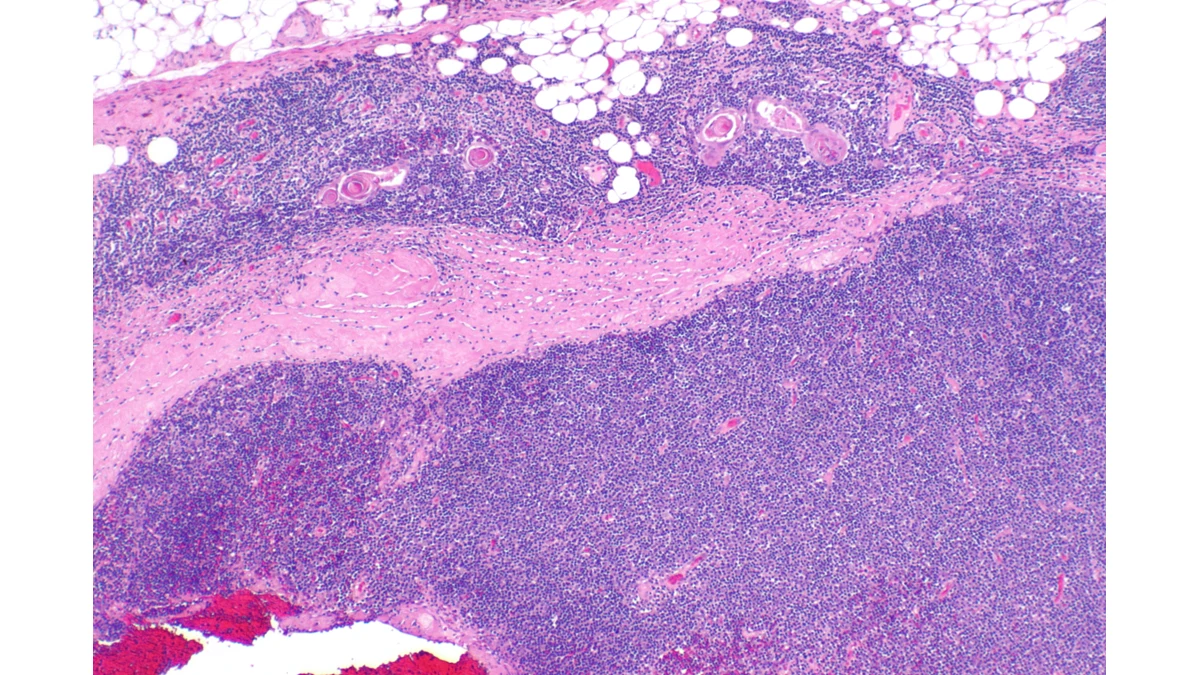
Image source and reuse details
Source: Thymoma type B1 — low mag.jpg. Full 4272 × 2848 field proportionally reduced into 1200 × 675 with external white side margins and converted to WebP. No tissue cropped, recolored or retouched.
In this guide
Two different cancers of the thymus
The thymus lies behind the breastbone, in the front of the chest between the lungs. It helps the immune system develop. Thymoma and thymic carcinoma arise from its epithelial cells. Thymoma often grows more slowly, but can invade nearby structures, recur or spread; an encapsulated appearance does not make every thymoma harmless.
Thymic carcinoma usually behaves more aggressively and has a greater tendency to spread. Lymphoma, germ-cell tumors, cysts and neuroendocrine tumors in this area are different diseases. They should not receive a thymoma treatment plan solely because they occupy the same part of the chest. Children need a paediatric specialist pathway.
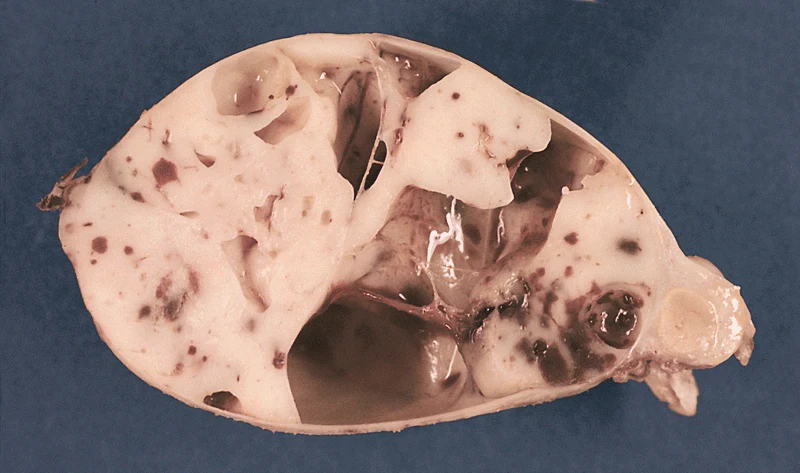
Image source and reuse details
Source: Encapsulated cystic thymoma.jpg. Whole 800 × 473 photograph converted to WebP at its original dimensions. No enlargement, crop, recoloring or diagnostic alteration.
Source: National Cancer Institute — United States — Thymoma and Thymic Carcinoma Treatment (PDQ®)–Health Professional Version · National Cancer Institute — United States — Thymoma and Thymic Carcinoma
Symptoms and urgent warning signs
A tumor may be found incidentally on a scan. Persistent cough, chest pain, breathlessness or hoarseness warrant assessment. Swelling of the face, neck or arms can signal pressure on a major vein. These symptoms can have other causes, but worsening symptoms should not wait for a distant routine appointment.
Severe or rapidly worsening breathing difficulty is an emergency. So are major swallowing difficulty, choking or quickly worsening muscle weakness with breathing problems. Use the local emergency service rather than waiting for a reply from a specialist abroad. Mention known myasthenia and current medicines immediately.
Source: National Cancer Institute — United States — Thymoma and Thymic Carcinoma · National Health Service — United Kingdom — Myasthenia gravis — Symptoms
Myasthenia and other immune conditions
Thymoma can be associated with myasthenia gravis: the immune system disrupts communication between nerves and muscles. Drooping eyelids, double vision, chewing difficulty, a weak voice or weakness that worsens with use should be reported. Breathing or swallowing muscles can also be affected. Association does not mean that every person with thymoma has myasthenia.
Other associated problems include Good syndrome, with low protective antibodies and infections, and pure red-cell aplasia, in which too few red blood cells are produced. Blood and immune tests depend on the assessment. Removing the thymus does not reliably eliminate these conditions. Neurology and other specialists should coordinate care, particularly before anesthesia and surgery.
Source: National Cancer Institute — United States — Thymoma and Thymic Carcinoma Treatment (PDQ®)–Health Professional Version · Sociedad Española de Oncología Médica; Grupo Español de Cáncer de Pulmón; Grupo Español de Tumores Huérfanos e Infrecuentes — Spain — SEOM-GECP-GETTHI Clinical Guidelines for the treatment of patients with thymic epithelial tumours (2021) · National Health Service — United Kingdom — Myasthenia gravis — Symptoms
Imaging and when a biopsy is needed
Contrast-enhanced chest CT usually defines the mass and its relationship to lungs, heart covering and major vessels. MRI can clarify a cystic lesion, thymic enlargement or invasion. PET is selected for particular questions, not required for every thymic mass. Blood tests may help distinguish germ-cell tumors or other diagnoses and assess associated immune disease.
Biopsy should be planned by the specialist team. For a highly suspected thymic tumor that can be removed completely at the outset, surgery without a prior biopsy may be appropriate. If diagnosis is uncertain or drug treatment will come first, a tissue sample is usually needed. The route must avoid unnecessary disruption or pleural seeding; a core sample is often more useful than cells alone.
Source: Sociedad Española de Oncología Médica; Grupo Español de Cáncer de Pulmón; Grupo Español de Tumores Huérfanos e Infrecuentes — Spain — SEOM-GECP-GETTHI Clinical Guidelines for the treatment of patients with thymic epithelial tumours (2021) · Istituto Europeo di Oncologia — Italy — Tumori toracici — Tumori del timo
Get the pathology reviewed
An experienced pathologist distinguishes thymoma from thymic carcinoma, lymphoma and other mediastinal tumors. Thymoma types A, AB, B1, B2 and B3 describe microscopic appearance; B3 is not the same as thymic carcinoma. Special stains may support diagnosis, but no single stain should replace the complete assessment.
Ask about invasion, lymph nodes and surgical margins. R0 means no tumor at the resection edges, R1 microscopic residual disease and R2 visible residual disease. A positive CD117 stain is not by itself proof of a drug-sensitive KIT mutation. Molecular tests and treatment selection require interpretation by the rare-tumor team.
Source: Sociedad Española de Oncología Médica; Grupo Español de Cáncer de Pulmón; Grupo Español de Tumores Huérfanos e Infrecuentes — Spain — SEOM-GECP-GETTHI Clinical Guidelines for the treatment of patients with thymic epithelial tumours (2021) · National Cancer Institute — United States — Thymoma and Thymic Carcinoma Treatment (PDQ®)–Health Professional Version · The Institute of Tuberculosis and Lung Diseases; The Maria Sklodowska-Curie National Research Institute of Oncology — Poland — Targeted Next-Generation Sequencing of Thymic Epithelial Tumours Revealed Pathogenic Variants in KIT, ERBB2, KRAS, and TP53 in 30% of Thymic Carcinomas — Cancers 2022;14:3388
Stage and operability guide the plan
Staging describes invasion, involved lymph nodes and spread. Reports may use TNM and the Masaoka–Koga system; their numbers are not interchangeable. Ask which system is being used. Spread onto the lining of the lungs or heart differs from a small enclosed mass, and from disease in distant organs.
The central question is whether complete removal is feasible safely, initially or after treatment. Histology, extent, general health and immune conditions all matter. Outlook differs greatly between a local thymoma and advanced thymic carcinoma. A group survival figure is not a personal deadline. Ask whether the goal is cure, prolonged control, symptom relief or a combination.
Source: National Cancer Institute — United States — Thymoma and Thymic Carcinoma Treatment (PDQ®)–Health Professional Version · Sociedad Española de Oncología Médica; Grupo Español de Cáncer de Pulmón; Grupo Español de Tumores Huérfanos e Infrecuentes — Spain — SEOM-GECP-GETTHI Clinical Guidelines for the treatment of patients with thymic epithelial tumours (2021)
Surgery when complete removal is feasible
For operable disease, surgery is a main treatment. It generally aims to remove the tumor and thymus with appropriate surrounding tissue and assessment of lymph nodes. In selected small lesions a less extensive approach may be discussed. Minimally invasive surgery and open surgery are choices based on safe complete removal, not cosmetic preference alone.
Larger or invasive tumors can require an opening through the breastbone and sometimes removal of involved nearby tissue. If complete removal is unlikely, chemotherapy may come first, followed by reassessment. Neurologist, anesthesiologist and surgeon should plan myasthenia management. Recovery and lifting restrictions depend on the operation; a center’s typical hospital stay is not a promise for every patient.
Source: Sociedad Española de Oncología Médica; Grupo Español de Cáncer de Pulmón; Grupo Español de Tumores Huérfanos e Infrecuentes — Spain — SEOM-GECP-GETTHI Clinical Guidelines for the treatment of patients with thymic epithelial tumours (2021) · The University of Texas MD Anderson Cancer Center — United States — Thymoma & Thymic Carcinoma Treatment — reviewed May 12, 2026 · Istituto Europeo di Oncologia — Italy — Tumori toracici — Tumori del timo
When radiotherapy is added
Radiotherapy may lower local recurrence risk after selected operations, particularly with residual disease or higher-risk findings. It is not automatically needed after every completely removed early thymoma. Decisions differ for thymic carcinoma and depend on invasion, margins and the overall plan. Ask what benefit is expected in your case.
For unresectable disease it may be combined or sequenced with chemotherapy, or used to relieve symptoms. Modern photon techniques and proton therapy can help limit exposure to the heart and lungs, but proton treatment is not always necessary or proven superior for every person. Planning must account for previous chest radiation and possible heart, lung, swallowing and thyroid effects.
Source: Sociedad Española de Oncología Médica; Grupo Español de Cáncer de Pulmón; Grupo Español de Tumores Huérfanos e Infrecuentes — Spain — SEOM-GECP-GETTHI Clinical Guidelines for the treatment of patients with thymic epithelial tumours (2021) · The University of Texas MD Anderson Cancer Center — United States — Thymoma & Thymic Carcinoma Treatment — reviewed May 12, 2026
Chemotherapy before surgery or for spread disease
Platinum-based combinations are commonly used when systemic treatment is needed. Cisplatin, doxorubicin and cyclophosphamide is one regimen used for thymoma; carboplatin and paclitaxel is commonly used for thymic carcinoma. The choice depends on histology, previous treatment, heart and kidney function, hearing, nerves and general fitness.
Treatment before surgery aims to make complete removal possible; further scans assess whether that goal has become realistic. In widespread disease, chemotherapy may control growth and symptoms. Adjuvant chemotherapy is not routine for every resected thymoma. Infusion schedules and supportive medicines are individualized; do not copy doses or combine medicines from an online list.
Source: National Cancer Institute — United States — Thymoma and Thymic Carcinoma Treatment (PDQ®)–Health Professional Version · Sociedad Española de Oncología Médica; Grupo Español de Cáncer de Pulmón; Grupo Español de Tumores Huérfanos e Infrecuentes — Spain — SEOM-GECP-GETTHI Clinical Guidelines for the treatment of patients with thymic epithelial tumours (2021)
If the cancer returns
Recurrence can be local, on the pleura or elsewhere, sometimes many years after thymoma treatment. The team should review the new scans and, when needed, confirm the diagnosis. Selected recurrences can still be treated with surgery or focused radiation; recurrence does not automatically mean the same chemotherapy for everyone.
When systemic treatment is needed, options can include pemetrexed, gemcitabine with capecitabine, etoposide or reusing an earlier effective regimen in selected cases. Previous radiation, cumulative doxorubicin exposure and organ function affect safety. There is no single second-line regimen suitable for both tumor types and every treatment history.
Source: National Cancer Institute — United States — Thymoma and Thymic Carcinoma Treatment (PDQ®)–Health Professional Version · Sociedad Española de Oncología Médica; Grupo Español de Cáncer de Pulmón; Grupo Español de Tumores Huérfanos e Infrecuentes — Spain — SEOM-GECP-GETTHI Clinical Guidelines for the treatment of patients with thymic epithelial tumours (2021)
Targeted drugs and what their results mean
Lenvatinib and sunitinib can be considered for selected previously treated thymic carcinoma. Everolimus is another option in some pathways but can cause serious lung inflammation. Octreotide, sometimes with prednisone, may be considered for selected thymoma with somatostatin-receptor uptake. These medicines are not interchangeable; local authorization and access may differ or involve off-label use.
In the single-arm phase 2 REMORA study, 16 of 42 people with previously treated thymic carcinoma had tumor shrinkage with lenvatinib: 38%. There was no randomized control group, and every participant needed at least one dose reduction. This is evidence of activity, not a cure rate or proof of superiority over another medicine. Blood pressure, skin, diarrhoea and laboratory monitoring are essential.
Source: National Cancer Institute — United States — Thymoma and Thymic Carcinoma Treatment (PDQ®)–Health Professional Version · Sociedad Española de Oncología Médica; Grupo Español de Cáncer de Pulmón; Grupo Español de Tumores Huérfanos e Infrecuentes — Spain — SEOM-GECP-GETTHI Clinical Guidelines for the treatment of patients with thymic epithelial tumours (2021)
Immunotherapy needs particular caution
Checkpoint inhibitors such as pembrolizumab can help selected thymic carcinoma patients, but serious autoimmune reactions occur more often than in many other cancers. They can inflame the heart, muscles, liver or lungs and trigger myasthenia. A high PD-L1 result does not remove these risks. Existing autoimmune disease must be discussed before any proposal.
Immunotherapy is not a routine treatment for thymoma. Its use in a research protocol or exceptional expert pathway should not be generalized from thymic carcinoma. New chest pain, breathlessness, palpitations, severe muscle weakness or swallowing problems during or after treatment need urgent assessment. Do not wait until the next infusion or assume symptoms are ordinary fatigue.
Source: National Cancer Institute — United States — Thymoma and Thymic Carcinoma Treatment (PDQ®)–Health Professional Version · Sociedad Española de Oncología Médica; Grupo Español de Cáncer de Pulmón; Grupo Español de Tumores Huérfanos e Infrecuentes — Spain — SEOM-GECP-GETTHI Clinical Guidelines for the treatment of patients with thymic epithelial tumours (2021) · The University of Texas MD Anderson Cancer Center — United States — Thymoma & Thymic Carcinoma Treatment — reviewed May 12, 2026
Recent research: promising does not mean proven cure
PECATI, published in 2025, studied lenvatinib plus pembrolizumab after platinum treatment in 43 adults: 36 with thymic carcinoma and 7 with B3 thymoma. It excluded autoimmune disorders. At 5 months, 88.4% were alive without progression; 90% confidence interval 79.8–96.7%. The single-arm design cannot establish superiority over another treatment or benefit for people excluded from the trial.
Grade 3 or worse treatment-related effects occurred in 16 of 43 participants, 37%; serious treatment-emergent effects in 17, 40%; and grade 3 or worse immune-related effects in 6, 14%. No treatment-related deaths were reported. Funding came from Merck Sharp & Dohme’s investigator-initiated studies program. These findings require specialist review of risks and local access; they do not set a date when the combination will be available to everyone.
Source: Université Paris-Saclay / Gustave Roussy; Università degli Studi di Torino and collaborating trial centres — Lenvatinib plus pembrolizumab in pretreated metastatic B3 thymoma and thymic carcinoma (PECATI): a single-arm, phase 2 trial — primary abstract, The Lancet Oncology 2025;26:1215–1226 · National Cancer Institute — United States — What Are Clinical Trials?
A written safety plan
Before treatment, ask whom to call day and night and which symptoms require emergency care. Fever during chemotherapy, inability to drink, uncontrolled diarrhoea, new breathing problems or marked weakness need prompt advice. Rare-tumor treatment and management of infections or autoimmune disease must be coordinated rather than handled as unrelated problems.
Some medicines can worsen myasthenia or interact with cancer treatment. Tell every clinician and pharmacist about the condition and all medicines and supplements. Do not stop steroids, myasthenia treatment or cancer drugs on your own. Sudden severe breathing or swallowing difficulty is an emergency even if the tumor scan was recently stable.
Source: National Health Service — United Kingdom — Myasthenia gravis — Symptoms · The University of Texas MD Anderson Cancer Center — United States — Thymoma & Thymic Carcinoma Treatment — reviewed May 12, 2026 · Sociedad Española de Oncología Médica; Grupo Español de Cáncer de Pulmón; Grupo Español de Tumores Huérfanos e Infrecuentes — Spain — SEOM-GECP-GETTHI Clinical Guidelines for the treatment of patients with thymic epithelial tumours (2021)
Follow-up must continue long term
Thymoma may recur late, so follow-up commonly extends well beyond the first few years. Chest imaging, symptoms, operation margins and histology guide the schedule. Thymic carcinoma or residual disease often needs closer early monitoring. Ask for a written plan and who remains responsible if you move or change hospitals.
Follow-up also checks myasthenia, antibody deficiency, anemia and the effects of chemotherapy or chest radiation. These conditions do not always track tumor size. Keep ordinary age-appropriate preventive care; a higher risk of another cancer does not justify every scan or blood test without a clinical reason. New symptoms should be assessed between scheduled visits.
Source: National Cancer Institute — United States — Thymoma and Thymic Carcinoma · Sociedad Española de Oncología Médica; Grupo Español de Cáncer de Pulmón; Grupo Español de Tumores Huérfanos e Infrecuentes — Spain — SEOM-GECP-GETTHI Clinical Guidelines for the treatment of patients with thymic epithelial tumours (2021)
Eating, activity and daily support
No diet, thymus extract or supplement has been shown to cure these cancers. A dietitian can help with weight loss, poor appetite or swallowing difficulty. If chewing or swallowing causes choking, request a swallowing assessment rather than simply forcing more food or drink. Review supplements for interactions and do not use them instead of treatment.
Activity should be adapted to surgery, breathing, myasthenia and fatigue. Follow the surgeon’s breastbone and lifting restrictions; rehabilitation can support gradual recovery. Discuss work, mental health, fertility preservation when relevant and practical help. Supportive and palliative care can relieve symptoms alongside treatment aimed at controlling or curing the cancer.
Source: National Cancer Institute — United States — Nutrition During Cancer Treatment · National Cancer Institute — United States — Complementary and Alternative Medicine · National Health Service — United Kingdom — Myasthenia gravis — Symptoms · The University of Texas MD Anderson Cancer Center — United States — Thymoma & Thymic Carcinoma Treatment — reviewed May 12, 2026
Preparing a useful second opinion
Ask whether the center regularly treats thymoma and thymic carcinoma and reviews pathology through a rare thoracic tumor board. The team may need thoracic surgery, oncology, radiation oncology, pathology, radiology, neurology and immunology. A second opinion is especially useful for uncertain histology, an unresectable diagnosis or proposed immunotherapy.
Bring pathology reports and requested slides or blocks, scan files and reports, operation notes, prior drug and radiation records, autoimmune assessments and your medicine list. Ask what can be delivered locally and what requires travel. A remote opinion does not guarantee admission or trial eligibility; confirm costs, referral documents and urgent care arrangements before travelling.
Source: Sociedad Española de Oncología Médica; Grupo Español de Cáncer de Pulmón; Grupo Español de Tumores Huérfanos e Infrecuentes — Spain — SEOM-GECP-GETTHI Clinical Guidelines for the treatment of patients with thymic epithelial tumours (2021) · The University of Texas MD Anderson Cancer Center — United States — Thymoma & Thymic Carcinoma Treatment — reviewed May 12, 2026 · Réseau Tumeurs THYmiques et Cancer — France — RCP Régionales — centres experts et présentation des dossiers
Finding documented specialist contacts
The Istituto Europeo di Oncologia publishes a thymic tumor pathway within thoracic oncology. MD Anderson publishes a dedicated thymoma and thymic carcinoma program. The French RYTHMIC network lists expert centers including Gustave Roussy and explains how cases reach specialist meetings. These are documented examples, not a claim that one center is best worldwide.
Use the directory’s country and tumor filters, then confirm the precise team, appointment, acceptance and language support with the institution. A country in the selector does not mean every center there is listed. The directory does not yet calculate distance from a postcode. Do not send urgent symptoms or sensitive medical records to an unconfirmed address.
Find documented pancreatic pathways →
Source: Istituto Europeo di Oncologia — Italy — Tumori toracici — Tumori del timo · The University of Texas MD Anderson Cancer Center — United States — Thymoma & Thymic Carcinoma Treatment — reviewed May 12, 2026 · Réseau Tumeurs THYmiques et Cancer — France — RCP Régionales — centres experts et présentation des dossiers
Questions to take to your appointment
- Is every thymoma benign? No. Even a slower-growing or encapsulated thymoma can invade or recur. Histology, extent and complete removal matter.
- Must every thymic mass be biopsied before surgery? No. The expert team may operate directly when a thymic tumor is highly likely and completely removable. Uncertain diagnoses or planned initial drug therapy usually require tissue first.
- Does removing the thymus cure myasthenia? Not reliably. Myasthenia needs its own neurological follow-up and can persist after surgery. Breathing or severe swallowing problems need urgent care.
- Is immunotherapy suitable for both tumor types? No. It is not routine for thymoma and can cause serious autoimmune effects even in thymic carcinoma. Expert assessment is essential.
- Does an encouraging trial result mean I can get that treatment now? No. Eligibility, evidence, local authorization, reimbursement and availability need separate verification. Tumour control is not proof of cure.
Sources and verification
- National Cancer Institute — United States — Thymoma and Thymic Carcinoma Treatment (PDQ®)–Health Professional Version
- National Cancer Institute — United States — Thymoma and Thymic Carcinoma
- Sociedad Española de Oncología Médica; Grupo Español de Cáncer de Pulmón; Grupo Español de Tumores Huérfanos e Infrecuentes — Spain — SEOM-GECP-GETTHI Clinical Guidelines for the treatment of patients with thymic epithelial tumours (2021)
- National Health Service — United Kingdom — Myasthenia gravis — Symptoms
- The University of Texas MD Anderson Cancer Center — United States — Thymoma & Thymic Carcinoma Treatment — reviewed May 12, 2026
- Université Paris-Saclay / Gustave Roussy; Università degli Studi di Torino and collaborating trial centres — Lenvatinib plus pembrolizumab in pretreated metastatic B3 thymoma and thymic carcinoma (PECATI): a single-arm, phase 2 trial — primary abstract, The Lancet Oncology 2025;26:1215–1226
- Istituto Europeo di Oncologia — Italy — Tumori toracici — Tumori del timo
- Réseau Tumeurs THYmiques et Cancer — France — RCP Régionales — centres experts et présentation des dossiers
- National Cancer Institute — United States — Nutrition During Cancer Treatment
- National Cancer Institute — United States — Complementary and Alternative Medicine
- National Cancer Institute — United States — What Are Clinical Trials?
- The Institute of Tuberculosis and Lung Diseases; The Maria Sklodowska-Curie National Research Institute of Oncology — Poland — Targeted Next-Generation Sequencing of Thymic Epithelial Tumours Revealed Pathogenic Variants in KIT, ERBB2, KRAS, and TP53 in 30% of Thymic Carcinomas — Cancers 2022;14:3388
Sources checked: 2026-11-16