


Stomach cancer: tests, treatments and life after surgery
A stomach cancer treatment plan starts with the biopsy, the extent of the disease and the person’s ability to eat and recover. This guide explains the main decisions for adults and where to seek specialist support.
MyMedNest editorial guide · Sources checked:
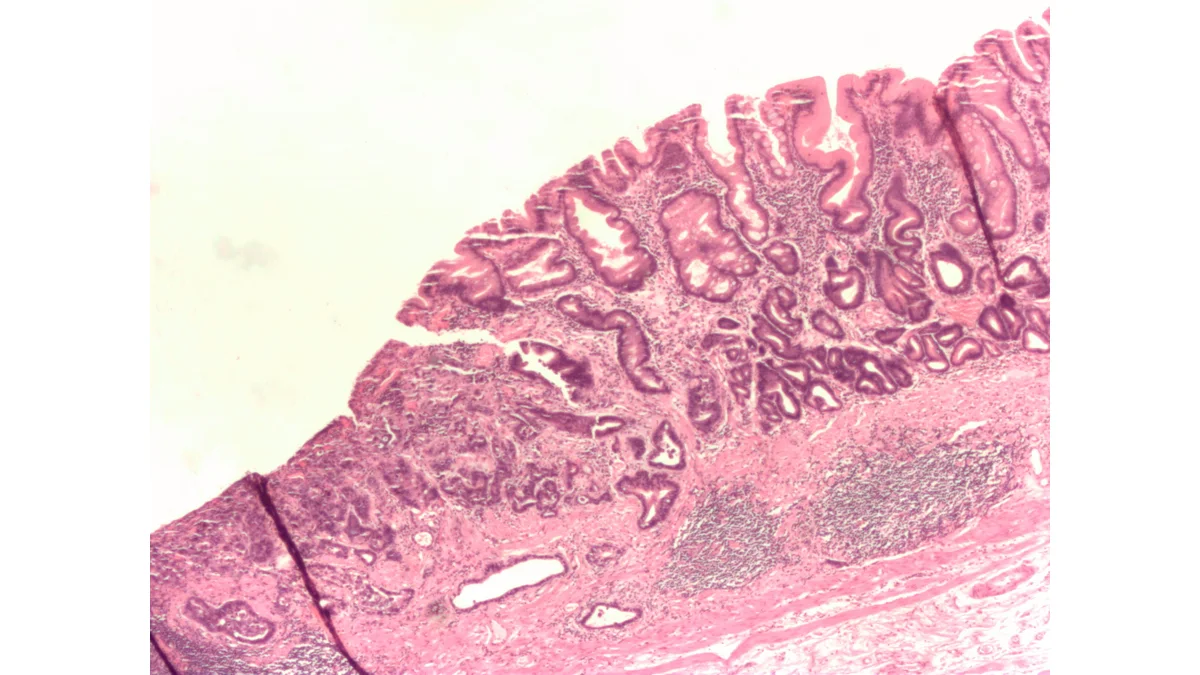
Image source and reuse details
Source: Gastric adenocarcinoma.jpg. Proportional reduction to 900 × 675 pixels, external white side margins and WebP conversion. Entire microscopic field preserved; no diagnostic crop, recolouring or added annotation. The image remains under CC BY-SA 3.0.
In this guide
Start with the diagnosis, not a drug list
Most stomach cancers arise from the gland cells of the lining and are called adenocarcinomas. Their intestinal or diffuse pattern, location and spread can affect care. Lymphomas, gastrointestinal stromal tumours and neuroendocrine tumours in the stomach need different pathways; the treatments below must not be applied to them automatically.
Ask for copies of the endoscopy, pathology report and scans. A team that includes digestive cancer specialists, a surgeon and a dietitian can explain whether the aim is cure, disease control or symptom relief. A second opinion can clarify difficult choices without promising a different outcome.
Source: National Cancer Institute — United States — Stomach Cancer Treatment · National Cancer Institute — United States — Finding Cancer Care
Symptoms and when to seek help
Persistent indigestion, loss of appetite, feeling full unusually quickly, difficulty swallowing, vomiting, unexplained weight loss or anaemia need medical assessment. These symptoms often have other causes. Early cancer may have few or no symptoms; absence of pain does not rule it out. Do not rely on an internet symptom list to diagnose yourself.
Vomiting blood, black tarry stools with weakness or fainting, severe abdominal pain, or inability to keep fluids down require urgent medical assessment. Use local emergency services for severe bleeding, collapse or breathing difficulty. Do not wait for a directory reply or a scheduled cancer visit when acutely unwell.
Source: National Cancer Institute — United States — Stomach Cancer Symptoms · National Health Service — United Kingdom — Symptoms of stomach cancer · National Health Service — United Kingdom — Vomiting blood
Gastroscopy, biopsy and the pathology report
Gastroscopy passes a thin camera through the mouth to examine the stomach. Small tissue samples, called biopsies, allow a pathologist to identify cancer under a microscope. A scan or a blood tumour marker alone cannot replace this tissue diagnosis. Ask when and how you will receive results rather than assuming every health system has the same timetable.
The report should clarify the tumour type. Samples can also be used for treatment-related tests and Helicobacter pylori, a bacterium linked to stomach cancer risk. Infection does not mean cancer, and treating an infection is not a substitute for treating an established adenocarcinoma. Do not start antibiotics or stop prescribed medicines without medical advice.
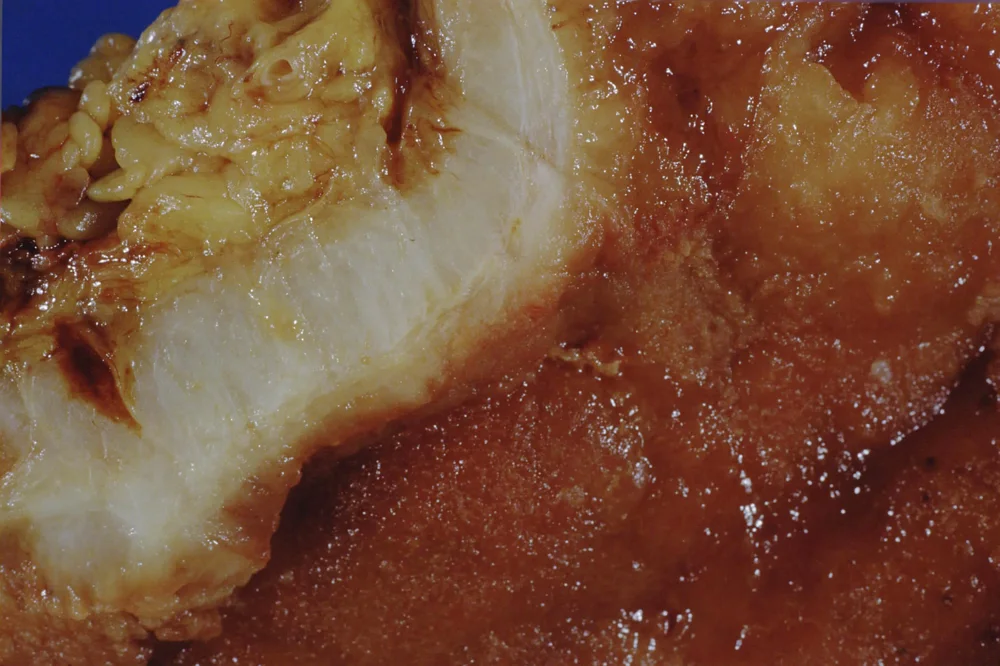
Image source and reuse details
Source: Infiltrative gastric cancer showing thickened stomach wall.jpg. Proportional reduction from 2816 × 1876 to 1000 × 666 pixels and WebP conversion, with file metadata removed. No diagnostic crop, recolouring or new annotation.
Source: National Cancer Institute — United States — Stomach Cancer Diagnosis · National Health Service — United Kingdom — Tests and next steps for stomach cancer · National Health Service — United Kingdom — Causes of stomach cancer
How doctors establish the extent of the disease
Staging describes how far cancer has grown into the stomach wall, whether nearby lymph nodes are involved and whether it has spread elsewhere. CT is commonly used. Endoscopic ultrasound, selected other scans or a laparoscopy may add information. Not everyone needs every test; an examination should answer a particular treatment question.
Laparoscopy uses small cuts to inspect the abdomen and may collect cells from a washing. It can reveal spread not obvious on scans and change a surgical plan. Ask whether the cancer is removable, whether treatment could make surgery possible, and whether the findings have been discussed by the full specialist team.
Source: National Cancer Institute — United States — Stomach Cancer Diagnosis · National Health Service — United Kingdom — Tests and next steps for stomach cancer
Biomarkers and inherited risk are different questions
For relevant treatment decisions, ask about HER2, PD-L1, mismatch repair or microsatellite instability (dMMR/MSI-H), and CLDN18.2. These are properties of the tumour that may help choose a medicine. PD-L1 scoring, HER2 test thresholds, disease stage and previous treatment matter. A positive result does not guarantee benefit or eligibility for every drug.
Inherited testing asks a different question about risk in a family. Young age, diffuse gastric cancer or a pattern of gastric and lobular breast cancers may justify genetic counselling. CDH1 and, less often, CTNNA1 are involved in some hereditary diffuse gastric cancer families. A tumour test alone does not establish an inherited condition or justify preventive surgery for relatives.
Source: National Cancer Institute — United States — Stomach Cancer Diagnosis · National Cancer Institute — United States — Biomarker Testing for Cancer Treatment · National Cancer Institute — United States — Hereditary Diffuse Gastric Cancer (PDQ®)–Health Professional Version · United States Food and Drug Administration — FDA approves zolbetuximab-clzb with chemotherapy for gastric or gastroesophageal junction adenocarcinoma
Early cancer and surgery
Selected very early cancers with a low risk of lymph node spread can be removed through an endoscope at an experienced centre. The removed tissue must still be examined to see whether that treatment was sufficient. This option is not appropriate for every small tumour; depth and tissue features also matter.
Other operable cancers may require removal of part or all of the stomach, together with nearby lymph nodes. After total gastrectomy, the digestive tract is reconnected so food can pass into the small intestine. Ask about the intended extent, risks, nutrition support and recovery. Radiation is used in selected situations, not automatically after every operation.
Source: National Cancer Institute — United States — Stomach Cancer Treatment · National Cancer Institute — United States — Stomach Cancer Treatment by Stage · National Health Service — United Kingdom — Treatment for stomach cancer
Treatment around surgery: a newer option
Perioperative means before and after an operation. On 25 November 2025, the United States Food and Drug Administration approved durvalumab with FLOT chemotherapy before and after surgery, followed by durvalumab alone, for adults with resectable gastric or gastroesophageal junction adenocarcinoma. FLOT combines fluorouracil, leucovorin, oxaliplatin and docetaxel. Eligibility also depends on fitness and local authorisation.
The randomised, placebo-controlled MATTERHORN trial enrolled 948 people. Adding durvalumab improved event-free survival, a measure that includes specified setbacks such as recurrence or progression, and overall survival. The study did not isolate the contribution of treatment before versus after surgery. Immune reactions can affect healthy organs; the team must explain symptoms, monitoring and chemotherapy risks.
If the cancer cannot be removed or returns
Treatment may aim to slow cancer, ease symptoms and help a person live longer. Chemotherapy, targeted medicines and immunotherapy are selected according to tissue tests, previous treatment, general health and preferences. After progression, options may include different chemotherapy, ramucirumab, or a HER2-directed treatment such as trastuzumab deruxtecan in the appropriate setting. This is not an interchangeable shopping list.
Supportive and palliative care can accompany anticancer treatment from the start. Pain, nausea, bleeding, fluid build-up and blockage deserve active treatment. A stent, bypass or radiation may help a specific problem without curing the cancer. Ask what improvement is realistic, how it will be measured and when the burden of a treatment may outweigh its benefit.
Source: National Cancer Institute — United States — Stomach Cancer Treatment · National Cancer Institute — United States — Stomach Cancer Treatment by Stage · National Health Service — United Kingdom — Treatment for stomach cancer
HER2-positive disease: do not mix the treatment criteria
On 19 March 2025, the United States Food and Drug Administration gave traditional approval to pembrolizumab with trastuzumab and fluoropyrimidine/platinum chemotherapy for first-line treatment of adults with unresectable locally advanced or metastatic HER2-positive gastric or junctional adenocarcinoma expressing PD-L1 CPS ≥1. KEYNOTE-811 enrolled 698 people; 594 met that PD-L1 threshold. These criteria must not be replaced by HER2 positivity alone.
A further US approval on 25 August 2026 added zanidatamab with tislelizumab and fluoropyrimidine/platinum chemotherapy for HER2 IHC 3+ or IHC 2+/ISH-positive advanced disease. The separate combination without tislelizumab is limited to IHC 3+. In HERIZON-GEA-01, the combination including tislelizumab had median overall survival of 26.4 versus 19.2 months with trastuzumab/chemotherapy. This group result is not a personal deadline or a comparison with every other regimen. Severe diarrhoea, heart dysfunction, infusion reactions and immune toxicity require monitoring.
Source: United States Food and Drug Administration — FDA approves pembrolizumab for HER2 positive gastric or gastroesophageal junction adenocarcinoma expressing PD-L1 (CPS ≥1) · United States Food and Drug Administration — FDA approves zanidatamab-hrii and tislelizumab-jsgr for HER2-positive gastric, gastroesophageal junction, or esophageal adenocarcinoma
CLDN18.2-positive, HER2-negative disease
The US approval of 18 October 2024 covers zolbetuximab with fluoropyrimidine/platinum chemotherapy as first treatment for adults with unresectable locally advanced or metastatic HER2-negative gastric or junctional adenocarcinoma that is CLDN18.2-positive on an approved test. It is not a treatment for every gastric cancer or for all stages.
SPOTLIGHT randomised 565 people and GLOW 507, using different chemotherapy backbones. Median overall survival was 18.2 versus 15.5 months in SPOTLIGHT and 14.4 versus 12.2 months in GLOW, compared with placebo plus the same chemotherapy. Do not compare those medians directly across trials. Serious nausea, vomiting, infection and other complications occurred. An overseas approval does not establish local availability, reimbursement or suitability.
Eating after stomach surgery
Ask for dietitian support before treatment if eating is difficult or weight is falling. After surgery, restart textures and portions according to your team’s plan. Smaller, more frequent meals, slow eating and careful chewing often help. There is no single menu or recovery deadline that fits everyone. Rapid weight loss or food sticking needs assessment.
Food may move into the small bowel too quickly, causing dumping symptoms such as cramps, nausea or dizziness after meals. The team can adjust meals and fluid timing. Vitamin deficiencies may require prescribed supplements or vitamin B12 injections. These replace a nutritional need; they are not anticancer treatments. Ask who will monitor weight, blood results and long-term supplementation.
Source: National Health Service — United Kingdom — Recovering from a gastrectomy · National Cancer Institute — United States — Nutrition During Cancer Treatment
Activity, supplements and practical support
Gentle walking and a gradual return to activity can support recovery when your team agrees. Heavy lifting, driving and work depend on the operation, wound healing, symptoms and treatment. Do not force a generic exercise target when weak, dehydrated or losing weight. Ask for help with fatigue, sleep, anxiety and daily tasks.
No special diet, herb or supplement has been proved to cure stomach cancer. Restrictive diets can worsen malnutrition. Tell the team about all non-prescription products because some interfere with treatment. Smoking cessation and sensible prevention advice remain useful, but during treatment the immediate priority may be enough energy, protein and fluids rather than weight loss.
Source: National Health Service — United Kingdom — Recovering from a gastrectomy · National Cancer Institute — United States — Nutrition During Cancer Treatment · National Cancer Institute — United States — Complementary and Alternative Medicine
Follow-up and symptoms that should not wait
Follow-up checks recovery, nutrition, treatment effects and possible recurrence. The timing of visits, blood tests, scans and endoscopy depends on the original disease and treatment. A tumour marker result alone does not settle whether cancer is present or absent. Ask for a written plan and a named contact; report new symptoms between visits.
During treatment, fever of 38°C or higher can signal a serious infection. Follow your team’s urgent instructions, including any lower threshold, and do not simply mask fever with medicine. New breathlessness, severe diarrhoea, persistent vomiting or inability to drink also needs prompt advice. Immune-related side effects may appear during or after immunotherapy.
Source: National Cancer Institute — United States — Stomach Cancer Treatment · National Health Service — United Kingdom — Treatment for stomach cancer · National Cancer Institute — United States — Infection and Neutropenia during Cancer Treatment · United States Food and Drug Administration — FDA approves durvalumab for resectable gastric or gastroesophageal junction adenocarcinoma
Clinical trials and realistic hope
Trials test new approaches in a defined group. Ask whether a study is currently recruiting, accepts your exact tumour type and biomarkers, and fits your prior treatments and health. The team should explain phase, comparison, likely burdens, uncertain benefits and costs. A registry entry is not proof that a place or a successful treatment is available.
Approaches such as heated chemotherapy in the abdomen (HIPEC) are being studied for stomach cancer and may be offered in selected centres. They are not automatically a standard cure for everyone with spread to the abdominal lining. New approvals improve choices for particular groups, but cannot predict a cure date. This guide selects relevant developments rather than cataloguing every investigational molecule.
Source: National Cancer Institute — United States — Stomach Cancer Treatment · National Cancer Institute — United States — What Are Clinical Trials?
Choosing a centre and preparing a second opinion
Look for a team with documented experience in gastric cancer, specialist endoscopy and pathology, digestive surgery, medical oncology and nutrition. Ask how cases are discussed together and what support exists after discharge. There is no single best hospital for every stage and person; a high-profile name does not establish access, eligibility or a better personal outcome.
Use the country and tumour filters in the directory below to find documented contacts. Coverage is selective and is not a distance or postcode service. Confirm referral rules, language, appointment location, insurance, costs and international access directly. Bring the biopsy report, available slides, scans, previous treatments and medicine list. Never send urgent symptoms to a general appointment mailbox.
Find documented stomach cancer services →
Source: National Cancer Institute — United States — Stomach Cancer Diagnosis · National Cancer Institute — United States — Finding Cancer Care · National Cancer Institute — United States — What Are Clinical Trials?
Questions to take to your appointment
- What is the exact tissue diagnosis and where did the tumour start?
- What is the stage, and can treatment aim to cure it?
- Which HER2, PD-L1, MMR/MSI and CLDN18.2 results do we need?
- Do I need treatment before surgery, after surgery, or both?
- What would change if I obtain a specialist second opinion?
- Who will plan my nutrition and check deficiencies after surgery?
- Which symptoms require an urgent call, and which number should I use?
- Is a suitable trial recruiting, and what travel and costs would it involve?
Sources and verification
- National Cancer Institute — United States — Stomach Cancer Diagnosis
- National Cancer Institute — United States — Stomach Cancer Treatment
- National Cancer Institute — United States — Stomach Cancer Treatment by Stage
- National Cancer Institute — United States — Stomach Cancer Symptoms
- National Health Service — United Kingdom — Symptoms of stomach cancer
- National Health Service — United Kingdom — Vomiting blood
- National Health Service — United Kingdom — Tests and next steps for stomach cancer
- National Health Service — United Kingdom — Causes of stomach cancer
- National Health Service — United Kingdom — Treatment for stomach cancer
- National Health Service — United Kingdom — Recovering from a gastrectomy
- National Cancer Institute — United States — Hereditary Diffuse Gastric Cancer (PDQ®)–Health Professional Version
- National Cancer Institute — United States — Biomarker Testing for Cancer Treatment
- United States Food and Drug Administration — FDA approves durvalumab for resectable gastric or gastroesophageal junction adenocarcinoma
- United States Food and Drug Administration — FDA approves pembrolizumab for HER2 positive gastric or gastroesophageal junction adenocarcinoma expressing PD-L1 (CPS ≥1)
- United States Food and Drug Administration — FDA approves zanidatamab-hrii and tislelizumab-jsgr for HER2-positive gastric, gastroesophageal junction, or esophageal adenocarcinoma
- United States Food and Drug Administration — FDA approves zolbetuximab-clzb with chemotherapy for gastric or gastroesophageal junction adenocarcinoma
- National Cancer Institute — United States — Nutrition During Cancer Treatment
- National Cancer Institute — United States — Complementary and Alternative Medicine
- National Cancer Institute — United States — Infection and Neutropenia during Cancer Treatment
- National Cancer Institute — United States — What Are Clinical Trials?
- National Cancer Institute — United States — Finding Cancer Care
Sources checked: 2026-11-15