


Colorectal cancer: tests, treatments and the next decisions
Colon cancer and rectal cancer share some features, but their treatment plans can differ. The useful starting point is the exact site, the tissue diagnosis, the stage and any tests that could change the choice of treatment. This guide helps you organize those results and prepare questions for your care team.
MyMedNest editorial guide · Sources checked:
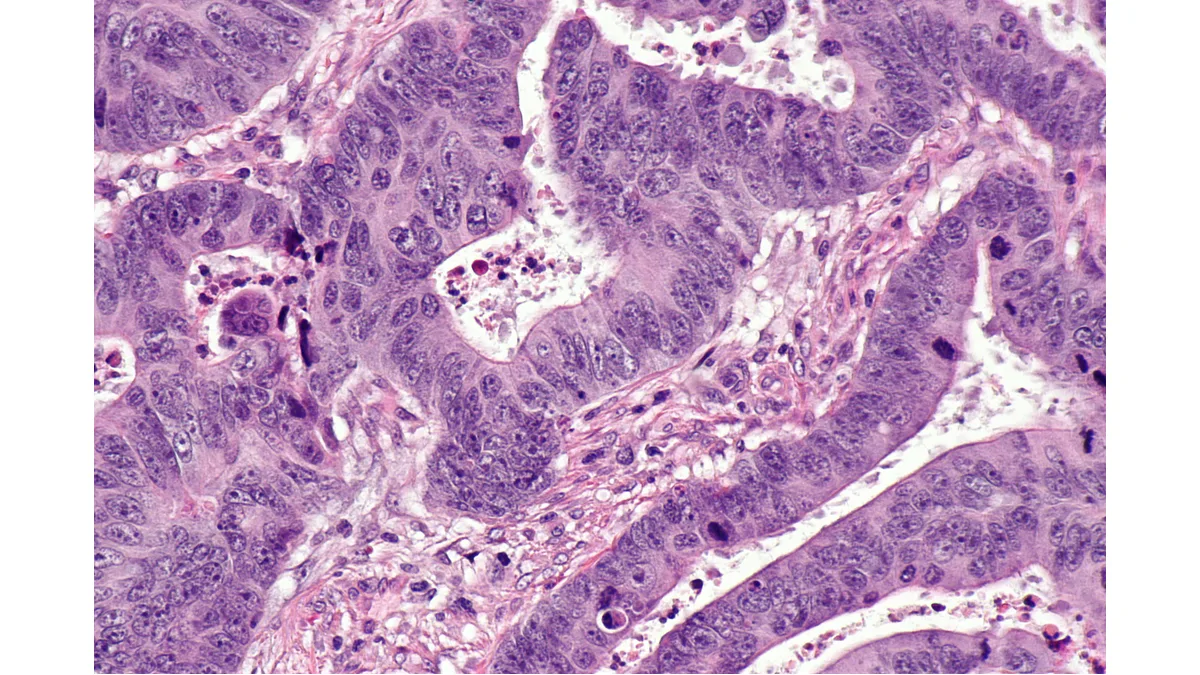
Image source and reuse details
Source: Colorectal adenocarcinoma — high mag.jpg. Proportional reduction, external white side margins and WebP conversion. The entire microscopic field is preserved, with no clinical cropping, recolouring or added annotation. The image remains under CC BY-SA 3.0.
In this guide
Start with the site and the written reports
Ask for copies of the colonoscopy, pathology and imaging reports, the images themselves and your current medicine list. Find out who coordinates the case and when missing results will arrive. A colorectal team may involve a bowel surgeon, oncologist, radiotherapy specialist, radiologist, pathologist, specialist nurse and dietitian. Discuss a second opinion before a major decision, without delaying care that the team considers urgent.
This guide concerns adults with the usual adenocarcinomas of the colon or rectum. The rectum is the last part of the large bowel, close to structures that affect surgery and radiotherapy planning. Anal cancer, small bowel cancer and uncommon tumour types need different guidance. A colon cancer that spreads to the liver remains colon cancer; it is not automatically treated as a cancer that began in the liver.
Source: National Cancer Institute — United States — Colon Cancer Treatment (PDQ®)–Patient Version · National Cancer Institute — United States — Rectal Cancer Treatment (PDQ®)–Patient Version · National Cancer Institute — United States — Finding Cancer Care
Do not wait for screening if you have symptoms
A persistent change in bowel habits, blood in the stool, unexplained weight loss, abdominal pain or unusual tiredness deserves assessment. Low red blood cell levels can also lead to fatigue and breathlessness. These problems often have other causes, but an internet checklist cannot rule out cancer. Heavy or continuing bleeding, faintness, or severe abdominal pain with vomiting and swelling needs urgent medical help.
Screening looks for disease before symptoms and may also find polyps that can be removed. A faecal immunochemical test, or FIT, looks for blood in stool; a positive result does not itself diagnose cancer. Screening ages and methods differ by country and personal risk. A screening result should not be used to dismiss persistent symptoms. Follow the clinician's advice about further testing, including colonoscopy when indicated.
Source: National Health Service — United Kingdom — Symptoms of bowel cancer · National Cancer Institute — United States — Colon Cancer Treatment (PDQ®)–Patient Version · National Cancer Institute — United States — Advances in Colorectal Cancer Research
What colonoscopy, biopsy and scans each tell you
During colonoscopy, a flexible camera examines the bowel and the clinician can take tissue samples. A pathologist examines that tissue to establish the diagnosis. The location of the lesion, the cell type and the tissue report matter more than how alarming one photograph looks. Ask how and when you will receive the results, and what to do if you do not hear back.
After diagnosis, scans help assess spread and plan treatment. These may include CT of the chest, abdomen and pelvis; pelvic MRI is especially useful for rectal cancer planning. Blood tests assess general health and may include carcinoembryonic antigen, or CEA. CEA is a marker that can help with monitoring in some people, not a reliable stand-alone way to diagnose or exclude colorectal cancer.
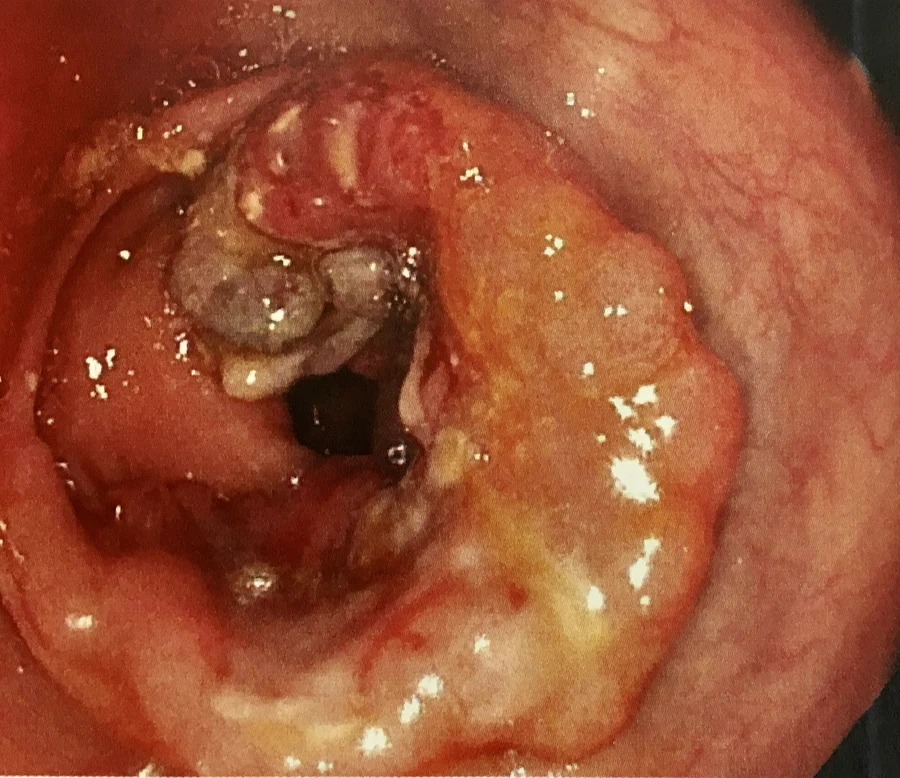
Image source and reuse details
Source: Circumferential carcinoma of colon resulting in stricture. Proportional reduction from 2419 × 2092 to 900 × 778 pixels and WebP conversion, with file metadata removed. No diagnostic cropping, recolouring or added annotation.
Source: National Health Service — United Kingdom — Tests and next steps for bowel cancer · National Cancer Institute — United States — Colon Cancer Treatment (PDQ®)–Patient Version · National Cancer Institute — United States — Rectal Cancer Treatment (PDQ®)–Patient Version
Stage describes spread, not a personal deadline
The stage considers how deeply the tumour has grown, whether nearby lymph nodes contain cancer and whether it has reached distant sites. Stage I is different from stage III with involved lymph nodes, and stage IV means distant spread. The stage estimated before treatment can change after surgery, when the removed tissue and lymph nodes are examined more fully.
Ask the team to explain whether treatment aims to remove all known disease, lower the chance of recurrence, control cancer over time or relieve symptoms. These aims can overlap and can change. Statistics describe groups, not how long a particular person will live. Fitness, molecular results, the pattern of spread and response to treatment also influence the options.
Source: National Cancer Institute — United States — Colon Cancer Treatment (PDQ®)–Patient Version · National Cancer Institute — United States — Rectal Cancer Treatment (PDQ®)–Patient Version
Molecular results can change the plan
Mismatch repair proteins help cells correct errors in DNA. A tumour described as dMMR has a defect in that repair system; MSI-H describes a related pattern of DNA changes. These findings can affect immunotherapy choices. In advanced disease, tests for alterations such as BRAF V600E, KRAS G12C or excess HER2 can identify specific treatment possibilities. The relevant panel depends on the clinical situation; a matching result does not guarantee benefit.
Testing the tumour is different from testing for an inherited cancer risk. A dMMR or MSI-H result does not by itself prove Lynch syndrome. Personal and family history, young age at diagnosis or tumour findings may lead to genetic counselling and, where appropriate, a separate blood or saliva test. Ask what the results mean for you, whether relatives need advice and how their information will be protected.
Source: National Cancer Institute — United States — Biomarker Testing for Cancer Treatment · National Cancer Institute — United States — Genetic Testing for Inherited Cancer Risk · National Cancer Institute — United States — Advances in Colorectal Cancer Research · United States Food and Drug Administration — FDA approves sotorasib with panitumumab for KRAS G12C-mutated colorectal cancer
Colon cancer: surgery and treatment after surgery
Many localized colon cancers are treated by removing the affected bowel segment and nearby lymph nodes. Some very early lesions can be removed more locally. The operation, the possibility of joining the bowel ends and any need for a temporary or permanent stoma depend on the site and circumstances. Ask about recovery, expected bowel changes and the benefits and risks of the proposed operation.
Treatment after surgery is called adjuvant treatment. Chemotherapy is commonly considered for stage III disease and for selected higher-risk stage II situations. The tissue findings, mismatch repair status, general health and treatment risks guide the discussion; not everyone needs the same medicines or duration. New options for dMMR stage III colon cancer are described below and should not be assumed to apply to every stage or to rectal cancer.
Source: National Cancer Institute — United States — Colon Cancer Treatment (PDQ®)–Patient Version · National Health Service — United Kingdom — Treatment for bowel cancer · United States Food and Drug Administration — FDA approves atezolizumab in combination with chemotherapy for stage III mismatch repair deficient colon cancer
Rectal cancer: the sequence matters
For rectal cancer, treatment may combine surgery, radiotherapy and chemotherapy in a planned order. In some locally advanced cases, chemotherapy and radiotherapy are given before surgery, an approach often called total neoadjuvant therapy. Other cases need a different sequence or less treatment. The position within the rectum, MRI findings, molecular results and the person's health all matter.
Some people with a complete clinical response can discuss an organ-preserving surveillance programme with an experienced team. This is not simply skipping surgery: it requires repeated examinations, endoscopy and imaging, and a plan if cancer returns or becomes detectable. A clinical response is not proof that every cancer cell has gone. Ask about bowel function, urinary or sexual effects and fertility before treatment starts.
Source: National Cancer Institute — United States — Rectal Cancer Treatment (PDQ®)–Patient Version · National Cancer Institute — United States — Advances in Colorectal Cancer Research
When the cancer has spread
Metastatic colorectal cancer is not one single situation. Selected liver or lung metastases may be considered for surgery or local treatments after specialist assessment, sometimes alongside medicines. Other patterns of spread are mainly managed with systemic treatment, which reaches different parts of the body. Ask for review by the relevant specialist team before assuming either that surgery is possible or that it is impossible.
Chemotherapy, targeted medicines and immunotherapy are chosen according to previous treatment, molecular results, the site of the original tumour, health and goals. Supportive and palliative care can help with pain, bowel problems, nutrition and emotional strain alongside anticancer treatment. They are not reserved for the last days of life. Reassessment can change the plan when the cancer responds, progresses or treatment becomes too difficult.
Source: National Cancer Institute — United States — Colon Cancer Treatment (PDQ®)–Patient Version · National Cancer Institute — United States — Rectal Cancer Treatment (PDQ®)–Patient Version · National Health Service — United Kingdom — Treatment for bowel cancer
Selected medicine updates: who they apply to
On 24 February 2026, the United States Food and Drug Administration granted traditional approval to encorafenib with cetuximab and fluorouracil-based chemotherapy for adults with BRAF V600E-mutated metastatic colorectal cancer, identified by an approved test. In the relevant 479-patient randomized comparison in BREAKWATER, median overall survival was 30.3 versus 15.1 months. This is a result in a selected study population, not a personal forecast. The combination has important risks, including liver, heart and bleeding problems.
On 8 October 2026, the same authority approved intravenous atezolizumab with fluoropyrimidine- and oxaliplatin-based chemotherapy after surgery for stage III dMMR colon cancer. ATOMIC showed an improvement in disease-free survival; that outcome is not the same as proving longer overall survival. Separately, US approvals cover nivolumab with ipilimumab for unresectable or metastatic MSI-H/dMMR colorectal cancer, and sotorasib with panitumumab for selected KRAS G12C-mutated metastatic disease after specified previous chemotherapy. Immune-related, skin, bowel and other serious effects require treatment-specific advice. These are selected US decisions, not a full formulary or a promise of local access.
Source: United States Food and Drug Administration — FDA grants traditional approval to encorafenib for metastatic colorectal cancer with a BRAF V600E mutation · United States Food and Drug Administration — FDA approves atezolizumab in combination with chemotherapy for stage III mismatch repair deficient colon cancer · United States Food and Drug Administration — FDA approves nivolumab with ipilimumab for unresectable or metastatic MSI-H or dMMR colorectal cancer · United States Food and Drug Administration — FDA approves sotorasib with panitumumab for KRAS G12C-mutated colorectal cancer
Dostarlimab and preserving the rectum: read the limits
On 19 October 2026, the United States Food and Drug Administration granted accelerated approval to dostarlimab for adults with previously untreated stage II or III locally advanced rectal cancer that is MSI-H or dMMR on an approved test. In AZUR-1, people with a complete clinical response could move to close non-operative monitoring. Those without that response, or with progression, needed assessment for standard treatment. The drug is not an alternative for every rectal tumour.
The independent review found a complete clinical response maintained for at least 12 months in 47% of 116 evaluable patients. That is not a 100% cure rate. It is different from an early response or a result assessed by a different reviewer. Longer follow-up and confirmatory evidence remain important after accelerated approval. Immunotherapy can cause serious inflammation in organs and infusion reactions. A team must explain the monitoring, alternatives and consequences if the tumour returns.
A stoma needs a practical support plan
A colostomy brings part of the colon through an opening in the abdomen; an ileostomy uses the small bowel. A pouch collects the output. Either may be temporary or permanent, depending on the operation and why it is needed. If a stoma is possible, ask to meet a specialist nurse before surgery to discuss its position, equipment, skin care, supplies and everyday activities. Reversal is not guaranteed just because it is initially described as temporary.
An ileostomy can cause dehydration, especially with high output. Ask for an individualized plan for fluids, salts and when to call. Very little or no output with cramps, swelling or vomiting may signal a blockage and needs urgent advice. Tell the team about medicines that may not be absorbed as expected. Do not stop treatment or change formulations yourself. Stoma type and healing affect dietary advice; one person's food restrictions do not automatically apply to another.
Source: National Health Service — United Kingdom — What is an ileostomy? · National Health Service — United Kingdom — Complications of an ileostomy · National Health Service — United Kingdom — What is a colostomy? · National Health Service — United Kingdom — Recovery and lifestyle changes after a colostomy
Food, activity and symptoms during treatment
If appetite or weight is falling, ask for dietitian support early. Enough energy, protein and fluid can be more urgent than following a general prevention diet. After bowel surgery or with a stoma, a temporary lower-fibre plan may be advised, followed by gradual changes agreed with the team. Do not force high-fibre foods during a suspected blockage or ongoing bowel problem. Report persistent diarrhoea, vomiting or difficulty eating rather than managing it with a restrictive diet alone.
Gentle walking and a gradual return to activity may help recovery when the surgical team considers them safe. Follow advice about lifting, wound healing and stoma support. Discuss pain, fatigue, sexual function and distress as part of care. No special food or supplement has been proved to cure colorectal cancer or replace its treatment. Show the team all supplements and non-prescription products: natural products can interact with cancer medicines.
Source: National Health Service — United Kingdom — Recovery from an ileostomy · National Health Service — United Kingdom — Recovery and lifestyle changes after a colostomy · National Cancer Institute — United States — Nutrition During Cancer Treatment · National Cancer Institute — United States — Complementary and Alternative Medicine
Know the follow-up plan and the urgent number
Ask for a written follow-up plan with appointments, any colonoscopy, scans or blood tests, and who reviews the results. The schedule depends on the cancer, treatment and whether an organ-preserving programme is being used. New symptoms should be reported between appointments. Blood tests for circulating tumour DNA are being studied and used in selected settings; a commercial test does not automatically replace the established follow-up plan or determine treatment on its own.
During cancer treatment, a temperature of 38°C or higher can need urgent assessment, particularly when white blood cells are low. Follow the team's emergency instructions and call before taking a medicine just to hide the fever. Heavy bleeding, severe abdominal pain, repeated vomiting or signs of dehydration also need prompt help. Keep a daytime and out-of-hours number; this website and hospital directory are not emergency services.
Source: National Cancer Institute — United States — Colon Cancer Treatment (PDQ®)–Patient Version · National Cancer Institute — United States — Rectal Cancer Treatment (PDQ®)–Patient Version · National Cancer Institute — United States — Advances in Colorectal Cancer Research · National Cancer Institute — United States — Infection and Neutropenia during Cancer Treatment · National Health Service — United Kingdom — Symptoms of bowel cancer
Choose a team for the decision you face
Look for a documented colorectal pathway and the expertise relevant to your case: rectal surgery, organ preservation, liver or lung metastases, molecular treatments, stoma care or inherited risk. Ask whether cases are discussed by a multidisciplinary team and how second opinions work. Bring the actual reports and images. A centre's reputation alone cannot establish that it offers the best option for a particular person.
The country directory below links to a documented selection of official pathways and contact details; it is not a complete global ranking or a postcode-distance service. Confirm referral rules, acceptance, waiting times, language support and costs with the centre before travelling. For a trial, verify the recruiting site, eligibility, expected visits and who pays for care and travel. A promising result does not establish a reliable date for future approval or guarantee that a study will help you.
Find documented colorectal cancer care pathways →
Source: National Cancer Institute — United States — Finding Cancer Care · National Cancer Institute — United States — What Are Clinical Trials?
Questions to take to your appointment
- Is this colon or rectal cancer, and what does the pathology report show?
- What is the stage, and is any result still missing before we choose treatment?
- What do my mismatch repair, MSI and other molecular results mean?
- Is the aim cure, reducing recurrence, disease control or symptom relief?
- Which surgery, medicines or radiotherapy do you recommend, in what order and why?
- Could I need a stoma, and who will help me manage it?
- Would an expert second opinion or a recruiting trial change my options?
- What should I eat, which symptoms need an urgent call, and what is my follow-up plan?
Sources and verification
- National Cancer Institute — United States — Colon Cancer Treatment (PDQ®)–Patient Version
- National Cancer Institute — United States — Rectal Cancer Treatment (PDQ®)–Patient Version
- National Health Service — United Kingdom — Tests and next steps for bowel cancer
- National Health Service — United Kingdom — Symptoms of bowel cancer
- National Health Service — United Kingdom — Treatment for bowel cancer
- National Cancer Institute — United States — Biomarker Testing for Cancer Treatment
- National Cancer Institute — United States — Genetic Testing for Inherited Cancer Risk
- National Cancer Institute — United States — Advances in Colorectal Cancer Research
- United States Food and Drug Administration — FDA grants traditional approval to encorafenib for metastatic colorectal cancer with a BRAF V600E mutation
- United States Food and Drug Administration — FDA approves atezolizumab in combination with chemotherapy for stage III mismatch repair deficient colon cancer
- United States Food and Drug Administration — FDA approves nivolumab with ipilimumab for unresectable or metastatic MSI-H or dMMR colorectal cancer
- United States Food and Drug Administration — FDA approves sotorasib with panitumumab for KRAS G12C-mutated colorectal cancer
- United States Food and Drug Administration — FDA grants accelerated approval to dostarlimab for locally advanced rectal cancer
- National Health Service — United Kingdom — What is an ileostomy?
- National Health Service — United Kingdom — Recovery from an ileostomy
- National Health Service — United Kingdom — Complications of an ileostomy
- National Health Service — United Kingdom — What is a colostomy?
- National Health Service — United Kingdom — Recovery and lifestyle changes after a colostomy
- National Cancer Institute — United States — Nutrition During Cancer Treatment
- National Cancer Institute — United States — Complementary and Alternative Medicine
- National Cancer Institute — United States — Infection and Neutropenia during Cancer Treatment
- National Cancer Institute — United States — What Are Clinical Trials?
- National Cancer Institute — United States — Finding Cancer Care
Sources checked: 2026-11-15