




Storing breast milk: clear steps for chilling, thawing and feeding
Storing breast milk safely depends on cleanliness, temperature and time. Freshly expressed milk, thawed milk and milk left after a feeding have different limits. Moving a container into the refrigerator or freezer does not reset every clock.
This guide follows the Centers for Disease Control and Prevention (CDC) home-storage advice, updated in August 2026, for healthy full-term babies. A premature, ill or hospitalized baby may need different rules. In those circumstances, follow the care team’s instructions rather than a general chart online.
Fresh milk: the limits to keep handy
Freshly expressed milk can stay at room temperature for up to 4 hours if the room is no warmer than 77°F (25°C). This is a maximum under those conditions, not a reason to leave milk on the counter. Chill it promptly if you will not use it soon. Do not automatically apply four hours in hotter conditions.
In a refrigerator at 40°F (4°C) or colder, CDC’s limit is up to 4 days from expression. In a freezer at 0°F (about −18°C) or colder, use within 6 months is best; up to 12 months is acceptable. Freezing preserves milk, but quality and some properties can change over time. Frozen milk does not remain identical to fresh milk.
Freeze it promptly if you do not expect to use it within four days. Do not wait until the last moment to “rescue” milk whose storage conditions are uncertain. These times depend on the temperature being maintained. A poorly cooling refrigerator or a bag without ice packs does not meet the same conditions.
Before collecting: hands, pump and containers
Wash your hands well with soap and water. You can express milk by hand or with a manual or electric pump. Check that the equipment is clean and undamaged, and follow its manufacturer’s instructions. Replace moldy tubing; wiping the outside is not enough.
Use breast milk storage bags or clean, food-grade glass or plastic containers with suitable tight-fitting lids. Ordinary kitchen bags and disposable bottle liners do not replace purpose-made storage bags. Seal the container after collecting, avoiding unnecessary contact with its inside.
Divide milk into small portions suitable for a feeding so you thaw only what you need. Leave room for expansion when freezing. CDC suggests about one inch (2.5 cm) at the top of the container. Also follow the product’s fill limit, rather than applying the same fraction to every container.
Labels and refrigerator placement make a difference
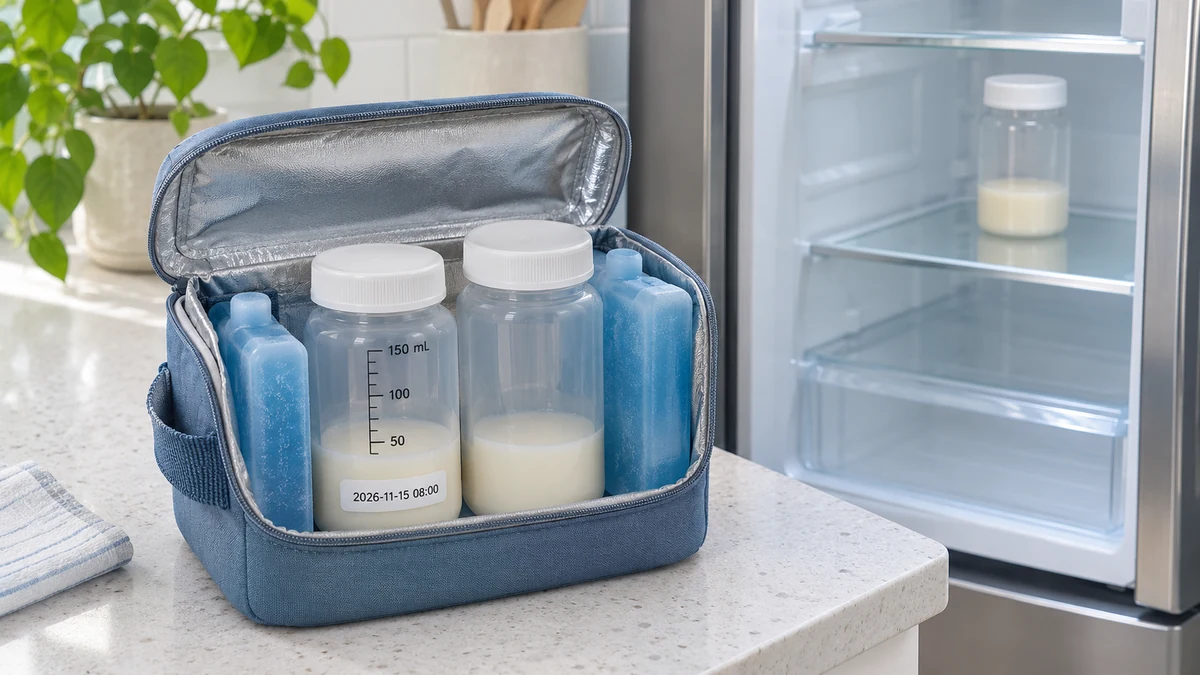
Write the date and time of expression. Add your baby’s name when sending milk to childcare or another caregiver, and agree on any additional requirements. Arrange portions so the oldest are used first, keeping fresh and thawed milk clearly distinguishable.
Store milk farther inside the refrigerator or freezer, not in the door, where temperatures fluctuate more. An appliance thermometer helps check the actual temperature. A refrigerator suitable for food can also hold sealed breast milk; it does not need to be treated as medical waste.
Can I combine milk from different pumping sessions?
Do not pour warm, freshly expressed milk directly into chilled or frozen milk because it can warm the older portion. Cool the new milk first. When combining previously cooled milk collected at different times, count storage time from the oldest portion, not the latest addition.
Follow a separate-container plan if your hospital or childcare provider requires one. Keeping portions separate can also make dates and amounts easier to track. Do not add new milk to a bottle already used for a feeding.
Thawing: when the 24-hour clock starts
You can leave the container in the refrigerator overnight, or use lukewarm water, including lukewarm running water. Do not use a microwave, boiling water or direct heat on the stove. Microwaves can affect some milk properties and create hot spots that can burn a baby’s mouth.
After thawing in the refrigerator, use the milk within 24 hours of the time it is completely thawed. The clock does not start when you take it out of the freezer. Once milk is brought to room temperature or warmed, CDC says to use it within 2 hours. Never refreeze completely thawed milk.
For example, milk fully thawed at 8 a.m. Tuesday has a refrigerator deadline of 8 a.m. Wednesday. If you warm it at 6 p.m. Tuesday, its deadline becomes 8 p.m. Tuesday. Use the earliest deadline. Putting it back in the refrigerator does not erase time already spent warm.
Does it need warming, and what about leftovers?
Breast milk does not have to be warm. It can be offered cold or at room temperature. If you choose to warm it, keep the container sealed in lukewarm water for a few minutes. Test a few drops on your wrist before feeding. Gently swirl the container to mix fat that may have separated.
If your baby does not finish the bottle, CDC allows leftover milk to be used within 2 hours after the feeding ends; discard it afterward. That does not extend an earlier deadline, such as one for warmed milk. Prepare small amounts and offer another portion in a clean container when needed, rather than repeatedly warming the same leftover milk.
Traveling or dealing with a power outage
CDC advises that milk can travel in an insulated cooler with frozen ice packs for up to 24 hours. At your destination, use it or promptly put it in a suitable refrigerator or freezer, taking its age and previous conditions into account. An ordinary bag cannot guarantee these temperatures.
During a power outage, keep the refrigerator and freezer closed as much as possible. CDC says milk that still contains ice crystals can be refrozen. Completely thawed milk that is still cold goes in the refrigerator: use it within 24 hours of complete thawing, without restarting the clock when power returns. The shorter limits for warmed milk and leftovers still apply. Discard milk that has exceeded a limit. If you cannot establish its storage times and temperatures, do not feed it to your baby and ask for advice. Smell alone cannot confirm safety.
CDC estimates that, left unopened, a full freezer can keep food safe for about 48 hours and a half-full freezer for about 24 hours. A closed refrigerator keeps food cold for about 4 hours. These are general appliance estimates. Check the milk’s condition, temperature history and existing deadlines rather than assuming those estimates guarantee the safety of every portion.
Clean after every use and allow everything to dry
Take apart and wash pump parts that touch your breast or milk after each use, following the manufacturer’s instructions. For handwashing, use a clean dedicated basin instead of putting parts directly in the sink. Rinse and let them air-dry completely in a protected area. Do not rub them dry with a used dish towel.
Sanitizing is an additional step after cleaning to reduce germs. Daily sanitizing is especially important for babies under 2 months, premature babies and those with weakened immune systems. Use a method compatible with the materials. Daily sanitizing may not be needed for older healthy babies when every part is carefully cleaned after each use. Refrigerating dirty parts does not replace thorough cleaning after use.
For removable parts that the manufacturer allows you to sanitize this way, use a steam system as directed, or cover the disassembled parts with water and boil for 5 minutes. Remove them with clean tongs and let them air-dry. If a dishwasher uses hot water and a heated drying cycle or a sanitizing setting, a separate sanitizing step is not needed. Follow the instructions for each part, including cooling before handling.
A workable routine, not a freezer-filling contest
Expressing milk can help with work, appointments, breaks or temporary separation. You do not need a huge freezer supply to prove breastfeeding is going well. If treatment or medicine affects your feeding plan, ask your team which milk to use and how to organize expression rather than deciding on your own to stop breastfeeding.
Guidance can differ between facilities. For example, the Bambino Gesù hospital page updated in March 2025 gives a longer refrigerated interval for thawed milk. This guide uses CDC’s 24-hour limit after complete thawing, keeping one consistent approach. Agree on a few clear rules with everyone who feeds your baby: date, temperature, milk condition and earliest deadline. That shared understanding helps prevent everyday mistakes.
Content details
- Population and context
- Families collecting and storing breast milk at home for healthy full-term babies. Premature, ill or hospitalized babies need their care team’s instructions.
- Evidence limitations
- This guide uses CDC home-storage limits with specific temperatures and conditions. Some sources and facilities use different intervals; your care team or equipment manufacturer may give stricter instructions.
📚 Sources
- Centers for Disease Control and Prevention — Breast Milk Storage and Preparation
- Centers for Disease Control and Prevention — Breast Milk Storage Questions and Answers
- Centers for Disease Control and Prevention — How to Clean and Sanitize Breast Pumps
- Centers for Disease Control and Prevention — How to Clean, Sanitize, and Store Infant Feeding Items Frequently Asked Questions
- Ospedale Pediatrico Bambino Gesù — Come conservare il latte materno
Sources checked on: 15 November 2026